
National Parks in Arunachal Pradesh
Arunachal Pradesh lies within the Eastern Himalayan Biodiversity Hotspot and possesses one of the richest forest ecosystems in India. The state is home to two national parks—Namdapha National Park and Mouling National Park. In addition, Arunachal Pradesh has several wildlife sanctuaries, an orchid sanctuary, tiger reserves, elephant reserves, community reserves, and one biosphere reserve, making it a key region for biodiversity conservation. Therefore, aspirants should study this topic not only for UPSC and APPSC Prelims but also for Mains answers related to conservation, ecology, biodiversity, and sustainable development. Students preparing at an Assam Civil Service Academy should pay special attention to this topic, as environmental geography and protected areas of Northeast India are frequently covered in competitive examinations.
List of National Parks in Arunachal Pradesh
There are two national parks in Arunachal Pradesh:
| National Park | Area | Important Features |
| Namdapha National Park | 1985.24 sq. km | Tiger Reserve, Eastern Himalayan biodiversity hotspot, big cat diversity |
| Mouling National Park | 483 sq. km | Part of Dihang-Dibang Biosphere Reserve, rich mountain ecosystem |
Know about Namdapha National Park
- Namdapha National Park is the largest and most famous among the national parks in Arunachal Pradesh. It was created in 1972 and is located in Changlang district. In 1983, it was declared as a Tiger Reserve.
- The park lies between the Dapha Bum range of the Mishmi Hills and the Patkai range. The Noa-Dihing River, a tributary of the Brahmaputra, flows through this region.
- Namdapha is extremely important because it represents the Eastern Himalayan biodiversity hotspot. Its altitude variation supports tropical evergreen forests, temperate forests and high-altitude ecosystems. Therefore, it shelters a wide variety of flora and fauna.
- The park is famous for its rich cat species diversity. It is known for the presence of tiger, leopard, snow leopard and clouded leopard.
- Arunachal Pradesh lies within the Eastern Himalayan Biodiversity Hotspot and possesses one of the richest forest ecosystems in India. The state is home to two national parks—Namdapha National Park and Mouling National Park. In addition, Arunachal Pradesh has several wildlife sanctuaries, an orchid sanctuary, tiger reserves, elephant reserves, community reserves, and one biosphere reserve, making it a key region for biodiversity conservation. Therefore, aspirants should study this topic not only for UPSC and APPSC Prelims but also for Mains answers related to conservation, ecology, biodiversity, and sustainable development. Students preparing at an Assam Civil Service Academy should pay special attention to this topic, as environmental geography and protected areas of Northeast India are frequently covered in competitive examinations.
Know About Mouling National Park
- Mouling National Park is another important national park in Arunachal Pradesh. It was created in 1982 and located in the Upper Siang region. Moreover, it forms part of the Dihang-Dibang Biosphere Reserve.
- Mouling National Parks covers an area of 483 sq. km. Notably, Mouling National Park derives its name from its highest peak i.e. Mouling Peak.
- Siyom River flows along the western fringes of the park and several small rivers such as the Siring, Krobong, Semong and Subong drain into the Siang River near the eastern boundary of the park.
- Mouling National Park has a diverse landscape. Its lower areas contain tropical forests, while higher regions support moist temperate forests. This altitudinal variation makes the park ecologically rich.
- Mouling National Park shows rich genetic and ecological diversity. It represents one of the finest examples of balanced natural forests in the Eastern Himalayas.
- The park supports a wide range of habitats and life zones. Moreover, its landscape shows sharp changes in altitude, which create different ecological conditions within a limited area.
- The altitude variation ranges from about 3064 m to 5000 m. As a result, Mouling National Park forms a transition zone from tropical conditions to cold climatic zones.
- This transition creates favourable conditions for diverse plant and animal life. Therefore, the park supports a wide variety of flora and fauna.
- The unique combination of different biotopes makes Mouling National Park ecologically significant. Such rare genetic and ecological diversity strengthens its importance as a biodiversity hotspot in Arunachal Pradesh.
Tiger Reserves in Arunachal Pradesh
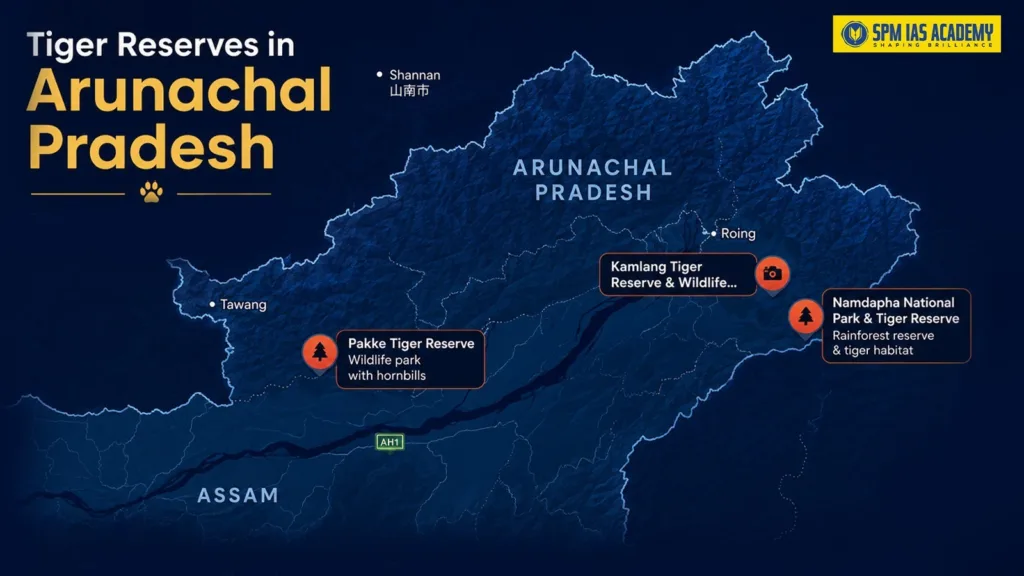
Along with the national parks of Arunachal Pradesh, aspirants should also remember the state’s tiger reserves, as they are frequently asked in competitive examinations. Arunachal Pradesh has three tiger reserves, each playing a vital role in the conservation of the Bengal tiger and the rich biodiversity of the Eastern Himalayas. This topic is especially important for students pursuing an APSC course online, as questions on protected areas, wildlife conservation, and environmental geography regularly appear in APSC, APPSC, and UPSC examinations.
- Namdapha Tiger Reserve
- Pakke Tiger Reserve
- Kamlang Tiger Reserve
Pakke Tiger Reserve, also known as Pakhui Tiger Reserve, lies in the foothills of the Eastern Himalayas. It is well known for the Hornbill Nest Adoption Programme, which promotes community-based conservation. Kamlang Tiger Reserve is located near the Lohit region and is named after the Kamlang River.
Wildlife Sanctuaries in Arunachal Pradesh
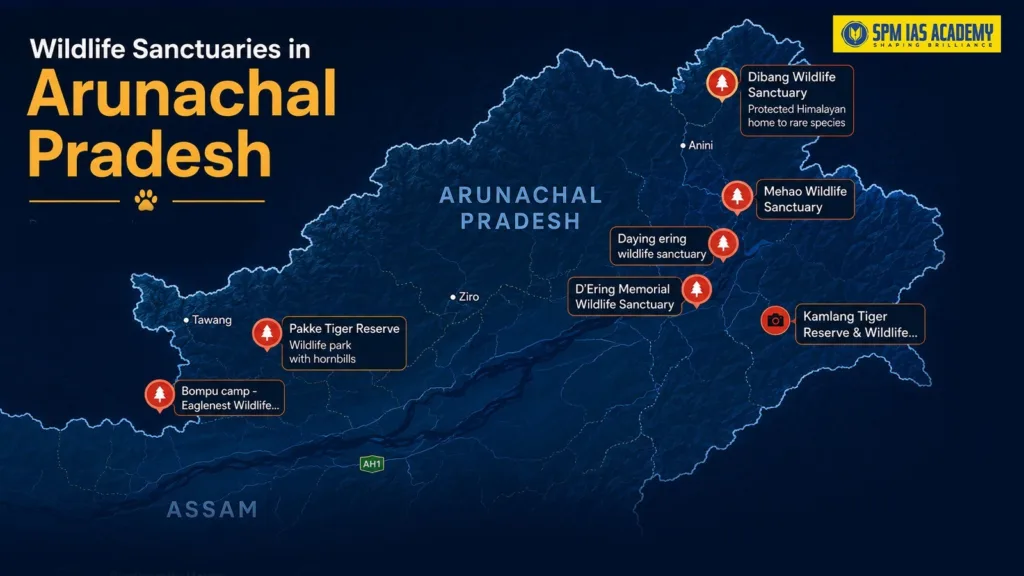
Arunachal Pradesh has 13 wildlife sanctuaries. Some important ones include:
- Pakke Wildlife Sanctuary
- Kamlang Wildlife Sanctuary
- Eaglenest Wildlife Sanctuary
- Mehao Wildlife Sanctuary
- Dibang Wildlife Sanctuary
- Daying Ering Memorial Wildlife Sanctuary
- Kane Wildlife Sanctuary
- Yordi Rabe SupseWildlife Sanctuary
- Itanagar Wildlife Sanctuary
- Tale Wildlife Sanctuary
- Sessa Orchid Wildlife Sanctuary
- Ringba-RobaWildlife Sanctuary
- Kamala Wildlife Sanctuary
Among these, Eaglenest Wildlife Sanctuary is famous among birdwatchers and biodiversity researchers. Sessa Orchid Wildlife Sanctuary is important for orchid conservation. Dibang Wildlife Sanctuary supports species like takin, red goral and red panda.
Biosphere Reserve and Elephant Reserves in Arunachal Pradesh
The state has one biosphere reserve, the Dihang-Dibang Biosphere Reserve. It includes ecologically rich landscapes and supports rare Himalayan species. Mouling National Park and Dibang Wildlife Sanctuary are associated with this biosphere reserve.
Arunachal Pradesh also has two elephant reserves:
- Kameng Elephant Reserve
- Southern Arunachal Elephant Reserve
These reserves help protect elephant habitats and movement corridors. They also support broader landscape-level conservation.
Why Arunachal Pradesh is Important for Biodiversity
- Arunachal Pradesh has a unique location in the Eastern Himalayas. It shares international borders with Bhutan, China and Myanmar. Moreover, its altitude changes from lowland tropical forests to alpine zones. As a result, the state supports diverse habitats, rare species and rich vegetation.
- The state has around 79.63% forest and tree cover of its total geographical area.
- In addition, its Protected Area Network covers nearly 9,779 sq. km, which is much higher than the national average in terms of geographical coverage. This makes Arunachal Pradesh a key state for India’s biodiversity conservation strategy.
- The state is home to many species of mammals, birds, reptiles, amphibians, fishes, butterflies, orchids, rhododendrons, bamboo and medicinal plants.
Conservation Challenges in Arunachal Pradesh
Despite its rich biodiversity, Arunachal Pradesh faces several conservation challenges. These include habitat loss, infrastructure expansion, illegal wildlife trade, human-wildlife conflict, climate change and pressure on forest resources.
Moreover, mountain ecosystems are highly fragile. Road construction, hydropower projects and unplanned development can affect wildlife corridors and river systems. Therefore, conservation in Arunachal Pradesh must balance ecological security with local development.
Conclusion
National parks in Arunachal Pradesh represent India’s rich Eastern Himalayan biodiversity. Namdapha National Park and Mouling National Park are not only important protected areas but also major exam topics for UPSC, APPSC and other State PCS exams.
Aspirants should remember their location, ecological features, important species and links with tiger reserves and biosphere reserves. Moreover, they should understand the larger significance of Arunachal Pradesh in India’s biodiversity conservation strategy. Therefore, studying national parks in Arunachal Pradesh helps candidates strengthen their preparation for environment, geography and Northeast India-specific current affairs.
Also Read:
Source:
Frequently Asked Questions
There are 2 national parks in Arunachal Pradesh – Namdapha National Park and Mouling National Park.
Namdapha National Park is the largest national park in Arunachal Pradesh. It also functions as a tiger reserve.
Namdapha National Park is famous for its rich biodiversity, big cat diversity, Eastern Himalayan ecosystem and the critically endangered Namdapha flying squirrel.
Mouling National Park is part of the Dihang-Dibang Biosphere Reserve.

Behind every article at SPM IAS Academy is a team of skilled content writers and subject experts committed to making preparation easier for aspirants. From answering common doubts to breaking down complex issues and current affairs, we create content that is accurate, easy to understand, and directly useful for UPSC, APSC, and other competitive exams.