
Assam is home to many indigenous communities, each contributing to the state’s rich cultural heritage and identity. The Rabha Tribe of Assam is one such important community, known for its unique language, customs, traditional attire, folk music, and vibrant festivals. The Rabhas have historically maintained a close relationship with agriculture and nature, which continues to shape many aspects of their social and cultural life. At the same time, education, urbanisation, and modern development have influenced the community, bringing significant social and economic changes. This article explores the history, traditions, social structure, and cultural identity of the Rabha Tribe of Assam in a simple and easy-to-understand manner. Aspirants preparing through the best APSC coaching should study this topic carefully, as Assam’s tribes, society, and culture are important areas in both the Preliminary and Main examinations.
Who Are the Rabha Tribe of Assam?
The Rabha Tribe of Assam belongs to the larger Bodo-Garo ethnolinguistic group, which includes several communities sharing related languages, traditions, and cultural practices. The Rabha population is concentrated mainly in Assam, particularly in districts such as Goalpara, Kamrup, Kokrajhar, and Udalguri. Smaller Rabha communities are also found in Meghalaya, West Bengal, and neighbouring regions. Aspirants preparing to crack APSC exam online should understand the distribution, language, and cultural background of the Rabha community, as Assam’s tribal society and cultural diversity are frequently covered in competitive examinations.
The community has several subgroups. These include Rongdani, Maitori, Pati, Kocha, Dahori, Hana, Bitolia, and Totla. The number and spelling of these groups may differ across studies. Moreover, each group may follow slightly different customs or speak a different form of the language.
Important Facts About the Rabha Community in Assam
The following table presents some key facts:
| Category | Important information |
| Community status | Recognised as a Scheduled Tribe in Assam outside the autonomous hill districts |
| Main settlements | Lower Assam and areas near the Meghalaya border |
| Major districts | Goalpara, Kamrup, Kokrajhar, Darrang, Udalguri and nearby areas |
| Language family | Trans-Himalayan or Tibeto-Burman |
| Language subgroup | Bodo-Garo |
| Main occupation | Agriculture and related rural work |
| Major celebration | Baikho |
| Cultural features | Weaving, folk songs, dances, oral stories, and traditional rituals |
Where Does the Rabha Tribe of Assam Live?
The Rabha Tribe of Assam mainly lives in the plains of Lower Assam. Goalpara and Kamrup have notable Rabha populations. Rabha villages are also found in Kokrajhar, Baksa, Darrang, Udalguri, and other nearby districts.
Many Rabha settlements are located close to forests, rivers, and fertile agricultural land. As a result, nature has played a significant role in shaping their traditional lifestyle, occupations, food habits, housing patterns, and cultural practices. Their close relationship with the environment is reflected in their farming traditions, festivals, and respect for natural resources. Aspirants preparing through online coaching in Assam should understand this connection between tribal communities and their environment, as it is an important aspect of Assam’s society, geography, and culture in competitive examinations.
Some Rabhas also live in the Garo Hills of Meghalaya and the Dooars region of West Bengal. Yet Assam remains one of the main centres of their cultural and social life.
History and Origin of the Rabhas
The early history of the Rabhas is mostly preserved through oral traditions. These include folk tales, songs, myths, and stories passed down by elders. However, there is no single accepted account of their exact origin.
Linguistic studies connect the Rabhas with the Bodo-Garo branch of languages. This connection points to an old relationship with other indigenous communities of Northeast India. The Central Institute of Indian Languages has also studied Rabha as part of the wider Bodo-Garo language group
Over time, different Rabha groups settled in different regions of Assam, leading to the development of distinct local customs, dialects, and cultural practices. Continuous interaction with Assamese, Garo, Bengali, and other neighbouring communities also influenced their language, social traditions, and way of life, bringing gradual social and cultural change while preserving their unique tribal identity. Aspirants preparing through APSC coaching in Assam should understand these historical and cultural developments, as questions related to Assam’s tribes, society, and cultural diversity are frequently asked in competitive examinations.
Today, the Rabha Tribe of Assam works to protect its language and cultural identity. Community organisations, writers and cultural groups play an important part in this effort.
Social and Family Life
Traditionally, Rabha society has followed a clan-based social system. Members of the same clan are often considered relatives. Therefore, marriage within the same clan is generally avoided.
Family and community cooperation are highly valued. Important occasions bring relatives and neighbours together. These include births, marriages, deaths, festivals, and agricultural activities.
Village elders have traditionally helped settle social matters. However, modern administration and elected local bodies now play a greater role.
Women hold an important place in household and economic life. They take part in agriculture, weaving, and family work. Rabha women are especially known for their knowledge of handloom weaving.
Rabha Tribe Culture and Traditions
The Rabha tribe culture and traditions are closely linked with nature, farming, and community life. Songs and dances are performed during festivals and social gatherings. Many of them tell stories about ancestors, heroes, crops, and the natural world.
Oral literature is another valuable part of Rabha heritage. It includes folk tales, riddles, traditional songs, and myths. In the past, elders passed this knowledge to children by speaking and singing.
Music is usually supported by traditional instruments. Drums, flutes, and different bamboo instruments are commonly used. Group performances create a strong feeling of unity.
Weaving is also a major cultural skill. Traditional textile designs often include shapes inspired by plants, animals, and daily life. A study of Rabha clothing notes that colours, patterns and motifs carry cultural meaning
What Is the Rabha Tribe Traditional Dress?
The Rabha tribe traditional dress is colourful, handwoven, and closely connected with community identity.
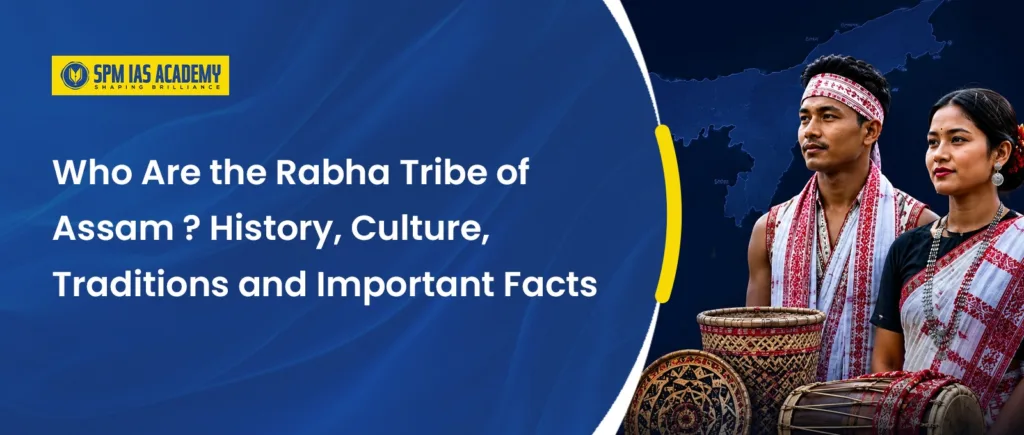
Rabha women traditionally wear a lower garment known as Kambung. They may also wear garments called Rifan or Kambang in different areas. Names and styles can vary among subgroups. Women complete their dress with a piece of cloth worn over the upper body.
Traditional ornaments include necklaces, earrings, bangles, and other locally made jewellery. Beads, coins, and metal pieces may be used in their designs.
Men traditionally wear a handwoven cloth around the lower body. They may also use a woven cloth over the shoulders or around the head.
Today, modern clothes are common in everyday life. Still, traditional clothes are proudly worn during festivals, dances, weddings, and cultural programmes.
Rabha Tribe Language and Religion
The Rabha tribe language and religion show both old traditions and later cultural influences.
Rabha belongs to the Bodo-Garo subgroup of the Trans-Himalayan language family. Rongdani and Maitori are two wide varieties. Kocha is also identified as an important variety in linguistic studies.
According to the Rabha Language Resource, around 140,000 people spoke Rabha across Assam, Meghalaya, and West Bengal in the 2011 Census. The collection also preserves stories, songs, and festival records shared by community members
However, not every Rabha person speaks the language today. Assamese is widely used by many families. Bengali and other regional languages are also spoken in some locations. Therefore, community groups are working to teach and preserve Rabha.
Traditional Rabha belief includes respect for nature, ancestors, and different spiritual powers. Baikho is an important deity connected with prosperity and protection. Over time, many Rabhas adopted Hindu beliefs and practices. Some members of the community also follow Christianity.
As a result, religious practices may differ from one subgroup or village to another.
Major Rabha Tribe Festivals
The Rabha tribe festivals reflect the community’s close relationship with agriculture and nature.
Baikho is the best-known traditional celebration. It is usually observed before or around the farming season. People pray for good crops, rain, health, and protection from danger.
The festival includes worship, music, singing, and group dancing. Hui Maru songs are linked with Baikho celebrations. These songs help preserve memories of legendary figures and the community’s past. Research on Rabha folklore describes Baikho as a symbol of unity and ethnic pride
Food and Traditional Occupations
Agriculture has long been the main occupation of the Rabha Tribe of Assam. Rice is the most important crop. Families also grow vegetables, mustard, maize, and seasonal crops.
Their food is simple and often prepared with local ingredients. Rice, leafy vegetables, fish, meat, and bamboo shoots form part of the traditional diet. Fermented foods are also eaten in some areas.
In addition, people may rear pigs, poultry, and cattle. Fishing, weaving, and forest-based work have supported many rural households.
Today, the Rabha people also work in education, government service, business, healthcare, and other modern professions.
Art, Dance and Oral Heritage
Rabha folk dances are performed during celebrations and cultural events. The style of performance can differ among subgroups.
The Pati Rabhas are known for the Bogejari folk dance. It is mainly performed by women and presents stories through song and movement. Other traditional performances may have religious or seasonal meanings.
Folk songs keep the community’s memories alive. They speak about love, work, farming, nature, and historical figures. Thus, oral heritage acts like a living record of the past.
Contribution to Assamese Society
The Rabha Tribe of Assam has made valuable contributions to the cultural diversity of the state. Rabha writers, teachers, artists, activists, and public figures have helped both their community and wider society.
Birubala Rabha was one of the best-known social activists from the community. She led a long campaign against witch-hunting and supported its victims. The Government of India honoured her with the Padma Shri in 2021.
Rabha cultural organisations also promote literature, language education, and traditional performances. These efforts help younger people understand their roots.
Challenges in Preserving Rabha Heritage
The community faces several modern challenges. Many young people move away from villages for education and work. As a result, they may have fewer chances to learn traditional songs, stories, and weaving skills. The use of the Rabha language is also decreasing in some areas. Assamese, English, and other widely used languages often become the main languages of education and employment.
Moreover, traditional clothes and customs are now mostly seen during special events. This change does not mean that the culture has disappeared. Still, regular teaching and documentation are needed. Schools, families, and cultural bodies can work together. They can record folk songs, publish books, and organise language classes. Digital archives can also protect old stories and performances.
Conclusion
The Rabha Tribe of Assam has a rich and living heritage. Its language, festivals, weaving, music, and oral stories reveal a deep bond with nature and community life. At the same time, Rabha society is moving forward through education and new professions. Protecting its heritage does not mean rejecting change. Instead, it means carrying valuable traditions into the future. Learning about the Rabhas also helps us understand the wider cultural diversity of Assam. Their history is not only the story of one community. It is an important part of Assam’s shared identity.

Behind every article at SPM IAS Academy is a team of skilled content writers and subject experts committed to making preparation easier for aspirants. From answering common doubts to breaking down complex issues and current affairs, we create content that is accurate, easy to understand, and directly useful for UPSC, APSC, and other competitive exams.