
The Role of ASO in government policy implementation is linked to file work and official drafting. It also includes record-keeping and departmental coordination. An Assistant Section Officer supports senior officers by checking documents and preparing notes. Moreover, ASOs help ensure that government instructions are communicated properly. They do not make policies directly. However, their work supports the smooth functioning of governance.
Many aspirants choose UPSC coaching in Assam to build strong administrative and governance knowledge.
What is the role of ASO in government?
The Role of ASO in government is mainly administrative. An Assistant Section Officer works inside a government department or ministry. Their duty is to support the smooth movement of official work.
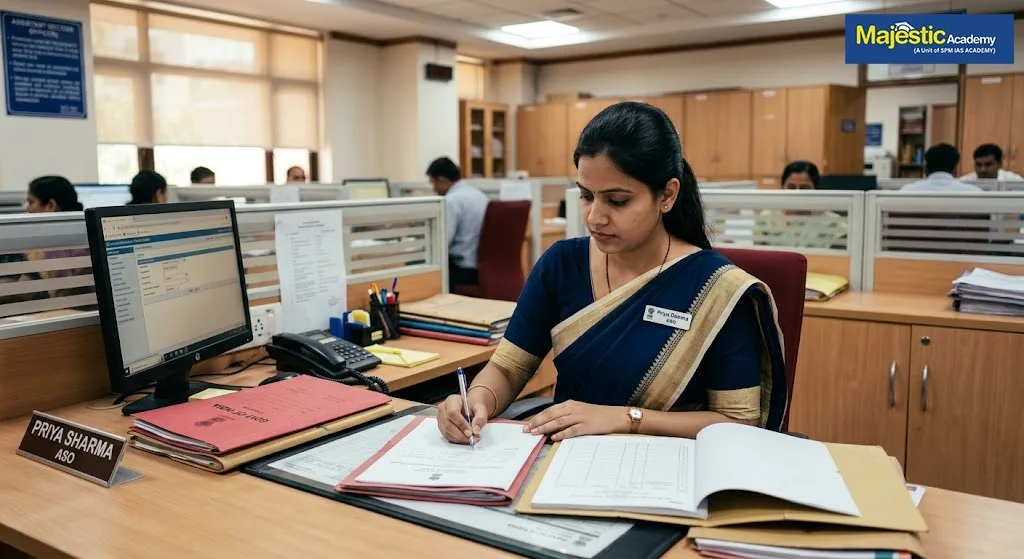
ASOs handle files and examine documents. They prepare notes for senior officers. They also help in drafting official letters and replies. In many cases, they check whether a matter follows the rules and procedures of the department.
Moreover, ASOs help maintain records. This is important because government decisions need proper documentation. They also coordinate with other sections when a file or matter needs input from different offices.
However, an ASO does not usually make direct policy decisions. That responsibility lies with senior officers and the government. Still, ASOs play an important support role. They help convert official instructions into proper administrative action
Who Is an Assistant Section Officer?
An Assistant Section Officer is a government official who works in a department or ministry. The post is mainly linked with office administration and file work. An ASO works under the supervision of senior officers. Their work includes examining files and preparing notes.
They also help in drafting official letters and replies. Moreover, an ASO checks whether a matter follows official rules and procedures. This makes their role important in daily government work.
However, an ASO does not usually take final decisions. That power remains with higher authorities. Still, ASOs support the decision-making process by keeping files clear and organised. Therefore, the Role of ASO is important in government offices. They help senior officers process work smoothly and maintain proper records.
Quality UPSC coaching in north east India helps students understand governance, policy, and administration concepts.
How Are ASOs Connected With Policy Implementation?
ASOs are connected with policy implementation through daily administrative work. A policy needs proper files, notes, orders, and communication before it can move forward. This is where the Role of an ASO becomes important.
An Assistant Section Officer helps in processing official files related to government decisions. They examine documents and place important facts before senior officers. After that, they help prepare drafts, notes, and official replies as per the rules.
Moreover, ASOs help maintain records of decisions and actions taken by the department. This makes the process more organised and accountable. However, ASOs do not usually decide the final policy. That responsibility belongs to senior officers and the government. Still, ASOs support the system by making sure that the required paperwork is complete and clear.
Therefore, the Role of ASO in policy implementation is supportive but important. Their work helps government decisions move from official approval to practical action.
What Are the Main Duties of an ASO?
The duties of an Assistant Section Officer are mainly linked with office work and government administration. Their work helps senior officers manage files and take informed decisions.
A good civil services coaching assam program strengthens analytical skills and understanding of government functioning.
- Handling official files: An ASO receives and processes official files. They check the matter carefully and move it to the right authority.
- Preparing notes: ASOs prepare notes on files. These notes help senior officers understand the issue clearly.
- Drafting official letters: They help draft letters, replies, reports, and office orders. This ensures proper communication within the department
- Checking rules and procedures: ASOs examine whether a file follows official rules. This helps avoid mistakes in government work.
- Maintaining records: They keep records of files, orders, and decisions. As a result, important information remains available for future use.
- Coordinating with other sections: Many files need input from different offices. Therefore, ASOs coordinate with other sections to collect the required details.
How Do ASOs Help in File Processing?
ASOs help in file processing by managing the movement of official files in a proper way. Their work begins when a file or document reaches the concerned section.
- First, an Assistant Section Officer examines the file carefully. They check the subject and read the attached documents. After that, they look at previous records if the matter is linked to an earlier decision.
- Secondly, ASOs prepare notes on the file. These notes explain the issue in a clear and organised manner. They may also mention relevant rules, past references, or required action.
- Moreover, ASOs help prepare drafts of letters, orders, or replies. Senior officers then check these drafts before final approval.
However, ASOs do not usually take the final decision on important matters. Their role is to support the process with correct facts and proper documentation.
Therefore, the Role of ASO in file processing is very important. They help files move smoothly from one level to another. This supports timely action in government departments.
How Can Aspirants Prepare for ASO Roles?
Aspirants should prepare for ASO roles with both exam knowledge and office skills. The first step is to understand the exam pattern. For central government ASO posts, candidates must appear for SSC CGL. Therefore, they must focus on Reasoning, General Awareness, Quantitative Aptitude, and English.
Next, aspirants should build good reading habits. This helps in understanding rules, notices, reports and official instructions. A strong command of English is also useful because ASOs often deal with drafting and written communication.
Moreover, candidates should practise typing and basic computer work. This is important because government offices now use digital files and online systems. For SSC CGL, the Data Entry Speed Test is also part of the process. In addition, current affairs should be studied regularly.
Finally, mock tests and revision are important. They help candidates improve speed and accuracy. However, preparation should not be limited to clearing the exam only. A good ASO also needs discipline, clarity, patience and respect for official procedure.
Conclusion
To sum up, the Role of ASO is important in the smooth working of government departments. ASOs may not take final policy decisions. However, they support the system through file work, drafting, records and coordination. Their work helps senior officers act with proper facts and documents. Therefore, an ASO plays a quiet but meaningful role in turning government instructions into organised administrative action.
Frequently Asked Questions
The main Role of ASO is to support daily administrative work in government offices. ASOs handle files and prepare notes. They also help in drafting replies and maintaining records. Moreover, they assist senior officers by keeping official work clear and organised.
ASOs do not usually make final policy decisions. That responsibility stays with senior officers and the government. However, ASOs support policy implementation through file work and documentation. They check facts and prepare drafts. Therefore, their work helps government decisions move smoothly through the official system.

Behind every article at SPM IAS Academy is a team of skilled content writers and subject experts committed to making preparation easier for aspirants. From answering common doubts to breaking down complex issues and current affairs, we create content that is accurate, easy to understand, and directly useful for UPSC, APSC, and other competitive exams.