Why Starting UPSC Preparation After 12th Is a Smart Move
Beginning UPSC preparation after 12th gives students a powerful advantage. Instead of rushing through the syllabus in the final year of graduation, early starters get three full years to build a strong foundation.
The Civil Services Examination is not only about memorizing facts. It tests Conceptual clarity, Analytical thinking, Awareness of national and global issues, and Strong writing skills.
Students who begin early can gradually develop these abilities while completing their graduation. This foundation-building phase helps reduce pressure later and increases the chances of clearing the exam on the first or second attempt.
For structured guidance, explore the best online upsc coaching for beginners to strengthen your preparation strategy.
If you are wondering how to start IAS preparation from the 1st year college, this guide will provide a structured roadmap that balances academics and UPSC preparation effectively.
Understanding the Civil Services Exam (CSE) Eligibility After 12th
Before planning preparation, students must understand the Civil Services Exam (CSE) eligibility after 12th. You cannot appear for the UPSC exam immediately after school.
If confused, learn how to start your upsc exam preparation with a clear step-by-step beginner roadmap.
The minimum requirement is:
- A bachelor’s degree from a recognized university
- Minimum age: 21 years
However, students can start preparation during graduation, which gives them a major advantage.
The UPSC examination has three stages:
1. Prelims: Objective screening test
2. Mains: Descriptive written examination
3. Interview (Personality Test)
Understanding this structure early helps you align your preparation with the exam requirements.
Choosing the Best Graduation Course for UPSC
One of the most common questions students ask is: Which is the best graduation course for UPSC? The truth is that no specific degree guarantees success. However, some subjects naturally align with the UPSC syllabus.
1. Arts / Humanities: Most Common Choice
Subjects such as Political Science, History, Sociology, Geography, and Public Administration are often favored by students preparing for the UPSC exam. One of the main advantages of choosing these subjects is the direct overlap with the UPSC syllabus, which makes it easier for students to select their optional subjects.
Additionally, studying these disciplines helps in preparing for the General Studies papers. This is why many consider pursuing a degree in the Arts to be one of the best choices for those aiming to succeed in the UPSC examinations.
2. Science Stream
Students from science backgrounds can also excel in the UPSC examinations. They possess strong analytical and logical thinking skills, which are advantageous in their studies. This background is particularly helpful for subjects like environment, science, and technology.
However, these students may need to allocate extra time to cover humanities subjects to ensure a well-rounded preparation.
3. Engineering
Many successful candidates for competitive exams like the UPSC come from engineering backgrounds, largely due to their strong problem-solving abilities and disciplined study habits.
However, one significant challenge they face is balancing the demands of technical coursework with UPSC preparation after 12th. The key takeaway from this experience is to choose a degree that you genuinely enjoy, as it requires three years of dedicated study.
UPSC Syllabus for 12th Pass Students: What Should You Know?
Students planning UPSC preparation after 12th must first understand the syllabus.
The UPSC syllabus broadly covers:
- Indian History and Culture
- Indian Polity and Constitution
- Geography of India and the World
- Economy and Development
- Environment and Ecology
- Science and Technology
- Current Affairs
This syllabus forms the foundation of the IAS preparation strategy for beginners.
The 3-Year UPSC Preparation Strategy for Beginners
Below is a practical roadmap for students wondering how to start IAS preparation from the 1st year college.
Year 1: Build the Foundation
The first year should focus on understanding the basics.
Key Goals:
- Understand the UPSC syllabus and exam pattern
- Develop a habit of reading newspapers
- Start basic NCERT books
What to Study:
NCERTs are the backbone of preparation.
Recommended subjects:
- History (Class 6–12)
- Geography (Class 6–12)
- Polity basics
- Economy basics
Develop These Habits:
- Read The Hindu or The Indian Express daily
- Maintain short notes
- Watch educational discussions on current affairs
At this stage, the focus should be on concept clarity, not speed.
Year 2: Standard Books and Optional Subject
In the second year, students should move from basics to advanced resources.
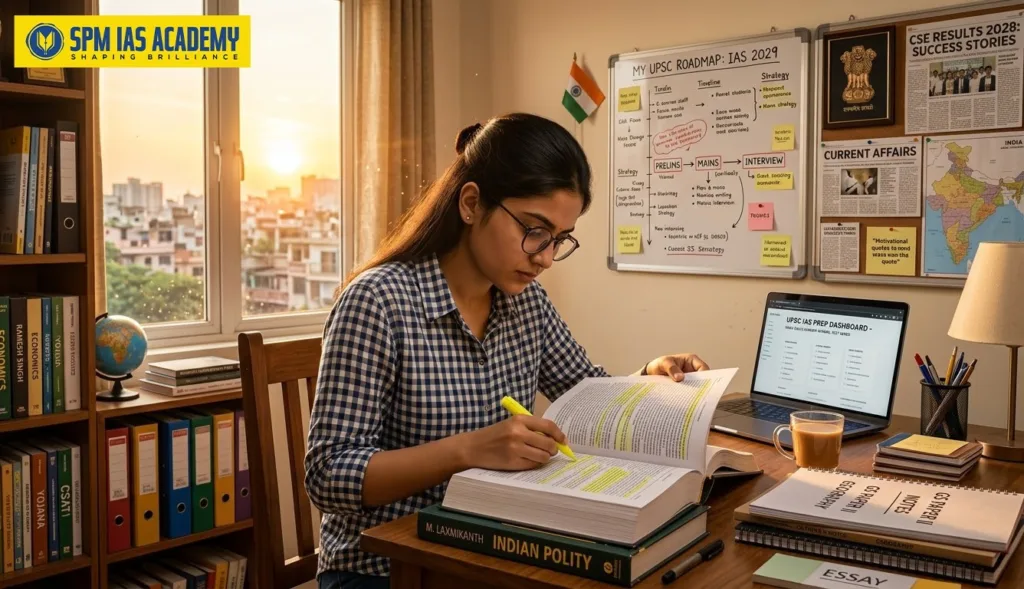
Some important books include:
- Indian Polity: M. Laxmikanth
- Modern History: Spectrum
- Geography: GC Leong
- Economy: Basic Indian Economy books
These books form the core of most successful candidates’ preparation.
Choose Your Optional Subject
Selecting the optional subject early helps in better preparation.
Factors to consider:
- Interest in the subject
- Availability of study material
- Overlap with General Studies
- Previous academic background
Many aspirants choose optional subjects such as:
- Sociology
- Political Science
- Geography
- Anthropology
This is an important step in any IAS preparation strategy for beginners.
Year 3: Answer Writing, CSAT, and Mock Tests
The final year of graduation should focus on exam-oriented preparation.
Practice Answer Writing
The UPSC Mains exam requires strong writing skills, making it necessary for candidates to start practicing effectively. One important aspect is to practice answering questions in both 150-word and 250-word formats. Additionally, structuring answers with a clear introduction, body, and conclusion is important for coherence and clarity.
Candidates should also train themselves to write within time limits, as managing time effectively during the exam can significantly impact performance. By focusing on these elements, aspirants can enhance their writing abilities and improve their chances of success in the UPSC Mains exam.
Prepare for CSAT
CSAT includes:
- Logical reasoning
- Reading comprehension
- Basic mathematics
Although qualifying in nature, many candidates underestimate it.
Take Mock Tests
Mock tests help in:
- Time management
- Identifying weak areas
- Improving exam temperament
A serious aspirant should complete multiple mock tests before attempting the exam.
Subject-Wise Foundation for UPSC
A strong subject foundation is important for effective UPSC preparation after 12th.
1. History
Focus on three areas:
- Ancient India
- Medieval India
- Modern India
Modern history is especially important for the Prelims and Mains.
2. Polity
Polity is one of the most scoring subjects.
Focus on:
- Constitution
- Fundamental Rights
- Parliament
- Judiciary
- Federal structure
3. Geography
Study both physical and Indian geography.
Important areas include:
- Climate
- Natural resources
- Agriculture
- Environmental issues
4. Economy
Economy becomes easier when connected with current affairs.
For beginners, focus on:
- Basic economic terms
- Government schemes
- Budget and Economic Survey
- Inflation and growth concepts
The Role of Current Affairs in UPSC Preparation
Current affairs play a central role in both Prelims and Mains.
Best Sources
Students should regularly follow:
- The Hindu
- The Indian Express
- PIB (Press Information Bureau)
- Monthly current affairs compilations
How to Study Current Affairs?
Follow this method:
- Read the news daily
- Note important government schemes
- Focus on issues, not just events
- Revise monthly notes
Consistency in current affairs preparation gives aspirants a major edge in the exam.
Regional Strategy: Preparing from Different Regions
Students often believe they must move to Delhi to succeed. This is no longer true. With online resources, aspirants can prepare from anywhere.
Students from Northeast India
Students from the Northeast should concentrate on building strong internet-based resources, joining online test series, and utilizing digital libraries and lectures for their exam preparation.
They should also consider preparing for State Public Service Commission exams, such as state administrative services exams and allied government services. These State PSCs can serve as a solid backup career option while they are preparing for the UPSC.
A reputed IAS academy guwahati can support aspirants with regional guidance and quality mentorship programs.
Conclusion
Starting UPSC preparation after 12th gives you one powerful advantage: time. You can use these three years wisely. First, focus on building strong concepts. This foundation will be important for your success. Next, develop your writing skills. Good writing will help you express your ideas clearly. Additionally, stay consistent with current affairs. Being updated will enhance your understanding of various topics.
Remember, the Civil Services Examination is a marathon, not a sprint. It requires patience and sustained effort. Therefore, with disciplined preparation and the right strategy, college students can confidently aim for success.
Frequently Asked Questions:
No. Starting early helps build conceptual clarity and reduces pressure later. Many successful candidates begin their IAS preparation strategy for beginners during their first year of college.
There is no compulsory degree. However, subjects like Political Science, History, and Geography often overlap with the UPSC syllabus, making them popular choices.
Yes. Many toppers clear the exam without coaching. With proper planning, good books, and online resources, self-study can be highly effective.
College students should aim for 3–5 hours of focused study daily. Consistency matters more than studying long hours occasionally.

Behind every article at SPM IAS Academy is a team of skilled content writers and subject experts committed to making preparation easier for aspirants. From answering common doubts to breaking down complex issues and current affairs, we create content that is accurate, easy to understand, and directly useful for UPSC, APSC, and other competitive exams.