Choosing the right optional subject is one of the most important decisions in your UPSC journey. History Optional for UPSC remains one of the most popular choices among aspirants and for good reason. The biggest advantage is the syllabus overlap. A large portion of the UPSC History syllabus directly aligns with GS Paper I. Topics like the freedom struggle, social reforms, and ancient civilisations appear in both. This means your optional preparation also strengthens your General Studies score.
Many aspirants fear that History is too vast. This is a myth. Unlike theoretical subjects, History is concrete. Events are fixed. Timelines are clear. Once you understand the narrative, answers flow naturally. The key is a smart, structured strategy.
Explore expert-led coaching classes for upsc in assam to strengthen your preparation with structured guidance.
In this article, we will look into everything, from syllabus breakdown to answer writing. Let us begin.
Understanding the UPSC History Syllabus
The History Optional for UPSC consists of two papers: Paper I and Paper II. Each paper carries 250 marks, making the total 500 marks. Understanding what each paper covers is the first step.
Paper I: Ancient and Medieval India
Paper I focuses on Ancient India preparation and Medieval history. It covers prehistoric cultures, the Indus Valley Civilisation, the Vedic age, the Mauryan Empire, the Gupta period, and the Sultanate and Mughal periods.
Key focus areas for Paper I:
- Map-based questions carry 50 marks in Paper I. Do not ignore this section.
- The history map pointing requires you to identify and locate ancient and medieval sites accurately.
- Focus on art, architecture, and culture for high-scoring answers.
- Medieval history notes should include Bhakti-Sufi movements and agrarian history.
Paper II: Modern India and World History
Paper II covers Modern History for UPSC and the World History UPSC strategy. Modern India spans from the eighteenth century to Independence. World History covers topics from the Industrial Revolution to post-World War II developments.
Key focus areas for Paper II:
- Maintain a chronological flow in all your answers.
- Connect colonial policies to the rise of nationalism.
- For World History, focus on revolutions, World Wars, and decolonisation.
- Link historical themes to contemporary relevance wherever possible.
Phase-wise Preparation Strategy for History Optional for UPSC
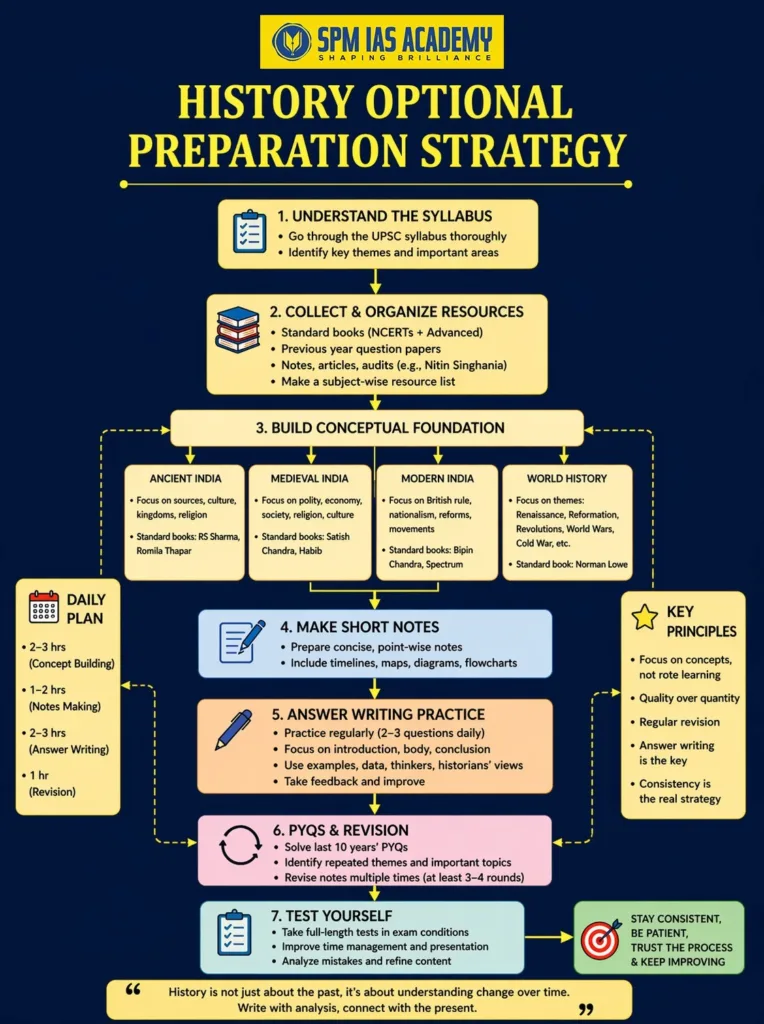
A structured, phase-wise approach is the most effective way to master the History Optional for UPSC. Here is how to divide your preparation into three phases.
Phase 1: Foundation – Start with NCERTs
Begin with NCERT textbooks. They build your conceptual foundation. Read all History NCERTs from Class VI to XII carefully. Do not rush this stage.
Important NCERTs for History Optional:
- Class VI to VIII: Our Pasts (Parts I, II, III)
- Class IX: India and the Contemporary World
- Class X: India and the Contemporary World II
- Class XI: Themes in World History and An Introduction to Indian Art
- Class XII: Themes in Indian History (Parts I, II, III)
Find reliable UPSC coaching in north east India offering dedicated mentorship and comprehensive preparation support.
Phase 2: Standard Reference Books
Once your foundation is ready, move to standard reference books. These provide depth and analytical perspectives essential for the History Optional for UPSC.
Recommended books by topic:
- Ancient India: A History of Ancient and Early Medieval India by Upinder Singh
- Medieval India: Medieval India by Satish Chandra (Parts I and II)
- Modern India: India’s Struggle for Independence by Bipan Chandra
- Modern India: Modern India by Bipan Chandra (for concise coverage)
- World History: History of the World by Arjun Dev
Phase 3: Value Addition – Notes and Map Work
This is the most important phase. Here you consolidate everything into your own short notes. Your notes should include key arguments, historians’ views, dates, and important sites.
- Prepare topic-wise self-notes. Keep them concise but comprehensive.
- Create a separate register for map work. Practice locating sites daily.
- Revise your notes at least three times before the exam.
Mastering UPSC Mains Answer Writing for History
Strong UPSC Mains answer writing is the difference between a mediocre score and a top rank. History answers require a specific style and structure.
1. Include Historiography
Historiography means discussing how different historians have interpreted an event or period. UPSC examiners reward candidates who show awareness of academic debates. For example, when writing about the Harappan Civilisation, mention perspectives from scholars like Romila Thapar or B.B. Lal.
2. Quote Historians Strategically
Quoting historians adds authority to your answer. However, do not overuse quotes. One or two well-placed references per answer are sufficient. Quotes show depth of reading and analytical thinking.
3. Link Past to Present
Where relevant, connect historical events to contemporary themes. For instance, the Bhakti movement’s emphasis on social equality can be linked to modern constitutional values. This demonstrates holistic understanding and impresses the examiner.
General answer writing tips:
- Structure every answer with an introduction, body, and conclusion.
- Use subheadings for long answers.
- Maintain chronological flow, especially in Modern History answers.
- Practice writing answers within the word limit of 250 and 150 words.
Learn from the best history teacher for upsc aspirants to master concepts, answer writing, and historiography effectively.
History Map Pointing: Tips for the 50-Mark Section.
The map section in Paper I carries 50 marks. Many aspirants neglect it and lose easy marks. Excelling at History map pointing can significantly boost your final score.
Here is how to prepare for the map section:
- Practice on blank outline maps of India every day. Use a fresh map each time to avoid muscle memory.
- Learn to locate all Harappan sites such as Mohenjo-daro, Harappa, Lothal, Dholavira, and Kalibangan.
- Mark Buddhist and Jain pilgrimage centres, including Sarnath, Bodh Gaya, and Vaishali.
- Memorise Mughal and Sultanate-era cities, battle sites, and trade routes.
- Solve at least five years of past paper map questions to understand the pattern.
- Group sites by period and theme. This makes revision faster and more systematic.
Conclusion: Your Journey with History Optional for UPSC Starts Now
The History Optional for UPSC is one of the most rewarding choices you can make. It offers massive GS overlap, a concrete and learnable syllabus, and a rich tradition of high-scoring answers.
Follow the phase-wise strategy outlined in this guide. Start with NCERTs. Move to standard books like Upinder Singh, Satish Chandra, and Bipan Chandra. Build your notes. Master map pointing. Write daily.
Every topper who has chosen History Optional for UPSC will tell you the same thing: consistency and revision are the true keys to success. Trust the process. Stay disciplined.
Frequently Asked Questions:
No. The History Optional for UPSC only appears vast because of poor planning. The syllabus is well-defined and concrete. Events do not change. With a structured phase-wise plan, NCERTs first, then standard books, then self-notes, even a beginner can cover the syllabus comfortably within 10 to 12 months. Many toppers had no prior history background and still scored above 280 marks in this optional.
Extremely important. The map section in Paper I carries 50 marks, 20% of the total Paper I score. The map pointing in History is one of the most scoring and predictable parts of the entire optional. With regular practice on blank maps, you can consistently score 35 to 45 out of 50. Never skip this section during preparation.
The following NCERTs are non-negotiable for the UPSC syllabus for History preparation:
Class VI to VIII: Our Pasts Series
Class IX and X: India and the Contemporary World (Parts I and II)
Class XI: Themes in World History
Class XII: Themes in Indian History (Parts I, II, and III)
These form the backbone of your preparation before you move to advanced reference books.
Absolutely. A formal background in History is not required. The History Optional for UPSC is accessible to anyone with interest, discipline, and the right resources. Candidates from engineering, science, and commerce backgrounds have consistently excelled. Start with NCERT books to build your foundation. The language is simple, and the concepts are presented logically. Your discipline matters far more than your academic background.
The overlap is substantial. The History syllabus for the optional shares significant content with GS Paper I, particularly under the section on Indian Heritage and Culture, History, and Geography of the World and Society. Topics like ancient Indian culture, medieval socio-economic history, the freedom movement, and post-Independence consolidation feature in both. World History, which is a part of Paper II, also overlaps with GS Paper I. This dual benefit makes History Optional for UPSC one of the most time-efficient choices for aspirants.

Behind every article at SPM IAS Academy is a team of skilled content writers and subject experts committed to making preparation easier for aspirants. From answering common doubts to breaking down complex issues and current affairs, we create content that is accurate, easy to understand, and directly useful for UPSC, APSC, and other competitive exams.