The Civil Services Examination (CSE), conducted by the Union Public Service Commission (UPSC), is India’s most prestigious public exam. Each year, over 10 lakh (1 million) aspirants register, but only a few thousand pass the Preliminary stage. Fewer still become IAS, IPS, or IFS officers.
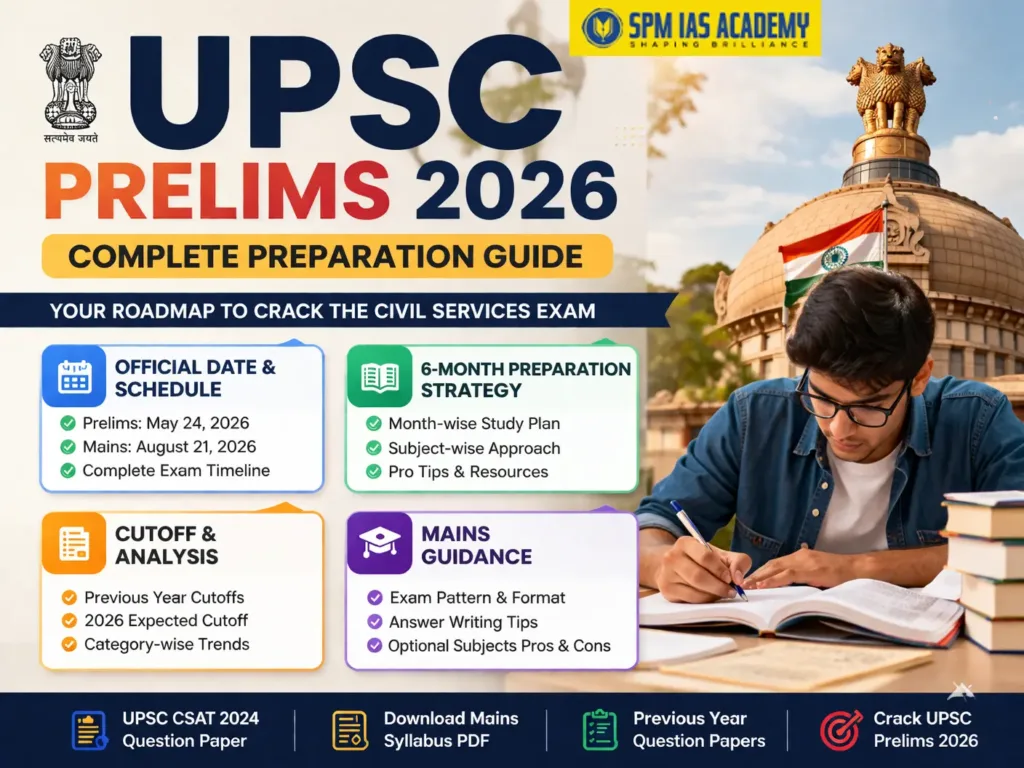
The UPSC Prelims 2026 is the first step in a three-stage process: Preliminary Examination, Main Examination, and Personality Test (Interview). This process determines who fills around 1,000 seats in 24 Central Services. Success requires broad knowledge, analytical skills, emotional resilience, and a disciplined preparation strategy.
In this article, we will look into the official schedule, the cutoff trend analysis and the Mains guidance. We will also discuss a month-by-month preparation roadmap for UPSC Prelims 2026.
UPSC Prelims 2026 Date and Schedule
1. Official Notification and Exam Date
The UPSC Calendar for 2026 has been officially released. Here are the key dates every aspirant must mark:
| Event | Date |
| UPSC 2026 Official Notification Release | February 4, 2026 |
| Online Application Window Opens | February 4, 2026 |
| Last Date to Apply Online | February 24, 2026 |
| UPSC Prelims 2026 Exam Date | May 24, 2026 (Sunday) |
| UPSC Mains 2026 Exam Start Date | August 21, 2026 |
| UPSC Interview / Personality Test | January-April 2027 (Tentative) |
Important: The UPSC Prelims 2026 date of May 24, 2026, is confirmed. There has been no official postponement or revision as of the date of this publication.
2. UPSC Prelims 2026: Paper Timings on Exam Day
On May 24, 2026, two papers will be conducted at exam centres across India. Below is the schedule:
| Paper | Subject | Timing | Duration | Marks | Questions |
| Paper I | General Studies (GS) | 9:30 AM – 11:30 AM | 2 Hours | 200 Marks | 100 MCQs |
| Paper II | CSAT (Civil Services Aptitude Test) | 2:30 PM – 4:30 PM | 2 Hours | 200 Marks | 80 MCQs |
Note: CSAT (Paper II) is qualifying in nature. Candidates must score a minimum of 33% (66 marks out of 200) to have their GS Paper I evaluated. Only GS Paper I marks count towards the merit-based cutoff.
Negative Marking Rule: Each incorrect answer carries a penalty of 1/3rd of the marks assigned to that question. Unattempted questions carry no penalty.
How to Prepare for UPSC Prelims in 6 Months
1. Can You Clear UPSC Prelims 2026 in 6 Months?
With the exam on May 24, 2026, a candidate starting preparation in late November or early December 2025 has approximately 6 months of preparation time. This is a tight but absolutely achievable window provided the strategy is smart, not just hardworking.
The 6-month plan below is divided into Static GS and Current Affairs tracks to be pursued simultaneously. Each month has a clear theme and milestone:
2. Month-by-Month UPSC Prelims Preparation Plan (December 2025 – May 2026)
Month 1 (December 2025): Foundation and Orientation
Theme: Build your knowledge base and understand the exam pattern.
Static GS Focus:
- History: NCERT Class 6-12 (Ancient, Medieval, Modern India – Bipin Chandra’s India’s Struggle for Independence for Modern History)
- Polity: Laxmikant’s Indian Polity – Chapters 1-20 (Constitutional Framework, Fundamental Rights, DPSPs)
- Geography: NCERT Class 6-12 Physical Geography + Orient Blackswan Atlas
Current Affairs Focus:
- Subscribe to one quality newspaper (The Hindu or The Indian Express)
- Begin a daily Current Affairs note-making habit (minimum 30 minutes/day)
- Start one monthly magazine (Vision IAS PT365 or Insights on India)
CSAT Focus:
- Assess your baseline level with a mock CSAT paper.
- Begin Reasoning and Comprehension practice (RS Aggarwal / Arihant CSAT)
Milestone: Complete all NCERTs for History and Geography; finish Laxmikant Part 1.
Month 2 (January 2026): Consolidation of Core Static Subjects
Theme: Complete the high-weightage static subjects.
Static GS Focus:
- Polity: Finish Laxmikant (Chapters 21–80)
- Economy: NCERT Class 11-12 + Ramesh Singh’s Indian Economy (Chapters on Planning, Sectors, Budget, Monetary Policy)
- Environment & Ecology: Shankar IAS Environment book + NCERT Biology basics
Current Affairs Focus:
- Begin solving previous year MCQs on Current Affairs (2023–2025) to understand question framing.
- Follow PIB (Press Information Bureau) summaries for government schemes.
CSAT Focus:
- 3 full-length CSAT mock tests; aim to clear the 66-mark threshold consistently
- Focus on Data Interpretation and Number System if weak areas are identified.
Milestone: Finish Laxmikant, complete Economy basics, and hit 66+ on all CSAT mocks.
Month 3 (February 2026): Science, Technology & Revision Round 1
Theme: Cover remaining static subjects; begin first revision cycle.
Static GS Focus:
- Science & Technology: NCERT Class 9–10 Science + selective reading on Space, Biotech, Defence Tech (from The Hindu and PIB)
- Art & Culture: Nitin Singhania’s Indian Art and Culture (Full)
- Revision: Revise History, Geography, and Polity notes made in Months 1–2
Current Affairs Focus:
- UPSC 2026 Notification will be released around February 4, 2026 – download the syllabus and cross-check your preparation gaps
- Compile a “Monthly Revision Sheet” of important events/schemes.
CSAT Focus:
- Focus on Quant: Percentage, Ratio & Proportion, Average, Time-Speed-Distance
- Solve 2–3 mocks per week.
Milestone: Complete Art & Culture; complete the first full revision of all static subjects.
Month 4 (March 2026): Mock Tests Begin in Earnest
Theme: Shift from input-mode to output-mode; stress-test your preparation.
Strategy:
- Enroll in a structured Test Series (Vision IAS, Forum IAS, Insights IAS, or GS Score)
- Take a minimum of 2 full-length GS Paper I mocks per week.
- Analyze each mock in depth – errors, guesswork patterns, time management.
Static GS Focus:
- Deep-dive revision of Economy and Environment (the two most dynamic static subjects)
- Fill gaps identified in mock test analysis.
Current Affairs Focus:
- Begin the 6-month Current Affairs consolidation (Sept 2025 – Feb 2026)
- Use a single, structured source like Vision IAS Monthly/Yearly Compilation.
Milestone: Score 95+ on at least two GS Paper I mocks; CSAT consistently above 80.
Month 5 (April 2026): Intensification and Gap Analysis
Theme: Plug all remaining gaps; focus on high-ROI topics.
High-ROI Topic Checklist:
- Government Schemes & Programs (last 2 years)
- International Relations (bilateral agreements, summits, organizations)
- Constitutional Amendments (recent and important historic ones)
- Economic Survey and Union Budget 2025–26 highlights
- Important Reports and Indices (Human Development Index, Global Hunger Index, Ease of Doing Business, etc.)
Mock Test Frequency: 3 full-length GS mocks per week + 2 CSAT mocks per week
Current Affairs: Complete consolidation; solve Current Affairs MCQs from your test series on a daily basis.
Milestone: Consistent score of 105–115 on GS Paper I mocks (target cutoff-safe range).
Month 6 (May 2026 – Exam Month): Final Lap
Theme: Revision, confidence, and exam-day strategy.
Week 1-2 of May:
- Final revision of all subject-wise notes
- Focus only on notes; do NOT start any new resource.
- 1 full-length mock every 2 days to maintain accuracy and speed
Week 3 of May (10 days before exam):
- Revise all high-density factual topics: Polity Articles, Constitutional Bodies, Economic terms, and Geography maps.
- Light CSAT practice (maintain, don’t overwork)
Last 3 Days Before Exam:
- Only revision – no new mocks
- Ensure the admit card download, exam centre visit, and ID proof readiness.
- Sleep at least 7–8 hours per night.
Pro Tip: Keep your revision notes to one A4 page per subject. What you can recall in 30 seconds before walking into the exam hall is more valuable than 500 pages of unread notes.
UPSC CSAT 2024 Question Paper with Answers
Analysis of CSAT 2024 Trends
The UPSC CSAT 2024 paper, held on May 26, 2024, brought a significant shift in difficulty, one that every UPSC Prelims 2026 aspirant must take note of.
Key Observations from CSAT 2024:
| Section | 2023 Difficulty | 2024 Difficulty | Change |
| Reading Comprehension | Moderate | Moderate | Stable |
| Logical Reasoning | Moderate | Moderate–High | Slight increase |
| Quantitative Aptitude / Number System | Easy–Moderate | High | Significant Increase |
| Data Interpretation | Moderate | Moderate–High | Slight increase |
| Decision Making | Easy | Easy | Stable |
The Quant Shift in 2024: Questions on Number Systems, Divisibility, LCM/HCF, and Complex Arithmetic saw a marked increase in difficulty in 2024, catching many candidates off-guard who had assumed CSAT Quant would remain a formality. The message is clear: treat CSAT as a real paper, not an afterthought.
How to Use the CSAT 2024 Paper for UPSC Prelims 2026 Prep:
- Solve the 2024 paper under timed conditions (2 hours, 80 questions, 1/3 negative marking)
- Identify the 3-4 question types where you drop maximum marks.
- Practice those specific types daily for 4-6 weeks.
[Download UPSC CSAT 2024 Question Paper with Official Answer Key – Free PDF]
[Download UPSC CSAT 2023, 2022, 2021 Solved Papers Bundle – Free PDF]
UPSC Prelims 2026 Question Paper
1. When Will the UPSC Prelims 2026 Paper Be Available?
The UPSC Prelims 2026 Question Paper will be officially available for download from the UPSC website (upsc.gov.in) within 24-48 hours of the May 24, 2026, exam conclusion. Answer keys from leading coaching institutes (SPM IAS Academy) typically appear within 4-6 hours of the exam ending. Until then, here is how to maximise your preparation:
Importance of Solving Mock Tests Before the Real Paper
Solving mock tests is the closest simulation of the actual UPSC Prelims 2026 experience. Here is why they are non-negotiable:
- Accuracy Training: UPSC rewards calculated attempts. Mocks help you develop intuition for when to attempt and when to skip.
- Time Management: 100 questions in 120 minutes = 72 seconds per question. Without deliberate practice, time management fails on exam day.
- Elimination Skill: UPSC MCQs are designed so that even partial knowledge can help eliminate 2 of 4 options. Mocks build this skill.
- Pattern Recognition: Certain question archetypes recur every year. Mocks expose you to these patterns before the real exam.
[Access UPSC Prelims 2026 Question Paper – Available After May 24, 2026]
[Download UPSC Prelims Previous Year Papers 2015–2025 – Free PDF Bundle]
UPSC Prelims 2026 Cutoff: Expected and Previous Year Analysis
The UPSC Prelims exam is an important step for aspirants aiming to join the civil services in India. Understanding the cutoff trends through UPSC expected and previous year analysis is necessary for candidates, as it provides valuable insights into the changing dynamics of the examination.
1. Understanding the UPSC Prelims Cutoff
The UPSC Prelims cutoff is the minimum score on GS Paper I that a candidate must achieve to qualify for the Mains examination. It varies each year based on:
- Difficulty level of the paper
- Total number of candidates who appeared
- Number of vacancies announced
- Category of the candidate (General, OBC, SC, ST, EWS, PwBD)
Previous Year UPSC Prelims Cutoffs (GS Paper I – Out of 200 Marks) are as follows:
| Year | General (UR) | EWS | OBC | SC | ST | PwBD-1 | PwBD-2 |
| 2021 | 87.54 | 85.27 | 84.27 | 78.52 | 69.32 | 55.05 | 44.10 |
| 2022 | 90.10 | 87.00 | 83.99 | 75.00 | 68.00 | 61.33 | 48.66 |
| 2023 | 92.00 | 88.00 | 86.00 | 78.00 | 71.00 | 63.00 | 50.00 |
| 2024 | 98.66 | 95.27 | 96.66 | 86.00 | 79.66 | 69.00 | 60.33 |
| 2025 | 96.33* | 93.50* | 94.00* | 84.50* | 77.00* | — | — |
Note: 2025 figures are provisional/estimated based on post-exam analysis. Official figures subject to UPSC notification.
2. UPSC Prelims 2026 Expected Cutoff
Based on the upward trend in cutoffs and assuming a moderate-to-high difficulty paper in 2026:
| Category | Expected Cutoff Range (2026) |
| General (UR) | 94 – 102 marks |
| EWS | 90 – 98 marks |
| OBC | 91 – 99 marks |
| SC | 82 – 90 marks |
| ST | 75 – 83 marks |
Disclaimer: These are predictive estimates based on historical trends. Actual cutoffs depend on the 2026 paper’s difficulty, number of vacancies, and candidate distribution. Always aim to score 10-15 marks above the expected cutoff as your personal target.
3. Key Insight: The Cutoff Trend You Must Understand
The General category cutoff rose by approximately 11 marks from 2021 to 2024. This reflects:
- A growing quality of serious aspirants
- Increasing use of mock test series
- Better coaching ecosystem and online resources
What this means for you: Targeting 100+ in GS Paper I is no longer ambitious – it is the new baseline for General category candidates.
UPSC Mains 2026 Exam Date and Format
1. UPSC Mains 2026 Start Date
Candidates who clear UPSC Prelims 2026 on May 24 will appear for the UPSC Mains 2026, which is scheduled to begin on August 21, 2026.
The Mains exam typically runs for 5 consecutive days, covering all 9 papers.
2. The 9-Paper Structure of UPSC Mains
The UPSC Mains is a descriptive (written) examination comprising 9 papers. Two of these are qualifying papers, and the remaining seven are merit-ranked.
| Paper | Subject | Marks | Type |
| Paper A | Indian Language (Compulsory) | 300 | Qualifying |
| Paper B | English (Compulsory) | 300 | Qualifying |
| Paper I | Essay | 250 | Merit |
| Paper II | GS Paper I (History, Heritage, Geography) | 250 | Merit |
| Paper III | GS Paper II (Governance, Polity, IR) | 250 | Merit |
| Paper IV | GS Paper III (Economy, S&T, Environment, Security) | 250 | Merit |
| Paper V | GS Paper IV (Ethics, Integrity, Aptitude) | 250 | Merit |
| Paper VI | Optional Subject Paper I | 250 | Merit |
| Paper VII | Optional Subject Paper II | 250 | Merit |
| Total (Merit Marks) | 1750 |
The Qualifying papers (A & B) require a minimum of 25% marks (75/300). They do not count towards the final merit ranking.
How to Write Answers in UPSC Mains
1. The Core Philosophy of UPSC Mains Answer Writing
UPSC Mains is not a test of memory; it is a test of structured thinking and articulate expression. Examiners at UPSC are looking for candidates who can think like civil servants: analytically, multi-dimensionally, and with sensitivity to diverse perspectives.
2. The Intro-Body-Conclusion (IBC) Framework
Every UPSC Mains answer, regardless of the paper, benefits from this three-part structure:
a. Introduction (23 Lines)
- Define the concept, cite a statistic, quote a committee/report, or reference a recent event.
- Do NOT begin with “In today’s world…” or “Since time immemorial…”
- Examples of strong openers:
- “As per the 2021 Census, India’s urban population crossed 35%, underscoring the urgency of…”
- “The 2nd Administrative Reforms Commission noted that…”
b. Body (80–85% of Word Limit)
- Use sub-headings for multi-part questions (e.g., “Economic Impact / Social Impact / Way Forward”)
- Use bullet points for lists, but paragraphs for analytical arguments.
- Aim for 3–5 dimensions per answer (social, economic, political, environmental, constitutional, ethical, etc.)
- Quote relevant Articles, Acts, Committees, and Policies with accuracy.
c. Conclusion (23 Lines)
- Be forward-looking and solution-oriented, and avoid ending on a negative or inconclusive note.
- Reference a policy initiative, Supreme Court judgment, or committee recommendation where appropriate
- Example: “A multi-pronged approach combining legislative reform, technology adoption, and civil society participation can effectively address this challenge.”
3. The Power of Diagrams, Maps, and Flowcharts
One of the most underutilised tools in UPSC Mains is visual representation. Research on UPSC toppers consistently shows that answers with well-drawn, relevant visuals fetch 2–5 extra marks per answer.
When to use visuals:
- Maps: Geography-related questions (river systems, tectonic zones, agricultural regions, international boundaries)
- Flowcharts: Policy implementation processes, constitutional amendment procedures, and election processes
- Tables: Comparing two concepts, pros vs. cons, pre vs. post-reform scenarios
- Diagrams: Economic concepts (supply-demand curves), environmental cycles, institutional structures
Practice Tip: Practice answer writing for 45 minutes daily starting from Month 4 of your Prelims preparation. Answer writing is a perishable skill; it requires regular daily exercise.
UPSC Optional Subjects List with Pros and Cons
The optional subject contributes 500 marks (250 + 250) to your Mains merit score, nearly 29% of the total 1750 merit marks. This choice can make or break your rank. The ideal option is one where:
1. You have a genuine interest or a prior academic background
2. The syllabus overlaps with GS papers
3. Quality study material and mentorship are accessible
Top UPSC Optional Subjects: Pros and Cons
Below are the pros and cons of the top UPSC optional subjects:
| Optional Subject | Pros | Cons |
| PSIR (Political Science & International Relations) | High GS overlap (Polity, IR); popular = more resources & test series; stable scoring | Very competitive; requires a nuanced understanding of political theory |
| Sociology | High GS-I overlap (society topics); relatively concise syllabus; good scoring potential | Abstract concepts depend heavily on contemporary examples |
| Geography | Strong overlap with GS-I & GS-III; diagram-friendly; objective scoring | Vast syllabus; requires good map work; Physical Geography can be technical |
| History | Deep GS-I overlap; rich study material available | Very vast syllabus; the Modern World History section is often neglected |
| Public Administration | Direct overlap with GS-II (Governance); good for essay writing; scoring | Syllabus update debate; reduced popularity; fewer good mentors now |
| Anthropology | Short, crisp syllabus; good scoring; unique = less competition at top | Limited resource availability; niche subject – finding a good mentor is key |
| Mathematics | Purely objective scoring (no subjectivity); high scores possible for those with a Maths background | Extremely difficult; zero overlap with GS; all-or-nothing risk |
| Literature Optionals (Hindi/Telugu/etc.) | Scoring for strong vernacular medium writers; high topper rank correlation | Language-specific; requires deep literary knowledge; niche |
| Law | Strong Polity overlap; LLB graduates have an advantage | Technical; requires a law background for efficient preparation |
| Economics | Overlap with GS-III; good for Economics graduates | Highly technical; requires quantitative aptitude; the mathematical economics section is tough. |
Recommendation: If you are a first-time aspirant without a specific background, Sociology, Geography, or PSIR offer the best combination of syllabus overlap, resource availability, and scoring predictability.
Download UPSC Mains Syllabus PDF
Before buying a single book or enrolling in a course, every aspirant must download and thoroughly read the official UPSC Mains Syllabus. It is the single authoritative document that defines what is in scope and what is not, and UPSC is known to ask questions directly from the syllabus language.
What the Syllabus PDF Contains:
- Complete syllabus for GS Papers I, II, III, and IV
- Essay Paper Guidelines
- Language Paper requirements
- Syllabus for all 48 optional subjects
[Download UPSC Mains 2026 Syllabus – Official PDF (GS + Optional Subjects)]
[Download UPSC Civil Services 2026 Complete Syllabus (Prelims + Mains) – Free PDF]
[Download UPSC Optional Subjects Full Syllabus – All 48 Subjects PDF Bundle]
Important Changes in UPSC 2026: What Every Aspirant Must Know
The UPSC 2026 notification introduced several procedural changes that represent the most significant update to the examination process in recent years. Every aspirant must be aware of these to avoid last-minute disqualification.
Change 1: Mandatory Live Photo Capture at Exam Centres
Starting with UPSC Prelims 2026, all examination centres will conduct mandatory live biometric/photo capture at the time of entry. This replaces the earlier system of pre-uploaded photos being used for verification.
What this means for you:
- Arrive at least 60 minutes before the reporting time.
- Expect longer queues at entry gates due to the photo capture process.
- Ensure your appearance on exam day closely matches the photo on your Admit Card.
Change 2: Aadhaar-Based Verification
The 2026 cycle has introduced Aadhaar-based identity verification as a primary mode of candidate authentication at examination venues. This move aims to eliminate impersonation, a persistent integrity concern in large-scale examinations.
What this means for you:
- Ensure your Aadhaar card details (name, date of birth) exactly match the details in your UPSC application.
- Carry your original Aadhaar card to the examination hall (photocopies may not be accepted)
- If you do not have an Aadhaar, carry a valid alternative identity proof as specified in the Admit Card instructions.
IAS 2026 Eligibility Criteria (Quick Reference)
| Criterion | General (UR) | OBC | SC/ST | EWS |
| Minimum Age | 21 years | 21 years | 21 years | 21 years |
| Maximum Age | 32 years | 35 years | 37 years | 32 years |
| Number of Attempts | 6 | 9 | Unlimited* | 6 |
| Educational Qualification | Graduate (any discipline) from a recognised university | Same | Same | Same |
SC/ST candidates have unlimited attempts until the age limit is reached.
Note: Age is calculated as of August 1, 2026, for the UPSC CSE 2026 cycle.
Conclusion: Your UPSC Prelims 2026 Journey Starts Today
The journey to becoming an IAS, IPS, or IFS officer is undoubtedly long and demanding. The first step in this journey is the UPSC Prelims 2026, scheduled for May 24, 2026.
Now, all that’s left is for you to pick up your study materials, open the syllabus PDF, and begin your preparations. The best time to start was yesterday; the second-best time is now.
Best of luck with UPSC Prelims 2026! The nation needs its next generation of civil servants, and that could be you.
Frequently Asked Questions (FAQs)
No. As of the date of this publication, the UPSC Prelims 2026 exam date remains May 24, 2026 (Sunday). There has been no official communication from UPSC regarding any postponement or rescheduling. Aspirants are advised to monitor the official UPSC website (upsc.gov.in) for any updates and not rely on unofficial social media rumours.
The minimum age to appear for the UPSC Civil Services Examination 2026 is 21 years. This applies uniformly across all categories (General, OBC, SC, ST, EWS, PwBD). Age is calculated as of August 1, 2026 – meaning you must have been born on or before August 1, 2005, to be eligible.
Candidates belonging to the General (Unreserved) category are allowed a maximum of 6 attempts at the UPSC Civil Services Examination. The attempt limit per category is:
General / EWS: 6 attempts (up to age 32)
OBC: 9 attempts (up to age 35)
SC / ST: Unlimited attempts (up to age 37)
PwBD (General/EWS): 9 attempts (up to age 42)
PwBD (OBC): 9 attempts (up to age 45)
PwBD (SC/ST): Unlimited (up to age 47)
Note: An attempt is counted if a candidate appears for at least GS Paper I of the Preliminary Examination. Merely registering without appearing does NOT count as an attempt.