If you are preparing for the UPSC Civil Services Mains Examination with Sanskrit as your compulsory Indian language paper, then solving UPSC Sanskrit previous year papers from 2016 to 2025 is one of the most productive things you can do right now. These papers give you a direct window into the real exam, not a simulated version, not a coaching estimate, but the actual questions that UPSC asked in previous Mains cycles.
UPSC Sanskrit previous year papers are a practical tool for understanding the exam pattern, the types of questions that appear year after year, and the specific language skills that the paper tests. Regular practice with these papers also builds exam temperament, that combination of speed, accuracy, and calm that distinguishes candidates who clear the qualifying paper comfortably from those who struggle despite knowing the language well.
Aspirants can build a strong civil services foundation with expert guidance and structured learning through UPSC coaching in Assam.
This blog covers the complete year-wise PDF list from 2016 to 2025, explains the paper structure, and walks you through a preparation strategy that makes the most of this resource.
About the UPSC Sanskrit Compulsory Paper
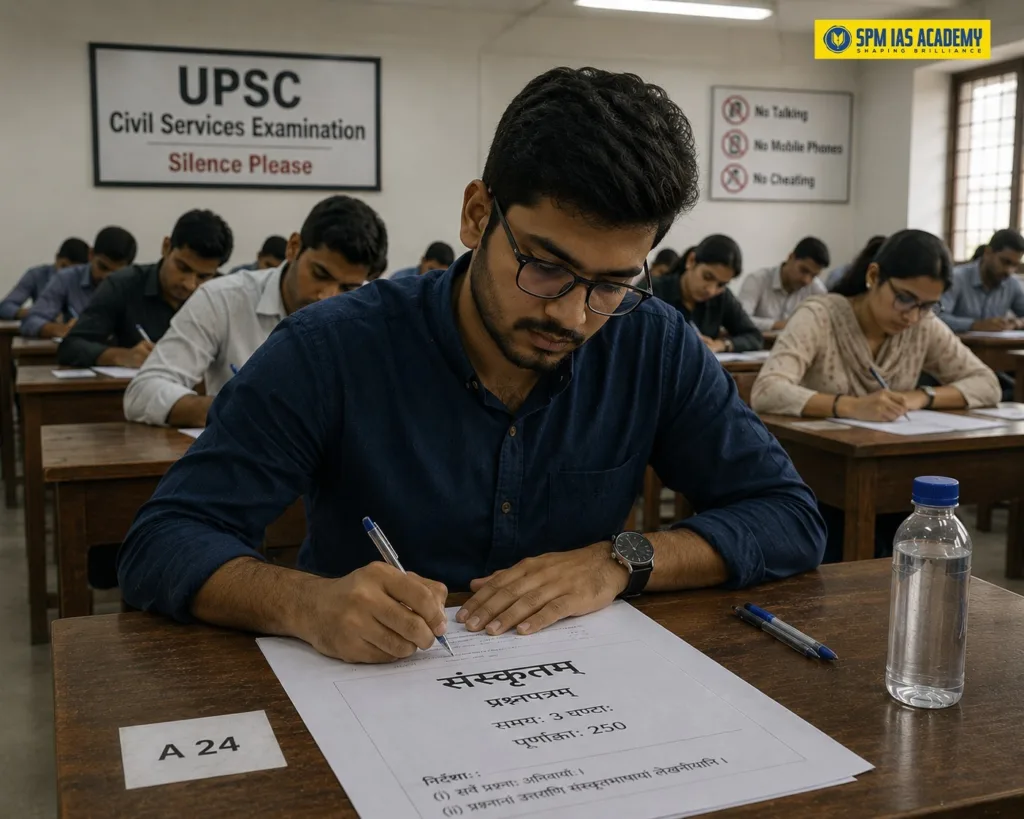
Before downloading and solving Sanskrit previous year papers, understanding the paper’s structure and purpose gives you a clearer frame for your preparation.
The Sanskrit Compulsory Paper forms part of the Indian Language requirement under Paper A in UPSC Civil Services Mains. Like all Indian language papers in the UPSC Mains, it is qualifying in nature, meaning the marks do not count toward your final merit ranking. However, you must clear it to have your general studies and optional papers evaluated at all.
Students preparing for competitive exams can access quality mentorship and preparation resources through UPSC coaching in north east India.
The paper tests four core areas:
Comprehension — Reading an unseen passage in Sanskrit and answering questions about its content with accuracy and precision.
Translation — Converting passages between Sanskrit and English or vice versa, retaining meaning, tone, and structure throughout.
Precis Writing—Condensing a longer passage into a shorter, accurate summary in your own words without losing key content.
Essay Writing — Organizing and expressing thoughts in structured Sanskrit prose on a given topic within a word or time limit.
All four sections reward genuine language command built through consistent practice rather than last-minute revision. The UPSC Sanskrit Previous Year Papers series gives you ten years of actual exam questions to build that command on.
Understanding Manipur PSC Services helps candidates explore different posts, responsibilities, and career opportunities available through the Manipur PSC CCE.
Download UPSC Sanskrit Previous Year Papers PDF — Year-Wise List (2016–2025)
Here is the complete year-wise list of UPSC Sanskrit previous year papers from 2016 to 2025. Each paper corresponds to the Sanskrit compulsory paper from the respective Civil Services Mains examination year.
| Year | Download Link |
| UPSC Sanskrit PYQ Paper 2025 | Download PDF |
| UPSC Sanskrit PYQ Paper 2024 | Download PDF |
| UPSC Sanskrit PYQ Paper 2023 | Download PDF |
| UPSC Sanskrit PYQ Paper 2022 | Download PDF |
| UPSC Sanskrit PYQ Paper 2021 | Download PDF |
| UPSC Sanskrit PYQ Paper 2020 | Download PDF |
| UPSC Sanskrit PYQ Paper 2019 | Download PDF |
| UPSC Sanskrit PYQ Paper 2018 | Download PDF |
| UPSC Sanskrit PYQ Paper 2017 | Download PDF |
| UPSC Sanskrit PYQ Paper 2016 | Download PDF |
You can also access these papers directly through the official UPSC website at upsc.gov.in, where UPSC publishes past question papers after each examination cycle. Always verify that the paper you download is the actual UPSC Compulsory Language Paper A for Sanskrit and not a practice paper created by a third party.
Year-Wise Insight — What Each Paper Offers
Working through the UPSC Sanskrit Previous Year Papers collection year by year gives you different preparation benefits depending on which paper you focus on and when.
UPSC Sanskrit Paper 2025
The 2025 UPSC Sanskrit Paper entry is the most current available and gives you the sharpest insight into where the exam stands right now. Start your paper-based preparation here to set the baseline before working backward through older years.
UPSC Sanskrit Paper 2024
The 2024 paper, studied alongside 2025, builds a two-year view of recent trends. Analyzing both papers together reveals which question formats UPSC has continued and which have shifted, helping you allocate preparation time more precisely.
UPSC Sanskrit Paper 2023
The 2023 UPSC Sanskrit Paper PDF offers strong insight into how UPSC frames comprehension passages and essay topics. Practicing this paper specifically targets your writing and comprehension skills at the level the exam expects.
UPSC Sanskrit Paper 2022
The 2022 paper provides a solid foundation for understanding the question framing conventions UPSC uses across the four sections. Candidates who work through this paper gain a reliable sense of how the language demands sit relative to the qualifying threshold.
UPSC Sanskrit Paper 2021
The 2021 UPSC Sanskrit Previous Year Paper entry is important for understanding language nuances and the essay writing conventions specific to this paper. Practicing the essay section from this year builds the structured expression habit that the exam rewards.
UPSC Sanskrit Paper 2020
The 2020 paper is a strong revision resource, alongside being a practice tool. Candidates can use it for both fresh, timed practice sessions and for targeted revision of weaker sections like translation or precise writing.
UPSC Sanskrit Paper 2019
The 2019 UPSC Sanskrit Previous Year Paper PDF helps you understand the consistent patterns UPSC follows across years. Regularly practicing this paper builds familiarity and reduces hesitation when approaching unseen comprehension passages in the actual exam.
UPSC Sanskrit Paper 2018
The 2018 paper is particularly useful for noting format changes and recurring themes. Reviewing this UPSC Sanskrit Previous Year Papers entry alongside more recent years shows you which elements of the paper have remained stable and which have evolved.
UPSC Sanskrit Paper 2017
The 2017 UPSC Sanskrit Previous Year Paper PDF serves as an excellent full mock exam resource. Using it in a complete timed simulation, where you solve the entire paper with no reference material and strict time discipline, builds the exam readiness that matters most on the actual day.
UPSC Sanskrit Paper 2016
The 2016 paper rounds out the ten-year collection. Solving this UPSC Sanskrit Previous Year Paper PDF in combination with recent papers gives you a comprehensive view of the paper’s evolution, which language areas have consistently appeared, and what preparatory depth the exam actually demands.
Benefits of Solving UPSC Sanskrit Previous Year Papers
The advantages of working through the UPSC Sanskrit Previous Year Papers collection go well beyond basic practice. Here is what consistent engagement with these papers actually builds:
Familiarity with the Exam Pattern
Every paper in the collection follows the same structural template, comprehension, translation, precise writing, and essay. Working through multiple years makes this structure completely familiar, so you walk into the exam hall knowing exactly what to expect from the first question to the last.
Improved Answer Writing in Sanskrit
Regular practice with actual exam questions improves your ability to write clean, precise, and well-structured answers in Sanskrit. The improvement is gradual but compounding, each paper you solve adds a layer of confidence and fluency to your written expression.
Genuine Confidence Building
One of the most underrated benefits of solving the UPSC Sanskrit Previous Year Paper series is the confidence it builds. Repeated exposure to the actual exam format under timed conditions shifts your relationship with the paper from anxiety to familiarity. That psychological shift directly improves performance.
Real-Time Management Skills
Practicing under the actual time constraints that the UPSC Mains imposes teaches you to manage the four sections efficiently within the available time. Candidates who have solved multiple papers under timed conditions arrive at the exam knowing exactly how to pace themselves, something that no theoretical study plan can provide.
Identification of High-Frequency Topics
Analyzing the UPSC Sanskrit Previous Year Papers collection across years reveals which topics and passage types UPSC returns to repeatedly. This pattern recognition allows you to prioritize your preparation time on high-yield areas rather than spreading effort uniformly across the entire language domain.
How to Use UPSC Sanskrit Previous Year Papers Effectively
Downloading the UPSC Sanskrit previous year paper PDFs is the first step. Using them effectively is what actually produces results. Here is a structured approach:
Complete the syllabus before solving papers.
Before you start working through previous year papers in timed conditions, make sure you have covered the core syllabus for the Sanskrit compulsory paper, grammar rules, vocabulary range, translation conventions, and essay structure. Attempting papers before completing the syllabus produces low scores that discourage rather than inform.
Simulate Real Exam Conditions Every Time
When you sit down with any UPSC Sanskrit Previous Year Paper PDF to solve it, treat it as the actual exam. Set a timer, keep all reference material away, and complete the paper in one sitting without pausing. This discipline builds the mental stamina and pacing instinct that only comes from repeated real-pressure practice.
Analyze Every Mistake After Each Paper
After solving each paper, go through every section carefully and identify where you lost marks or made errors. Categorize mistakes as grammatical errors, translation inaccuracies, structural weaknesses in essays, or comprehension misreads. Each category needs a specific fix, and tracking them across multiple papers shows you your actual weak areas rather than your perceived ones.
Build Consistent Practice Into Your Daily Routine
Incorporating UPSC Sanskrit previous year papers practice into your daily study schedule, even just one section per day rather than a full paper, builds continuous familiarity with the exam format. Consistency across weeks produces far better results than occasional intensive sessions.
Revise Grammar and Vocabulary Alongside Paper Practice
The translation and comprehension sections of the UPSC Sanskrit previous year papers consistently test grammatical accuracy and vocabulary range. Alongside paper practice, keep a dedicated focus on Sanskrit grammar revision and vocabulary expansion. Maintaining a language notebook where you record grammar patterns and new words from each paper you solve accelerates this process considerably.
Preparation Strategy for UPSC Sanskrit Compulsory Paper
With the UPSC Mains examination scheduled for August 21, 2026, here is a three-phase preparation strategy that uses the UPSC Sanskrit Previous Year Papers collection most effectively:
Phase 1 — Syllabus Completion and Orientation (First 6 to 8 weeks). Complete your Sanskrit grammar revision and build your working vocabulary. During this phase, read through the 2025 and 2024 previous year papers without time pressure to understand the format and language level. Do not solve them under exam conditions yet, just familiarize yourself with what the actual paper looks like.
Phase 2 — Timed Practice and Pattern Analysis (Next 8 to 10 weeks). Start solving the papers from 2023 backward to 2019 under full-time exam conditions. After each paper, conduct a thorough mistake analysis and update your grammar notebook. By the end of this phase, you should see steady improvement in translation accuracy, precision length control, and essay coherence.
Phase 3 — Intensive Revision and Mock Testing (Final 4 to 6 weeks). Use the 2016 to 2018 papers as full mock examinations in this phase. Additionally, re-attempt the 2025 and 2024 papers to measure how much your performance has improved since Phase 1. Focus the final two weeks entirely on the weak areas identified across all previous paper attempts.
Conclusion
The UPSC Sanskrit Previous Year Papers collection from 2016 to 2025 is the most direct and practical resource available for anyone preparing for this qualifying paper. Ten years of real UPSC questions give you everything you need, pattern clarity, language level benchmarks, section-wise practice, and a reliable measure of your improving preparation. Use them with focus, analyze them with honesty, and let the consistency of your practice carry you through this qualifying paper and into the evaluation stages that actually count toward your merit.
Frequently Asked Questions
The UPSC Sanskrit Compulsory Paper is the Indian Language Paper A in the UPSC Civil Services Mains examination, and candidates who opt for Sanskrit as their Indian Language must appear in it. The paper is qualifying in nature, meaning the marks it carries do not add to the final merit score. However, a candidate who does not clear this qualifying paper has their General Studies and Optional answer sheets rejected entirely, which makes clearing it a non-negotiable requirement regardless of how well you perform in the merit-counting papers. The paper tests comprehension, translation, precise writing, and essay writing in Sanskrit at a functional proficiency level. It is not designed to test advanced classical Sanskrit scholarship but rather to ensure that the candidate can read, write, and communicate effectively in the language. Solving UPSC Sanskrit previous year papers gives you the clearest picture of what “functional proficiency” means in the specific context of this exam.
The official source for the previous year papers is the UPSC website at upsc.gov.in, where UPSC publishes past question papers from each Mains cycle. These papers are available for free download and carry the official UPSC format, header, and section structure that distinguishes them from coaching-created practice papers. The complete collection from 2016 to 2025 is also available through several reliable educational preparation portals that compile year-wise UPSC paper archives. When accessing papers from any source, verify that the paper is genuinely from the official UPSC examination and not a simulated practice paper. The differences in question format and language level between official papers and simulated ones are significant enough to affect how well your practice translates to actual exam performance.
Solving UPSC Sanskrit previous year papers gives you benefits that no other preparation resource provides. First, these papers expose you to the exact language level, question format, and section distribution that UPSC uses, information that study guides and grammar books cannot accurately replicate. Second, practicing under timed conditions with real papers builds the speed and accuracy combination that the qualifying paper demands, and that combination only develops through repeated real-pressure practice rather than open-ended studying. Third, analyzing your mistakes across multiple papers gives you specific, targeted information about which areas of your Sanskrit preparation need the most work, grammar, translation precision, precise writing, or essay structure. Fourth, consistent paper practice builds genuine confidence in handling the paper on exam day, which directly reduces anxiety and improves performance. The candidates who clear this qualifying paper without difficulty are almost always those who took the Sanskrit Previous Year Papers collection seriously throughout their preparation.

Behind every article at SPM IAS Academy is a team of skilled content writers and subject experts committed to making preparation easier for aspirants. From answering common doubts to breaking down complex issues and current affairs, we create content that is accurate, easy to understand, and directly useful for UPSC, APSC, and other competitive exams.