Why was EMRS in the news?
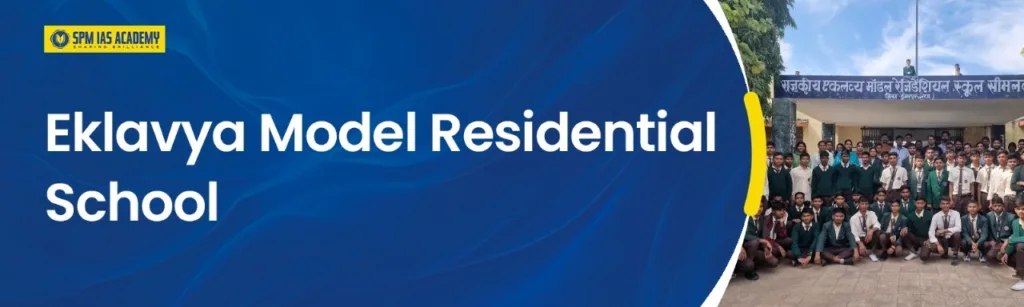
Recently, to enhance educational access for tribal communities, the Prime Minister of India laid the foundation stone of an Eklavya Model Residential School (EMRS) at Kombo in the West Siang district of Arunachal Pradesh. In this context, the project is being implemented by the Union Ministry of Tribal Affairs to strengthen schooling facilities in tribal-dominated regions.
About the Project:
To begin with, the EMRS project aims to provide quality education along with well-equipped residential facilities for tribal students. Moreover, it focuses on holistic development by offering academic learning, skill development, and co-curricular opportunities. As a result, the school is expected to play a transformative role in improving educational infrastructure in remote and underserved tribal areas. Finally, by creating new pathways for learning and empowerment, the project contributes to the long-term socio-economic development of tribal youth in Arunachal Pradesh.
What is Eklavya Model Residential Schools (EMRS)?
- To begin with, EMRS is a flagship scheme of the Ministry of Tribal Affairs, Government of India.
- Moreover, it provides quality residential education to Scheduled Tribe (ST) students from Classes VI to XII.
- In addition, the scheme primarily targets students living in remote and tribal-dominated regions, where access to quality schooling is limited.
- Therefore, its core objective is to ensure equal educational opportunities and bridge the educational gap between tribal students and the general population.
- Historically, the programme was launched in 1998.
- Subsequently, it was revamped in 2018–19 to expand coverage and upgrade infrastructure and facilities.
- Furthermore, EMRS schools are planned in every block with over 50% ST population and at least 20,000 tribal residents, ensuring need-based expansion.
- At the national level, the target is to establish 728 EMRS schools by 2026.
- Finally, the schools are managed by the National Education Society for Tribal Students (NESTS) under the Ministry of Tribal Affairs.
Key Features of EMRS:
- To begin with, EMRS are co-educational residential schools for students from Classes VI to XII.
- Moreover, they offer facilities and infrastructure comparable to Navodaya Vidyalayas, ensuring quality schooling.
- In addition, the schools actively preserve local tribal art, culture, and traditions as part of education.
- At the same time, students receive training in sports, skill development, and extracurricular activities for all-round growth.
- Academically, EMRS follows the CBSE curriculum, ensuring national-level standards.
- Importantly, education in EMRS is completely free, including boarding and lodging.
- Furthermore, each EMRS can accommodate 480 students, with equal seats for boys and girls.
- However, up to 10% of seats may be allotted to non-ST students, as per norms.
- Finally, 20% of seats are reserved under the sports quota for ST students who show proven excellence in sports.
What are the Significances of EMRS for Arunachal Pradesh?
- Enhancing Educational Access in Remote Areas:
To begin with, EMRS plays a crucial role in improving access to quality education in remote and tribal-dominated regions of Arunachal Pradesh. By providing residential schooling, it bridges the gap in areas where formal education facilities are limited or absent. - Promoting Inclusive Growth for Tribal Communities:
Moreover, with a tribal population of over 68.79% (Census 2011), EMRS supports inclusive socio-economic development. Through education, skill development, and personality grooming, it empowers Scheduled Tribe youth and enhances their long-term opportunities. - Reducing School Dropout Rates:
In addition, many tribal students drop out due to long travel distances, poor infrastructure, and lack of nearby schools. EMRS addresses these challenges by offering free education, residential facilities, food, and academic support, thereby significantly reducing dropout rates. - Preserving Tribal Culture and Heritage:
Furthermore, EMRS integrates local tribal art, languages, and traditions into its curriculum. As a result, it helps preserve cultural heritage while promoting modern education. - Boosting Employment and the Local Economy:
At the same time, the construction and operation of EMRS campuses generate employment opportunities for local workers, teachers, and support staff, thereby strengthening the local economy. - Developing a Skilled Future Workforce:
Additionally, with CBSE-based education, sports training, exposure to technology, and vocational skills, EMRS prepares tribal students for competitive examinations, higher education, and modern job markets. - Strengthening State Human Capital:
Finally, EMRS contributes to building a strong pool of future administrators, professionals, and leaders from tribal communities, thereby enhancing the overall human capital of the state. - Alignment with National Priorities:
Overall, EMRS aligns with national goals such as inclusive development, the objectives of the National Education Policy (NEP) 2020, and the government’s broader focus on uplifting tribal communities.
Conclusion:
In conclusion, the establishment of Eklavya Model Residential School in Arunachal Pradesh marks an important step towards improving educational access and social inclusion for tribal communities. It addresses long-standing challenges such as remoteness, dropout rates, and lack of infrastructure. It also promotes holistic development, cultural preservation, and skill enhancement. Therefore, by aligning with national education policy and empowering tribal youth, EMRS has the potential to significantly strengthen human capital and contribute to the state’s long-term socio-economic progress.
Prelims Practice MCQ:
Q. With reference to the Eklavya Model Residential Schools (EMRS), consider the following statements:
- EMRS schools provide free residential education to Scheduled Tribe (ST) students from Class 6 to 12.
- The scheme aims to establish an EMRS in every block with over 50% tribal population and at least 20,000 ST residents.
- EMRS are managed by the National Education Society for Tribal Students (NESTS) under the Ministry of Education.
- Up to 10% of the seats in EMRS may be allotted to non-ST students.
How many of the above statements are correct?
(a) Only one
(b) Only two
(c) Only three
(d) All four
Correct Answer: (c) Only three
FAQ:
To begin with, EMRS is a flagship residential school scheme for Scheduled Tribe students. It is important for Arunachal Pradesh because it provides free, quality education in remote tribal areas. Moreover, it helps reduce dropouts and promotes inclusive growth among tribal youth.
In addition, EMRS supports tribal development by offering CBSE-based education, skill training, and cultural preservation. At the same time, it aligns with the National Education Policy (NEP) 2020. Therefore, it helps build skilled human capital and ensures equal educational opportunities for tribal communities.
Source: Arunachal Times