The UPSC Civil Services Examination is widely regarded as one of the most competitive exams in India. Every year, lakhs of aspirants register for the Preliminary Examination — yet only a fraction successfully advance to the Mains. Therefore, understanding how to crack UPSC Prelims in first attempt is not just aspirational; it is a strategic necessity.
In this article, we cover a proven UPSC Prelims study plan, break down the exam pattern, outline the best resources, and highlight the common mistakes to avoid in UPSC preparation for Prelims — so you can begin your civil services journey with clarity and confidence.
UPSC Prelims Exam Pattern: What Every Aspirant Must Know
Before diving into understanding how to crack UPSC Prelims in first attempt, it is essential to understand the structure of the exam. The UPSC Prelims consists of two papers. Paper I (General Studies) determines your merit ranking for Mains qualification, while Paper II (CSAT) is qualifying in nature — you simply need to score 33% to pass.
| Paper | Subject | Marks | Nature |
| Paper I | General Studies | 200 | Merit Ranking |
| Paper II | CSAT | 200 | Qualifying (33%) |
Since Paper I directly determines whether you qualify for Mains, your preparation strategy should prioritise it heavily. However, as discussed later, do not make the mistake of neglecting CSAT altogether.
Why Clearing UPSC Prelims in the First Attempt Matters
Knowing how to crack UPSC Prelims in first attempt offers significant advantages that go beyond saving time:
- It saves years of repeated preparation cycles and reduces mental fatigue
- It builds strong confidence for the Mains and Personality Test stages
- It allows candidates to enter the civil service career path sooner
- Early success reinforces study habits that benefit the entire selection process
Achieving this goal, however, requires a disciplined preparation strategy combined with consistent practice. Moreover, a clear understanding of the syllabus and smart resource selection are equally critical.
Step-by-Step UPSC Prelims Preparation Strategy
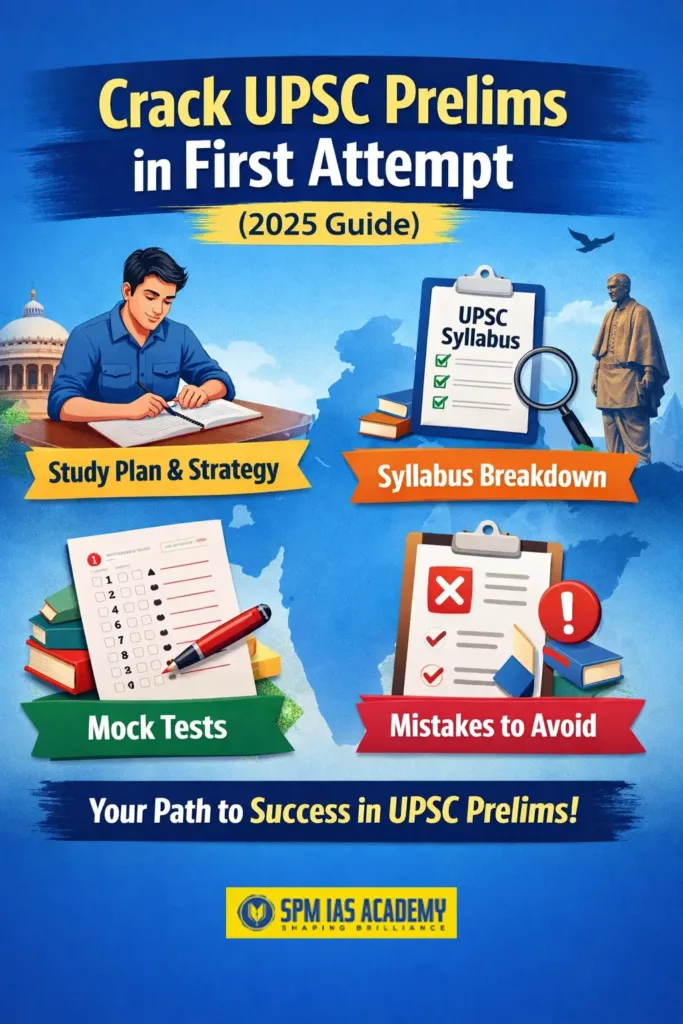
A structured and systematic approach to knowing how to crack UPSC Prelims in first attempt is the foundation of any successful UPSC Prelims preparation strategy. The following strategy breaks down the process into actionable steps — from understanding the syllabus to revising on exam eve.
Step 1: Master the UPSC Prelims Syllabus First
Understanding the syllabus is the very first step in learning how to crack UPSC Prelims in first attempt. Many aspirants begin studying without a clear picture of what is actually tested — this leads to wasted effort and poor coverage. The UPSC Prelims syllabus for General Studies includes:
- Indian History — Ancient, Medieval, and Modern
- Geography — Physical, Indian, and World Geography
- Indian Polity and Governance — Constitution, Panchayati Raj, Public Policy
- Economy — Planning, Growth, Development, Fiscal Policy
- Environment and Ecology — Biodiversity, Climate Change, Conservation
- Science and Technology — Space, Defence, Biotechnology
- Current Affairs — National and International Events
Furthermore, mapping each topic to the syllabus helps aspirants identify high-yield areas and allocate study time more efficiently.
Step 2: Build Strong Fundamentals Using NCERT Books
NCERT textbooks are the most reliable starting point for how to crack UPSC Prelims in first attempt. They provide conceptual clarity in simple language — an essential foundation before moving to advanced reference books. Strong fundamentals directly improve your performance in factual and application-based questions.
| Subject | Recommended NCERT Level |
| History | Class 6–12 |
| Geography | Class 6–12 |
| Polity | Class 9–12 |
| Economy | Class 11–12 |
Additionally, reading NCERTs helps aspirants retain information longer, as the content is presented in a structured and progressive manner. Once these books are covered thoroughly, advanced resources become far easier to comprehend.
Step 3: Analyse Previous Year Question Papers (PYQs)
Previous Year Question Papers (PYQs) are arguably the most underutilised tool in UPSC Prelims preparation. Analysing PYQs from the last 10–15 years reveals recurring themes, question styles, and the depth of knowledge required. Moreover, PYQs help aspirants develop elimination techniques for tricky options.
Key benefits of solving PYQs regularly include:
- Identifying the most frequently tested topics across each subject
- Learning how to apply elimination strategies in objective questions
- Building confidence and familiarity with UPSC’s unique questioning style
- Reducing exam-day anxiety through pattern recognition
Step 4: Build a Structured, Phase-Based Study Plan
A well-designed timetable is important for covering the vast UPSC syllabus systematically. Rather than studying randomly, a phase-based approach ensures strong coverage while leaving adequate time for revision and practice.
| Preparation Phase | Duration | Focus Area |
| Foundation Phase | 3–4 months | NCERTs and basic concepts |
| Core Preparation | 4–6 months | Standard books and current affairs |
| Revision Phase | 2–3 months | Mock tests and full revision |
Consistency is more valuable than intensity. Therefore, aspirants should follow their study plan daily — even on difficult days — and track their progress weekly to identify gaps.
Step 5: Follow Current Affairs Every Single Day
Current affairs consistently form a significant portion of UPSC Prelims questions — particularly in areas like government schemes, international relations, economy, and environment. Consequently, daily reading combined with monthly consolidation is necessary for comprehensive preparation.
| Source | Purpose |
| The Hindu / Indian Express | Daily news analysis |
| PIB (Press Information Bureau) | Government policies and schemes |
| Monthly Magazines | Consolidated revision material |
In addition to newspaper reading, aspirants should maintain short notes on important events, government policies, and reports — since these are regularly referenced in Prelims questions.
Step 6: Take Mock Tests Regularly and Analyse Them Thoroughly
Mock tests do far more than measure your preparation — they simulate actual exam conditions, improve time management, and reveal weak areas. Experts consistently recommend solving 30–40 full-length mock tests before the actual exam.
The benefits of consistent mock test practice include:
- Developing question-solving speed under time pressure
- Improving overall accuracy through pattern recognition
- Building mental stamina and managing exam-day pressure
- Identifying subject-wise weaknesses for targeted revision
Pro Tip: Never skip mock test analysis. Reviewing wrong answers and understanding the reasoning behind correct ones is where real improvement happens.
Step 7: Create Concise Revision Notes Throughout Preparation
Short, well-organised notes are a powerful revision tool — especially during the final weeks before the exam. Rather than re-reading entire books, notes allow aspirants to revise the full syllabus multiple times in a compressed timeframe.
Effective revision notes should include:
- Key concepts and definitions — in your own words
- Important facts, dates, and statistics — tabulated for quick recall
- Diagrams, flowcharts, and mind maps — for visual learners
- Mnemonics and memory hooks — for dense topic areas like Acts and Articles
Step 8: Revise the Syllabus Multiple Times
Revision is arguably the most critical — and most neglected — component of how to crack UPSC Prelims in first attempt. Without regular revision, even well-studied material fades from memory. Multiple revision cycles significantly improve both retention and recall accuracy during the exam.
Effective revision techniques include:
- Weekly revision schedules for each subject area
- Spaced repetition using flashcards for high-frequency facts
- Mind maps for interconnecting themes across subjects
- Subject-wise revision before each mock test
Step 9: Do Not Underestimate CSAT Preparation
A common and costly mistake many aspirants make while understanding how to crack UPSC Prelims in first attempt is treating CSAT as an afterthought. While it is qualifying in nature, failing to secure the 33% threshold will lead to immediate disqualification — regardless of how well you perform in Paper I. Therefore, consistent CSAT practice must be built into your preparation from the beginning.
Focus on the following CSAT areas:
- Reading Comprehension — speed and accuracy with dense passages
- Logical Reasoning — puzzles, syllogisms, and analytical reasoning
- Basic Quantitative Aptitude — arithmetic, data interpretation, and number systems
Common Mistakes to Avoid in UPSC Preparation
Even well-prepared candidates can underperform due to avoidable mistakes. Understanding these pitfalls is an important part of learning how to crack UPSC Prelims in first attempt. Identifying and correcting these issues early can meaningfully improve your results.
| Common Mistake | Why It Is Harmful |
| Studying too many books | Leads to confusion and information overload |
| Ignoring CSAT preparation | Risk of disqualification despite strong GS score |
| Skipping revision cycles | Poor retention and weak recall during exam |
| Not practicing PYQs | Weak exam strategy and unfamiliarity with patterns |
| Avoiding mock tests | Poor time management and exam-day anxiety |
Additionally, avoid comparing your preparation pace with others. Each aspirant has a different background, available time, and learning speed. Instead, focus on covering the syllabus thoroughly and revising consistently — this is what ultimately determines results.
Conclusion
Cracking UPSC Prelims in the first attempt is a challenging but entirely achievable goal. The most successful aspirants share a set of common habits: they understand the syllabus deeply, rely on a limited set of trusted resources, revise consistently, and practice under exam-like conditions.
With the right approach for how to crack UPSC Prelims in first attempt, dedication, and patience, qualifying UPSC Prelims in your very first attempt is not just a possibility — it is a well-defined, reachable milestone.
Ready to begin? Start with your NCERT readings today — the first step is always the most important one.
Frequently Asked Questions
Yes — many candidates successfully clear the exam on their very first attempt. However, the key differentiator is a disciplined study plan, consistent revision, and regular mock test practice. Aspirants who begin with a clear strategy and stick to it are significantly more likely to succeed.
Most successful aspirants dedicate 6–8 focused hours of study per day, alongside consistent current affairs reading and mock test practice. Quality of study matters far more than quantity — avoid passive reading and ensure active engagement with the material.
NCERTs are essential for building foundational knowledge, but are not sufficient on their own. Aspirants should additionally refer to standard reference books and stay updated with current affairs through reliable news sources.
Experts recommend attempting 30–40 full-length mock tests before the actual exam. Equally important is thoroughly analysing each test — understanding mistakes and reviewing concepts tested is what drives score improvement.
Most aspirants require 10–12 months of structured preparation to cover the full syllabus effectively. Candidates with prior academic exposure to subjects like History, Polity, or Economics may require slightly less time.

SPM IAS Academy is a leading APSC & UPSC coaching institute based in Guwahati, Assam, dedicated to helping aspirants achieve success in civil services examinations. The academy provides expert mentorship, comprehensive study materials, current affairs guidance, test series, and personalized preparation strategies for APSC, UPSC, and other competitive exams. With a strong focus on quality education, discipline, and result-oriented learning, SPM IAS Academy has become a trusted name among civil service aspirants across Assam and Northeast India.