
The 2026 Civil Services Examination cycle is one of the most anticipated in recent years. Increased competition and evolving question trends make thorough preparation more critical than ever. Before you open a single textbook, you must understand the UPSC Mains 2026 Exam Pattern in complete detail. It defines how you will be tested, how marks are awarded, and ultimately, how toppers are selected. Ignoring the pattern is the single biggest mistake aspirants make.
In this article, we will look into the UPSC exam pattern 2026 and marking scheme. We will also discuss merit ranking papers.
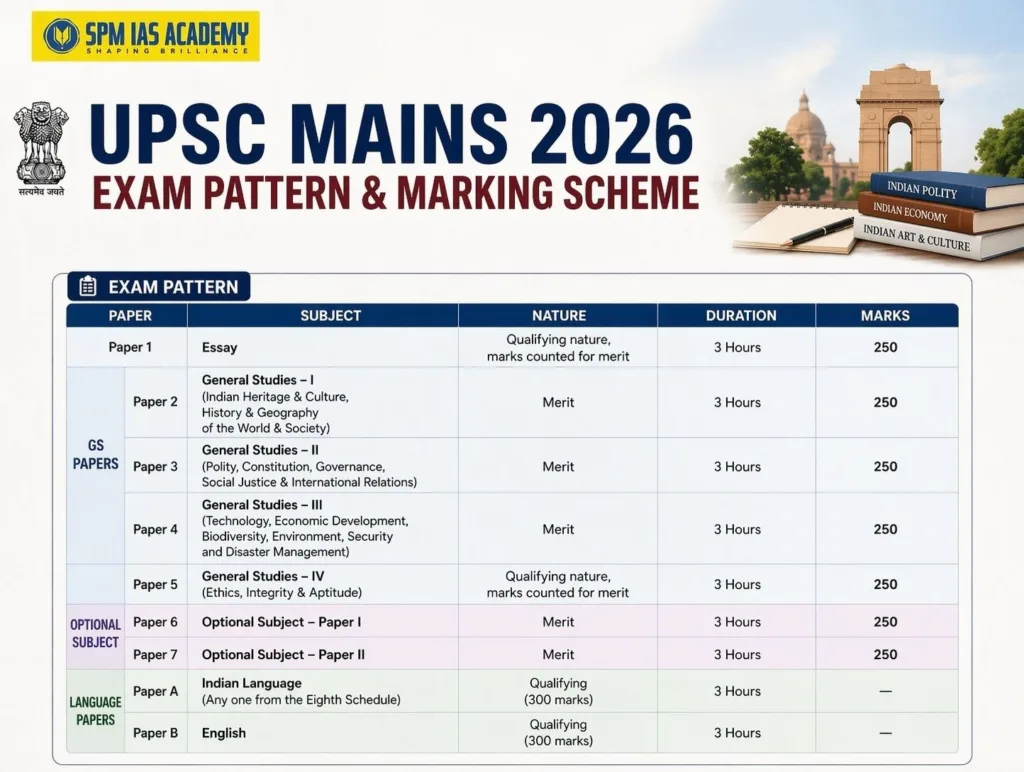
Overview of UPSC Mains 2026
The UPSC Mains is a written examination. Unlike Prelims, it is descriptive in nature. You must write detailed, analytical answers within strict word limits. This test is not just about knowledge, but clarity of thought and communication.
The 9-Paper Structure
The IAS Mains 2026 structure consists of nine papers spread across multiple days. These nine papers fall into two broad categories:
- Qualifying Papers (2 papers): These papers are mandatory but do not count towards your merit rank.
- Merit-Ranking Papers (7 papers): These are the papers that determine your final score and rank.
Understanding this split is important. Many aspirants waste precious preparation time on qualifying papers. Time is better spent on merit papers where every mark counts.
Before planning preparation, review UPSC CSE 2026 age limit, attempts, eligibility explained to ensure you meet all criteria.
Qualifying Papers in UPSC: Paper A and Paper B
The two qualifying papers test basic language proficiency. They carry 300 marks each but are not counted in the merit total.
Paper A: Indian Language
You must choose one Indian language from the Eighth Schedule of the Constitution. The paper tests your ability to read, write, and comprehend that language.
- Total Marks: 300
- Qualifying Marks: 25% (i.e., 75 out of 300)
- Duration: 3 hours
- Script: The language’s own script (e.g., Devanagari for Hindi)
Note: Candidates from certain northeastern states may be exempted. Check the qualifying papers in the UPSC notification carefully for your eligibility.
Paper B: English
This paper tests general English comprehension and writing skills. The standard is approximately Class 10 level.
- Total Marks: 300
- Qualifying Marks: 25% (i.e., 75 out of 300)
- Duration: 3 hours
Both Paper A and Paper B are pass/fail in nature. Failing either disqualifies your entire Mains attempt, regardless of your score in other papers. Do not neglect them.
Merit-Ranking Papers: Where the Real Battle Is Fought
The seven merit-ranking papers carry 250 marks each. Together, they form the UPSC Mains total marks of 1750 for the written stage. Your rank in the final list depends heavily on your performance here.
Paper I: Essay (250 Marks)
You must write two essays, one from each section. Topics range from abstract philosophical ideas to current national and international issues. The UPSC GS papers syllabus does not directly apply here, but a broad reading habit helps enormously.
- Marks: 250
- Duration: 3 hours
- Key Skill: Structure, coherence, and original thought
Papers II to V: General Studies I to IV (250 Marks Each)
These are the four GS papers, and they form the core of Mains preparation. Each paper covers a distinct domain:
- GS I (History, Geography, Society): Indian heritage, world history, physical and human geography, social issues.
- GS II (Polity, Governance, IR): Constitution, government schemes, international relations, social justice.
- GS III (Economy, Environment, Technology): Economic development, biodiversity, disaster management, internal security.
- GS IV (Ethics): Ethical theories, integrity, case studies and emotional intelligence.
GS IV (Ethics) is a unique paper. It requires genuine reflection, not just rote learning. Many toppers gain significant marks here through well-structured, thoughtful answers.
Papers VI and VII: Optional Subject (250 Marks Each)
You choose one optional subject from the UPSC list. Both Paper VI and Paper VII test the same subject, but at different levels of depth and analysis. The same subject applies to both papers. You cannot mix subjects across Paper VI and VII.
- Total Optional Marks: 500 (250 x 2)
- Popular choices: History, Geography, Public Administration, Sociology, PSIR
- Choose based on your academic background and genuine interest.
UPSC Mains 2026 Summary Table
The information below gives you a quick reference to the complete IAS Mains 2026 structure:
| Paper | Subject | Marks |
|---|---|---|
| Paper A | Indian Language (Qualifying) | 300 |
| Paper B | English (Qualifying) | 300 |
| Paper I | Essay | 250 |
| Paper II | General Studies I | 250 |
| Paper III | General Studies II | 250 |
| Paper IV | General Studies III | 250 |
| Paper V | General Studies IV | 250 |
| Paper VI | Optional Subject – Paper 1 | 250 |
| Paper VII | Optional Subject – Paper 2 | 250 |
| Merit Total | Papers I-VII (Written) | 1750 |
| Interview | Personality Test | 275 |
| Grand Total | Written + Interview | 2025 |
UPSC Marking Scheme 2026: What You Must Know
Understanding the UPSC marking scheme 2026 gives you a strategic edge. Here are the key rules:
1. No Negative Marking
There is no negative marking in UPSC Mains 2026. Unlike Prelims, you will not lose marks for a wrong answer in the descriptive stage. However, this does not mean you should write anything randomly. Irrelevant content wastes both your time and the examiner’s goodwill.
2. What Examiners Actually Look For
UPSC evaluators assess three dimensions of every answer:
- Content: Accuracy, depth, and relevance of information. Facts, examples, and case studies matter.
- Flow: Logical structure and coherent progression of ideas. Use subheadings and paragraph breaks.
- Handwriting Legibility: Neat, readable handwriting creates a positive impression. Illegible writing can lead to avoidable mark deductions.
Practice writing full-length answers by hand. Many aspirants type extensively for months and then struggle during the actual exam. Writing speed and legibility are skills that need separate, dedicated practice.
Join a top-rated upsc coaching centre guwahati for structured learning, mentorship, and answer-writing practice support.
3. UPSC Mains Total Marks Breakdown
- Written Mains (Papers I-VII): 1750 marks
- Interview / Personality Test: 275 marks
- Grand Total: 2025 marks
The merit list is prepared based on the combined score of the written Mains and the Interview. The qualifying paper marks are never included in this calculation.
The Final Hurdle: Interview / Personality Test
After clearing the written examination, selected candidates appear for a Personality Test before the UPSC board. This stage carries 275 marks.
- It is not a knowledge test; it evaluates your personality, balance, and leadership potential.
- The board assesses your communication, awareness, decision-making, and composure.
- Your DAF (Detailed Application Form) becomes the basis for many questions.
Adding the Interview marks (275) to the Mains written total (1750) gives the Grand Total of 2025 marks. This is the score on which final selections and service allocations are made.
Conclusion: Build Your 2026 Strategy Around the Pattern
The UPSC Mains 2026 Exam Pattern is not just administrative information; it is the blueprint of your preparation. Every hour you spend studying should be aligned with what the exam actually demands.
To succeed in the Civil Services Examination, understand which papers contribute to your merit and which are only qualifying. Allocate your study time wisely, focusing more on General Studies (GS) and your Optional subjects, while devoting minimal time to qualifying papers. Practice handwriting, answer structuring, and time management during your revision. Keep the UPSC marking scheme for 2026 in mind, emphasising content, flow, and legibility. Aim for strong performance in all seven merit papers to secure a high rank.
Explore expert guidance and proven strategies with UPSC coaching in Assam to strengthen your Mains preparation effectively.
Remember, success is about strategic preparation and knowing the exam inside out, not just knowledge.
Frequently Asked Questions:
No. There is no negative marking in UPSC Mains 2026. You are free to attempt every question. However, write only relevant, structured content. Rambling answers do not fetch marks and waste valuable time.
You must score at least 25% in each paper. That means a minimum of 75 out of 300 marks in both Paper A (Indian Language) and Paper B (English). Failing to meet this threshold in either paper will disqualify your entire Mains result.
Yes. You may choose to write your answers in any language listed in the Eighth Schedule of the Constitution, or in English. Your language choice for Essay papers does not have to match your choice for Optional papers. You declare your medium of writing when filling out the application form.
The final merit list is based on a Grand Total of 2025 marks. This includes 1750 marks from the seven merit-ranking written papers and 275 marks from the Interview / Personality Test. Qualifying paper marks (Paper A and B) are not counted.
Yes. Both Paper VI and Paper VII cover the same optional subject you select at the time of applying. You cannot choose two different subjects for these papers. The two papers test different aspects and depths of the same subject. Paper VI typically covers foundational topics, while Paper VII covers advanced themes.

Behind every article at SPM IAS Academy is a team of skilled content writers and subject experts committed to making preparation easier for aspirants. From answering common doubts to breaking down complex issues and current affairs, we create content that is accurate, easy to understand, and directly useful for UPSC, APSC, and other competitive exams.