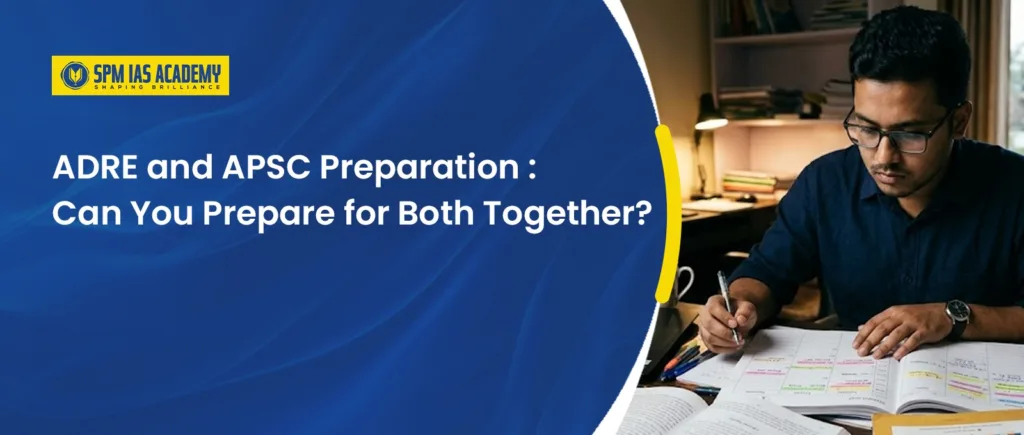
Many students in Assam apply for more than one government examination. ADRE offers opportunities for Grade III and Grade IV posts. Meanwhile, APSC recruits candidates for important administrative services. Since both are popular exams, students often wonder if they can study for them together.
The answer is yes. ADRE and APSC Preparation can be managed together with a clear strategy. Both exams include subjects such as General Knowledge, current affairs, reasoning, mathematics, and Assam-related topics. However, the question level and exam pattern are different. Therefore, students must understand where the two exams overlap and where they require separate attention.
Understanding ADRE and APSC Syllabus
The ADRE and APSC syllabus has several common subjects. Both exams test a candidate’s general awareness and basic knowledge of Assam. Subjects like history, geography, polity and current affairs appear in both examinations.
However, APSC demands a deeper level of preparation, with questions that assess conceptual understanding, analytical thinking, and decision-making ability. In contrast, ADRE primarily emphasizes factual knowledge, speed, and accuracy, while also placing significant weight on mathematics, reasoning, English, and computer knowledge. Aspirants enrolled in UPSC coaching in Assam can benefit from developing strong conceptual clarity and analytical skills, as these are essential not only for UPSC but also for excelling in APSC and other state-level competitive examinations.
| Common areas | Areas needing separate attention |
| Indian history and geography | Advanced reasoning and arithmetic for ADRE |
| Indian polity and economy | Analytical General Studies for APSC |
| Assam history and geography | APSC Mains answer writing |
| Current affairs | English and computer knowledge for ADRE |
| Environment and science | APSC essay and ethics preparation |
Students should first complete the common topics. After that, they can divide their time between the exam-specific sections.
ADRE vs APSC Exam: Major Differences
A well-planned ADRE and APSC preparation strategy should take into account the different difficulty levels and objectives of both examinations. ADRE is primarily a recruitment examination for various Grade III and Grade IV government posts, whereas the APSC Combined Competitive Examination (CCE) is conducted to recruit candidates for prestigious administrative and allied services in Assam. Regular mock test APSC practice helps aspirants strengthen conceptual understanding, improve answer accuracy, and develop effective time management skills, which are essential for success in the APSC examination.
The following ADRE vs APSC exam comparison explains the basic differences:
| Point | ADRE | APSC |
| Main focus | Speed, accuracy and factual knowledge | Conceptual and analytical knowledge |
| Question level | Basic to moderate | Moderate to advanced |
| Major skills | Mathematics, reasoning, English and GK | General Studies, analysis and answer writing |
| Preparation style | Practice-based | Concept and revision-based |
| Selection process | Depends on the post | Prelims, Mains and Interview |
Therefore, students should not follow the same preparation method for every subject. Common topics can be studied together. However, special skills must be developed separately.
Why Combined Preparation Is Possible
ADRE and APSC Preparation becomes easier because many General Studies topics overlap. For example, Indian polity is important for both exams. The Constitution, Fundamental Rights, Parliament and state government are useful areas for both.
Similarly, Assam’s history and geography play a crucial role in both examinations. Aspirants should focus on topics such as the Ahom dynasty, Assam’s freedom movement, major rivers, national parks, agriculture, and the state’s rich cultural traditions. A strong command of these subjects can significantly strengthen preparation for both ADRE and APSC. Students enrolled in APSC coaching Guwahati should give special attention to these state-specific topics, as they are frequently tested and can provide a valuable scoring advantage in competitive examinations.
Current affairs also create a strong connection. Students should follow important events related to Assam, India and the world. They should also study government schemes, awards, sports, science and the environment.
Thus, one strong foundation can reduce repeated study. It saves time and makes revision easier.
Build a Practical ADRE APSC Study Plan
A balanced ADRE APSC study plan should give enough time to common subjects and separate topics. Students can divide their daily routine into three parts.
First, study a common General Studies subject. It may include polity, history, geography, economy, or science. Second, practise ADRE-focused sections such as arithmetic, reasoning and English. Finally, spend time on APSC-focused learning, including conceptual current affairs or answer writing.
A simple daily routine may look like this:
- Study a General Studies subject for two hours.
- Practise mathematics or reasoning for one hour.
- Read current affairs for 45 minutes.
- Revise Assam-specific topics for one hour.
- Solve MCQs for 45 minutes.
- Practise APSC answer writing three or four times a week.
This schedule can be changed according to available time. Working candidates may study for fewer hours. However, they should remain regular.
Start with Common Subjects
The best way to begin ADRE and APSC Preparation is to identify the common subjects. Do not start with too many books. Select one reliable source for each subject.
Begin with Indian polity, history, geography, and the economy. Next, study Assam history, geography, culture and current affairs. Create short notes while studying. These notes will help during revision.
Once the basic topics are complete, solve previous-year questions from both exams. This will show how the same topic is asked at different levels. It will also help students understand which areas require deeper study.
Give Separate Time to Special Sections
Students who want to prepare for ADRE and APSC must not ignore their differences. ADRE needs regular practice in mathematics and reasoning. Reading theory alone will not improve speed. Candidates should solve questions daily and learn short methods where suitable.
For APSC, students need a broader understanding of General Studies. They should connect static subjects with current events. Those preparing for the Mains stage should also practise structured answers. An answer should have a clear introduction, main points, and a short conclusion.
Separate preparation prevents students from becoming strong in one exam but weak in the other.
Make Current Affairs a Daily Habit
Current affairs are an important part of ADRE and APSC Preparation . Students should read a reliable newspaper or daily current affairs source. However, they do not need to write down every news item.
Focus on government policies, Assam-related developments, national events, international relations, reports and environmental issues. Also, revise important appointments, awards and sports news for ADRE.
Prepare short monthly notes. Then revise them several times. Regular revision is more useful than collecting large amounts of material.
Use PYQs and Mock Tests
Previous-year questions, also known as PYQs, are essential. They reveal the question style, repeated topics and difficulty level. Solve the questions after completing each subject.
Mock tests are equally important. For ADRE, they improve speed and accuracy. For APSC, they help students manage time and apply concepts. After every test, check each wrong answer. Find out whether the mistake happened because of weak knowledge, confusion or carelessness.
Do not take mock tests only to check marks. Use them to improve future performance.
Follow a Strong Revision Method
Without revision, students may forget even well-studied topics. Therefore, revision should be part of ADRE and APSC Preparation from the beginning.
Revise short notes every week. Also, keep a separate notebook for facts, formulas and mistakes. Use it before mock tests. Students can also follow a three-step method:
- Read and understand the topic.
- Recall the main points without looking at the book.
- Solve related questions.
This active method strengthens memory. It is more effective than repeatedly reading the same chapter.
Common Mistakes to Avoid
Many students collect too many books and online materials. As a result, they complete none of them properly. Choose limited sources and revise them well.
Another mistake is studying only common subjects. Remember that both exams have unique requirements. Students should also avoid postponing mathematics, reasoning or answer writing.
Finally, do not change the timetable every few days. Give a plan enough time to work. Review your progress weekly and make only necessary changes.
Who Should Prepare for Both Exams?
Combined preparation is suitable for candidates who can follow a regular routine. It is also helpful for students who want more opportunities in Assam government services.
However, candidates should identify their main target. If APSC is the first goal, they should build strong concepts and keep ADRE practice alongside it. If ADRE is closer, they should temporarily give more time to speed-based questions and mock tests.
A clear priority prevents stress and confusion.
Conclusion
Yes, ADRE and APSC Preparation is possible when students use an organised approach. The common General Studies subjects can be studied together. At the same time, mathematics and reasoning need focused ADRE practice, while advanced General Studies and answer writing need separate APSC attention.
Success does not depend only on long study hours. It depends on regular learning, repeated revision, PYQs and honest test analysis. With a balanced timetable and limited resources, candidates can prepare confidently for both opportunities.
Frequently Asked Questions
Yes, beginners can prepare for both examinations together. They should begin with common General Studies subjects and Assam-related topics. Later, they can add mathematics, reasoning and English for ADRE. For APSC, they should gradually develop deeper conceptual knowledge, current affairs understanding and structured answer-writing skills through consistent practice.
A full-time candidate may study for five to seven productive hours daily. Working candidates can begin with three focused hours. Divide the available time among General Studies, current affairs, aptitude practice and revision. More than total hours, regular study, weekly targets and careful mock-test analysis decide the quality of preparation.
The same basic books can cover common subjects such as history, geography, polity and Assam General Knowledge. However, they may not cover every requirement. ADRE candidates need extra practice materials for arithmetic and reasoning. APSC candidates require detailed General Studies resources, current affairs analysis and Mains answer-writing practice.

Behind every article at SPM IAS Academy is a team of skilled content writers and subject experts committed to making preparation easier for aspirants. From answering common doubts to breaking down complex issues and current affairs, we create content that is accurate, easy to understand, and directly useful for UPSC, APSC, and other competitive exams.