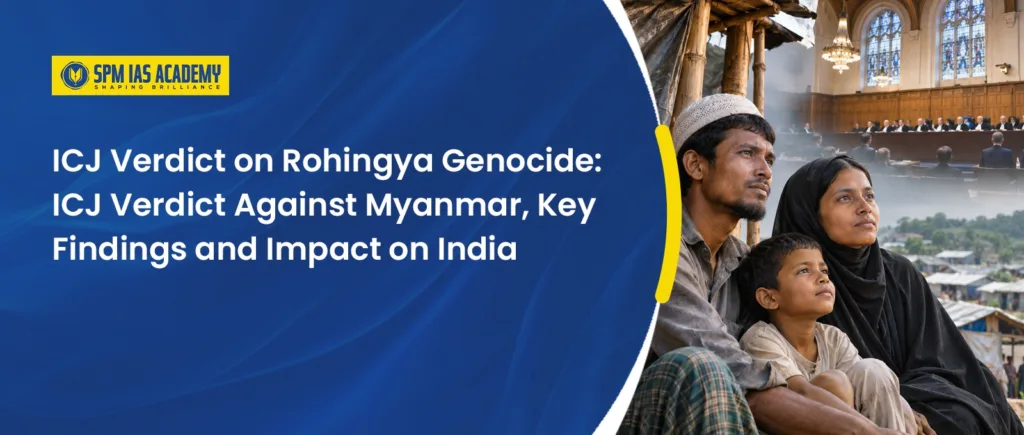
On 19 November 2026, the International Court of Justice (ICJ) delivered a landmark verdict on Rohingya Genocide. It held Myanmar responsible for genocide under the 1948 Genocide Convention. Understanding such important international developments is also useful for aspirants preparing for competitive examinations through APSC coaching in Assam. .
The judgment marked the first time the ICJ held a state responsible for committing genocide. It also strengthened international demands for justice, accountability and the safe return of Rohingya refugees.
This article explains the ICJ verdict, the meaning of genocide, the issue of Rohingya Genocide and its implications for India. This topic is important for UPSC, APSC. It comes under GS Paper II – International Organisation, Issues of Refugees, Human Rights etc.
Why Was the Rohingya Genocide in the News?
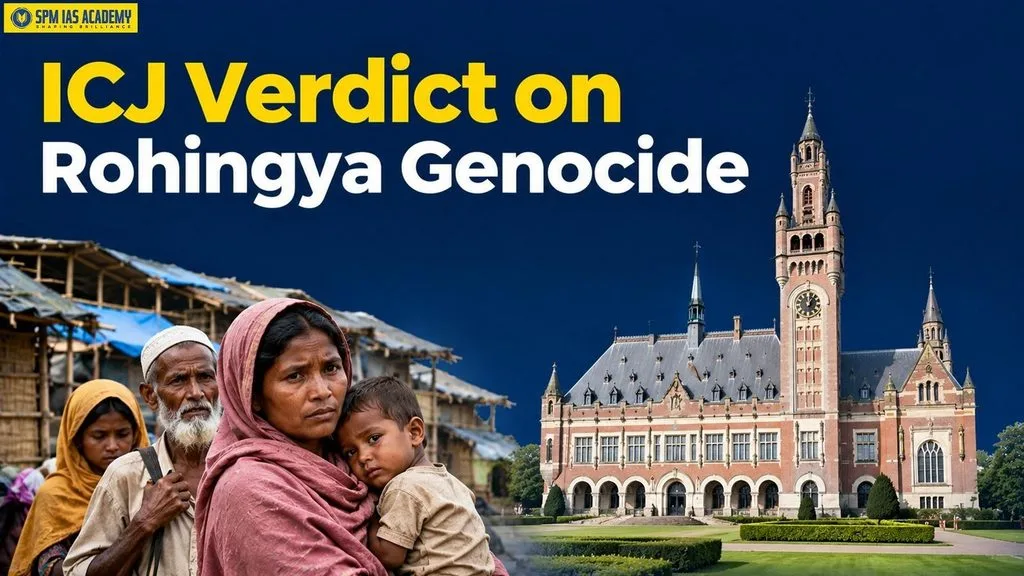
The International Court of Justice, located in The Hague, Netherlands, ruled that Myanmar committed genocide against the Rohingya minority during its 2017 military operations. The Court delivered its judgment in a case filed by The Gambia in 2019. Understanding such international developments is important for aspirants preparing for civil services examinations through UPSC coaching in the Northeast.
What are the Key findings on Rohingya Genocide?
- Myanmar’s security forces killed at least 10,000 Rohingya people.
- Moreover, the military committed widespread sexual violence and attacked civilians, including children.
- Consequently, more than 730,000 Rohingya fled to Bangladesh following the 2017 crackdown.
- Furthermore, the Court found that Myanmar violated its obligations under the Genocide Convention, 1948.
- The judges established genocidal intent behind the military’s actions in northern Rakhine State.
The judgment represents a major development in international human rights law.
What Is Genocide? Meaning and Genocide Convention, 1948
- Genocide means certain acts committed with the intention of destroying, wholly or partly, a national, ethnic, racial or religious group. The Convention on the Prevention and Punishment of the Crime of Genocide, 1948 defines genocide under Article II.
- Genocidal acts include killing members of a protected group, causing serious bodily or mental harm. It also includes deliberate creation of living conditions intended to destroy the group. Moreover, it also involves imposing measures to prevent births and forcibly transferring children to another group.
- Importantly, genocide requires proof of a specific intent to destroy a protected group, not merely evidence of mass killings.
- The UN General Assembly adopted the Convention on 9 December 1948. Subsequently, it entered into force on 12 January 1951. India is a party to the Convention.
UN Court Verdict on Myanmar’s Rohingya Genocide: Key Directions
The ICJ found Myanmar responsible for violating the Genocide Convention.
Moreover, the ICJ directed Myanmar to address the issues and concerns of the affected Rohingya population. This development is also an important topic for current affairs study and APSC exam preparation.
Major Directions of the ICJ
- Safe Repatriation: ICJ directed Myanmar to facilitate the safe, voluntary and dignified return of Rohingya refugees to their native places.
- Reparations: Moreover, it directed Myanmar to provide restitution and compensation for wrongful acts.
- Property Restoration: Furthermore, Myanmar should restore or replace destroyed community property.
- Rehabilitation: Similarly, it directed Myanmar to support victims of physical and psychological violence.
- Protection: In future, Myanmar should prevent further persecution and ensure non-repetition of genocidal acts.
The judgment is final and legally binding on Myanmar. However, implementation remains challenging because the ICJ lacks its own enforcement machinery.
What Is the International Court of Justice (ICJ)?
The International Court of Justice (ICJ) is the principal judicial organ of the United Nations.
Important facts for UPSC/APSC Prelims:
- Established: 1945; began functioning in 1946.
- Headquarters: Peace Palace, The Hague, Netherlands.
- Judges: 15 judges elected for nine-year terms.
- Functions: Settles legal disputes between states and provides advisory opinions.
- Jurisdiction: Depends on states’ consent or applicable treaty provisions.
- Enforcement: Under Article 94 of the UN Charter, states may approach the UN Security Council over non-compliance with judgments.
Unlike the International Criminal Court (ICC), which prosecutes individuals, the ICJ determines the legal responsibility of states.
Rohingya Refugee Crisis in Myanmar: Background
The Rohingya are a predominantly Muslim ethnic minority living mainly in Myanmar’s Rakhine State. Myanmar’s 1982 Citizenship Law excluded most Rohingya from recognised citizenship, leading to widespread statelessness among the community. Understanding such issues is valuable for current affairs and general studies topics covered in APSC coaching in Guwahati.
In August 2017, Myanmar’s military launched operations following attacks by Rohingya insurgents on security posts. Consequently, thousands of Rohingyas fled to Bangladesh, particularly Cox’s Bazar creating a refugee crisis in the neighbouring country. The refugee crisis continues because of insecurity, restrictions on citizenship, inadequate rehabilitation and ongoing conflict in Myanmar. Therefore, this scenario put India’s northeastern states at the risk of facing a refugee crisis.
Rohingya Genocide, Rohingya Refugee Crisis and Its Impact on India
The Rohingya Genocide has important humanitarian, diplomatic and security implications for India.
- Humanitarian Concerns: Rohingya refugees have entered India, raising questions about protection, shelter and basic rights.
- National Security: Moreover, India must manage border security, irregular migration and potential trafficking risks.
- India-Myanmar Relations: Myanmar remains important for India’s Act East Policy and connectivity with Southeast Asia. Moreover, Myanmar has a crucial role in the success of Kaladan Multi-modal Project. The Rohingya refugee crisis may disrupt India-Myanmar bilateral relations resulting in delaying the implementation of these projects.
- Regional Stability: Instability in Myanmar affects India’s northeastern states, particularly Manipur and Mizoram. Unrest in Myanmar may trigger safe haven for insurgent groups.
- Refugee Policy: India is not a signatory to the 1951 Refugee Convention or its 1967 Protocol. It manages refugees through domestic laws and administrative policies.
- Diplomatic Cooperation: India supports humanitarian assistance and conditions for the safe, voluntary and sustainable return of displaced Rohingya.
Therefore, India must balance national security, regional diplomacy and humanitarian responsibilities.
Convention on the Prevention and Punishment of the Crime of Genocide, 1948
The convention was in the news due to ICJ’s Verdict on Rohingya Genocide. The Genocide Convention, 1948, is an international treaty that requires countries to prevent and punish genocide. It provides a legal framework for protecting national, ethnic, racial and religious groups from deliberate destruction.
- Adoption: The United Nations General Assembly adopted the Genocide Convention on 9 December 1948 through Resolution 260 A (III). It entered into force on 12 January 1951.
- Definition of Genocide: Under Article II, genocide involves acts committed with the intent to destroy, wholly or partly, a national, ethnic, racial or religious group.
- Five Prohibited Acts: These include killing group members, causing serious physical or mental harm, imposing destructive living conditions, preventing births and forcibly transferring children to another group.
- Punishable Offences: Moreover, Article III criminalises genocide, conspiracy, direct and public incitement, attempts and complicity in genocide.
- State Obligations: Under Article I, countries must prevent and punish genocide, whether it occurs during peace or war.
- Individual Accountability: Furthermore, Article IV makes rulers, public officials and private individuals liable for genocide.
- Role of the ICJ: Under Article IX, the International Court of Justice (ICJ) can resolve disputes between states concerning the Convention’s interpretation, application and fulfilment.
- India’s Participation: India signed the Genocide Convention on 29 November 1949 and ratified it on 27 August 1959. Therefore, India has international obligations to prevent and punish genocide.
- International Significance: Finally, the Convention forms a key part of international human rights law and helps address mass atrocities, including allegations concerning the Rohingya community in Myanmar.
Conclusion
The Rohingya Genocide verdict of November 2026 marks a historic step towards international accountability. However, lasting justice requires effective implementation, rehabilitation and safe refugee repatriation.
For India, the crisis highlights the need to balance humanitarian values with national security and diplomatic interests while promoting peace and stability in the region.
UPSC/APSC Mains Practice Question
Q. Examine the role of the International Court of Justice (ICJ) in addressing the Rohingya genocide. Discuss the humanitarian, security and diplomatic implications of the Rohingya refugee crisis for India.
Read More:
Source:
Frequently asked question
1. What is the Rohingya Genocide, and why did Myanmar face an ICJ case?
The Rohingya Genocide refers to alleged genocidal acts against Myanmar’s Rohingya minority during the 2017 military crackdown in Rakhine State. Consequently, over 730,000 Rohingya fled to Bangladesh. In 2019, The Gambia filed a case against Myanmar before the International Court of Justice (ICJ) under the 1948 Genocide Convention.
2. What is the role of the ICJ in the Rohingya Genocide case?
The International Court of Justice (ICJ) examines Myanmar’s responsibility under the Genocide Convention, 1948. Moreover, it can issue binding judgments in disputes between states. Unlike the International Criminal Court (ICC), the ICJ determines state responsibility rather than prosecuting individuals.
3. How does the Rohingya refugee crisis impact India?
The Rohingya refugee crisis raises humanitarian, national security and diplomatic concerns for India. Moreover, instability in Myanmar affects India’s northeastern states and its Act East Policy. Therefore, India must balance border security, refugee protection and regional cooperation.

Behind every article at SPM IAS Academy is a team of skilled content writers and subject experts committed to making preparation easier for aspirants. From answering common doubts to breaking down complex issues and current affairs, we create content that is accurate, easy to understand, and directly useful for UPSC, APSC, and other competitive exams.