
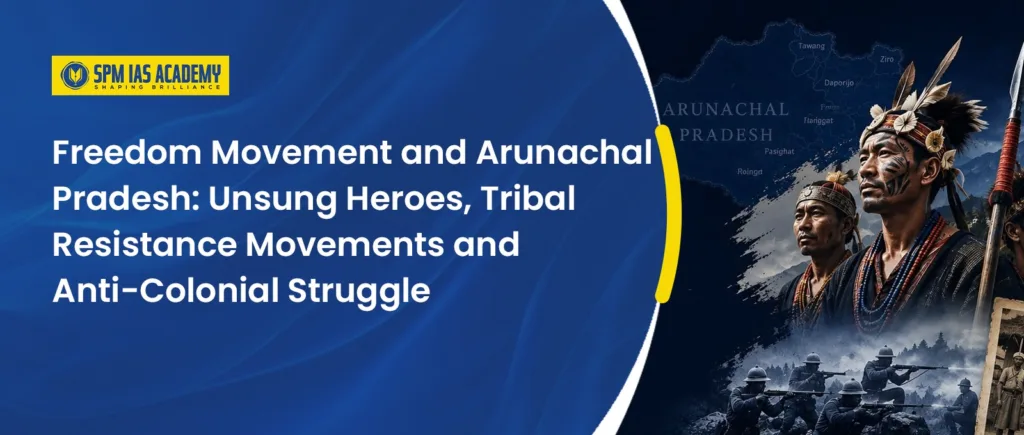
The contribution of Arunachal Pradesh in India’s Freedom Movement is one of the most significant yet less-discussed chapters of India’s anti-colonial history. The struggle in Arunachal Pradesh did not always follow the pattern of urban protests, Congress sessions, or newspaper-led nationalism. Instead, many tribal communities resisted British colonial expansion through armed resistance, defence of customary rights, protection of land, and refusal to accept outside political control. For aspirants preparing at an Assam Civil Service Academy, this topic is highly important as it frequently forms part of history, polity, and regional studies for APSC, UPSC, and other competitive examinations.
A report titled “Unsung Heroes of Arunachal Pradesh: Tribal Resistance Movements”, commissioned by the Government of Arunachal Pradesh and prepared by the Department of History, Rajiv Gandhi University, documents this forgotten history in detail. The report identifies 222 unsung heroes, including 18 Heroes, 76 Martyrs and 128 Freedom Fighters from different tribal resistance movements of Arunachal Pradesh.
For UPSC, APPSC and other State PCS aspirants, India’s Freedom movement and Arunachal Pradesh is important under Modern Indian History, Tribal Resistance, Northeast India, Colonial Expansion, Unsung Heroes and Regional Freedom Struggles.
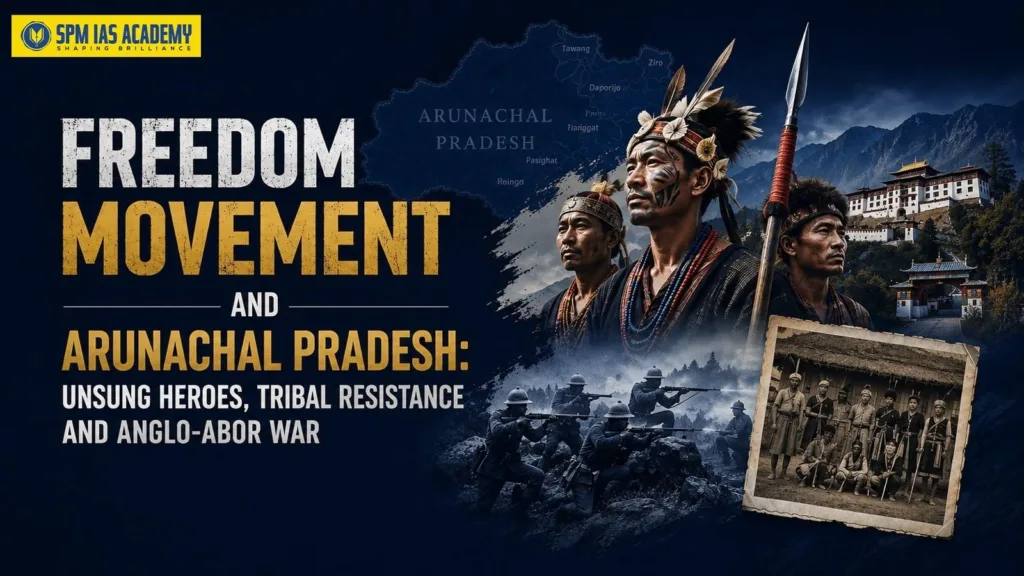
Freedom Movement and Arunachal Pradesh: Why is it Important?
India’s freedom struggle was not confined to major cities or the plains. Frontier communities also defended their territory, identity, and self-governing institutions against colonial power. Understanding these regional movements is equally important for APSC exam preparation, as questions on the contribution of Northeast India and tribal resistance frequently appear in history, polity, and current affairs sections of competitive examinations.
The people of Arunachal Pradesh actively took part in anti-colonial resistance movements despite living in one of the remotest parts of Northeast India. It also notes that their contributions and sacrifices did not receive proper recognition for a long time.
Therefore, this topic helps students understand the regional diversity of India’s freedom movement. It also shows how tribal communities linked freedom with land, autonomy, customary rights and dignity.
Historical Background of Freedom Movement and Arunachal Pradesh
Before the British entered Assam, the Ahoms sustained a flexible relationship with the hill tribes. The Ahom rulers could control the plains, but they could not fully penetrate the hills of present-day Arunachal Pradesh. Therefore, they used systems like posa and kotoki to maintain peace with the frontier tribes. This historical relationship is an important topic for aspirants preparing at an IAS coaching institute Assam, as it helps in understanding the administrative, political, and cultural history of Northeast India for UPSC, APSC, and other competitive examinations.
- Posa was a form of payment or allowance given to hill tribes.
- Kotoki acted as intermediaries for negotiation and diplomacy.
After the Treaty of Yandaboo in 1826, the British acquired Assam and inherited this complex hill-plain relationship. Initially, the British tried to maintain friendly relations with tribal communities. However, their interest in tea, timber, rubber, ivory, fishing, gold washing and frontier control created tension. Moreover, British police outposts, punitive expeditions, economic blockades and restrictions on movement disturbed the older balance.
Thus, Freedom movement and Arunachal Pradesh should be understood as a struggle against colonial intrusion into tribal land, resources and political autonomy.
Tribal Resistance Movements in Arunachal Pradesh
The major tribal resistance movements in Arunachal Pradesh during the British period include resistance by the Aka, Nyishi, Galo, Adi, Mishmi, Singpho, Wancho, and Tai Khamti communities. The table of contents itself reflects the wide geographical and ethnic spread of anti-colonial resistance across Arunachal Pradesh. This topic is highly relevant for aspirants studying at an APSC training centre, as it frequently supports history, culture, and Northeast India-related questions in APSC, UPSC, and other competitive examinations.
Aka Resistance and Anglo-Aka War
- The Aka or Hrusso resistance forms an important part of Freedom movement and Arunachal Pradesh. The important figures of this movement were Tagi Raja, Medhi Raja and Chandi or Sonji.
- Tagi Raja fought against British colonial authorities in the foothills of Balipara. He resisted the British because they restricted Aka rights over posa, taxation and access to the plains.
- Later, Medhi Raja played a major role in the Anglo-Aka War of 1883–84. The conflict reflected the Aka struggle to protect territory, dignity and traditional authority from British interference.
Nyishi Resistance: Amtolah Conflict and Miri Mission
- The Nyishi resistance was another major phase in the contribution of Arunachal Pradesh in India’s freedom movement. The report identifies Tana Nanna and Techi Gubin in connection with the Amtolah Conflict of 1873.
- The conflict emerged after disease and deaths in hill villages created tension between hill Nyishis, plain settlements and British subjects. When traditional negotiations failed, Tana Nanna and Techi Gubin led an attack. The British responded with negotiations, blockades and military pressure.
- Another major event was the Miri Mission of 1911–12. The British attempted to survey the feasibility of setting up an administrative outpost at Tali Lopo. Local Nyishi leaders saw this as a threat to their land. Langha Poja (Gungli) fought bravely and killed Captain A.M. Graham. The leaders who became martyred such as Rigio Saki, Yarda Dangpo, Yora Nakio, Rangpu Kiado and Tate Niangsa, and Sorang Dangpo played important role in mobilising people against the British.
Galo, Adi Resistance and the Anglo-Abor War
- The Galo and Adi resistance occupies a central place in Freedom movement and Arunachal Pradesh. The report discusses the Ambush on Captain Vetch’s Expedition, 1848, the Abor Expedition of 1911–12, and the Dipa Congress Movement of 1947-48.
- In 1848, Bachi Doye attacked Captain Vetch’s camp after tensions over traditional payments and British interference. The report remembers him as a fearless fighter.
- The Anglo-Abor War and related conflicts also saw strong resistance from Adi warriors. British forces faced opposition from villages such as Bomjir, Dambuk, Silluk, Mebo, Ayeng, Bodak, Sili and Padu. The Adis used forts, bamboo stockades, stones, arrows, swords and spears against better-armed colonial troops.
- In the Anglo-Abor war, leaders such as Sipang Pada, Ketong Saring and Kotrin Saring played crucial role. Ketong Saring, for example, died on the battlefield after attacking British personnel at Delang Yapgo, Silluk.
Dipa Congress Movement and Political Nationalism
- The Dipa Congress Movement of 1947-48 shows another dimension of Freedom movement and Arunachal Pradesh. Here, tribal participation took a more political and nationalist form.
- Important leaders included Moji Riba, Moje Riba, Ligin Bomjen, Rimo Riba, Kore Bagra, Dagi Angu, Kargo Basar and Gotu Bagra.
- Moji Riba, Moje Riba and others formed the Dipa Congress Committee and connected the frontier region with the wider Indian National Congress movement. They demanded education, development and political awakening. Moreover, they opposed the colonial administrative attitude that kept tribal areas backward and isolated.
- This movement proves that Arunachal’s freedom struggle included both armed tribal resistance and political participation in India’s national movement.
Mishmi, Singpho, Wancho and Tai Khamti Resistance
- The report also documents strong resistance by the Mishmi, Singpho, Wancho and Tai Khamti communities.
- Prominent leaders of this resistance were Taji Dele, Ponge Dele, Khunjing Wangham, Wangchin Wangsapa, Ningru Thumung, Bom Singpho, Beesa Gaum, Chowpha Planglu alias Ronua Gohain and Towa Gohain.
- In the Mishmi resistance, Ponge Dele emerges as a major figure who resisted colonial authority for nearly two decades. He organised raids and later died on the battlefield. Taji Dele was arrested and executed in Tezpur jail in January 1918.
The other important resistance in Arunachal Pradesh during India’s freedom movement are the Wancho Resistance of 1875, the Anglo-Singpho wars, and the Tai Khamti-Anglo War of 1839-43. These movements show that anti-colonial resistance spread across different frontier regions of Arunachal Pradesh.
Attempted Revolution of 1934 and Arunachal Frontier
The report also includes the Attempted Revolution of 1934, which aimed to capture the British military outpost at Sadiya. Revolutionaries linked with the wider anti-British movement planned to make Tinsukia a revolutionary centre. Moreover, they wanted to smuggle arms from Tibet, China and Siam, and gain support from tribal groups such as the Abor, Mishmi, Tibetan and Khamti communities.
This event connects Arunachal’s frontier history with the broader revolutionary freedom struggle in eastern India.
Challenges in Documenting Freedom Movement and Arunachal Pradesh
Several challenges make the contribution of Arunachal Pradesh in India’s freedom movement less visible.
- First, many events survived mainly through oral traditions, not written colonial records.
- Secondly, colonial accounts often described tribal resistance as “raids” or “law-and-order problems” rather than anti-colonial struggles.
- Thirdly, geographical remoteness and limited archival access affected documentation.
- However, recent efforts by Arunachal Pradesh, Rajiv Gandhi University researchers and cultural institutions have helped recover these histories. The state government’s documentation of 157 unsung heroes marks an important step towards giving Arunachal’s freedom fighters their rightful place in India’s national memory.
Conclusion
India’s Freedom movement and Arunachal Pradesh represents a powerful story of courage, autonomy and sacrifice. The Aka, Nyishi, Galo, Adi, Mishmi, Singpho, Wancho and Tai Khamti communities resisted British expansion in different ways. Their struggles defended land, customary rights, community dignity and political freedom.
Read More:
Source:
Frequently asked questions
The Ahoms influenced the Medieval History of Arunachal Pradesh through wars, trade, diplomacy and frontier administration. They interacted with Wanchos, Tangsas, Nishis, Mishings, Khamtis, Shyams and other tribes through both conflict and negotiation.
The Posa system was a conciliatory arrangement introduced by the Ahoms to reduce tribal raids. Under this system, selected foothill villages supplied goods like rice, salt, cotton, cloth and cattle to certain hill tribes.
Malinithan and Ita Fort are important because they provide archaeological evidence for the Medieval History of Arunachal Pradesh. Malinithan shows Hindu sculptural remains, while Ita Fort reflects brick architecture and Assam-Arunachal historical links.

Behind every article at SPM IAS Academy is a team of skilled content writers and subject experts committed to making preparation easier for aspirants. From answering common doubts to breaking down complex issues and current affairs, we create content that is accurate, easy to understand, and directly useful for UPSC, APSC, and other competitive exams.