
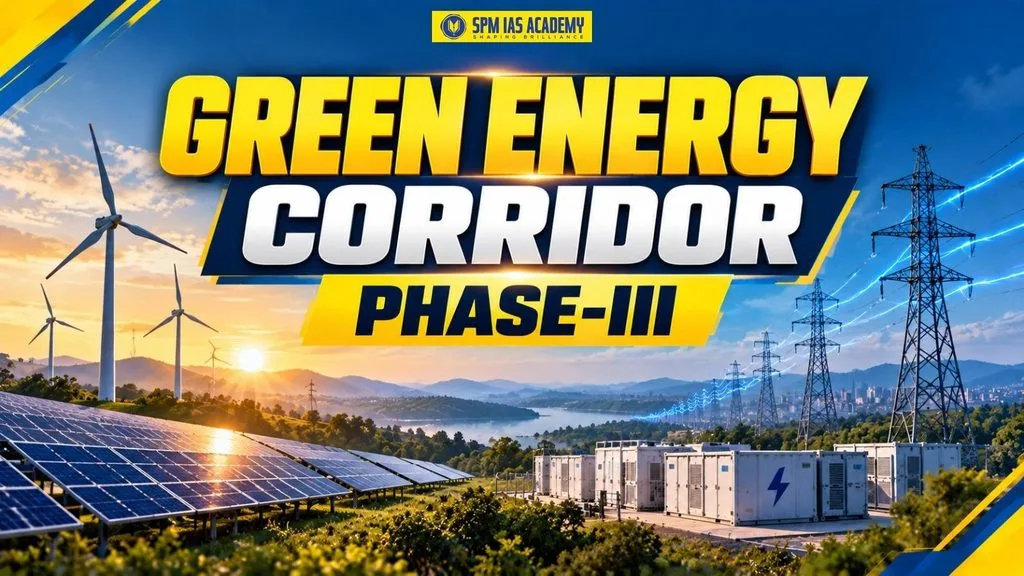
The Green Energy Corridor Phase-III is a major government scheme to strengthen India’s Intra-State Transmission System (InSTS) and integrate more renewable energy into the national grid. The Union Cabinet approved the scheme on 30 September 2026 with a total outlay of ₹1,86,405 crore. It aims to enable the evacuation of up to 135 GW of renewable energy across States and Union Territories by FY 2032-33.
For UPSC, APSC, and other State PCS examinations, the GEC is important under Environment. It also connects with topics such as Energy, Infrastructure, Sustainable Development, and the Indian Economy. Students preparing these interconnected subjects can benefit from structured study plans, current-affairs coverage, and revision support offered through the best online coaching for APSC.
In this article, you will learn about the GEC scheme, its objectives, BESS component and significance.
What Is the Green Energy Corridor Scheme?
- The GEC scheme is a transmission infrastructure programme. It supports the integration and evacuation of renewable energy into the power grid.
- The scheme strengthens transmission networks in renewable-energy-rich regions. Therefore, it helps to transfer solar and wind power to demand centres.
- The GEC-III focuses on strengthening the Intra-State Transmission System (InSTS).
- Moreover, GEC-III includes Battery Energy Storage Systems (BESS) to improve grid flexibility and manage variable renewable power.
- The scheme aims to support the evacuation of up to 135 GW of renewable energy across States and Union Territories.
- Furthermore, GEC-III plans to add 50 GWh of Battery Energy Storage Systems, helping balance electricity supply during periods of low renewable generation.
- The Union Cabinet approved GEC-III with a total outlay of ₹1.86 lakh crore and a completion target of FY 2032-33.
Therefore, the GEC can play an important role in India’s clean-energy transition, grid stability, and renewable-energy expansion. Understanding such developments is useful for aspirants covering Environment, Energy, Infrastructure, and Sustainable Development topics as they prepare to crack APSC exam online.
Why Is Green Energy Corridor Scheme in News?
This energy corridor scheme is in the news because the Union Cabinet approved GEC-III with a total outlay of ₹1,86,405 crore. The scheme will support up to 135 GW of renewable-energy evacuation capacity. Moreover, it will include 50 GWh of Battery Energy Storage Systems (BESS). Of the total outlay, ₹1,36,378 crore will support Intra-State Transmission Systems, while ₹50,000 crore will support BESS. Furthermore, the government will provide ₹54,082 crore as Central Financial Support. The scheme targets completion by FY 2032-33.
What Are the Objectives of Green Energy Corridor Phase-III?
The GEC-III scheme aims to address the infrastructure challenges that can limit renewable-energy expansion.
- Strengthen intra-state transmission: Firstly, it will expand and upgrade transmission networks within States and UTs.
- Improve renewable-energy evacuation: Secondly, it will enable the transfer of up to 135 GW of renewable power.
- Reduce grid congestion: Moreover, the scheme will help manage transmission bottlenecks and improve grid flexibility.
- Support energy storage: Furthermore, BESS will store electricity and support supply during non-solar hours.
- Reduce renewable-energy curtailment: In addition, better transmission and storage can reduce situations where renewable electricity cannot be fully evacuated.
- Support clean-energy targets: at the same time, the scheme will contribute to India’s target of 900 GW installed non-fossil capacity by 2035.
What Is the Role of Battery Energy Storage Systems (BESS) in GEC-III?
A major feature of GEC-III is the deployment of 50 GWh of Battery Energy Storage Systems (BESS).
Renewable sources such as solar and wind are variable. Solar generation, for example, falls after sunset. Therefore, energy storage can help balance electricity supply and demand. This makes renewable-energy integration, grid stability, and energy storage important areas for aspirants studying Environment and Energy for civil services examinations, including those pursuing UPSC coaching in North East India.
Under GEC-III, BESS will be deployed at renewable-energy developer or generator sites or at other locations important for grid flexibility. The systems will help address intermittency, transmission congestion and peak-hour curtailment. They can also supply electricity during non-solar hours.
How Will GEC Phase-III Be Implemented?
The government has provided different mechanisms for new and existing transmission infrastructure.
- For Greenfield projects: Firstly, the government will use Tariff-Based Competitive Bidding (TBCB) for new transmission projects.
- For Brownfield upgrades: Moreover, existing transmission infrastructure will follow the Cost-Plus-Basis (CPB) model.
- Role of State Transmission Utilities: Furthermore, State Transmission Utilities (STUs) will oversee the implementation of the projects.
- Role of Transmission Service Providers: Finally, Transmission Service Providers will implement TBCB projects through the Build-Own-Operate-Maintain (BOOM) model.
What Is the Significance of the Green Energy Corridor Scheme?
This energy corridor has significance beyond transmission infrastructure.
- First, it supports India’s clean-energy transition. Better transmission can help integrate growing renewable-energy capacity into the electricity grid.
- Second, it strengthens energy security. A stronger grid can improve the ability to move electricity across regions and manage changing supply patterns.
- Third, BESS strengthens grid flexibility. Storage can help balance intermittent renewable generation and electricity demand.
- Moreover, the scheme can support employment in power, manufacturing, construction and the domestic energy-storage sector. The government also expects long-term skilled employment in operations, maintenance and grid management.
Green Energy Corridor Phase-III: Key Facts
| Particular | Details |
| Scheme | GEC Phase-III |
| Focus | Intra-State Transmission System |
| Renewable-energy evacuation | Up to 135 GW |
| Total outlay | ₹1,86,405 crore |
| InSTS allocation | ₹1,36,378 crore |
| BESS allocation | ₹50,000 crore |
| Battery storage | 50 GWh |
| Central Financial Support | ₹54,082 crore |
| Completion target | FY 2032-33 |
| Implementing agencies | State Transmission Utilities |
| Key technology | Battery Energy Storage Systems |
| Linked target | 900 GW installed non-fossil capacity by 2035 |
Conclusion
The third phase of the Green Energy Corridor will strengthen India’s renewable-energy infrastructure and grid stability. Moreover, its 135 GW renewable-energy evacuation capacity and associated transmission infrastructure can support the integration of renewable power into the national grid. These developments are important for aspirants studying energy, infrastructure, and sustainable development, particularly those preparing through IAS coaching in Guwahati.
50 GWh BESS will support clean-energy integration. Therefore, the Green Energy Corridor can play an important role in India’s energy transition, energy security and sustainable development.
Read More:
Source:
Frequently asked questions
1. What is the Green Energy Corridor scheme?
The GEC scheme aims to strengthen transmission networks for renewable power. Moreover, it will help to move solar and wind energy to demand centres.
2. What is Green Energy Corridor Phase-III?
GEC-III aims to strengthen Intra-State Transmission Systems. It will support up to 135 GW of renewable-energy evacuation. Moreover, it also includes 50 GWh of BESS.
3. What is the significance of Green Energy Corridor Phase-III?
The scheme improves grid stability, energy security and renewable-energy integration. Furthermore, Battery Energy Storage Systems help manage variable solar and wind power.

Behind every article at SPM IAS Academy is a team of skilled content writers and subject experts committed to making preparation easier for aspirants. From answering common doubts to breaking down complex issues and current affairs, we create content that is accurate, easy to understand, and directly useful for UPSC, APSC, and other competitive exams.