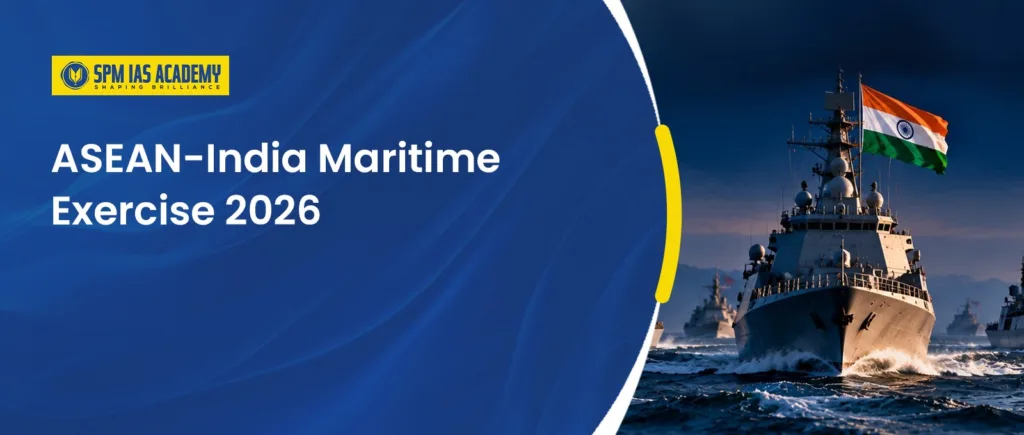
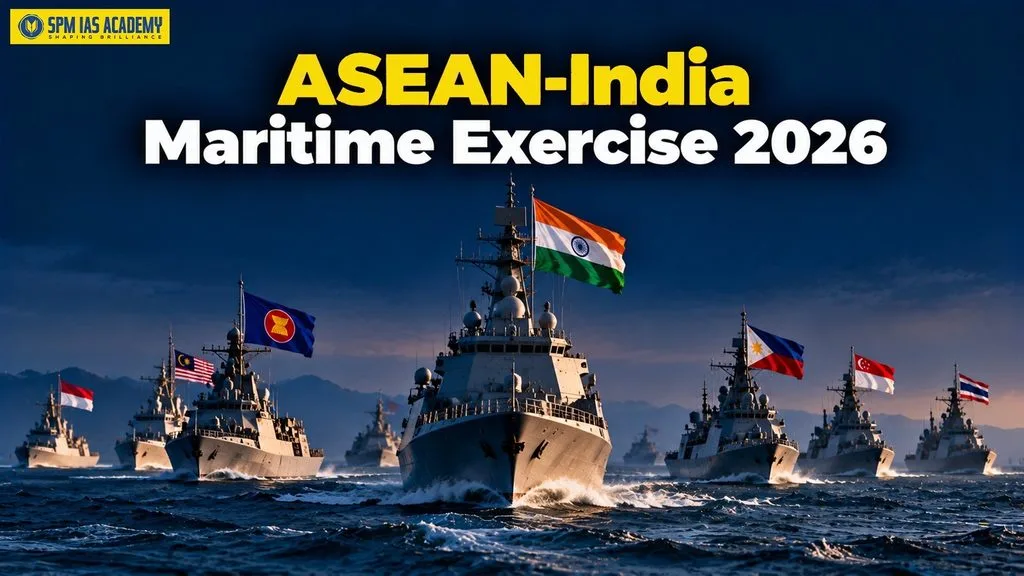
The ASEAN-India Maritime Exercise (AIME) 2026 is the second edition of the joint maritime exercise between India and ASEAN member states. It commenced on 28 September 2026 at Subic Bay, Philippines, with INS Sahyadri and INS Kulish representing the Indian Navy. The exercise aims to strengthen maritime cooperation, naval interoperability, operational coordination and mutual understanding between India and ASEAN maritime forces.
The exercise carries the theme “Anchored in Trust, United at Sea”. It also supports India’s Act East Policy and the MAHASAGAR vision.
In this article, you will learn about AIME 2026, its key facts, phases, objectives, and significance for India’s Indo-Pacific strategy. It is important from the perspective of Prelims and Mains GS 2, especially for understanding India’s maritime cooperation, regional security, and strategic engagement in the Indo-Pacific. Aspirants can also strengthen their preparation for such topics through an online UPSC institute in Assam.
What Is ASEAN-India Maritime Exercise 2026?
The AIME 2026 is a multilateral maritime exercise. It brings together the Indian Navy and maritime forces from ASEAN member states. Moreover, it focuses on practical cooperation and improving the ability of participating forces to work together at sea. The exercise is relevant to India’s Indo-Pacific strategy, maritime security, and regional cooperation, making it a useful topic for current-affairs study through the best APSC coaching in Assam.
The second edition is being conducted at Subic Bay, Philippines. Indian Naval Ships Sahyadri and Kulish are participating in the exercise.
Who are the participants of ASEAN-India Maritime Exercise 2026?
The AIME 2026 brings together the Indian Navy and maritime forces of ASEAN member states. India is represented by INS Sahyadri and INS Kulish. Together, the participating forces conduct maritime drills to improve interoperability, coordination and maritime security.
What Are the Objectives of ASEAN-India Maritime Exercise?
The AIME 2026 focuses on strengthening practical cooperation among participating maritime forces.
- Improve naval interoperability: The exercise helps forces coordinate their operations more effectively.
- Strengthen maritime security: Moreover, it supports cooperation on shared maritime challenges.
- Enhance operational coordination: Furthermore, practical drills improve coordination between participating navies.
- Build mutual understanding: At the same time, joint activities encourage professional interaction and trust.
- Support regional cooperation: The exercise strengthens India’s maritime engagement with ASEAN.
What Are the Phases of AIME 2026?
The AIME 2026 has Harbour and Sea Phases.
Harbour Phase:
The Harbour Phase includes professional and social engagements. These include Subject Matter Expert Exchanges, cultural and sporting activities, community interaction, and operational synchronisation. Moreover, a Pre-Sail Brief prepares the participating forces for the Sea Phase. These activities are relevant to understanding maritime cooperation and regional security, and students can revise such current-affairs topics through UPSC online coaching with test series.
Sea Phase:
The Sea Phase involves coordinated maritime exercises and operational activities at sea. In 2026, participating forces conducted activities such as Humanitarian Assistance and Disaster Relief (HADR), Visit-Board-Search-Seizure (VBSS) and Underway Replenishment. Helicopter activities included cross-deck landings, vertical replenishment and CASEVAC drills.
Why Is ASEAN-India Maritime Exercise 2026 Important for India?
The AIME 2026 strengthens India’s wider engagement with Southeast Asia and the Indo-Pacific.
- Strengthens Maritime Security: India and ASEAN share important maritime interests. Therefore, regular naval exercises can improve coordination and preparedness.
- Supports Act East Policy: The exercise directly supports India’s Act East Policy. It seeks deeper economic, strategic and security engagement with Southeast Asia and the wider Indo-Pacific.
- Advances MAHASAGAR: The exercise also reflects India’s MAHASAGAR vision. Therefore, it highlights India’s approach towards stronger maritime partnerships.
- Builds Maritime Interoperability: Furthermore, practical drills allow participating forces to understand each other’s procedures. Additionally, it will improve coordinated responses during maritime operations.
ASEAN-India Maritime Exercise and India’s Indo-Pacific Strategy
The Maritime Exercise between ASEAN and India forms part of India’s growing maritime engagement with ASEAN. India views ASEAN as an important partner in building a free, open, inclusive, and rules-based Indo-Pacific. This cooperation is important for understanding India’s Act East Policy, maritime security, and regional diplomacy, making it a relevant topic for aspirants pursuing UPSC coaching in North East India.
The exercise also complements other regional mechanisms and activities involving ASEAN maritime forces. Thus, AIME contributes to stronger defence cooperation and practical maritime partnerships.
Conclusion
Therefore, the AIME 2026 strengthens India’s maritime partnership with ASEAN. Its focus on interoperability, HADR, maritime training and operational coordination adds practical value. Moreover, AIME 2026 reinforces India’s Act East Policy and MAHASAGAR vision and supports deeper engagement with the Indo-Pacific.
Read More:
Source:
Frequently Asked Questions
1. What is ASEAN-India Maritime Exercise 2026?
The AIME 2026 is a multilateral naval exercise. It strengthens maritime cooperation, interoperability and operational coordination between India and ASEAN.
2. Where is AIME 2026 being conducted?
The AIME 2026 is being conducted at Subic Bay, Philippines. The Indian Navy is represented by INS Sahyadri and INS Kulish.
3. Why is AIME 2026 important for India?
The exercise strengthens India’s Act East Policy and MAHASAGAR vision. Moreover, it improves maritime security, HADR cooperation and India’s engagement in the Indo-Pacific.

Behind every article at SPM IAS Academy is a team of skilled content writers and subject experts committed to making preparation easier for aspirants. From answering common doubts to breaking down complex issues and current affairs, we create content that is accurate, easy to understand, and directly useful for UPSC, APSC, and other competitive exams.