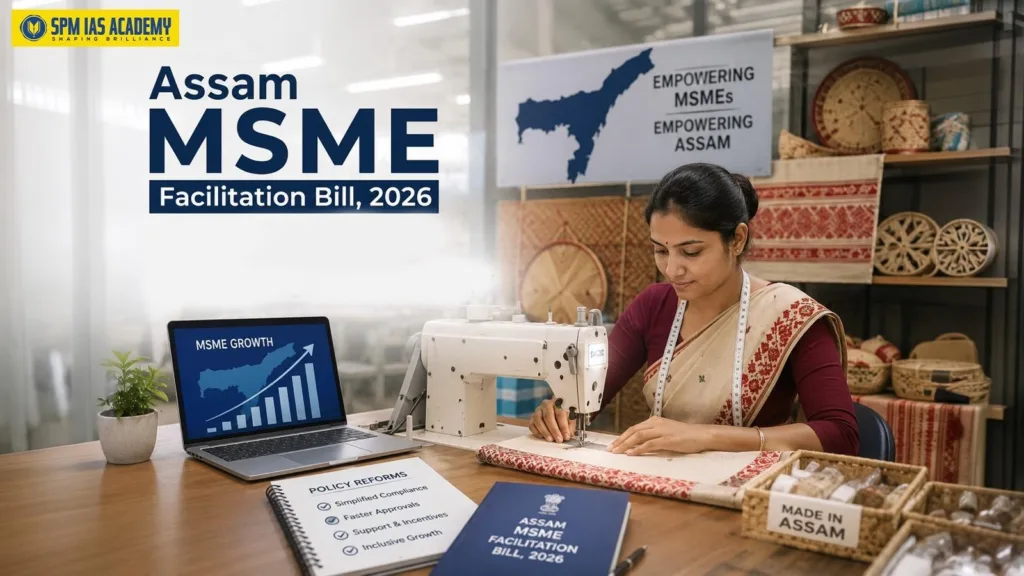
The Assam MSME Facilitation Bill, 2026 aims to strengthen Assam’s industrial and entrepreneurial ecosystem by simplifying the process of establishing and operating Micro, Small, and Medium Enterprises (MSMEs). The Assam Cabinet approved the Assam Micro, Small and Medium Enterprises (Facilitation of Establishment and Operation) Bill, 2026 as part of broader reforms under the state’s Ease of Doing Business framework. The Bill seeks to reduce regulatory barriers, streamline approvals, and encourage investment, making it easier for eligible MSMEs to start and expand their businesses in Assam. This is an important current affairs topic for aspirants studying at an IAS Academy Guwahati, as it is highly relevant for UPSC and APSC examinations, particularly in governance, economy, and state policy.
For APSC and other government competitive exams, this topic is highly important as it connects various topics like MSME sector, local economy, ease of doing business, rural entrepreneurship, employment generation etc.
Why was the Assam MSME Facilitation Bill in the news?
- The Assam MSME Facilitation Bill, 2026 came into focus after the Assam Cabinet cleared a set of business and governance reform Bills. These included the Assam Micro, Small and Medium Enterprises (Facilitation of Establishment and Operation) Bill, 2026 and the Assam Ease of Doing Business (Amendment) Bill, 2026.
- The bill seeks to reduce delays, paperwork and procedural hurdles for small businesses. In simple terms, Assam wants to shift from a permission-heavy system to a trust-based business environment.
What are the Objectives of Assam MSME Facilitation Bill, 2026?
The Assam MSME Facilitation Bill, 2026 has four broad objectives aimed at creating a more business-friendly environment in the state. These include simplifying regulatory procedures, reducing compliance burdens, promoting faster establishment and operation of MSMEs, and encouraging investment and employment generation through an improved Ease of Doing Business framework. Aspirants attending APSC online classes should study these objectives carefully, as they are highly relevant for current affairs, governance, economic development, and state policy questions in both APSC and UPSC examinations.
- Ease of Doing Business: It aims to improve the business environment in Assam by reducing unnecessary approvals and delays.
- Regulatory Simplification: It seeks to reduce the compliance burden on micro, small and medium enterprises.
- Entrepreneurship Promotion: It encourages first-generation entrepreneurs, rural enterprises, SHGs, FPOs and small investors.
- Employment Generation: It supports industrial growth that can create local employment, especially in rural and semi-urban areas.
Therefore, the Bill is not only an industrial reform. It is also a governance reform and employment-generation measure.
Key Features of Assam MSME Facilitation Bill, 2026
- Three-Year Approval Exemption for Eligible MSMEs
- One of the most important provisions of the Assam MSME Facilitation Bill, 2026 is the proposed approval exemption for eligible non-polluting MSMEs.
- Under this approach, eligible enterprises can establish and operate without taking prior government approvals for the first three years. This helps small entrepreneurs avoid long procedural delays during the early stage of business.
- However, this exemption does not mean absence of regulation. The government can still monitor compliance after establishment.
- Trust-Based Regulation
- The Bill promotes the idea of “Trust First, Regulate Later.”
- Earlier, many entrepreneurs had to obtain multiple permissions before starting production. This often delayed business plans and increased costs.
- The new model allows eligible MSMEs to begin operations first, while departments conduct inspections and monitoring later.
- This shift can reduce the fear of “Inspector Raj” and promote a more business-friendly environment.
- Strengthened Single Window Clearance in Assam
- The Assam MSME Facilitation Bill, 2026 also complements single-window reforms. The government wants to integrate multiple departmental approvals into a single digital platform.
- This can reduce delays in approvals, paperwork, compliance costs, administrative hurdles and multiple office visits.
- The single-window system can especially help small entrepreneurs who lack legal, technical or financial support to navigate complex government procedures.
- Focus on Non-Polluting Industries
- The Bill appears to focus mainly on eligible non-polluting MSMEs. This is important because Assam must balance industrial growth with environmental protection.
- Likely beneficiary sectors include:
| Sector | Why It Matters for Assam |
| Food Processing | Adds value to agriculture and horticulture products |
| Bamboo Products | Uses Assam and North-East India’s bamboo potential |
| Handloom and Handicrafts | Supports traditional skills and women entrepreneurs |
| Dairy | Promotes rural income and local supply chains |
| Beekeeping | Supports farmers and biodiversity-based livelihood |
| Agro-processing | Reduces post-harvest losses |
| Rural Enterprises | Creates local jobs and prevents migration |
This focus can help Assam promote green, sustainable, small-scale, and locally rooted industrialisation, encouraging balanced economic growth while supporting local entrepreneurs and employment generation. By reducing regulatory hurdles and creating a business-friendly environment, the initiative also strengthens the state’s long-term industrial development strategy. This is an important topic for aspirants preparing at an Assam Civil Service Academy, as issues related to MSME development, sustainable growth, and state economic policies are frequently covered in APSC and UPSC examinations.
Assam MSME Facilitation Bill, 2026 and Ease of Doing Business
- The Assam MSME Facilitation Bill, 2026 directly supports Assam’s Ease of Doing Business agenda. It can attract more small investors by reducing uncertainty and official delays.
- Entrepreneurs often face issues related to licences, clearances, inspections and departmental procedures. By simplifying these processes, Assam can encourage more people to start businesses.
- The Cabinet’s decision to bring the MSME Bill along with the Assam Ease of Doing Business reform package shows that the state is treating MSME growth as part of a wider governance reform agenda.
What are the Economic Significance of Assam MSME Facilitation Bill, 2026
The Bill can create several economic benefits for Assam.
- MSME Growth: It can increase the number of formal MSMEs in the state.
- Private Investment: It can encourage local investors and first-generation entrepreneurs to start small units.
- Industrial Competitiveness: Faster approvals can help Assam compete with other states for investment.
- Local Value Addition: Assam can process more of its own agricultural, forest and handloom products within the state.
- Rural Industrialisation: The Bill can promote small units outside major cities like Guwahati, Dibrugarh and Silchar.
This is especially important because Assam has strong potential in tea, bamboo, food processing, silk, handloom, horticulture, dairy and agro-based industries.
Employment and Rural Development Impact
- Employment Generation: The Assam MSME Facilitation Bill, 2026 can create more employment opportunities because MSMEs require more labour compared to large industries.
- Low-Capital Job Creation: Moreover, small enterprises can generate jobs with relatively lower capital investment, making them suitable for rural and semi-urban Assam.
- Rural Youth: The Bill can help rural youth start small businesses instead of depending only on government jobs or migration to cities.
- Women Entrepreneurs: In addition, it can support women-led enterprises in sectors like weaving, food processing, tailoring, dairy and handicrafts.
- Self Help Groups: The Bill can strengthen SHGs by helping them convert small livelihood activities into formal business units.
- Farmer Producer Organisations: Similarly, FPOs can benefit by setting up processing, packaging and marketing units for local agricultural products.
- Artisans and Handloom Workers: The reform can help artisans and handloom workers expand production, improve income and access wider markets.
- Small Traders: It can also reduce entry barriers for small traders and village-level entrepreneurs who want to establish local enterprises.
- Non-Farm Income: Further, MSME-led value addition can create non-farm income opportunities in rural Assam, where many households still depend mainly on agriculture.
Women Entrepreneurship and Assam MSME Facilitation Bill, 2026
- Women’s Economic Empowerment: The Assam MSME Facilitation Bill, 2026 can promote women’s economic empowerment by supporting women engaged in weaving, food processing, poultry, dairy, handicrafts, tailoring and SHG-based activities.
- Lower Entry Barriers: Moreover, the Bill can help women-led enterprises register, operate and expand faster by reducing procedural delays and regulatory hurdles.
- Income and Decision-Making: In addition, better access to credit, training and market linkages can improve women’s income, financial inclusion and decision-making power.
Governance Significance: From Inspector Raj to Facilitator Raj
- Governance Shift: The Assam MSME Facilitation Bill, 2026 shifts governance from control-based regulation to facilitation-based regulation, moving Assam from Inspector Raj towards Facilitator Raj.
- Transparency and Accountability: Moreover, digital platforms can improve transparency, reduce rent-seeking opportunities and make business approvals more accountable and entrepreneur-friendly.
- Balanced Regulation: However, the government must ensure clear rules, proper monitoring and accountable officials so that trust-based regulation does not become a loophole-based system.
Challenges in Implementation of Assam MSME Facilitation Bill, 2026
The Bill has strong potential, but implementation will decide its real impact.
- Identification of Non-Polluting Industries: The government must clearly define eligible non-polluting sectors.
- Risk of Misuse: Some enterprises may try to misuse the approval exemption.
- Post-Establishment Monitoring: Departments must inspect and monitor units without harassing entrepreneurs.
- Capacity of District Officials: Officials need training in digital approval systems, MSME rules and environmental safeguards.
- Entrepreneur Awareness: Many small entrepreneurs may not know how to use the new system.
- Finance Gap: MSMEs also need easy loans, working capital and credit guarantee support.
- Market Linkage: Without markets, even easy establishment will not ensure business success.
- Infrastructure Gaps: Power, roads, internet, storage and logistics remain crucial for MSME growth.
Conclusion
The Assam MSME Facilitation Bill, 2026 can become a crucial step towards transforming Assam into a more business-friendly and employment-oriented state. With its objectives to reduce regulatory burden, it aims at promoting trust-based governance. Moreover, its support for non-polluting MSMEs will promote environmental sustainability. However, Assam must ensure strong monitoring, easy finance, skilled manpower and market linkage. With the proper implementation of this bill, Assam can transform from a raw-material based economy to a value-added, entrepreneurial and job-creating economy.
Also Read:
| Articles |
| Assam Becomes India’s Fastest Growing State Economy: RBI Report |
| Advantage Assam 2.0 |
| MISSION SENEHJORI |
| ARUNACHAL MSME ORDINANCE |
| ASSAM LAND POLICY |
Source:
Frequently Asked Questions
The Assam MSME Facilitation Bill, 2026 is a MSME reform-oriented Bill. The Bill aims to reduce regulatory barriers for MSME and help eligible MSMEs begin and operate businesses in Assam smoothly.
One of the key features of Assam MSME Facilitation Bill 2026 is the three-year approval exemption for eligible non-polluting MSMEs. Non-polluting enterprises can establish and operate without taking prior government approvals during the initial three years. The government will complete the approval process in post establishment monitoring.
The Assam MSME Facilitation Bill 2026 can promote MSME growth, private investment, rural industrialisation and local value addition. Therefore, it will boost Assam’s economy. Moreover, it will create self-employment opportunities for the unemployed youth, women, SHG members etc.

Behind every article at SPM IAS Academy is a team of skilled content writers and subject experts committed to making preparation easier for aspirants. From answering common doubts to breaking down complex issues and current affairs, we create content that is accurate, easy to understand, and directly useful for UPSC, APSC, and other competitive exams.