
The ISRO NVS-03 Mission is India’s latest navigation satellite mission, scheduled for launch on 30 October 2026. The Indian Space Research Organisation (ISRO) will launch the NVS-03 satellite aboard the GSLV-F18 rocket from Sriharikota, Andhra Pradesh. The mission aims to strengthen NavIC (Navigation with Indian Constellation), India’s indigenous regional satellite navigation system. Moreover, NVS-03 carries an indigenous atomic clock to improve navigation and timing reliability.
This article explains the ISRO NVS-03 Mission, its major features, significance, and important facts for UPSC, APSC, and State PCS examinations. Aspirants preparing for both civil services examinations can also consider an APSC & UPSC combined course to build a strong foundation in general studies and stay updated with relevant current affairs.
Why Was ISRO’s NVS-03 Mission in the News?
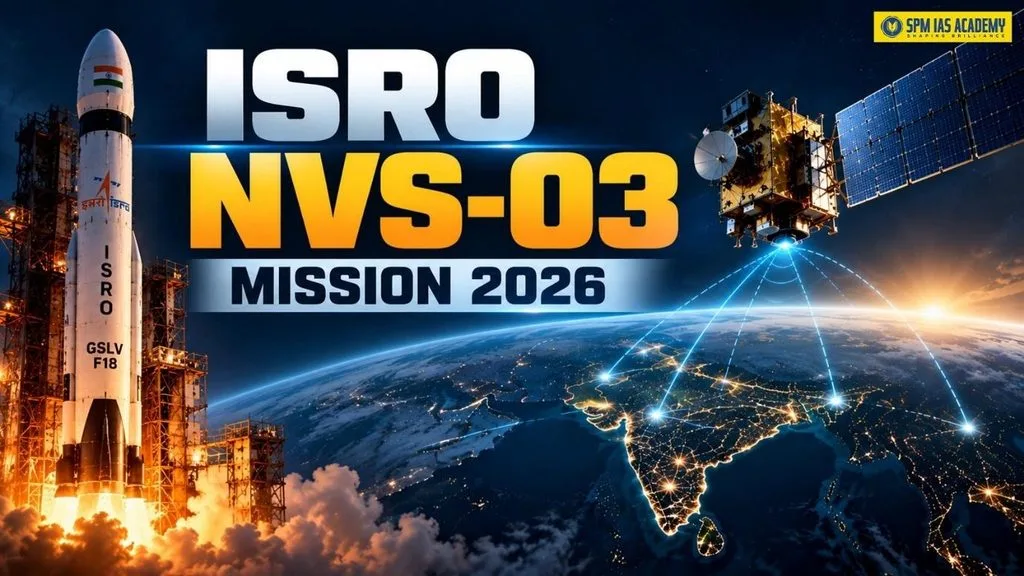
ISRO scheduled the GSLV-F18 launch carrying navigation satellite NVS-03 for 30 October 2026. The mission is particularly important because India’s NavIC constellation has faced operational challenges, including the NVS-02 satellite’s unsuccessful orbit-raising operation in January 2025. Consequently, NVS-03 aims to strengthen the continuity of India’s independent navigation services.
What Is ISRO NVS-03 Mission?
The ISRO NVS-03 Mission includes launching the third satellite in India’s second-generation navigation satellite series. The satellite will support the Indian Regional Navigation Satellite System (IRNSS), commonly known as NavIC. For aspirants exploring how to start preparing for APSC, understanding such space missions can strengthen their science and technology knowledge and help them prepare for current affairs questions.
Key Facts About GSLV-F18/NVS-03 Mission
| Particulars | Details |
| Mission Name | GSLV-F18/NVS-03 |
| Launch Date | 30 October 2026 (Scheduled) |
| Launch Vehicle | GSLV-F18 |
| Launch Site | Satish Dhawan Space Centre, Sriharikota |
| Launch Pad | Second Launch Pad |
| Satellite | NVS-03 |
| Satellite Mass | Approximately 2,250 kg |
| Target Orbit | Geosynchronous Transfer Orbit (GTO) |
| GSLV Flight | 20th |
| Navigation System | NavIC |
What Are the Features of ISRO’s NVS-03 Mission?
The ISRO NVS-03 Mission introduces important technological capabilities.
Indigenous Rubidium Atomic Clock:
NVS-03 carries an indigenously developed atomic clock, alongside other procured atomic clocks. Atomic clocks use stable atomic frequencies to measure time with exceptional precision. Moreover, satellite navigation systems calculate positions using the travel time of radio signals. Therefore, precise timing is essential for accurate location services. The mission also strengthens India’s technological self-reliance in critical navigation infrastructure. Aspirants enrolled in UPSC coaching in North East India can study such space technology developments to strengthen their science and technology preparation for the examination.
L1, L5 and S-Band Navigation Signals:
NVS-03 supports three navigation frequency bands:
- L1 Band: Improves compatibility with a wider range of navigation receivers.
- L5 Band: Supports satellite navigation and positioning services.
- S Band: Provides an additional navigation signal for regional applications.
Consequently, the addition of L1 can improve NavIC’s compatibility with modern devices.
Geosynchronous Transfer Orbit:
The GSLV-F18 rocket will initially place NVS-03 into a Geosynchronous Transfer Orbit (GTO). GTO is an elliptical transfer orbit used to position satellites before they reach their intended operational orbits.
Regional Navigation Coverage
NavIC provides navigation services across the entire Indian landmass. It covers areas extending approximately 1,500 km beyond India’s borders. Therefore, the system supports navigation requirements across India and surrounding regions. Aspirants preparing for civil services examinations at a Guwahati IAS Academy can study such developments to improve their understanding of India’s space technology and its strategic significance.
What Is NavIC, India’s Indigenous Navigation System?
- NavIC (Navigation with Indian Constellation) is an independent regional satellite navigation system developed by ISRO. It provides positioning, navigation and timing services.
- Unlike the United States’ GPS, which provides global coverage, NavIC primarily serves India and its surrounding region.
- NavIC supports several applications, including transportation, maritime navigation, disaster management and location-based services.
Significance of ISRO’s NVS-03 Mission
The ISRO’s Mission NVS-03 has major technological and strategic significance.
- Strategic Autonomy: It reduces dependence on foreign satellite navigation systems.
- Accurate Navigation: Moreover, Atomic clocks support precise positioning and timing.
- National Security: Furthermore, Independent navigation will strengthen India’s strategic and defence capabilities.
- Disaster Management: In addition, Reliable location services can support emergency response and rescue operations.
- Digital Infrastructure: Similarly, Precise timing supports telecommunications, financial systems and other critical services.
For example, NavIC-based navigation can help fishing vessels determine their positions and support maritime safety.
Furthermore, accurate navigation can improve emergency response in remote and disaster-prone regions, including Northeast India.
Why Is the GSLV-F18 Launch Crucial for NavIC?
The NVS-02 satellite, launched in January 2025, encountered problems during its orbit-raising operations. An investigation identified a failure in the signal required to operate a valve in its propulsion system. Therefore, ISRO introduced corrective measures before the NVS-03 mission.
A successful NVS-03 deployment is expected to help restore NavIC’s minimum operational constellation of four satellites. However, additional launches, including NVS-04 and NVS-05, remain important for strengthening the system.
Conclusion
Therefore, ISRO’s Mission NVS-03 represents an important step towards strengthening India’s indigenous satellite navigation capabilities. Through its atomic clock, additional L1 signal and next-generation technology, the mission aims to improve NavIC’s reliability and operational continuity. Ultimately, a successful mission can strengthen India’s strategic autonomy, technological independence and navigation infrastructure.
Read More:
Source:
Frequently Asked Question
1. What is the main objective of the ISRO NVS-03 Mission?
The ISRO NVS-03 aims to strengthen India’s indigenous navigation system, NavIC. It will improve the reliability of positioning, navigation and timing services. Moreover, the satellite carries an indigenous atomic clock to support accurate navigation.
2. What are the key features of the NVS-03 navigation satellite?
The NVS-03 satellite features an indigenous rubidium atomic clock and supports L1, L5 and S-band navigation signals. Additionally, the L1 signal improves compatibility with modern navigation devices. The satellite will also strengthen NavIC services across India and approximately 1,500 km beyond its borders.
3. Why is the ISRO NVS-03 Mission important for India?
The ISRO’s Mission NVS-03 will reduce India’s dependence on foreign navigation systems. Furthermore, it will strengthen national security, maritime navigation and disaster management. The mission also endorses technological self-reliance through indigenous atomic clock technology.

Behind every article at SPM IAS Academy is a team of skilled content writers and subject experts committed to making preparation easier for aspirants. From answering common doubts to breaking down complex issues and current affairs, we create content that is accurate, easy to understand, and directly useful for UPSC, APSC, and other competitive exams.