
Assam’s environmental issues are highly important for APSC Prelims and Mains preparation. Assam regularly faces floods, river erosion, wetland degradation, biodiversity loss, climate change impacts, and human-wildlife conflict. Moreover, these issues affect agriculture, livelihoods, public health, infrastructure, and sustainable development. Therefore, aspirants should prepare Assam’s environmental issues with current affairs, causes, impacts, and practical solutions.
Assam’s environmental issues are highly important environment topics for APSC GS Paper 5 and APSC Prelims. Moreover, aspirants should prepare Assam floods, biodiversity, climate change, wetlands, and disaster management with current affairs examples. This article highlights the major environmental issues in Assam for APSC Prelims and Mains preparation.
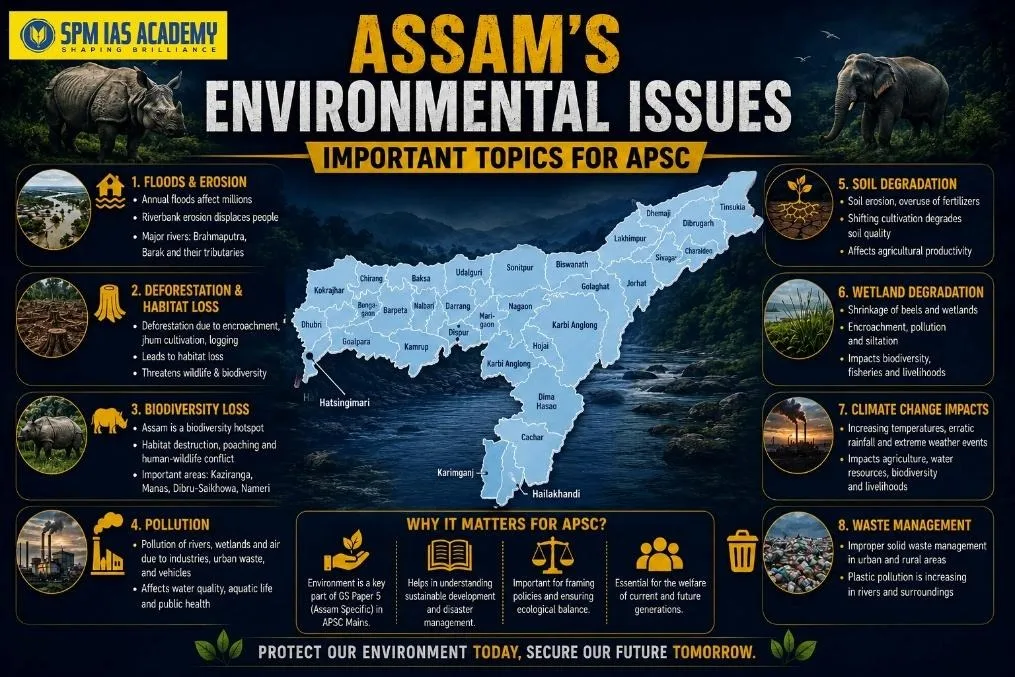
What are the major environmental issues in Assam important for APSC?
| Environmental Issue | Why It Matters for APSC |
| Floods in Assam | Disaster management, Brahmaputra, agriculture, displacement, |
| River erosion | Land loss, migration, livelihood crisis |
| Deepor Beel degradation | Wetland conservation, Ramsar site, urban pollution |
| Human-wildlife conflict | Elephant corridors, forest loss, community safety |
| Kaziranga flood and roadkill | Wildlife conservation, corridors, eco-sensitive zones |
| Climate change in Assam | Erratic rainfall, heat, agriculture, floods |
| Deforestation and habitat loss | Biodiversity loss, wildlife movement, erosion |
| Urban pollution and Urban flood | Guwahati growth, waste, water pollution |
| Biodiversity loss | Endangered species, protected areas, ecological balance |
Why Are Assam’s Environmental Issues Important for APSC Prelims and APSC Mains?
Assam’s environmental issues are important because they connect physical geography with society and governance. Floods, erosion, wetlands, wildlife corridors, and climate change shape Assam’s economy and daily life.
Moreover, APSC Mains GS Paper 3 and GS Paper 5 often need state-specific examples. Aspirants can use Assam’s environmental challenges in answers related to geography, society, disaster management, urbanisation, agriculture, biodiversity, and sustainable development.
APSC aspirants should focus on:
- Floods and river erosion in Assam
- Brahmaputra and Barak river systems
- Deepor Beel Ramsar site
- Kaziranga National Park and annual floods
- Human-elephant conflict
- Assam’s biodiversity and wildlife
- Climate change impacts in Assam
- Urbanisation and wetland loss
- Environmental governance in Assam
- Community-based conservation
Students seeking expert guidance can join APSC coaching in Assam for structured preparation and current affairs support.
Floods in Assam: A Major Environmental and Disaster Issue
Floods are one of the biggest environmental issues in Assam. Every year, the Brahmaputra and Barak river systems cause widespread flooding. The Assam Water Resources Department notes that Assam’s vast river network creates recurring flood and erosion problems, which negatively affect the state’s development.
Causes of floods in Assam
- Heavy monsoon rainfall increases river discharge.
- The Brahmaputra carries high sediment load.
- Hill streams from Arunachal Pradesh and Bhutan add sudden water flow.
- Encroachment on floodplains reduces natural drainage.
- Wetland loss weakens natural flood absorption.
- Climate variability increases rainfall uncertainty.
Impacts of floods in Assam
- Floods damage homes, roads, bridges, and schools.
- They destroy crops and affect rural livelihoods.
- They cause displacement and migration.
- They increase water-borne diseases.
- They affect Kaziranga and other wildlife habitats.
- They create long-term poverty in flood-prone areas.
Therefore, Assam floods are not only a natural disaster. They are also a governance and development challenge.
River Erosion in Assam
River erosion is another serious environmental issue in Assam. The Brahmaputra and its tributaries constantly change their courses. As a result, many villages lose land, homes, schools, farms, and community spaces.
Why river erosion matters
- It causes permanent land loss.
- It displaces thousands of families.
- It affects agriculture and food security.
- It increases rural poverty.
- It changes settlement patterns.
- It creates pressure on urban areas.
Moreover, climate-induced changes in river flow, sedimentation, and channel morphology can worsen erosion, flooding, and water resource variability in Assam.
Aspirants can link river erosion with Brahmaputra morphology, disaster governance, climate change, migration, land rights, and sustainable river management.
Climate Change in Assam
Climate change is making Assam’s environmental problems more complex. It affects rainfall, river flow, agriculture, forests, biodiversity, and disaster frequency.
The Assam State Action Plan on Climate Change was prepared to help the state respond to changing climatic conditions. It highlights sectoral concerns and strategies for climate action.
Major climate change impacts in Assam
- Erratic rainfall affects agriculture.
- Extreme rainfall increases flood risks.
- Rising temperatures affect health and crops.
- River flow patterns become unstable.
- Wetlands face ecological stress.
- Biodiversity faces habitat pressure.
- Landslides and erosion may intensify in vulnerable areas.
Moreover, recent reporting on the Barak Valley shows that erratic rainfall is worsening agricultural impacts in a flood-prone region.
Therefore, climate change should be studied with agriculture, disaster management, water resources, and biodiversity.
Deepor Beel Degradation: Assam’s Ramsar Site in Crisis
Deepor Beel is Assam’s only Ramsar site and one of the most important wetlands in Guwahati. However, it faces serious environmental pressure from pollution, encroachment, waste dumping, shrinking wetland area, and urbanisation.
In January 2026, the National Green Tribunal took serious note of pollution and degradation at Deepor Beel. Reports stated that the tribunal flagged violations and poor water quality.
A March 2026 NGT-related order also noted CPCB water quality data showing parameters beyond norms and the presence of faecal coliform and faecal streptococci in Deepor Beel.
Major threats to Deepor Beel
- Waste dumping
- Encroachment
- Urban expansion
- Sewage pollution
- Railway and road pressure
- Shrinking wetland area
- Loss of bird habitat
- Decline in fish resources
Why Deepor Beel is important for APSC
- It is Assam’s only Ramsar site.
- It supports migratory birds and aquatic life.
- It helps in flood control.
- It supports local livelihoods.
- It is linked with urban environmental governance.
Therefore, Deepor Beel is a high-value topic for APSC environment and Assam current affairs.
Human-Wildlife Conflict in Assam
Human-wildlife conflict is a growing environmental issue in Assam. Elephants, leopards, rhinos, wild boars, and other animals often enter human settlements because of habitat loss, forest fragmentation, and corridor disturbance.
Recent reports in May 2026 stated that three people died in elephant attacks across Assam within 24 hours. The incidents increased after rains and fresh vegetation drew elephants closer to human settlements.
Causes of human-wildlife conflict
- Shrinking forest habitats
- Blocked elephant corridors
- Expansion of villages and farms
- Tea garden expansion near forests
- Crop attraction
- Flood-driven animal movement
- Infrastructure projects
Impacts
- Loss of human lives
- Elephant deaths due to retaliation
- Crop and property damage
- Fear among villagers
- Pressure on forest officials
- Social tension around conservation
Solutions
- Restore elephant corridors.
- Use early warning systems.
- Promote community-based conservation.
- Provide quick compensation.
- Use legal and safe fencing methods.
- Reduce habitat fragmentation.
- Improve local awareness.
For APSC Mains, this topic connects ecology, ethics, governance, livelihood, and conservation.
Kaziranga, Floods and Wildlife Corridors
Kaziranga National Park faces a unique environmental challenge. Floods are natural for its grassland ecosystem, but extreme floods and road pressure can harm wildlife.
In 2024, floods in Assam killed more than 150 animals in Kaziranga, including nine one-horned rhinoceroses.
Moreover, the proposed Kaziranga elevated corridor has become an important current affairs topic. PIB stated in January 2026 that the elevated wildlife corridor will ensure uninterrupted animal movement, reduce human-wildlife conflict, improve road safety, and support connectivity.
Key issues around Kaziranga
- Annual floods
- Animal movement towards Karbi Anglong hills
- Vehicle-hit deaths on highways
- Tourism pressure
- Corridor fragmentation
- Need for eco-sensitive planning
APSC relevance
Kaziranga can be used in answers on wildlife corridors, floodplain ecology, eco-tourism, road ecology, human-wildlife conflict, and climate resilience.
Biodiversity Loss in Assam
Assam has rich biodiversity, but many species face increasing threats. Habitat loss, poaching, flood stress, river pollution, and climate change affect species survival.
Important species linked with Assam include:
- One-horned rhinoceros
- Bengal tiger
- Asian elephant
- Wild water buffalo
- Pygmy hog
- Golden langur
- Hoolock gibbon
- Greater adjutant stork
- Gangetic river dolphin
- Ganges softshell turtle
Recently, Assam achieved a conservation milestone by releasing India’s first satellite-tagged Ganges softshell turtle in the Brahmaputra at Kaziranga. This shows the increasing use of technology in freshwater turtle conservation.
Threats to biodiversity
- Habitat fragmentation
- Poaching
- Pollution
- Wetland loss
- River degradation
- Invasive species
- Climate change
- Human-wildlife conflict
Therefore, Assam’s biodiversity issues are important for both Prelims facts and Mains examples.
Urbanisation and Pollution in Assam
Urbanisation is creating new environmental challenges in Assam. Guwahati faces pressure from waste generation, traffic pollution, wetland encroachment, sewage discharge, and hill cutting.
Deepor Beel clearly shows the link between urban growth and ecological damage. NGT-related reports on Deepor Beel highlighted pollution and environmental degradation at this Ramsar-listed wetland.
Urban environmental issues in Assam
- Solid waste management problems
- Sewage pollution
- Wetland encroachment
- Air pollution from traffic
- Hill cutting and landslide risks
- Loss of green spaces
- Urban flooding
Deforestation and Habitat Fragmentation
Deforestation and habitat fragmentation weaken Assam’s ecological balance. Forest loss affects rainfall patterns, wildlife movement, soil stability, biodiversity, and local livelihoods.
Habitat fragmentation especially affects elephants, tigers, primates, birds, and freshwater species. It also increases conflict between humans and animals.
Causes
- Road and railway expansion
- Mining and quarrying
- Settlement growth
- Agricultural expansion
- Illegal logging
- Encroachment
- Infrastructure projects
Effects
- Loss of wildlife corridors
- Human-wildlife conflict
- Soil erosion
- Biodiversity decline
- Reduced carbon storage
- Flood vulnerability
Therefore, Assam needs habitat restoration, corridor protection, and sustainable development planning.
Plastic Pollution and Waste Management in Assam
Plastic pollution is an emerging environmental issue in Assam. It affects rivers, wetlands, drainage channels, livestock, fish, and birds.
Major concerns
- Plastic blocks urban drains.
- Waste enters wetlands and rivers.
- Single-use plastic harms animals.
- Poor segregation increases landfill pressure.
- Tourist areas generate unmanaged waste.
For APSC, aspirants can link plastic pollution with Swachh Bharat Mission, municipal governance, behavioural change, circular economy, and wetland conservation.
Environmental Issues in Assam and Public Health
Environmental degradation affects public health directly. Floods increase water-borne diseases. Pollution affects respiratory health. Heat stress affects workers and elderly people. Poor waste management spreads vector-borne diseases.
Public health links
- Floods increase diarrhoeal diseases.
- Stagnant water increases mosquito breeding.
- Air pollution affects lungs.
- Contaminated water affects children.
- Heat stress affects labour productivity.
Therefore, environmental issues should also be studied through a health and governance lens.
What are the Important Recent Environmental Issues in Assam for APSC?
APSC aspirants should track recent developments. These issues improve Mains answers and interview responses.
Recent issues to follow
- NGT concern over Deepor Beel degradation in 2026
- Tree felling and replantation promise near Deepor Beel
- Human-elephant conflict deaths in Assam
- Kaziranga elevated corridor project
- Assam floods and wildlife deaths
- Urban flood in cities
- Climate variability affecting agriculture in Barak Valley
- Anti-poaching operations in wildlife areas
- Freshwater turtle conservation in Brahmaputra
- Urban waste and wetland pollution in Guwahati
For example, the forest department recently promised to plant ten times the number of trees felled near Deepor Beel after public concern over tree loss and wetland shrinkage.
How to Prepare Assam Environmental Issues for APSC GS Paper I?
Aspirants should prepare Assam’s environmental issues with facts, examples, maps, and current affairs.
Preparation strategy
- Make short notes on floods and erosion.
- Draw a map of Brahmaputra and Barak systems.
- Prepare Deepor Beel as a case study.
- Study Kaziranga, Manas, and wildlife corridors and their current issues.
- Track human-elephant conflict news.
- Revise climate change impacts in Assam and the initiatives taken by central and state government.
- Connect environment with governance and economy.
Moreover, students should not study environmental issues in isolation. They should connect them with people, livelihoods, policy, and development.
Many aspirants prefer APSC coaching in north east India for region-specific mentorship, test series, and answer writing practice.
Environment Topics for APSC
- Study biodiversity hotspots, national parks, wildlife sanctuaries, and biosphere reserves.
- Prepare important environmental conventions like CBD, Ramsar Convention, UNFCCC, and Paris Agreement.
- Focus on climate change, global warming, El Niño, La Niña, and extreme weather events.
- Learn important pollution topics including air pollution, water pollution, soil pollution, and noise pollution.
- Study environmental laws like the Environment Protection Act, Biological Diversity Act, and Forest Conservation Act.
- Prepare Assam-specific environmental issues like floods, river erosion, wetland degradation, and human-wildlife conflict.
- Focus on important wetlands, Ramsar sites, and river ecosystems of India and Assam.
- Study important species conservation programmes like Project Tiger, Project Elephant, and rhino conservation.
- Learn concepts related to ecosystem, food chain, food web, ecological succession, and biogeochemical cycles.
- Focus on disaster management topics like floods, cyclones, landslides, droughts, and earthquakes.
- Prepare current affairs related to environment, climate summits, COP meetings, and wildlife conservation.
- Study renewable energy, sustainable development, carbon footprint, and green technology initiatives.
- Learn about deforestation, desertification, habitat fragmentation, and biodiversity loss.
- Focus on Assam’s biodiversity including Kaziranga, Manas, Deepor Beel, and Hoolock Gibbon conservation.
- Revise important environmental organisations like UNEP, IPCC, IUCN, and National Green Tribunal (NGT).
Beginners can follow this step-by-step APSC preparation guide to build strong basics in environment and current affairs.
Conclusion
In conclusion, Assam’s environmental issues are highly important for APSC Prelims, APSC Mains GS Paper 3 and GS Paper 5. Aspirants must study important topics like Assam floods, river erosion, Deepor Beel degradation, human-wildlife conflict, Kaziranga conservation, biodiversity loss, climate change, wetland pollution, urbanisation, and disaster management. Moreover, students should connect these topics with Assam current affairs, environmental governance, sustainable development, and community participation. Therefore, regular current affairs reading, map practice, case studies, and answer writing can help aspirants master Assam’s environmental issues for APSC.
Source:
Frequently Asked Questions:
The major environmental issues in Assam include floods, river erosion, climate change, Deepor Beel degradation, human-wildlife conflict, biodiversity loss, deforestation, urban pollution, and wetland encroachment.
Deepor Beel is important because it is Assam’s only Ramsar site. It supports biodiversity, birds, fisheries, livelihoods, and flood control. However, pollution and urbanisation now threaten the wetland.
You should prepare Assam environmental issues through maps, case studies, current affairs, short notes, and answer writing. Moreover, connect floods, erosion, biodiversity, wetlands, climate change, and governance.

Behind every article at SPM IAS Academy is a team of skilled content writers and subject experts committed to making preparation easier for aspirants. From answering common doubts to breaking down complex issues and current affairs, we create content that is accurate, easy to understand, and directly useful for UPSC, APSC, and other competitive exams.