Have you ever wondered, “When is the best time to prepare for APSC?”
Many aspirants wait for the “perfect moment” to begin their preparation. Some think they should start only after completing graduation. Some believe they need to join coaching first. Others feel they are already late because they did not begin earlier.
But the truth is — there is no single starting point that guarantees success. The right time depends on your academic journey, responsibilities, awareness, and commitment towards becoming a civil servant.
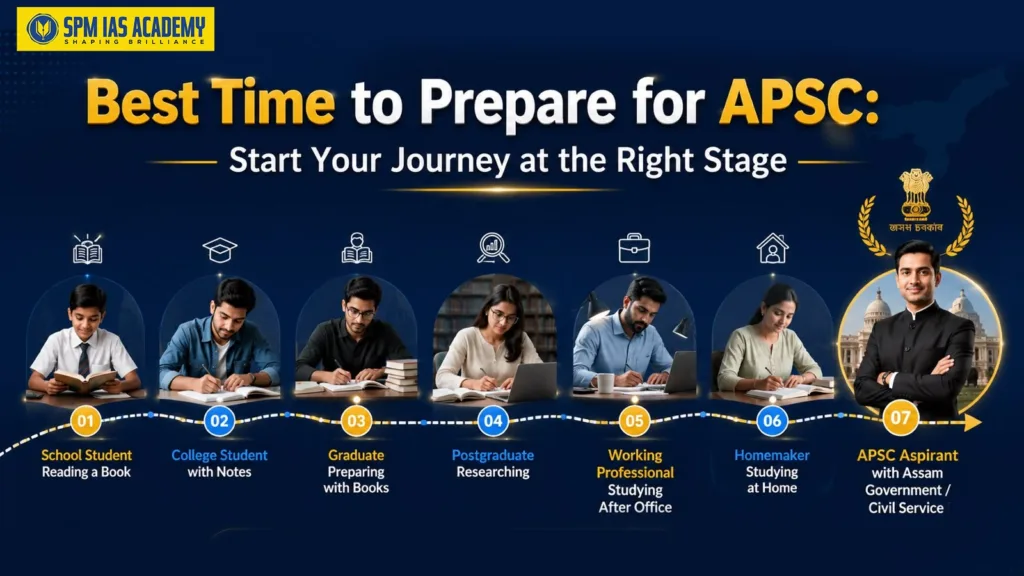
The best time to prepare for APSC is when you develop clarity about your goal and start building the right foundation. Whether you begin during school, graduation, after graduation, during post-graduation, while managing a family, or alongside a job — every phase offers unique advantages.
Let us explore how different stages of life can become the right time to start your APSC preparation.
Starting APSC Preparation During School: Why Beginning at 12 Matters
Imagine a student who starts understanding the world around them from an early stage — reading newspapers, learning about Assam’s history, following current affairs, and developing curiosity about society.
Starting awareness around this stage does not mean studying like a full-time aspirant. It means developing habits that create a strong foundation for the future.
This is why starting preparation around the age of 12 can be valuable.
At this stage, students can focus on:
- Developing reading habits
- Improving vocabulary and communication skills
- Understanding Indian history, geography, and culture
- Building curiosity about Assam and its issues
- Learning critical thinking skills
A student who grows up with awareness of society naturally develops a broader perspective. Later, when they begin serious APSC preparation, many concepts become easier to understand because the foundation already exists.
The best time to prepare for APSC at this stage is not about memorising textbooks or following an intense study schedule. It is about nurturing curiosity.
Think about it — a future civil servant is someone who understands people, communities, challenges, and governance. These qualities can begin developing much earlier.
Preparing for APSC During Graduation: Building the Foundation
Graduation is often considered one of the most suitable phases to begin structured preparation.
Why?
Because students usually have more independence, academic maturity, and enough time to gradually understand the APSC syllabus.
During graduation, aspirants can:
- Read NCERT books and standard reference materials
- Understand the APSC syllabus
- Start newspaper reading
- Practice answer writing
- Follow Assam-related current affairs
- Build conceptual knowledge
One major advantage of starting during graduation is time.
Instead of rushing through the syllabus after completing college, students can prepare slowly and strategically. They can attempt mock tests, revise multiple times, and understand their strengths and weaknesses.
For many aspirants, the best time to prepare for APSC is during graduation because it allows preparation to grow alongside academic learning.
For example, a student studying Political Science, History, Geography, Economics, or Sociology may naturally connect their academic subjects with civil service preparation. However, even students from other streams can successfully prepare with proper planning.
The key question is not “Does my graduation subject match APSC?” The better question is: “Am I willing to understand the world beyond my textbook?”
Preparing After Graduation: A Fresh Start With Better Clarity
Many successful aspirants begin their preparation after graduation. And there are strong reasons why this phase can be advantageous. After graduation, many students have:
- Better understanding of career goals
- More maturity
- Improved reading ability
- Clearer motivation
- Greater discipline
At this stage, aspirants can dedicate focused time towards preparation.
They can create a structured plan:
- Complete the syllabus systematically
- Join guidance programs if required
- Practice previous year papers
- Take mock tests
- Improve answer writing skills
For those who were unsure about their career direction during college, starting after graduation can actually be the best time to prepare for APSC because they approach preparation with stronger determination.
Civil services require patience, consistency, and emotional strength. Sometimes, maturity gained after graduation becomes an advantage.
Preparing During Post-Graduation: The Advantage of Deeper Learning
Post-graduation provides another valuable opportunity for APSC aspirants.
Students pursuing higher education often develop:
- Analytical thinking
- Research skills
- Better understanding of their subjects
- Strong writing abilities
These skills directly help in civil service preparation. A postgraduate student can use their academic environment to strengthen their preparation while continuing their studies. For instance:
- A History student can develop deeper knowledge of historical events.
- A Political Science student can understand governance and constitutional issues.
- An Economics student can analyse economic policies more effectively.
The best time to prepare for APSC during post-graduation is when you balance your academic commitments with consistent preparation. Instead of seeing higher education as a delay, aspirants can use it as an opportunity to improve their knowledge base.
Can Homemakers Prepare for APSC? Absolutely.
Life does not always follow a fixed timeline. Many homemakers wonder: “Can I still prepare for APSC while managing household responsibilities?”
The answer is yes. Homemakers often develop qualities that are valuable for civil services:
- Time management
- Patience
- Problem-solving abilities
- Responsibility handling
- Emotional intelligence
The challenge is not ability; it is creating a realistic routine.
A homemaker can begin by:
- Studying during available hours
- Following current affairs regularly
- Making small but consistent progress
- Using online learning resources
The best time to prepare for APSC for a homemaker is when they decide to invest in their own growth and create a disciplined learning routine.
Small steps taken every day can create remarkable results over time.
Preparing for APSC Alongside a Job: Turning Limited Time Into Strength
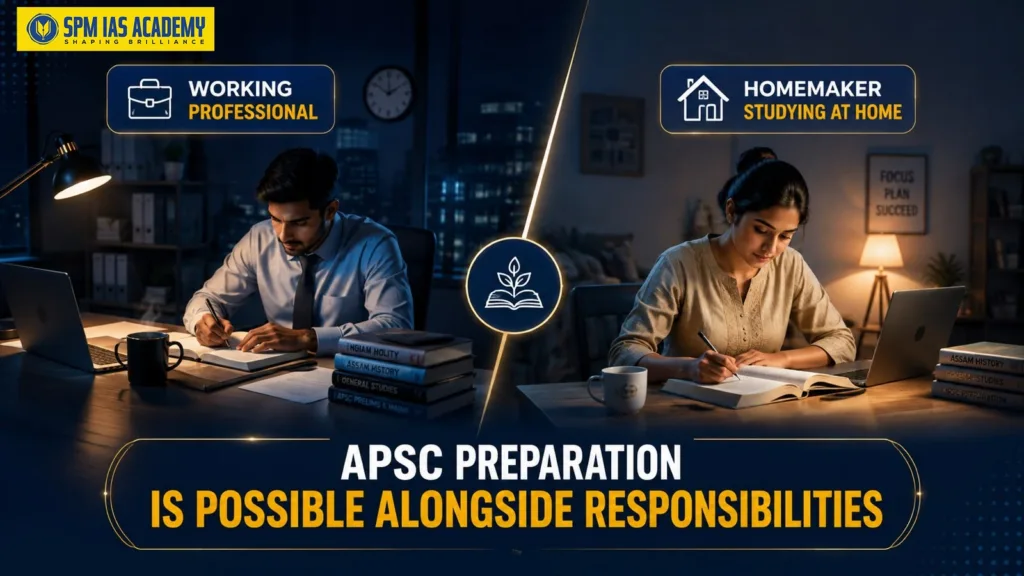
Many working professionals hesitate because they think they do not have enough time. But having a job does not mean your APSC dream has to stop. In fact, working professionals often develop:
- Strong discipline
- Time management skills
- Professional experience
- Practical understanding of society
A working aspirant can prepare by:
- Studying before or after office hours
- Utilising weekends effectively
- Creating realistic daily targets
- Focusing on quality rather than only hours
The best time to prepare for APSC while working is when you create consistency despite a busy schedule.
Remember, civil services preparation is a marathon, not a race. A focused two hours every day can become more powerful than irregular long study sessions.
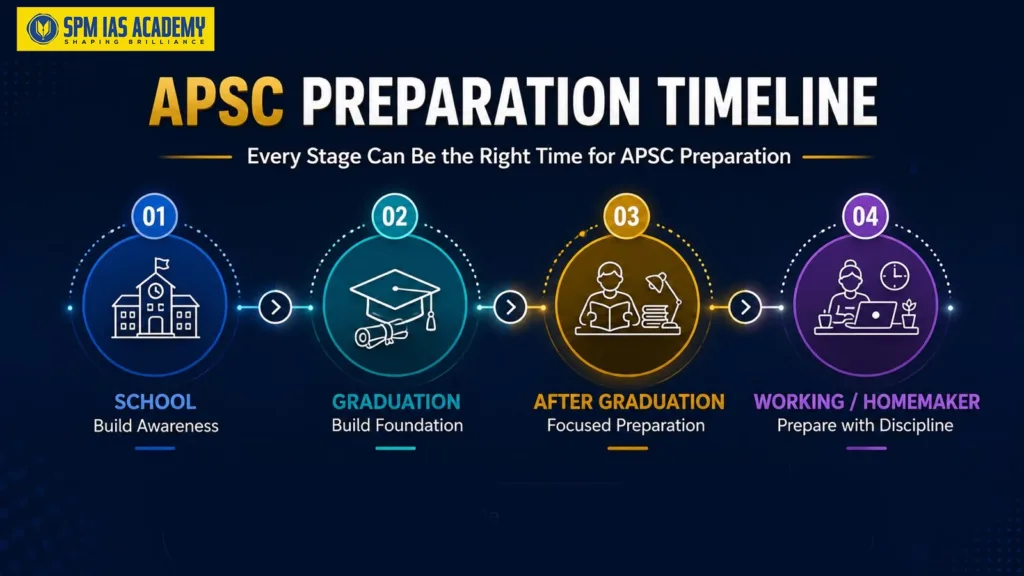
So, What Is Actually the Best Time to Prepare for APSC?
The answer is simple:
The best time is when you are ready to begin.

For some, it may be during school when curiosity develops.
For some, it may be during graduation when foundations are built.
For others, it may be after graduation when goals become clearer.
For some, post-graduation provides the perfect academic advantage.
For homemakers and professionals, the right time begins when they create space for their dreams.
APSC preparation is not defined by when you start. It is defined by how consistently you continue.
Aspirants often spend too much time asking: “Am I starting too early?” or “Am I starting too late?” Instead, ask yourself: “What can I do today that will bring me closer to becoming a civil servant?” Because ultimately, the best time to prepare for APSC is not a particular year, semester, or phase of life. It is the moment when you choose to begin.
The best time to prepare for APSC depends on individual circumstances. Students can start building foundations during school or graduation, while others can begin focused preparation after graduation, during post-graduation, or alongside work.
Yes, graduation is considered a beneficial phase because students get enough time to understand the syllabus, build concepts, and gradually develop preparation strategies.
No. Many aspirants begin after graduation with better clarity, maturity, and focused dedication.
Yes. Working professionals can prepare successfully by creating a realistic study schedule and maintaining consistency.
Starting from school helps develop awareness, reading habits, and analytical thinking. However, serious preparation should be planned according to academic maturity and personal readiness.

Written by SPM IAS Academy Content Team
We don’t create content to fill pages; we create content that fills the gaps in your preparation. Every article is researched, refined, and designed with one goal — to make your journey towards success a little sharper.
No unnecessary noise. No recycled information. Just focused insights, exam-oriented guidance, and content that actually helps aspirants move forward.
Because when the competition is tough, average preparation doesn’t make the cut.