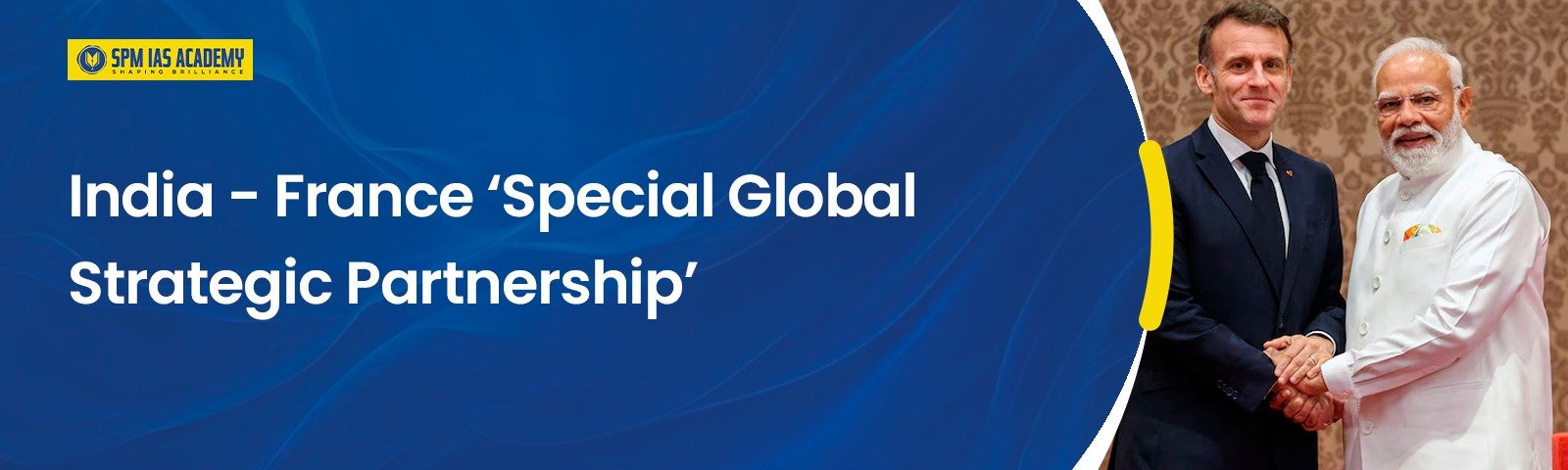
The announcement of India, France ‘Special Global Strategic Partnership’ marks a major shift in India’s foreign policy and global positioning. Prime Minister Narendra Modi and French President Emmanuel Macron elevated bilateral ties to a new level, focusing on defence, innovation, clean energy, and emerging technologies.
For UPSC and APSC aspirants, this development is highly relevant for International Relations, Security, Science & Technology, and Essay papers.
For structured preparation, explore UPSC coaching in Assam with expert mentorship and updated resources.
India, France ‘Special Global Strategic Partnership’ – A Turning Point in Bilateral Relations:
The elevation of India – France ties to ‘Special Global Strategic Partnership’ signals a deeper alignment between the two nations. The leaders described this move as a “turning point” and a “force for global stability” in an uncertain world.
Firstly, the partnership goes beyond traditional diplomacy. Secondly, it focuses on defence manufacturing, innovation ecosystems, and people-to-people exchanges. Therefore, this strategic upgrade reflects India’s growing global influence.
Why the India – France ‘Special Global Strategic Partnership’ Is Important?
The announcement was made during high-level talks in Mumbai. President Macron’s visit highlighted long-term cooperation under the Horizon 2047 vision.
The partnership includes:
- Defence manufacturing cooperation
- Joint innovation initiatives
- Clean energy collaboration
- Critical minerals and advanced materials cooperation
- Space and biotechnology research
As a result, both countries aim to strengthen global stability and economic resilience.
Defence Cooperation Under the India – France ‘Special Global Strategic Partnership’
Defence remains the backbone of the India – France ‘Special Global Strategic Partnership’.
Key Defence Developments:
- India’s first private helicopter Final Assembly Line at Vemagal, Karnataka.
- Production of H125 light utility helicopters (Made in India by 2027).
- BEL–Safran agreement for HAMMER precision-guided missiles manufacturing.
- Centre of Excellence in Pune for Indian Air Force and Navy.
- Renewal of Defence Cooperation Agreement.
- Moreover, reciprocal officer deployments between the Indian Army and French Land Forces will continue.
This aligns with India’s Atmanirbhar Bharat initiative. Therefore, it strengthens domestic defence production while maintaining global collaboration.
India-France Year of Innovation 2026:
- One of the major highlights of the India – France ‘Special Global Strategic Partnership’ is the launch of the India–France Year of Innovation 2026.
- Moreover, Prime Minister Narendra Modi emphasized that innovation thrives through collaboration rather than isolation.
Focus Areas of Innovation:
- The partnership will prioritise cooperation in Artificial Intelligence, Biotechnology, Advanced Materials, Clean Energy, and Space Technology.
- In addition, both nations will connect startups and MSMEs to strengthen innovation ecosystems.
- Furthermore, they will facilitate student and researcher exchange to promote knowledge sharing.
- They will also establish new joint innovation centres to enhance institutional collaboration.
- As a result, the strategic relationship is transforming into a true “Partnership of the People.”
Strategic Significance in Global Politics:
- To begin with, the India – France ‘Special Global Strategic Partnership’ carries significant geopolitical implications in the evolving global order.
- Secondly, France is a key European power and a permanent member of the UN Security Council, which enhances the strategic depth of this partnership.
- Moreover, France plays a crucial role in the Indo-Pacific region, thereby aligning with India’s maritime and regional interests.
- In addition, the partnership actively supports initiatives such as the International Solar Alliance (ISA), the India-Middle East-Europe Economic Corridor (IMEC), maritime security cooperation, and broader Indo-Pacific stability.
Therefore, this alliance strengthens India’s strategic autonomy while diversifying its partnerships beyond traditional geopolitical blocs.
Broader Economic and Strategic Impact:
- The India–France ‘Special Global Strategic Partnership’ promotes economic diversification by expanding cooperation across strategic sectors.
- Secondly, it boosts defence manufacturing in India, thereby strengthening domestic industrial capacity.
- Moreover, it facilitates technology transfer, which enhances innovation and indigenous capability development.
- In addition, the partnership encourages MSME collaboration and strengthens the startup ecosystem, fostering entrepreneurship and job creation.
- Furthermore, cooperation in critical minerals reduces supply chain risks and enhances resource security.
- Consequently, this partnership significantly strengthens India’s economic resilience and strategic autonomy.
Therefore, this partnership strengthens India’s economic resilience.
Innovation and Youth Engagement:
- Firstly, the “Partnership of the People” approach makes the India–France strategic relationship unique by emphasizing collaboration beyond traditional diplomacy.
- Similarly, the “Year of Innovation” will connect young innovators from both countries, thereby fostering cross-border creativity and idea exchange.
- Moreover, it will promote research collaborations and academic exchanges, strengthening institutional partnerships.
- In addition, it will encourage joint academic programs, thereby deepening educational cooperation.
- Consequently, such engagement enhances long-term diplomatic trust and mutual understanding.
Therefore, for aspirants, this development highlights that modern diplomacy increasingly integrates innovation ecosystems alongside political dialogue.
India – France Joint Statement:
Partnership for security and sovereignty:
- Firstly, both leaders reaffirmed their deep defence partnership and agreed to intensify joint research, co-design, co-development, and co-production of advanced air, naval, and land systems under the 2024 Defence Industrial Roadmap.
- Moreover, they welcomed the Technical Arrangement between DRDO and DGA and decided to establish a Joint Advanced Technology Development Group. This group will work to strengthen cooperation in emerging and critical technologies while mitigating supply chain risks.
- In addition, they appreciated progress in defence aeronautics, including the procurement of 26 Rafale-Marine jets, collaboration on jet and helicopter engines, Safran-HAL partnership on IMRH, MRO facilities for LEAP and M-88 engines, HAMMER missile production with BEL, and the inauguration of the H125 Final Assembly Line under Make in India.
- Furthermore, they highlighted the success of the Scorpène (P75–Kalvari) submarine program and welcomed continued cooperation in submarine development.
- Both leaders also underscored the importance of regular bilateral exercises (Varuna, Shakti, Garuda), officer exchanges, port calls, and expanded operational engagements across domains, including defence space cooperation under the 2024 Letter of Intent.
- Additionally, they agreed to deepen cooperation in critical minerals and rare earths to build resilient and diversified supply chains supporting green and digital transitions.
- They reaffirmed commitment to the India-Middle East-Europe Economic Corridor (IMEC) and encouraged concrete progress in upcoming ministerial meetings.
- In the Indo-Pacific, they reiterated support for a free, open, and rules-based region, strengthening collaboration under IPOI, ISA, CDRI, IPTDC, and trilateral formats with Australia and the UAE.
- In the space sector, they commended CNES-ISRO cooperation, supported sovereign access to space and space situational awareness, and looked forward to deeper collaboration, including participation in the 2026 International Space Summit.
- Moreover, they emphasized enhanced cooperation in ocean observation (CNES-INCOIS partnership) and the Ocean-Space nexus for sustainable ocean governance.
- In cyberspace, both sides agreed to strengthen cyber dialogue, coordination at the UN, and cooperation against malicious cyber activities in line with international law.
- Finally, they strongly condemned terrorism in all forms, reaffirmed cooperation through UN and FATF mechanisms, supported the upcoming “No Money For Terror Conference (2026)”, and welcomed expanded counter-terrorism collaboration, including NSG-GIGN cooperation and MILIPOL engagements.
Partnership for the Planet:
- Firstly, both leaders reaffirmed their commitment to climate action under the Paris Agreement and agreed to cooperate closely to limit global temperature rise to well below 2°C, while pursuing efforts toward 1.5°C, guided by science and the IPCC.
- Moreover, they strengthened collaboration through multilateral platforms such as the International Solar Alliance (ISA) and the Coalition for Disaster Resilient Infrastructure (CDRI), and supported decarbonization initiatives including LeadIT and the Chaillot Declaration for sustainable buildings.
- In addition, they welcomed renewed bilateral cooperation in renewable energy, green finance, urban mobility, biodiversity conservation, and disaster management, including collaboration with the AFD Group and NITI Aayog on energy transition modelling.
- Furthermore, both sides endorsed stronger global ocean governance, welcomed the BBNJ (Biodiversity Beyond National Jurisdiction) Treaty’s entry into force, supported expansion of marine protected areas, and reaffirmed commitment to the Kunming-Montreal Global Biodiversity Framework.
- Recognizing the role of low-carbon energy, they agreed to deepen cooperation in civil nuclear energy, including progress on the Jaitapur Nuclear Power Plant, SMR/AMR research, and strengthened collaboration between DAE and CEA, while upholding the highest safety and non-proliferation standards.
- Additionally, they welcomed growing bilateral trade and investments, enhanced MSME and startup collaboration, the India-France CEO Forum, and the amendment to the bilateral tax treaty to boost economic partnerships.
- Both leaders appreciated the expansion of UPI in France and agreed to promote secure digital payments to facilitate tourism and business transactions.
- Finally, they committed to expanding cooperation in the railway sector, including high-speed rail, hydrogen-powered trains, sustainability, infrastructure development, and skill enhancement, with plans for a Joint Declaration of Intent on railway collaboration.
Partnership for the People:
- Firstly, both leaders emphasized deepening cooperation in science and technology, particularly during the India–France Year of Innovation 2026, and welcomed progress in critical and emerging technologies such as space, civil nuclear energy, cyber, and AI.
- Moreover, they launched the India-France Innovation Network to digitally connect startups, innovators, incubators, and businesses from both countries, thereby strengthening innovation ecosystems.
- In addition, they encouraged expanded startup collaboration, welcomed the LoI between T-Hub and Nord France Invest, supported bringing VivaTech to India, and announced new joint research initiatives between INRIA–DST and CNRS–DST, including AI and advanced materials projects.
- Furthermore, they advanced cooperation in civil aviation and skill development, including a new airline route between La Réunion and Chennai, and the establishment of a National Centre of Excellence in Aeronautics at NSTI Kanpur.
- In the health sector, both leaders prioritized AI and digital health collaboration, welcomed the launch of a joint AI healthcare research centre (Sorbonne–AIIMS–Paris Brain Institute), and strengthened partnerships in digital health, life sciences, and infectious disease research.
- Building on strong cultural ties, they reaffirmed commitments to expand cultural exchanges, organize events under the Year of Innovation 2026, promote creative industries, and celebrate major exhibitions and heritage collaborations in both countries.
- Additionally, they supported enhanced cooperation in literature, translation, book fairs, and the continuation of Namaste France in 2028 to mark 30 years of strategic partnership.
- They also promoted language and education cooperation, including expansion of French language teaching in India, increased student mobility with a target of 30,000 Indian students in France by 2030, and strengthened academic recognition agreements.
- Moreover, they welcomed growing academic and scientific collaboration, including high-level university meetings, joint degrees, and research funding through CEFIPRA.
- To boost people-to-people ties, both leaders emphasized the Migration and Mobility Partnership Agreement, youth mobility schemes, skill cooperation MoUs, and the pilot visa-free transit facility for Indian nationals through French airports.
- Finally, they welcomed the Mediterranean Edition of the Raisina Dialogue and noted that the India-France Special Global Strategic Partnership marks a new chapter, fostering deeper collaboration for global peace, stability, and prosperity.
Conclusion – A Strategic Boost for India’s Global Role
The elevation of India – France ties to ‘Special Global Strategic Partnership’ represents a new phase in India’s foreign policy. It combines defence, innovation, clean energy, and people-to-people collaboration.
For UPSC and APSC aspirants, this topic is not just current affairs. It reflects India’s evolving global vision, strategic autonomy, and technological ambitions.
Strengthen your preparation through comprehensive UPSC coaching in north east India focused on current affairs.
Sources:
https://www.pib.gov.in/PressReleasePage.aspx?PRID=2229412®=3&lang=1
Frequently Asked Questions:
The India – France ‘Special Global Strategic Partnership’ is an upgraded bilateral framework focusing on defence, innovation, clean energy, and global stability.
It is important because it relates to international relations, defence cooperation and global diplomacy under UPSC and APSC syllabus.
The partnership promotes defence manufacturing in India, including helicopter production and missile systems, strengthening self-reliance.
It is a bilateral initiative to promote collaboration in AI, biotechnology, startups, and research exchanges.

Behind every article at SPM IAS Academy is a team of skilled content writers and subject experts committed to making preparation easier for aspirants. From answering common doubts to breaking down complex issues and current affairs, we create content that is accurate, easy to understand, and directly useful for UPSC, APSC, and other competitive exams.