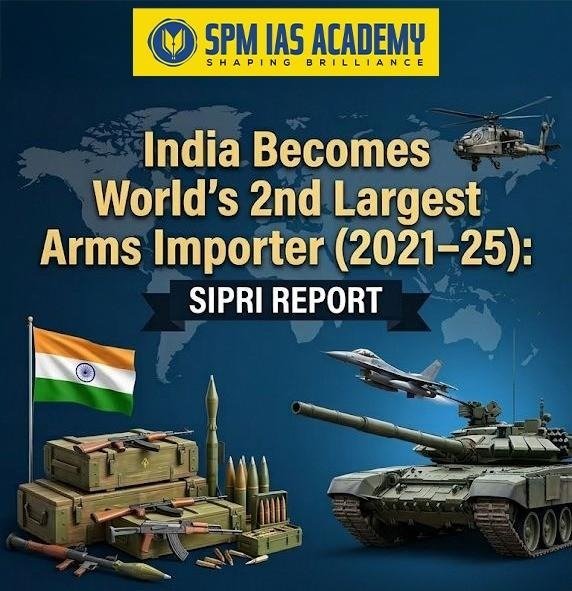
India has emerged as the world’s second largest arms importer during 2021-2025, according to the Stockholm International Peace Research Institute (SIPRI). At the same time, Ukraine ranked first, while the United States remained the largest global arms exporter. This development is highly important for UPSC, APSC, and other State PCS exams because it connects international relations, defence policy, geopolitics and India’s strategic autonomy. Therefore, aspirants must understand the key data, trends, and implications of this SIPRI report.
What Is SIPRI?
The Stockholm International Peace Research Institute (SIPRI) is a Sweden-based think tank. It publishes an annual report titled “Trends in International Arms Transfers”. This report tracks global arms imports and exports.
Importantly, SIPRI data is frequently quoted in government documents, media reports and international policy debates. Therefore, it is highly relevant for competitive exams.
India becomes world’s 2nd Largest Arms Importer (2021-2025)
According to SIPRI:
- India was the second largest arms importer globally during 2021-2025. Notably, it accounted for 8.2% of global arms imports over 2021-25.
- However, India’s overall arms imports decreased slightly by 4% compared to 2016-2020.
- Russia remained India’s largest supplier, accounting for 40% of imports. But this marks a sharp decline from 51% in 2016-2020 and 70% in 2011-2015.
- India is increasingly buying arms from France (second largest supplier providing 29% of India’s imports) and Israel (third largest supplier with 15% share of India’s arms import), indicating diversification.
Thus, while India still depends on imports, it is gradually reducing reliance on a single supplier.
Who Was the Largest Arms Importer?
Ukraine became the world’s largest arms importer during 2021-2025. It received 9.7% of total global arms transfers. This sharp rise occurred due to the ongoing conflict with Russia. As a result, Europe saw a dramatic increase in arms imports.
United States: The Largest Arms Exporter
The United States supplied 42% of global arms transfers in 2021-2025. Moreover, the share of US arms exports grew by 27%. Therefore, the US has strengthened its dominance as the world’s top arms supplier, even in a multipolar world.
Asia and Oceania: Key Trends in Arms Imports (2021-2025)
- Firstly, four countries from Asia and Oceania ranked among the top 10 global arms importers: India, Pakistan, Japan and Australia.
- Moreover, the United States emerged as the main supplier to the region, accounting for 35% of total regional arms imports.
- In addition, Russia supplied 17% of the region’s arms imports during this period.
- Similarly, China contributed 14% of arms supplies to Asia and Oceania.
- Interestingly, China dropped out of the list of the top 10 arms importers for the first time since 1991-1995.
- This development occurred because China significantly expanded its domestic defence production, thereby reducing its reliance on foreign arms imports.
India’s Defence Imports: Strategic Analysis
1. Declining Dependence on Russia
Although Russia still supplies 40% of India’s arms imports, this share has steadily declined. Therefore, India is diversifying its defence partnerships.
2. Increasing Western Collaboration
India is purchasing advanced defence systems from France, Israel, and the United States. This shift reflects stronger strategic ties with Western countries.
3. Push for Atmanirbhar Bharat in Defence
India aims to reduce imports through Make in India in Defence, Defence Production and Export Promotion Policy and Increasing domestic manufacturing. Thus, while India remains a major importer, it also seeks self-reliance.
Pakistan’s Arms Imports
SIPRI noted that Pakistan’s arms imports grew by 66% between 2016-2020 and 2021-2025.
Importantly, China supplied 80% of Pakistan’s arms imports in 2021-2025. This increased from 73% in the previous period. Therefore, China remains Pakistan’s primary defence partner.
Global Arms Transfer Trends (2021-2025)
Overall, Global arms transfers increased by 9.2% compared to 2016-2020. Europe became the largest importing region. Moreover, ongoing conflicts in Europe, Asia, and the Middle East drove higher defence spending. Consequently, global security tensions continue to shape defence markets.
Conclusion: India’s Arms Imports and Global Defence Trends
India’s position as the world’s second largest arms importer (2021-2025) highlights both its security challenges and strategic priorities. Although Russia remains a key supplier, India is increasingly diversifying toward Western partners. At the same time, global arms transfers have risen due to geopolitical tensions, especially in Europe and Asia.
For UPSC, APSC, and State PCS aspirants, understanding the SIPRI report, India’s defence imports, global arms transfers, and strategic partnerships is essential. These topics directly relate to international relations, defence policy, and national security which are crucial areas in competitive examinations.
Source:
Assam Current Affairs – SPM IAS Academy
Assam Current Affairs Articles
FAQs
India became the world’s second largest arms importer during 2021-2025 because it continued to modernize its armed forces amid regional security challenges. According to SIPRI, India accounted for 8.2% of global arms imports. Although India slightly reduced its total imports compared to 2016-2020, it still relied on foreign suppliers for advanced defence systems.
Russia remained India’s largest arms supplier during 2021-2025, accounting for 40% of India’s imports. However, India reduced its dependence on Russia compared to previous years. At the same time, India increased purchases from France and Israel, thereby diversifying its defence partnerships.
Ukraine was the world’s largest arms importer during 2021-2025. It received 9.7% of total global arms transfers. The ongoing conflict with Russia significantly increased Ukraine’s defence imports, which also led to a sharp rise in arms transfers to Europe.
India is reducing its dependence on arms imports by promoting domestic defence production under initiatives like Make in India and the Defence Production and Export Promotion Policy. Furthermore, India is expanding indigenous manufacturing capabilities to achieve long-term self-reliance in defence technology.

Behind every article at SPM IAS Academy is a team of skilled content writers and subject experts committed to making preparation easier for aspirants. From answering common doubts to breaking down complex issues and current affairs, we create content that is accurate, easy to understand, and directly useful for UPSC, APSC, and other competitive exams.