
The GOBARdhan Scheme has become one of India’s most important clean energy and waste-to-wealth initiatives. The Union Cabinet, chaired by Prime Minister Narendra Modi, approved GOBARdhan, the National Circular Bioenergy Scheme, with a total outlay of ₹23,731 crore. The scheme aims to convert India’s agricultural residue, cattle dung, press mud, municipal organic waste and other biomass into Compressed Biogas (CBG), organic manure, rural income and economic value.
For UPSC, APSC and other State PCS aspirants, the GOBARdhan Scheme is important under Environment, Economy, Energy Security, Agriculture, Waste Management, Circular Economy, Rural Development and Sustainable Development.
GOBARdhan Scheme: Why is it in News?
The GOBARdhan Scheme was in discussion as recently the Union Cabinet approved it as India’s National Unified Scheme for Compressed Biogas. The government will implement the scheme from FY 2026-27 to FY 2035-36. It aims to make CBG a major pillar of India’s future energy mix.
The GOBARdhan scheme offers an integrated framework for the CBG sector through assured offtake, stable pricing, capital assistance, pipeline infrastructure, credit support and technology development. Therefore, it gives investors, developers, lenders and rural entrepreneurs an expectable policy environment.
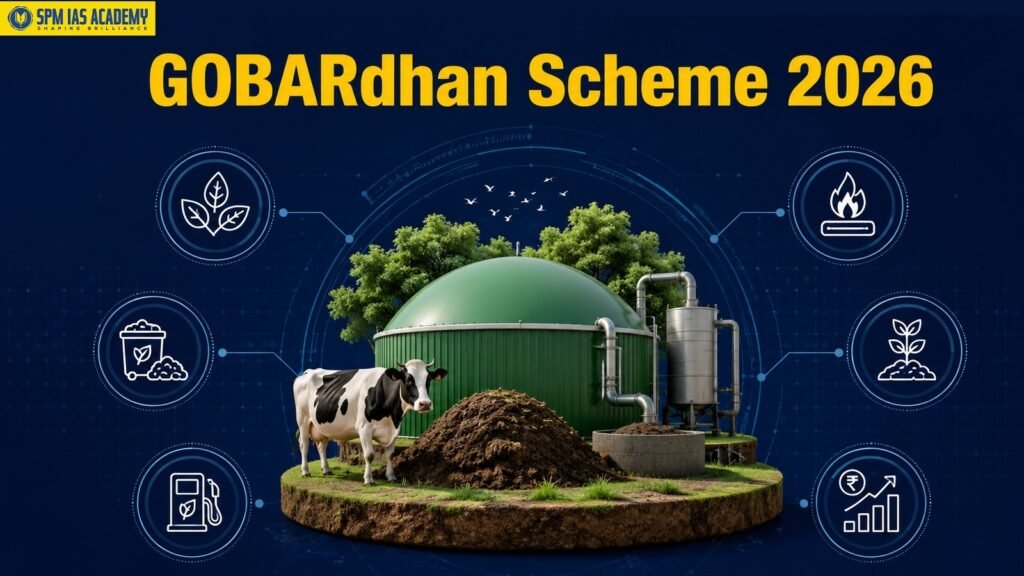
What is the GOBARdhan Scheme?
The GOBARdhan Scheme is a national circular bioenergy programme that encourages the production of Compressed Biogas from organic waste. It follows a simple but powerful idea: India’s waste can fuel India’s growth.
Under this scheme, organic waste will not remain a burden on villages, cities and farms. Instead, it will become a source of clean fuel, organic manure and rural livelihood. The official release states that the scheme seeks to increase domestic CBG production nearly ten-fold and create a vibrant circular bioeconomy across India.
Why is Compressed Biogas Important?
Compressed Biogas is significant because it can be a substitute for India’s fossil fuel demand. India’s natural gas demand is increasing in transport, households, industry and commercial sectors. CBG can meet a growing share of this demand through domestic renewable production. Thus, it can strengthen energy resilience and reduce dependence on imported fossil fuels.
CBG is also chemically equivalent to natural gas. Therefore, it can integrate with India’s existing gas infrastructure and support the country’s clean energy transition.
Six Growth Engines under GOBARdhan Scheme
The GOBARdhan Scheme has six major components that support the entire CBG value chain.
1. Assured CBG Offtake under GOBARdhan Scheme:
The scheme creates a dedicated offtake assurance framework. City Gas Distribution entities will procure CBG to meet the notified CBG obligation of 3% in FY 2026-27, 4% in FY 2027-28 and 5% from FY 2028-29 onwards in CNG transport and PNG domestic segments. This gives producers a long-term demand signal and improves project bankability.
2. Stable CBG Pricing Framework:
The GOBARdhan Scheme introduces a stable administered CBG price of ₹2,110 per MMBTU. The pricing framework will operate with a minimum ten-year horizon and provide revenue certainty to producers.
3. Capital Assistance for CBG Projects:
Eligible greenfield CBG projects will receive capital assistance of up to ₹2 crore per ton per day of installed CBG capacity. Brownfield projects expanding production capacity will also be eligible. This support can reduce the initial capital burden and encourage MSMEs, cooperatives and rural entrepreneurs.
4. Pipeline Infrastructure Development:
The scheme supports pipeline infrastructure connecting CBG plants with trunk pipelines and City Gas Distribution networks. Better connectivity will reduce evacuation costs, improve reliability and expand market reach.
5. Credit Guarantee Support:
A dedicated credit guarantee mechanism will improve institutional credit access for eligible MSME-based CBG projects. It will also reduce collateral pressure and improve lender confidence.
6. CBG Ecosystem Challenge Fund:
The GOBARdhan Scheme will also create a CBG Ecosystem Challenge Fund. It will support feedstock mapping, aggregation infrastructure, district-level planning, technology adoption, capacity building and stakeholder awareness.
What is the relation between GOBARdhan Scheme and Circular Economy?
The GOBARdhan Scheme directly supports circular economy. Each CBG plant can use cattle dung, agricultural residue, press mud, municipal organic waste and biomass. In return, it can produce clean fuel and organic manure.
This generates local economic activity around feedstock supply, transport, plant operations and manure production. Moreover, it improves scientific waste management and lowers greenhouse gas emissions by replacing fossil fuels and productively using organic waste.
Benefits of GOBARdhan Scheme
The GOBARdhan Scheme can create multiple benefits for India:
- It can increase domestic CBG production nearly ten-fold.
- It can reduce dependence on imported fossil fuels.
- It can create new income opportunities for farmers, feedstock aggregators, cooperatives and rural entrepreneurs.
- It can strengthen rural livelihoods and private investment.
- It can support organic manure production and reduce chemical fertiliser dependence.
- It can improve urban and rural waste management.
- It can contribute to Atmanirbhar Bharat and Viksit Bharat goals.
Conclusion
The GOBARdhan Scheme is more than an energy scheme. It connects clean fuel, farmer income, waste management, private investment and climate action into one national framework. By converting organic waste into Compressed Biogas and manure, India can reduce fossil fuel dependence, build rural prosperity and promote circular economy. Therefore, the scheme can become a key pillar of India’s clean energy transition and sustainable development journey.
Read More:
Source:
Frequently Asked Questions
1. What is the GOBARdhan Scheme?
The GOBARdhan Scheme is a national circular bioenergy programme that promotes the production of Compressed Biogas from organic waste. It converts cattle dung, agricultural residue, press mud, municipal organic waste and biomass into clean fuel, organic manure and rural income.
2. Why is the GOBARdhan Scheme important for India’s clean energy transition?
The GOBARdhan Scheme is important because it reduces dependence on imported fossil fuels, increases domestic CBG production and supports India’s renewable energy goals. Moreover, it strengthens waste management, rural livelihoods and circular economy.
3. What are the major benefits of the GOBARdhan Scheme?
The GOBARdhan Scheme can increase CBG production nearly ten-fold, create income opportunities for farmers and rural entrepreneurs, support organic manure production, reduce chemical fertiliser use and improve urban and rural waste management.

Behind every article at SPM IAS Academy is a team of skilled content writers and subject experts committed to making preparation easier for aspirants. From answering common doubts to breaking down complex issues and current affairs, we create content that is accurate, easy to understand, and directly useful for UPSC, APSC, and other competitive exams.