
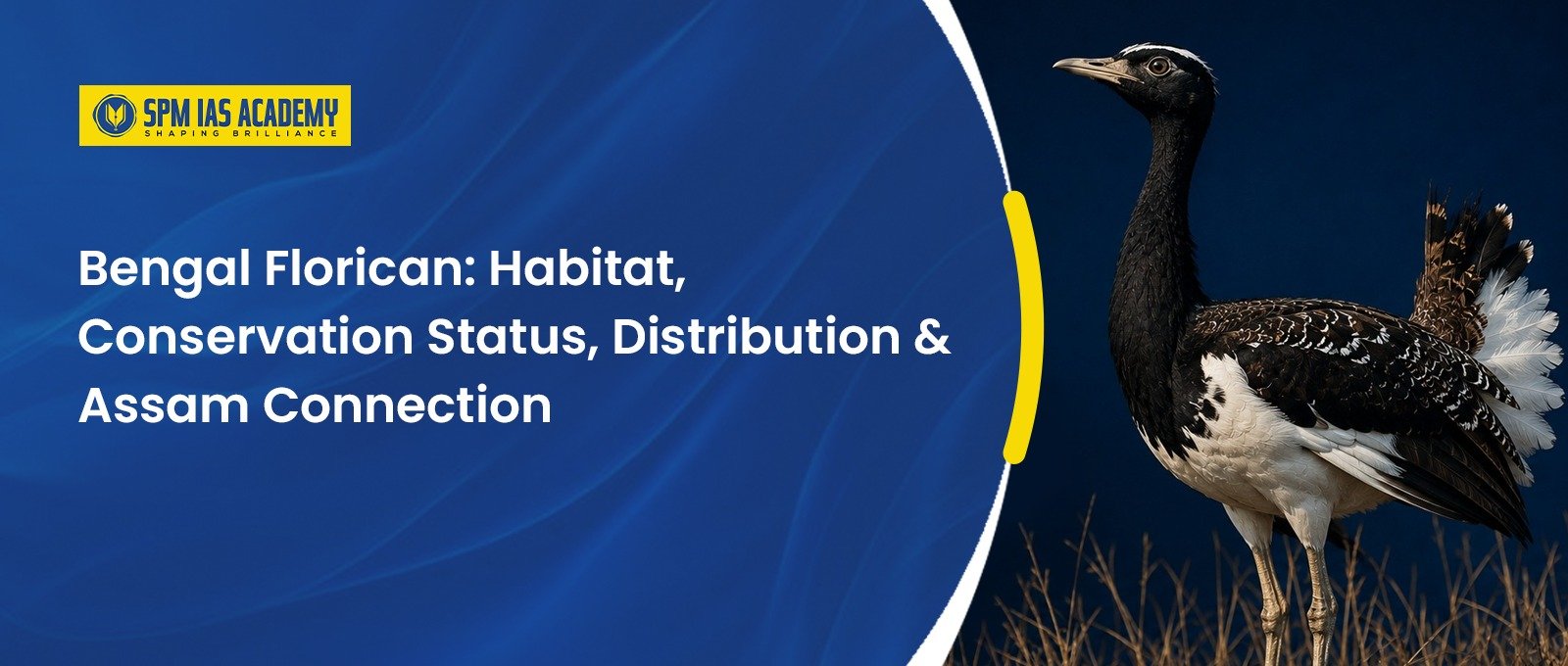
The Bengal Florican (Houbaropsis bengalensis) is one of the world’s rarest bustards and an important indicator of healthy grassland ecosystems. It survives mainly in fragmented patches of alluvial and floodplain grasslands in India, Nepal and Cambodia. In India, Assam forms one of its most important landscapes, with populations occurring in protected grasslands such as Manas, Kaziranga and Orang.
The species attracts special conservation attention because the IUCN lists it as Critically Endangered. Moreover, it receives protection under Schedule I of India’s Wildlife (Protection) Act, 1972, CITES Appendix I, and the Convention on Migratory Species (CMS) Appendix I.
For UPSC, APSC and other State PCS examinations, the species connects with biodiversity conservation, grassland ecosystems, protected areas, species recovery and Assam geography.

Key Facts about Bengal Florican
| Feature | Details |
| Common Name | Bengal Florican |
| Scientific Name | Houbaropsis bengalensis |
| Family | Otididae |
| Type | Grassland bustard |
| IUCN Status | Critically Endangered |
| Wildlife (Protection) Act | Schedule I |
| CITES | Appendix I |
| CMS | Appendix I for H. b. bengalensis |
| Major Indian Range | Assam, Uttar Pradesh and Arunachal Pradesh |
| Preferred Habitat | Moist, open alluvial and floodplain grasslands |
| Ecological Importance | Indicator and flagship species of grassland ecosystems |
Why Are Grasslands Crucial for the Bengal Florican Habitat?
- The habitat of this bird species mainly consists of flat, moist and relatively open grasslands. The Wildlife Institute of India describes it as a habitat specialist that prefers short, open and relatively undisturbed grasslands. It particularly depends on the alluvial grasslands associated with the Terai and Brahmaputra floodplains.
- However, the bird does not use every grassland equally. It needs a suitable mosaic of shorter grass for visibility and displaying, along with taller vegetation that provides cover.
- Important grass species in occupied habitats include Imperata cylindrica, Saccharum spontaneum and Saccharum narenga. Consequently, poorly planned burning, excessive grazing or complete conversion of grasslands can rapidly reduce suitable habitat.
This ecological dependence makes the bird an important grassland indicator species. If its population declines, the decline can indicate deterioration of the wider floodplain grassland ecosystem.
Where Is the Bengal Florican Found in India?
Historically, this species occupied a much wider belt of Terai, Duars and Brahmaputra Valley grasslands. However, habitat conversion has fragmented this range considerably.
- Dudhwa-Kishanpur landscape, Uttar Pradesh
- Manas National Park/Tiger Reserve, Assam
- Kaziranga National Park, Assam
- Orang National Park, Assam
- D’Ering Wildlife Sanctuary, Arunachal Pradesh
BNHS identifies Dudhwa, Kishanpur and Pilibhit in Uttar Pradesh, Manas, Orang and Kaziranga in Assam, and D’Ering in Arunachal Pradesh as important locations. Meanwhile, conservation records from Assam also report the species from areas such as Sonai-Rupai and other grassland landscapes.
Bengal Florican Assam Connection: Why Manas Is Important
The bird is particularly important for APSC preparation because Assam protects some of the species’ most significant remaining grasslands.
- Manas National Park remains a major stronghold. Assam government records identify the bird among the park’s critically endangered species.
- A scientific survey carried out in 2021 recorded 50 males and 17 females in Manas. Researchers also found that grassland succession, livestock grazing, invasive plants and collection of non-timber forest products continued to affect its habitat.
- More recently, a synchronised census on 9-10 April 2025 recorded 38 displaying males and two females across the Manas landscape. Importantly, Kokilabari Seed Farm recorded 12 individuals, showing that seasonally fallow agricultural areas adjoining natural grasslands can also support breeding birds.
These figures should not be treated as directly comparable population totals because surveys can differ in methodology and detectability.
Unique Features and Breeding Behaviour of Bengal Florican
- During the breeding season, the male develops striking black plumage with conspicuous white wing patches, while the female remains largely buff-brown and camouflaged.
- The male is especially famous for its elaborate courtship display. It repeatedly leaps vertically above the grass, flaps its wings and displays its contrasting plumage to attract females. This behaviour makes the bird easier to detect during its display season.
The species is omnivorous and may consume insects, seeds, fruits, flowers and small vertebrates.
Conservation Status and Legal Protection
The Conservation Status of this bird reflects the severe pressure on South Asia’s natural grasslands.
The conservation status:
- IUCN Red List – Critically Endangered
- Wildlife (Protection) Act, 1972 – Schedule I
- CITES – Appendix I
- CMS – Appendix I for the Indian-subcontinent subspecies
India successfully proposed the inclusion of Houbaropsis bengalensis bengalensis in CMS Appendix I at COP13 in 2020, strengthening international cooperation for its conservation.
What are the Major Threats to Bengal Florican Habitat?
The survival of the bird depends primarily on conserving and scientifically managing grasslands. Major threats include:
- Grassland Conversion: Agricultural expansion and new settlements destroy and reduce natural grassland habitat.
- Habitat Fragmentation: Infrastructure and land-use changes break continuous grasslands into smaller, isolated patches, limiting safe breeding areas.
- Unsustainable Burning: Excessive or poorly timed burning disturbs nesting and breeding cycles and reduces suitable habitat.
- Overgrazing: Uncontrolled livestock grazing degrades grassland vegetation and reduces the resources available to the species.
- Invasive Species: Invasive alien plants and natural woody succession alter open grassland ecosystems and reduce suitable florican habitat.
- Infrastructure Development: Roads and other infrastructure disturb habitats and increase human pressure on grassland ecosystems.
- Altered River Regimes: Changes in natural flooding and river-flow patterns can transform grassland habitats and affect their regeneration.
- Human Disturbance & Hunting: Hunting, resource extraction and other human activities increase disturbance and threaten species survival.
Conservation of Bengal Florican in Assam
Conservation requires more than protecting individual birds. Authorities must maintain the grassland ecosystem itself.
- Assam-based conservation organisation Aaranyak has worked with the Assam Forest Department and other partners to survey populations, identify threats, restore degraded habitat, build local conservation networks and create alternative livelihood opportunities that reduce pressure on grasslands.
- Therefore, effective conservation should focus on scientific grassland burning, invasive-species control, habitat monitoring, community participation and protection of grassland mosaics outside core protected areas.
Conclusion
The Bengal Florican represents both the richness and vulnerability of India’s natural grasslands. Its Critically Endangered status results largely from shrinking and degrading alluvial grasslands.
Assam, especially the Manas landscape carries major conservation responsibility. By protecting grasslands through scientific management and community participation, India can conserve not only this bird species but also an entire ecosystem shared by numerous threatened species.
Read More:
Source:
Frequently asked question
1. What is the conservation status of the Bengal Florican?
The conservation status of this bird species is Critically Endangered as per IUCN Red List. Moreover, India protects the species under Schedule I of the Wildlife (Protection) Act, 1972, while CITES and CMS provide additional international protection.
2. Where is the Bengal Florican found in India?
This bird species occurs mainly in moist alluvial and floodplain grasslands. In India, important populations occur in Assam, Uttar Pradesh and Arunachal Pradesh, including Manas, Kaziranga, Orang, Dudhwa, Kishanpur and D’Ering Wildlife Sanctuary.
3. Why is Assam important for Bengal Florican conservation?
Assam plays a crucial role in Bengal Florican conservation because the state contains important grassland habitats, particularly in the Manas landscape. Therefore, protecting these habitats through scientific grassland management, invasive-species control, habitat monitoring and community participation can support the species’ recovery.

Behind every article at SPM IAS Academy is a team of skilled content writers and subject experts committed to making preparation easier for aspirants. From answering common doubts to breaking down complex issues and current affairs, we create content that is accurate, easy to understand, and directly useful for UPSC, APSC, and other competitive exams.