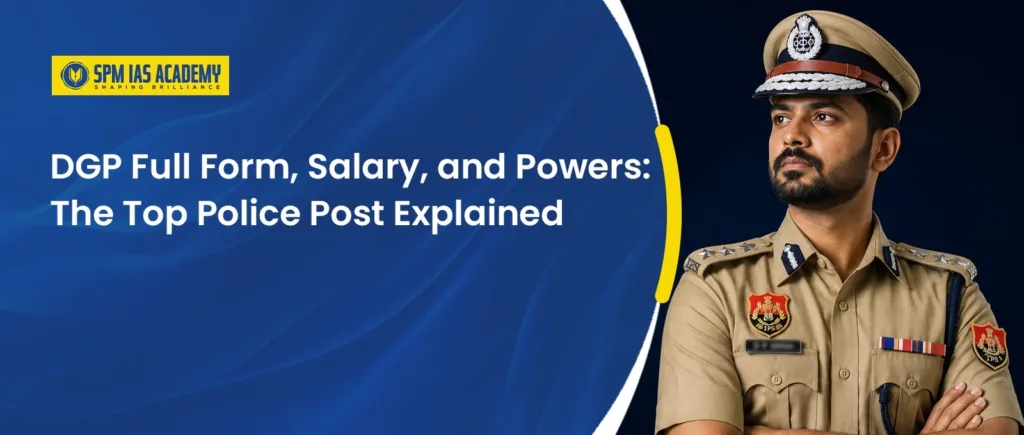
Every state in India has one police officer whose signature can move an entire force of tens of thousands of men and women. That officer is the DGP. The post is at once the most visible job in Indian policing and one of the least understood—people know the DGP is “the boss,” but far fewer know what the DGP can actually order, what the job pays, or why the Supreme Court has spent the better part of two decades fighting with state governments over who gets to sit in that chair. In this article, we will answer the frequent queries related to DGP, including DGP full form, salary, promotion, and how to become a DGP.
Here is the complete picture, updated for 2027.
DGP Full Form: What Does DGP Stand For?
DGP Full Form stands for Director General of Police.
The Director General of Police is the senior-most police officer in an Indian state or union territory, and the operational head of that state’s police force. In official paperwork the post is often written as DGP (Head of Police Force) or HoPF — a distinction that matters more than it sounds, and one we’ll come back to.
A few quick facts that anchor everything else:
| Attribute | Detail |
| DGP Full form | Director General of Police |
| Service | Indian Police Service (IPS), an All-India Service under Article 312 |
| Status | Highest-ranking police officer in a state or UT |
| Pay level | Level 17 (Apex Scale) of the 7th CPC pay matrix |
| Basic pay | ₹2,25,000 per month (fixed, no increments) |
| Appointed by | State cabinet, from a panel prepared by the UPSC |
| Minimum tenure | 2 years |
| Insignia | National Emblem above a crossed sword and baton |
| Reports to | State Home Minister / Home Department |
| Route to the post | UPSC Civil Services Examination → IPS → ~30 years of service |
DGP Full Form in Hindi and other usages
In Hindi, DGP is written as पुलिस महानिदेशक. You will also see “DGP full form in police” searched frequently — the answer is the same, Director General of Police. Some states use the older colonial title Inspector-General of Police in their statutes even though the officer is called DGP in practice; more on that in the powers section.
Is DGP the Highest Rank in Police?
Many asks us about this too after searching for the DGP full form. Yes. Director General is the highest rank in Indian policing, and there is no rank above it. Within a state, the DGP heading the police force is the senior-most officer. What sits above a DGP is not another police rank — it is the political executive.
Three refinements matter here, and the first is the single most common error in writing on this subject.
DGP vs DG: the distinction almost everyone misses
Director General (DG) is a rank. DGP (Head of Police Force) is a post.
A large state may have eight, ten, even fifteen officers holding DG rank at any given time — Director General of Prisons, DG Fire and Emergency Services, DG Vigilance, DG Home Guards, DG Training, and so on. All of them wear identical shoulder insignia. All of them are addressed as “DG.” Only one of them is the state police chief.
This distinction has real financial and legal consequences:
- DG-rank officers sit at Pay Level 16 (₹2,05,400–₹2,24,400)
- The DGP who heads the police force sits at Pay Level 17 (₹2,25,000 fixed) — the apex scale, equivalent to a Secretary to the Government of India
It also drives eligibility. Under the framework the Supreme Court has enforced, the apex Level 17 post is filled by selection from officers already holding DG-level posts at Level 16 — which is exactly what the ongoing Odisha DGP dispute in 2026 turned on, when the state promoted ADG-rank officers from Level 15 to Level 16 shortly before the UPSC panel was to be finalised.
The centre has DG-rank posts too
The Director of the Intelligence Bureau, the Director of the CBI, and the Directors General of the CRPF, BSF, CISF, ITBP and SSB are all IPS officers at DG rank. The Director IB is widely regarded as the senior-most position an IPS officer can hold, though it is not formally “higher” in rank than a state DGP.
The DGP is not the highest police authority
Under Section 3 of the Police Act, 1861, the State Government has superintendence over the police. The DGP commands the force but does not control it — a distinction the Supreme Court has spent two decades trying to protect through fixed tenures. We’ll unpack this in the powers section.
How Many DGPs Are There in One State?
Each state has exactly one DGP in the sense that matters — the Director General of Police who heads the police force, at Pay Level 17. But the same state may simultaneously have five to fifteen officers holding DG rank at Level 16, all addressed as “DG.”
Typical DG-rank posts in a large state alongside the police chief:
- Director General of Prisons and Correctional Services
- DG Vigilance / Anti-Corruption Bureau
- DG Fire and Emergency Services
- DG Home Guards and Civil Defence
- DG Training / Police Academy
- DG CID or Crime
- DG Police Housing and Welfare Corporation
- Special DGP (Law and Order) or (Intelligence) in some states
The number is capped by each state’s sanctioned IPS cadre strength, fixed by the Centre and reviewed periodically, so it varies widely — Uttar Pradesh and Maharashtra carry many more DG-rank posts than Sikkim or Goa. The insignia is identical across all of them, which is why news captions routinely misidentify a DG-rank officer as “the DGP.”
How Many DGPs Are There in India?
India has 28 state DGPs, one for each state, plus police chiefs in the union territories — bringing the number of DG-rank police heads to roughly 35. Counting every officer of DG rank across states and central forces, the figure runs into the low hundreds.
The breakdown, with the caveats that make the answer defensible:
- 28 states, each with one DGP heading its police force.
- Union territories vary. Jammu and Kashmir, Ladakh, Chandigarh, Puducherry and the Andaman and Nicobar Islands have DGPs. Delhi is the notable exception — its force is headed by a Commissioner of Police, not a DGP. The smallest UTs are headed by officers below DG rank.
- Central forces add more. The Directors General of the CRPF, BSF, CISF, ITBP, SSB, NSG and NIA, and the Directors of the IB and CBI, are all IPS officers at DG level.
For scale: the sanctioned strength of the IPS was 5,099 posts as of 1 January 2025, with 505 vacancies, per a Rajya Sabha reply tabled on 12 February 2026. DG-rank officers are a small fraction of that, and DGPs heading state forces are a fraction of the fraction.
DGP Salary in India (2026)
The basic pay
The DGP heading a state police force draws a fixed basic pay of ₹2,25,000 per month under Pay Level 17 of the 7th Central Pay Commission matrix. “Fixed” is literal — Levels 15 through 18 have no cells and no annual 3% increment. The 7th CPC took the view that officers at this altitude serve short, tenure-bound stints before retirement, so a flat figure was appropriate. Dearness Allowance, however, continues to be revised on that fixed base.
DGP salary per month: the 2026 breakdown
The Union Cabinet approved a 2% DA hike on 18 April 2026, taking Dearness Allowance from 58% to 60%, effective retrospectively from 1 January 2026.
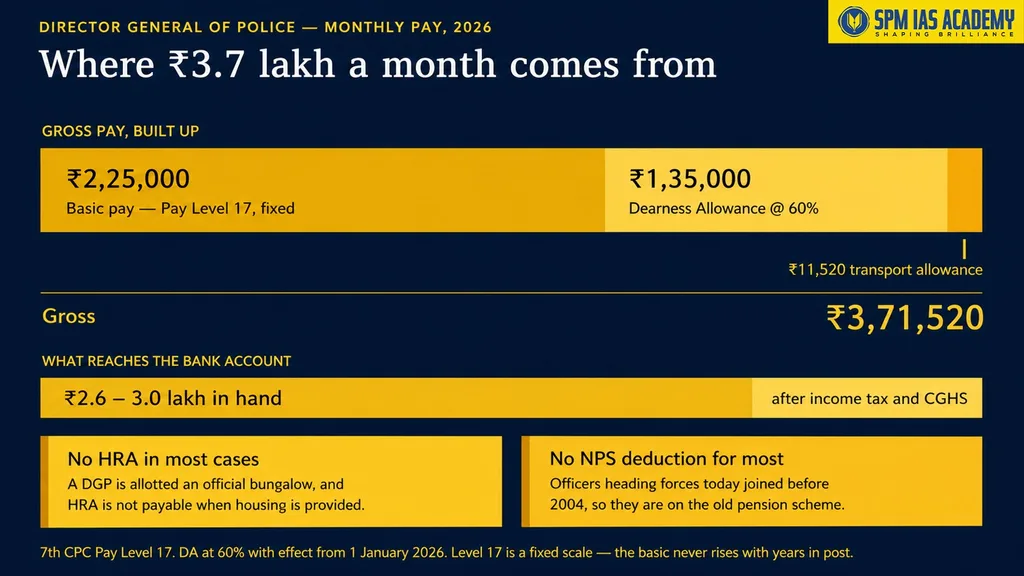
Working through the arithmetic for a serving DGP:
| Component | Amount (₹/month) | Notes |
| Basic pay (Level 17) | 2,25,000 | Fixed |
| Dearness Allowance @ 60% | 1,35,000 | Revised twice yearly |
| Basic + DA | 3,60,000 | |
| Transport Allowance + DA on TA | ~11,520 | Most DGPs use an official vehicle instead |
| House Rent Allowance (X city @ 30%) | 67,500 | Usually not paid — see below |
| Indicative gross | ₹3.7 – 4.4 lakh | Depends on accommodation and state allowances |
| Approximate in-hand | ₹2.6 – 3.0 lakh | After tax and other deductions |
The HRA caveat is important. DGPs are almost always allotted government accommodation — typically a large official bungalow in the state capital. When government housing is allotted, HRA is not payable. So the realistic gross for most serving DGPs is closer to ₹3.7 lakh than ₹4.4 lakh, with the difference showing up as a rent-free house rather than cash.
Two details most articles get wrong
First, the widely-copied “₹2,52,550 in-hand” figure is stale. It predates the current DA rate of 60%.
Second, almost every article deducts 10% NPS. Most sitting DGPs joined the IPS between 1990 and 1995, comfortably before the 1 January 2004 cut-off, and are therefore on the old defined-benefit pension scheme with no compulsory NPS deduction. Their General Provident Fund contribution is voluntary. That single correction moves in-hand estimates by roughly ₹36,000 a month.
What does come off the payslip:
- CGHS contribution (top slab)
- Income tax at the highest marginal rate — the dominant deduction
- Any voluntary GPF or insurance contributions
DGP salary after 10 years: correcting a common misconception
Two things are worth saying plainly, because this is one of the most-searched and least-accurately-answered questions on the topic.
No officer is a DGP at 10 years of service. At that stage an IPS officer is typically an SP at Pay Level 11 or 12, earning ₹67,700–₹78,800 basic. The realistic ladder:
| Years of service | Rank | Basic pay (₹) |
| 0–4 | ASP / SDPO | 56,100 |
| 5–9 | SP | 67,700 – 78,800 |
| 10 | SP / Selection Grade | ~78,800 – 1,23,100 |
| 14–16 | DIG | 1,31,100 |
| 18–20 | IG | 1,44,200 |
| 25 | ADGP | 1,82,200 |
| 30+ | DG rank | 2,05,400 |
| 30–33+ | DGP (Head of Police Force) | 2,25,000 |
And ten years as a DGP would pay the same as day one. Level 17 is a fixed scale with no increments. What rises is Dearness Allowance, revised twice a year on the fixed base. In practice the point is moot: a DGP’s statutory tenure is two years, and superannuation at 60 usually arrives soon after.
DGP salary compared across police ranks
| Rank / Post | Pay Level | Basic Pay (₹) |
| ASP (probationer) | Level 10 | 56,100 |
| SP | Level 11 / 12 | 67,700 / 78,800 |
| SSP | Level 13 | 1,23,100 |
| DIG | Level 13A | 1,31,100 |
| IG | Level 14 | 1,44,200 |
| ADGP | Level 15 | 1,82,200 – 2,24,100 |
| DG-rank officer | Level 16 | 2,05,400 – 2,24,400 |
| DGP (Head of Police Force) | Level 17 | 2,25,000 (fixed) |
| Cabinet Secretary (for reference) | Level 18 | 2,50,000 |
Pay levels are uniform across states because IPS pay is governed by central rules. What varies is HRA class, state-specific allowances, and the scale of official perquisites.
Does the DGP salary change with the 8th Pay Commission?
Eventually, yes — but not soon.
The 8th Central Pay Commission was constituted by Gazette notification on 3 November 2025, chaired by Justice Ranjana Prakash Desai (Retd.). It has an 18-month mandate, putting its report around mid-2027. The reference date for revised pay is 1 January 2026, so whenever the government notifies the new structure, arrears will run back to that date.
The critical variable is the fitment factor, which is not yet decided. Estimates in circulation range from about 1.83 to 2.86, with staff federations pushing for 3.83. Any number you see today for “DGP salary under the 8th Pay Commission” is a projection, not a figure. Treat it accordingly — and note that a high fitment factor is less generous than it looks, because the existing 60% DA gets absorbed into the new basic and resets to zero.
Perks and Facilities of a DGP
Beyond cash, the office carries a substantial non-monetary package:
- Official residence — a Type VIII-equivalent bungalow, rent-free, in the state capital
- Official vehicle with driver, escort, and pilot car as security assessment warrants
- Personal security detail, usually including armed commandos
- Domestic staff — orderlies, cook, gardener, as per state entitlement rules
- Medical cover through CGHS or the state’s equivalent scheme, extending to dependants
- Travel entitlements — highest class on official travel, plus LTC
- Communication and office allowances, secretarial support, and a personal staff establishment
- Pension — for officers on the old scheme, 50% of last drawn basic plus Dearness Relief, with commutation options
Post-retirement, DGP-rank officers are commonly appointed to State Human Rights Commissions, State Information Commissions, Police Complaints Authorities, PSU security roles, and central inquiry commissions.
Powers of a DGP: What the Post Can and Cannot Do
Here is where popular understanding diverges most sharply from the law. The DGP is powerful, but the power is administrative and operational rather than sovereign — and it is deliberately bounded.
The statutory foundation
Most states still trace their police law to the Police Act, 1861, or to a state police act modeled on it. Two sections define the architecture:
- Section 3 vests superintendence of the police throughout a general police district in the State Government, not in any police officer.
- Section 4 vests the administration of the police in an officer styled the Inspector-General of Police — the office that has since been re-designated as Director General of Police in most states.
That split—superintendence with the political executive, administration with the DGP — is the whole ballgame. It is why a DGP runs the force but does not own it, and why the fight over DGP appointments has been so bitter for so long.
Two further provisions matter in practice. Section 12 empowers the head of the force to frame rules for the police — subject to state government approval. And under the Bharatiya Nagarik Suraksha Sanhita, 2023 (which replaced the CrPC from 1 July 2024), the DGP is the authority through whom a range of investigative designations, notifications and procedural powers flow down the chain.
Administrative powers
- Command of the entire state police force, including armed battalions, CID, intelligence wing, special task forces, traffic, and technical branches
- Postings and transfers of subordinate officers within the powers delegated by the state government
- Disciplinary authority over subordinate ranks, including suspension, departmental inquiry, and punishment as per service rules
- Framing standing orders, police manuals and standard operating procedures
- Budget formulation for the police department and control of modernisation funds
- Recruitment and training policy for the state force
Operational powers
- Directing deployment across the state — including moving armed reserves between districts during communal tension, elections, festivals, or natural disasters
- Constituting Special Investigation Teams and reassigning investigations between units
- Approving sensitive operations — anti-insurgency, organised crime, counter-terror
- Requisitioning central armed police forces through the state government
- Coordinating with central agencies — IB, NIA, CBI, ED — on cases with inter-state or national dimensions
- Advising the state government on law and order, and representing the state at national security conferences convened by the MHA
Magisterial and legal powers
Under Section 5 of the Police Act, 1861, the head of the police force has the powers of a Magistrate throughout the general police district, exercisable subject to limitations the state government may impose. In commissionerate cities, magisterial powers of preventive action sit with the Commissioner of Police rather than the district magistrate — a structure recommended by the Gore Committee and endorsed by the Second Administrative Reforms Commission, and now used in Mumbai, Delhi, Kolkata, Chennai, Hyderabad, Bengaluru, Ahmedabad, Pune and elsewhere.
What a DGP cannot do
This list is as important as the one above:
- Cannot override the State Government. Superintendence rests with the political executive, and lawful government directions bind the DGP.
- Cannot register, quash or direct the outcome of a case in defiance of law. Investigation is a statutory function; courts have repeatedly held that supervisory officers may guide but not dictate the conclusion of an investigation.
- Cannot act against the IPS (Discipline and Appeal) Rules in dealing with IPS officers — that authority lies with the state government and, for certain actions, the Centre.
- Cannot secure their own tenure. Ironically, the officer who commands the force has historically had the least control over how long they command it — which is precisely what the courts have tried to fix.
How a DGP Is Appointed: The Prakash Singh Framework
The appointment process is the most litigated aspect of the post.
The 2006 judgment
In Prakash Singh v. Union of India (2006), the Supreme Court issued seven directives aimed at insulating the police from political interference. On the DGP specifically, it held that:
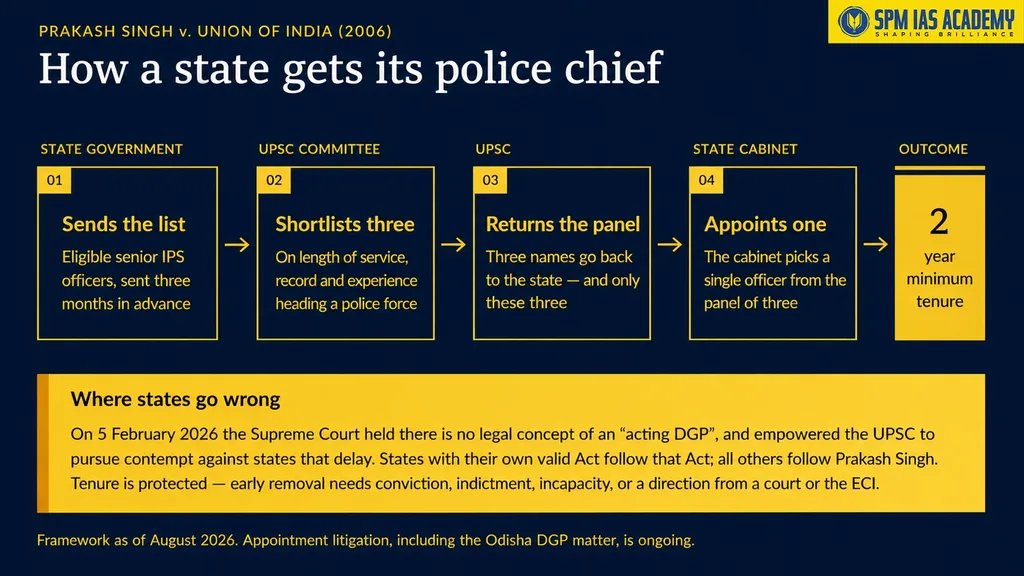
- The state must select the DGP from among the three senior-most officers empanelled by the UPSC for that rank
- Empanelment is based on length of service, a very good record, and range of experience in heading a police force
- The selected DGP must get a minimum tenure of two years, irrespective of the date of superannuation
The Court later clarified that the two-year requirement refers to the minimum tenure after appointment — it does not mean only officers with two years of residual service can be considered. A 2019 direction added that the UPSC panel should comprise officers with at least six months of residual service.
The step-by-step process
| Step | Who acts | What happens |
| 1 | State Government | Sends a proposal of eligible senior IPS officers to the UPSC, ideally three months before the incumbent retires |
| 2 | UPSC Empanelment Committee | Chaired by the UPSC Chairman, with the Union Home Secretary, the State Chief Secretary and the outgoing/senior-most DGP; shortlists three names |
| 3 | UPSC | Forwards the panel of three to the state |
| 4 | State Cabinet | Appoints one officer from the panel as DGP |
| 5 | — | Appointee gets a fixed two-year tenure |
Where a state has enacted its own valid Act governing DGP appointment — Uttar Pradesh and Jharkhand are examples — the Supreme Court has clarified that the state law governs. In the absence of such an Act, the Prakash Singh guidelines apply.
The 2026 crackdown on “acting DGPs”
Compliance has been patchy for two decades. Many states simply appointed “acting” or “in-charge” DGPs and never sent proposals to the UPSC at all — Telangana went without a regular DGP from 2017 onwards; Punjab, Tamil Nadu, Uttar Pradesh and Bihar have all used the acting arrangement for extended stretches.
That prompted a sharp escalation:
- 8 January 2026 — The UPSC issued fresh guidelines, framed on the Attorney General’s advice, requiring a state to seek the Supreme Court’s permission or clarification if it submits its DGP panel late.
- 5 February 2026 — A bench led by CJI Surya Kant, with Justices Joymalya Bagchi and Vipul Pancholi, hearing the UPSC’s grievance against Telangana, held that there is no legal concept of an “acting DGP”. It empowered the UPSC to send reminders to defaulting states and, failing compliance, to file applications in the Prakash Singh matter — opening the door to contempt.
- March 2026 — The Court closed contempt proceedings against Bihar, Andhra Pradesh and Telangana after proposals were finally submitted, and reiterated the rule: states with a valid Act follow the Act; everyone else follows Prakash Singh.
- August 2026 — The framework is being tested again in Odisha, where a PIL argued that the state withdrew its UPSC panel and promoted ADG-rank officers so they could be slotted into a fresh list. The Court directed the UPSC not to finalise the selection, and the matter has been listed for further hearing on 2 September 2026.
For anyone writing about, studying, or reporting on Indian policing, this is the live edge of the subject. The law is settled; the compliance is not.
DGP Insignia and Uniform
A DGP’s rank is identified by:
- Shoulder insignia: the National Emblem (Lion Capital of Ashoka) above a crossed sword and baton, in gold, on the epaulettes
- Gorget patches: dark blue collar tabs with an oak leaf pattern in gold
- “IPS” lettering on the epaulette below the insignia
One quirk worth knowing: the rank insignia of the DGP, Special DGP and Additional DGP is identical. You cannot tell a state police chief from an Addl. DGP by the shoulder alone. The difference is in the appointment order, the pay level, and the office — not the badge. It’s a small detail that trips up quiz questions and news captions alike.
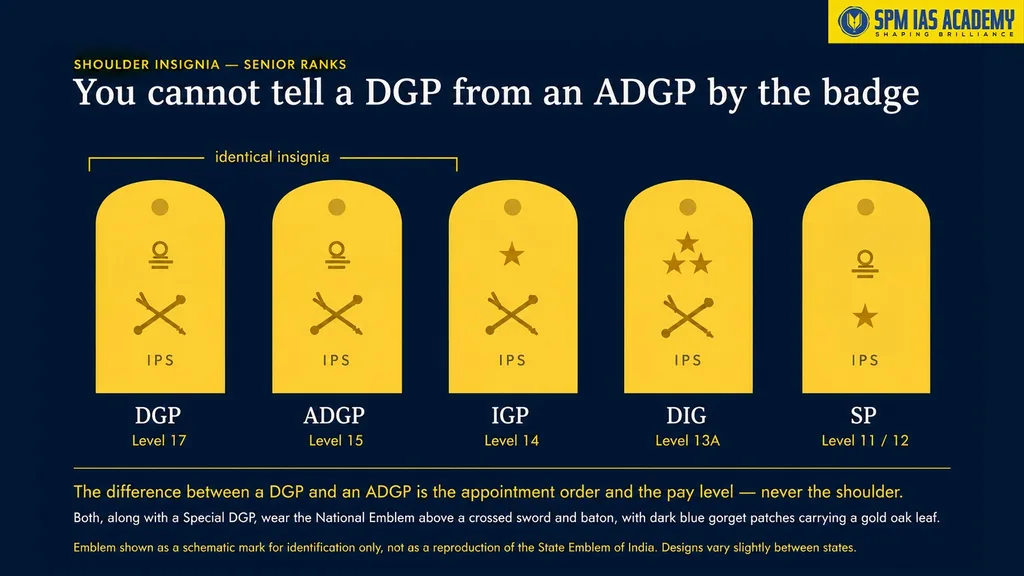
For reference, the senior ranks below:
| Rank | Insignia |
| DGP / Spl. DGP / Addl. DGP | National Emblem above crossed sword and baton |
| IGP | One star above crossed sword and baton |
| DIG | Three stars above crossed sword and baton |
| SSP / SP | National Emblem with star(s), plus gorget patches |
How to Become a DGP in India
There is exactly one route, and it is long.
DGP exam name: there isn’t one
Before the steps, clear up the most common search confusion. There is no DGP exam. DGP is a promotional post, not a recruitment grade. The examination you must clear is the UPSC Civil Services Examination (CSE).
| Question | Answer |
| Exam name | UPSC Civil Services Examination (CSE) |
| Conducting body | Union Public Service Commission |
| Stages | Prelims → Mains → Interview |
| Frequency | Annually |
| Service recruited into | Indian Police Service (IPS) |
| Route to DGP | Promotion over ~30 years + UPSC empanelment + state cabinet selection |
One alternative route exists. State Police Service officers — PPS, MPS and their equivalents — recruited through State Public Service Commission examinations can be inducted into the IPS through promotion. That path is slower and the officer joins the IPS at a senior age, so reaching DGP is uncommon but not impossible; a handful of promoted officers have reached DG and Special DG rank.
The four steps
Step 1 — Clear the UPSC Civil Services Examination. Prelims, Mains, Interview. The IPS is allotted on rank and preference, subject to the physical and medical standards specific to the service.
Step 2 — Training. Foundation Course at LBSNAA, Mussoorie, followed by Phase I and Phase II training at the Sardar Vallabhbhai Patel National Police Academy, Hyderabad, with a district practical attachment in between.
Step 3 — Climb the cadre. Indicative timelines, which vary by state cadre and vacancy position:
| Rank | Typical years of service |
| ASP / SDPO | 0 – 4 |
| SP | 5 – 9 |
| DIG | 14 – 16 |
| IG | 18 – 20 |
| ADGP | 25 |
| DG rank | 30+ |
| DGP (Head of Police Force) | 30 – 33+ |
Step 4 — Get empanelled and selected. DG-rank promotion depends on seniority, APAR record, a clean vigilance file, and available cadre posts. Selection as DGP then depends on making the UPSC panel of three and being picked by the state cabinet.
The honest caveat
Promotions in the IPS run on seniority, not heroics. There is no out-of-turn promotion for spectacular casework. Reaching DGP requires an unbroken thirty-year record, arriving in the eligibility zone while posts happen to be vacant, and a measure of institutional luck. Most IPS officers never head a state police force — each state has one such post, and roughly 150 to 200 officers enter the service each year.
Is DGP Higher Than IAS?
The question compares a post with an entire service, so it has no clean answer. IAS is a service; DGP is the top police post in a state. The fair comparison is DGP vs Chief Secretary — and both draw the same Pay Level 17 basic of ₹2,25,000, though the Chief Secretary outranks the DGP in state protocol.
Here is the accurate picture, because this is where most articles go wrong.
On pay, they are equal. The DGP heading a state police force and the Chief Secretary of that state both sit at Pay Level 17 of the 7th CPC matrix, drawing a fixed ₹2,25,000 basic. Neither earns more than the other.
On protocol, the Chief Secretary is senior. The Chief Secretary is the head of the state’s permanent executive and ranks 23rd on the Indian Order of Precedence, equivalent to a Secretary to the Government of India. State warrants of precedence typically place the Chief Secretary above the DGP. The Chief Secretary chairs bodies the DGP sits on, not the reverse.
On authority, they run different machines. The DGP commands an armed force of tens of thousands with statutory powers of arrest, investigation and preventive action — powers no IAS officer holds. The Chief Secretary coordinates every department in the state, including the Home Department through which police policy and budgets flow.
The structural asymmetry that fuels the debate. Under Section 3 of the Police Act, 1861, superintendence of the police vests in the State Government, while Section 4 vests only administration in the head of the force. At district level, Section 4 places the Superintendent of Police under the “general control and direction” of the District Magistrate — an IAS officer. That single clause is the root of the century-old IAS-versus-IPS friction, and it has survived every reform attempt.
Verdict: Neither service is “higher.” An IAS officer can rise to Cabinet Secretary at Level 18 (₹2,50,000), which is above any police post. An IPS officer’s ceiling is Level 17. On that narrow measure the IAS peak is higher — but a DGP is senior to the overwhelming majority of IAS officers in any state.
Which Is Higher, DGP or DC?
The DGP is far higher than a DC, on either meaning of the abbreviation. A DGP heads an entire state police force at Pay Level 17 (₹2,25,000). A DC — whether District Collector or Deputy Commissioner of Police — is a district-level officer roughly 20 to 25 years junior.
“DC” is ambiguous in Indian usage, so both readings are covered:
| DGP | DC (District Collector / Deputy Commissioner, IAS) | DCP (Deputy Commissioner of Police, IPS) | |
| Service | IPS | IAS | IPS |
| Jurisdiction | Entire state / UT | One district | One police district in a commissionerate city |
| Pay Level | 17 (₹2,25,000) | 11–13 (₹67,700–₹1,23,100) | 11–13 (₹67,700–₹1,23,100) |
| Service required | 30+ years | 5–9 years | 5–9 years |
| Equivalent police rank | — | SP-equivalent in protocol | SP |
One caveat worth including for accuracy: within his or her own district, a District Collector holds magisterial powers the DGP does not, including general control and direction over district police administration under the Police Act. Hierarchy and jurisdiction are different things. But in rank, pay, seniority and command, the DGP is unambiguously senior.
DGP vs Commissioner of Police vs Home Secretary
Three roles that get conflated constantly:
| DGP | Commissioner of Police | Home Secretary | |
| Service | IPS | IPS | IAS |
| Jurisdiction | Entire state / UT | One commissionerate city | State home department |
| Rank held | DG (Level 17 for HoPF) | Usually ADG or DG rank | Principal Secretary / ACS |
| Nature of role | Operational head of police | City police chief with magisterial powers | Civil administration of the home portfolio |
| Relationship | Senior in the police chain | Reports within the police chain | Parallel — administrative channel to government |
The DGP is not subordinate to the Commissioner of Police; the reverse is generally true within the police hierarchy, though the Commissioner in a major metro often reports directly to the state government on city law and order. And the DGP is not subordinate to the Home Secretary either — they are different channels running to the same political authority.
Sources: Police Act, 1861 (Ministry of Home Affairs); 7th Central Pay Commission pay matrix; Department of Expenditure DA Office Memorandum dated 22 April 2026; Supreme Court of India, Prakash Singh v. Union of India (2006) and subsequent orders; UPSC guidelines dated 8 January 2026; Rajya Sabha reply on All India Services cadre strength dated 12 February 2026; reporting by Bar and Bench, LiveLaw, The Hindu.
FAQs on The DGP Full Form
DGP’s full form is Director General of Police. The DGP is the senior-most police officer and heads the police force of an Indian state or union territory.
The DGP full form in police is Director General of Police. It is the highest rank in Indian policing, although a state can have several officers holding Director General (DG) rank.
DGP stands for Director General of Police. A DGP serving as the Head of Police Force receives a fixed basic pay of ₹2,25,000 per month at Pay Level 17, along with applicable allowances and official benefits.
The DGP full form is Director General of Police. There is no separate DGP exam. An officer typically clears the UPSC Civil Services Examination, joins the IPS, and reaches DGP level after around 30 or more years of service.
DGP means Director General of Police. Yes, Director General is the highest rank in Indian policing, and the DGP heading the police force is the senior-most police officer in a state or union territory.

Written by SPM IAS Academy Content Team
We don’t create content to fill pages; we create content that fills the gaps in your preparation. Every article is researched, refined, and designed with one goal — to make your journey towards success a little sharper.
No unnecessary noise. No recycled information. Just focused insights, exam-oriented guidance, and content that actually helps aspirants move forward.
Because when the competition is tough, average preparation doesn’t make the cut.