
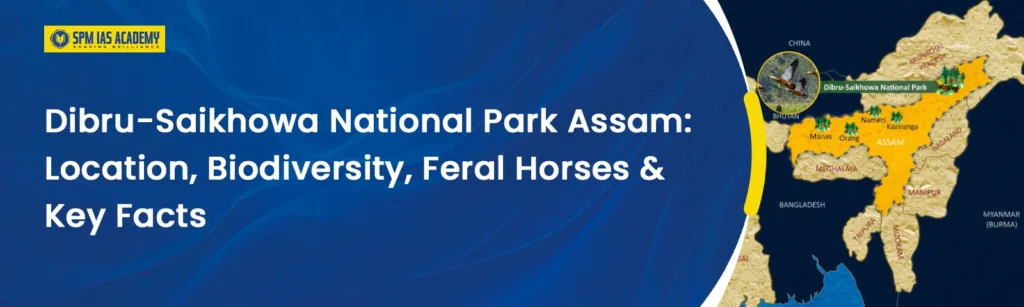
Dibru-Saikhowa National Park
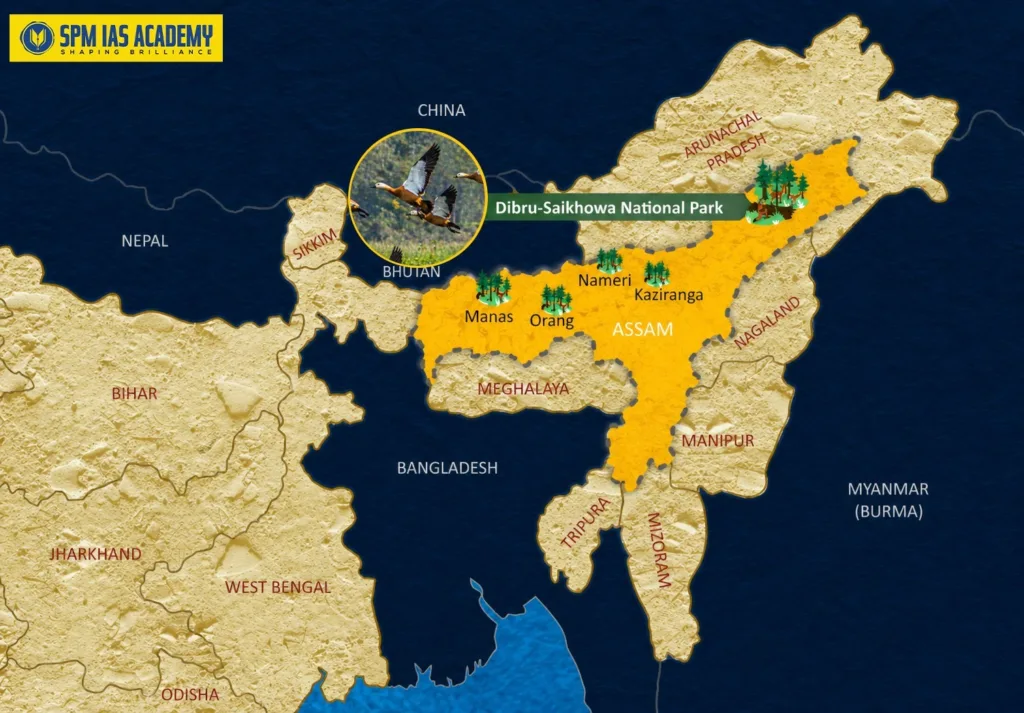
Dibru-Saikhowa National Park is a unique national park and biosphere reserve in India. It lies in the flood plains of the Brahmaputra River in Assam. Firstly, the park covers about 340 square kilometres as a national park. Moreover, along with its buffer zone, the biosphere reserve spreads over 765 square kilometres. The park is located in the Dibrugarh and Tinsukia districts of Assam.
Additionally, Dibru-Saikhowa National Park is famous for its feral horses and the White-winged Wood Duck. Furthermore, it is part of a globally important biodiversity hotspot, which makes it very rich in wildlife and plant species. Therefore, Dibru-Saikhowa National Park is a very important topic for UPSC, APSC, and other competitive exams.
For expert guidance on Assam and environment topics, join the best UPSC coaching center Guwahati for complete preparation.
Dibru-Saikhowa National Park: Quick Facts
| Feature | Details |
| Location | Dibrugarh and Tinsukia Districts, Assam, India |
| Nearest City | Tinsukia |
| Coordinates | 27 degrees 40 minutes N, 95 degrees 23 minutes E |
| National Park Area | 340 sq. km (core zone) |
| Biosphere Reserve Area | 765 sq. km (core 340 sq. km + buffer 425 sq. km) |
| Altitude | 110 to 126 metres (average 118 metres) above sea level |
| Declared Wildlife Sanctuary | 1986 (preliminary), 1995 (final – 340 sq. km) |
| Declared Biosphere Reserve | July 1997 |
| Declared National Park | 1999 |
| Bounded by Rivers | Brahmaputra and Lohit Rivers (north), Dibru River (south) |
| Annual Rainfall | 2,300 to 3,800 mm |
| Climate | Tropical monsoon – hot wet summer, cool dry winter |
| Famous For | Feral Horses, White-winged Wood Duck, biodiversity hotspot |
| Forest Type | Largest Salix swamp forest in Northeast India |
| Nearest Airport | Dibrugarh (Mohanbari Airport) |
Where is Dibru-Saikhowa National Park Located?
Dibru-Saikhowa National Park is located in the Dibrugarh and Tinsukia districts of Assam. It lies in the flood plains of the mighty Brahmaputra River in northeastern India. The nearest city is Tinsukia.
The park has a very distinctive boundary formed by rivers. Three rivers naturally enclose the park on different sides:
- North boundary: Brahmaputra River and Lohit River
- South boundary: Dibru River
This river-bounded location makes the park a riverine island ecosystem. Furthermore, it makes the park one of the most unique national parks in the entire country. The park sits at an average elevation of 118 metres above sea level.
Historical Background of Dibru-Saikhowa National Park
The history of Dibru-Saikhowa is long and systematic. Each stage of its development is important for competitive exams. Here is the complete timeline:
- Firstly, in 1890, the government declared the area as Dibru Reserved Forest.
- Moreover, in 1920, authorities added more land to the Dibru Reserve Forest.
- Additionally, in 1929, they declared Saikhowa as a separate Reserve Forest.
- Furthermore, in 1933, they added more area again to the Dibru Reserved Forest.
- After that, in 1986, officials declared around 650 sq. km as a Wildlife Sanctuary (preliminary stage).
- Later, in 1995, the government officially declared 340 sq. km as a Wildlife Sanctuary.
- In addition, in July, 1997, they declared Dibru-Saikhowa as a Biosphere Reserve covering 765 sq. km.
- Subsequently, in 1999, the core area of 340 sq. km became a National Park.
Prepare national parks and biodiversity topics effectively with expert-led UPSC Online Coaching 2026 from experienced faculty.
Dibru-Saikhowa National Park is Famous for Which Animal?
This is one of the most frequently asked questions about Dibru-Saikhowa. The park is primarily famous for two iconic species:
1. Feral Horses
Dibru-Saikhowa National Park is famous for its feral horses. These horses are descendants of army horses. During World War II, the British army used this region. After the war, they released the horses into the wild. Over time, these horses adapted and became fully wild. Today, they roam freely inside the park. Therefore, Dibru-Saikhowa National Park is the only national park in India with a large population of feral horses.
2. White-winged Wood Duck
The park was mainly created to protect the White-winged Wood Duck. This bird is one of the rarest water birds in the world. Moreover, it is listed as Endangered on the IUCN Red List. The White-winged Wood Duck is also the state bird of Assam. Therefore, Dibru-Saikhowa National Park is very important for its conservation. Additionally, the park’s dense forests and wetlands provide a safe and ideal habitat for this rare bird.
3. Ganges River Dolphin
The Ganges River Dolphin, India’s national aquatic animal, is also found in the waters of Dibru-Saikhowa. This makes the park even more significant from a conservation perspective.
Biodiversity of Dibru-Saikhowa National Park
Dibru-Saikhowa is one of the 19 biodiversity hotspots in the world. It supports an exceptional variety of wildlife. Scientists have recorded 36 mammal species here. Of these, 12 species are listed in Schedule 1 of the Wildlife Protection Act, 1972. Schedule 1 species receive the highest level of legal protection in India.
Key Mammal Species in Dibru-Saikhowa National Park
- Royal Bengal Tiger
- Indian Leopard and Clouded Leopard
- Asian Elephant
- Wild Water Buffalo
- Hoolock Gibbon (only ape found in India)
- Capped Langur and Pig-tailed Macaque
- Sloth Bear
- Dhole (Indian Wild Dog)
- Slow Loris
- Chinese Pangolin
- Ganges River Dolphin (National Aquatic Animal of India)
- Feral Horses (descendants of World War II army horses)
Important Bird Species in Dibru-Saikhowa National Park
Dibru-Saikhowa is also a very important bird area. Some key bird species include:
- White-winged Wood Duck (State Bird of Assam, Endangered)
- Swamp Francolin
- Spot-billed Pelican
- White-bellied Heron
- Lesser Adjutant Stork
- Black-necked Stork
- Bar-headed Goose
- Pallas’s Fish Eagle
- Greater Spotted Eagle
Flora of Dibru-Saikhowa National Park
The park contains rich and diverse vegetation. It holds the largest Salix (willow) swamp forest in northeastern India. The main forest types are:
- Moist mixed semi-evergreen forests (35.84% of the park)
- Moist mixed deciduous forests
- Canebrakes and bamboo forests
- Grasslands (21.25% of the park)
- Littoral and swamp forests
- Degraded forests (9.50% of the park)
Major tree species include Dillenia indica, Bombax ceiba (Silk Cotton Tree), Mesua ferrea (Iron Wood), and Dalbergia sissoo (Shisham). The park also records 35 epiphytic orchid species and 8 terrestrial orchid species.
Conservation Status and Special Designations
Dibru-Saikhowa holds multiple important conservation designations. Exam aspirants must remember all these designations clearly:
| Designation | Year | Details |
| Wildlife Sanctuary | 1995 | Core area of 340 sq. km protected |
| Biosphere Reserve | 1997 | Total area of 765 sq. km |
| National Park | 1999 | Core area of 340 sq. km declared national park |
| Biodiversity Hotspot | Ongoing | One of 19 globally recognised hotspots |
| Important Bird Area (IBA) | Ongoing | Designated for rare bird conservation |
Moreover, in December 2020, the Gauhati High Court stayed a government permission given to Oil India Limited. The permission was for hydrocarbon exploration inside the protected area. This shows the ongoing conservation challenges faced by the park.
Conclusion:
In conclusion, Dibru-Saikhowa National Park Assam is one of the most unique wildlife areas in India. It protects rich biodiversity, rare species, and riverine ecosystems. Moreover, it is famous for its feral horses and the White-winged Wood Duck, which make it special.
Furthermore, the park lies in the flood plains of the Brahmaputra River, so it supports a diverse range of plants and animals. Therefore, it plays a key role in wildlife conservation in India.
In addition, its status as a biosphere reserve and biodiversity hotspot increases its importance at the global level. As a result, it becomes a very important topic for UPSC, APSC, and other competitive exams.
Overall, understanding Dibru-Saikhowa National Park, its location, biodiversity, and importance helps in both exams and general knowledge. Hence, we must protect this park for future generations.
Strengthen your environment and geography concepts with focused UPSC Preparation in Guwahati for better exam performance.
Source:
Dibru-Saikhowa National Park is located in the Dibrugarh and Tinsukia districts of Assam. Moreover, it lies in the flood plains of the Brahmaputra River.
Dibru-Saikhowa National Park is famous for its feral horses and the White-winged Wood Duck. Additionally, it is known for its rich biodiversity.
The core area of Dibru-Saikhowa National Park is about 340 square kilometres. Furthermore, the biosphere reserve covers around 765 square kilometres.
Dibru-Saikhowa National Park is important because it is a biodiversity hotspot and biosphere reserve. Therefore, it protects many rare and endangered species.
The Brahmaputra, Lohit, and Dibru rivers surround Dibru-Saikhowa National Park. As a result, it forms a unique riverine island ecosystem.