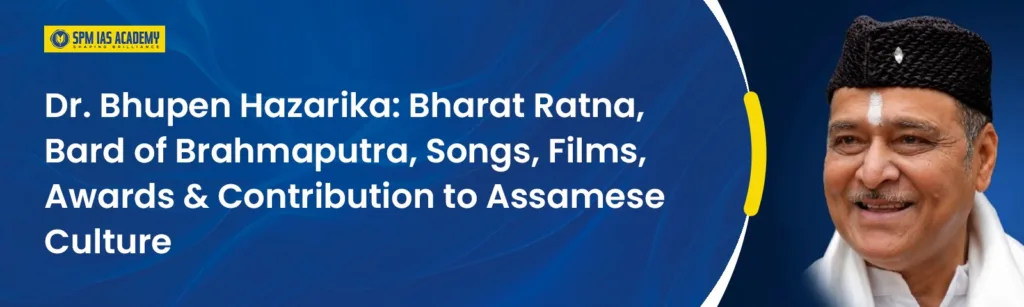
Bhupen Hazarika, popularly known as ‘Sudhakantha’ and the “Bard of Brahmaputra,” was one of India’s greatest cultural icons. He was a singer, music composer, lyricist, filmmaker, poet, writer, journalist, and social reformer. Moreover, Bhupen Hazarika used music and cinema to promote humanity, peace, social justice, and cultural unity. His songs popularised Assamese culture across India and abroad. Therefore, people continue to admire him as a symbol of Assamese identity and Indian cultural heritage. The Government of India posthumously honoured him with the Bharat Ratna in 2019. Furthermore, the Government of Assam is celebrating his birth centenary through year-long cultural programmes.
Therefore, the life, songs, films, awards, and contributions of Bhupen Hazarika are highly important for APSC, Assam GK, and State government examinations.
For APSC and UPSC preparation, many aspirants prefer the best apsc upsc coaching centre in guwahati for quality mentorship.
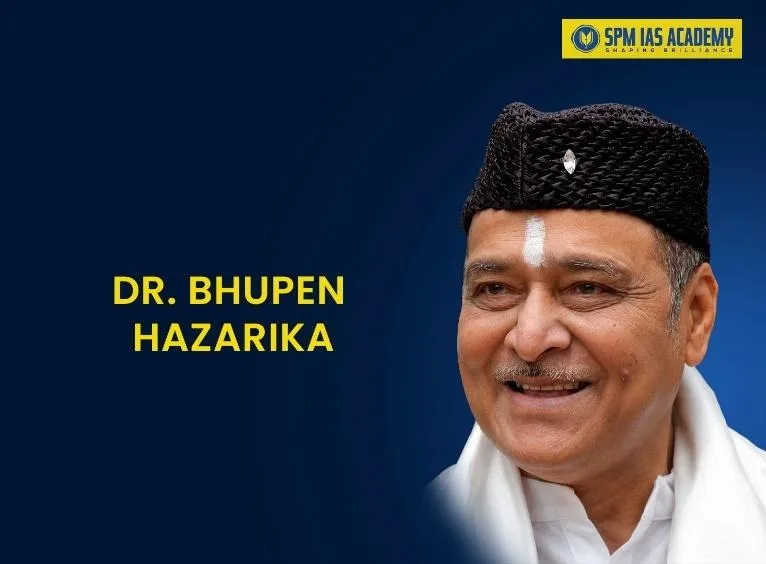
Who Was Bhupen Hazarika?
Biography of Bhupen Hazarika
- Bhupen Hazarika was born on 8 September 1926 in Sadiya. He later became one of the most influential cultural personalities in India during the 20th century.
- His father’s name was Nilakanta Hazarika, and his mother’s name was Shantipriya Hazarika. Moreover, his mother introduced him to Assamese music, lullabies, and traditional folk culture from an early age.
- In 1935, while living in Tezpur, the young Bhupen Hazarika came into contact with Jyoti Prasad Agarwala and Bishnu Prasad Rabha. Both cultural icons recognised his musical talent after hearing him sing a Borgeet taught by his mother.
- Furthermore, in 1936, Bhupen Hazarika travelled to Kolkata and recorded his first song at Aurora Studio for the Selona Company.
- At the age of 12, he sang two songs i.e. Kaxote Kolosi Loi and Biswo Bijoyi Naujawan in the Assamese film Indramalati (1939), directed by Jyoti Prasad Agarwala. These early experiences deeply shaped his artistic and nationalist vision.
- Bhupen Hazarika studied at Sonaram High School, Dhubri Government High School, and Tezpur High School. He passed matriculation in 1940 from Tezpur High School.
- Moreover, he completed his Intermediate Arts from Cotton College in 1942. Later, he earned his BA degree (1944) and MA in Political Science (1946) from Banaras Hindu University.
- For a brief period, Bhupen Hazarika worked at All India Radio, Guwahati. Afterwards, he received a scholarship from Columbia University and travelled to New York in 1949.
- Later, Bhupen Hazarika earned his PhD from Columbia University in 1952. His doctoral topic was “Proposals for Preparing India’s Basic Education to use Audio-Visual Techniques in Adult Education”.
- During his stay in New York, Bhupen Hazarika became close to Paul Robeson, the famous civil rights activist and singer. Robeson deeply influenced his social philosophy and musical vision.
- Robeson inspired Bhupen Hazarika to belief that music could become an instrument of social change. Bhupen Hazarika composed socially conscious songs such as Bistirno Parore, which reflected themes similar to Robeson’s “Ol’ Man River.”
- Moreover, Bhupen Hazarika translated and composed songs in several Indian languages, including Assamese, Bengali, and Hindi. His multilingual performances helped him connect with audiences across India and beyond.
- At Columbia University, he met Priyamvada Patel, whom he married in 1950. Their son, Tez Hazarika, was born in 1952.
- After returning to India in 1953, Bhupen Hazarika briefly worked as a teacher at Gauhati University.
- During his student life and professional journey, Bhupen Hazarika developed deep interest in music, literature, cinema, folk culture, and social issues. Therefore, his education and experiences greatly shaped his artistic vision and humanitarian philosophy.
Professional Life of Bhupen Hazarika
- After completing his MA, Bhupen Hazarika briefly worked at the All India Radio station in Guwahati.
- Moreover, after completing his doctoral studies, Bhupen Hazarika joined Gauhati University as a teacher for a short period.
- However, he later left academic life and moved to Kolkata, where he established himself as a successful singer, music director, lyricist, and filmmaker.
- Furthermore, Bhupen Hazarika directed and composed music for several acclaimed Assamese films such as Shakuntala and Pratidhwani.
- His film songs and musical compositions became extremely popular because they combined folk traditions, social messages, and modern musical styles.
- In addition, Bhupen Hazarika introduced new trends in Bengali music and gained recognition as an influential cultural figure beyond Assam.
- He also composed music for films from Bangladesh, many of which received international appreciation and recognition.
- Moreover, Bhupen Hazarika was elected President of the Asam Sahitya Sabha in 1993.
- In 1967, he also entered public life and got elected to the Assam Legislative Assembly from the Naoboicha constituency.
Therefore, the professional life of Bhupen Hazarika reflected excellence in music, cinema, literature, education, and public service.
Why Is Bhupen Hazarika Called the “Bard of Brahmaputra”?
- People fondly call Bhupen Hazarika the “Bard of Brahmaputra”. His songs reflected the life, culture, emotions, and struggles of people living near the Brahmaputra River.
- Moreover, Bhupen Hazarika used music and poetry to express Assamese identity, humanism, and social harmony through the symbolism of the Brahmaputra.
- His song ‘Bistirno Parore’ highlighted the deep emotional and cultural connection between the people of Assam and the Brahmaputra River.
Therefore, people across Assam and India recognise Bhupen Hazarika as the “Bard of Brahmaputra”. He gave a powerful musical voice to Assam, its people, and its cultural heritage.
National, International and State Awards and Honours Received by Bhupen Hazarika
Bhupen Hazarika received several prestigious national and international awards for his extraordinary contribution to music, cinema, literature, and culture.
- Moreover, the Assamese film Shakuntala, directed by Bhupen Hazarika, won the Best Feature Film in Assamese award at the 9th National Film Awards in 1961.
- Furthermore, his films Pratidhwani and Lotighoti also received the Best Feature Film in Assamese award at the 12th National Film Awards.
- In 1975, Bhupen Hazarika won the National Film Award for Best Music Direction for the film Chameli Memsaab at the 23rd National Film Award.
- The Government of India honoured Bhupen Hazarika with the Padma Shri in 1977.
- In 1979, the Government of Arunachal Pradesh awarded him a Gold medal for his contribution to tribal welfare and the promotion of tribal culture through music and cinema.
- Moreover, Bhupen Hazarika received the prestigious Sangeet Natak Akademi Award in 1987.
- In 1992, he received the Dadasaheb Phalke Award, India’s highest honour in cinema, for his lifetime contribution to Indian films and music.
- Moreover, he served as the President of the Asom Sahitya Sabha in 1993.
- Furthermore, the Government of India conferred the Padma Bhushan on Bhupen Hazarika in 2001.
- In 2008, he received the prestigious Sangeet Natak Akademi Fellowship for his lifelong contribution to Indian performing arts.
- Moreover, the Government of Assam honoured him with the Asom Ratna in 2009.
- In 2011, the Government of Bangladesh conferred the Friends of Liberation War Honour on Bhupen Hazarika for his support during Bangladesh’s liberation movement.
- The Government of India posthumously awarded Bhupen Hazarika the Padma Vibhushan in 2012.
- Finally, in 2019, the Government of India posthumously honoured Bhupen Hazarika with the Bharat Ratna, India’s highest civilian honour, for his unparalleled contribution to Indian music, cinema, and cultural unity.
What was the Contribution of Bhupen Hazarika in the field of India and Assamese Music?
- Bhupen Hazarika composed and sang thousands of songs in Assamese, Bengali, and Hindi throughout his musical career.
- Moreover, his music played a major role in popularising Assamese culture and regional identity across India and abroad.
- Furthermore, the songs of Bhupen Hazarika strongly promoted humanism, peace, brotherhood, equality, and social harmony.
- He also used music as a powerful medium to spread social awareness, cultural unity, and Assamese identity among the masses.
- In 1939, Bhupen Hazarika sang his first song on All India Radio Kolkata, marking the beginning of his musical journey.
- Moreover, at the age of 12, Bhupen Hazarika made his debut as a playback singer by singing two songs in Jyoti Prasad Agarwala’s Assamese film Indramalati (1939).
- Famous Assamese Songs of Bhupen Hazarika:
- Bistirno Parore
- Moi Eti Jajabor
- Ganga Mor Maa
- Bimurto Mur Nixati Jen
- Manuhe Manuhor Babey
- Snehe Aamar Xoto Shrabonor
- Gupute Gupute Kimaan Khelim
- Buku Hom Hom Kore
- Sagar sangamat
- Shillongore Godhuli
Candidates choosing Assamese Literature can study the complete upsc assamese optional syllabus for effective mains preparation.
What was Bhupen Hazarika’s Contribution in the field of Cinema?
Bhupen Hazarika as Filmmaker
Bhupen Hazarika made remarkable contributions to Indian cinema and Assamese films. He was best known as a filmmaker, music composer, lyricist, writer, and playback singer.
- He directed several Assamese films and played a major role in strengthening regional cinema in Northeast India.
- Furthermore, Bhupen Hazarika wrote screenplays, lyrics, and stories for many films and cultural projects.
- In addition, Bhupen Hazarika used cinema to highlight social issues, human suffering, cultural identity, and social justice.
- His first film as a director was Era Bator Sur, which became an important milestone in Assamese cinema.
- Moreover, he won the Best Feature Film in Assamese award for Shakuntala (1961), where he worked as a music composer.
- In 1975, Bhupen Hazarika received the National Film Award for Best Music Direction for Chameli Memsaab.
- His last film as a director was Siraj, while his last film as a music composer was ‘Kyon?’.
- Furthermore, his last contribution as a playback singer came through the film Gandhi to Hitler.
- After the release of Ek Pal (1986), Bhupen Hazarika mainly focused on Hindi cinema and collaborated closely with filmmaker Kalpana Lajmi.
- Some major Hindi films from this period include Ek Pal (1986), Rudaali (1993), and Daman: A Victim of Marital Violence (2001).
- In 1992, Bhupen Hazarika became the first Assamese personality to receive the prestigious Dadasaheb Phalke Award.
- He also served as the Chairman of the Sangeet Natak Akademi from 1998 to 2003.
Therefore, the cinematic contribution of Bhupen Hazarika greatly enriched Assamese cinema, Indian music, and regional cultural expression.
Why Did Bhupen Hazarika Receive the Bharat Ratna?
- The Government of India posthumously conferred the Bharat Ratna on Bhupen Hazarika in 2019.
- Moreover, the award recognised his extraordinary contribution to Indian music, Assamese culture, cinema, literature, and national integration.
- Bhupen Hazarika used music, films, and literature to promote humanity, social harmony, and cultural unity across India.
- Furthermore, his songs and artistic works connected people beyond regional, linguistic, and national boundaries.
- He also played a major role in bringing Assamese culture and Northeast Indian identity to the national stage.
- In addition, the contribution of Bhupen Hazarika greatly enriched Indian cultural heritage and artistic expression.
Therefore, Bhupen Hazarika became one of the most respected cultural personalities and musical legends in India.
What Is Bhupen Hazarika Setu?
- Bhupen Hazarika Setu is India’s longest river bridge built over the Lohit River, a major tributary of the Brahmaputra River.
- Moreover, the bridge connects Assam with Arunachal Pradesh and significantly improves transportation and regional connectivity in Northeast India.
- The construction of Bhupen Hazarika Setu greatly strengthened road communication, trade, and movement of people in the region.
- Furthermore, the bridge plays an important strategic role by improving India’s border infrastructure and defence connectivity in Northeast India.
- The Government of India named the bridge after Bhupen Hazarika to honour his immense contribution to Assamese culture, Indian music, and national integration.
- Therefore, Bhupen Hazarika Setu stands as both an important infrastructure project and a tribute to one of India’s greatest cultural icons.
Contribution of Bhupen Hazarika to Society
- Bhupen Hazarika strongly promoted social harmony, humanism, equality, and cultural unity through his music, writings, and public life.
- Moreover, he consistently raised his voice for poor people, labourers, marginalised communities, and tribal societies through his songs and social messages.
- He used music and cinema to highlight social injustice, poverty, human suffering, and the struggles of common people.
- Furthermore, Bhupen Hazarika advocated peace, brotherhood, dignity, and unity among different communities and cultures.
- His songs also encouraged compassion, secular values, and respect for humanity beyond regional and linguistic boundaries.
- In addition, Bhupen Hazarika played a major role in promoting the cultural identity and social concerns of Northeast India at the national level.
- Therefore, people continue to remember Bhupen Hazarika not only as a legendary musician but also as a powerful voice of humanity and social justice.
Birth Centenary Celebration of Dr. Bhupen Hazarika
- The year long birth centenary celebration of Bhupen Hazarika honoured his extraordinary contribution to Assamese culture, Indian music, cinema, literature, and social consciousness.
- The Prime Minister of India addressed the 100th birth anniversary of Dr. Sudhakantha Bhupen Hazarika.
- Moreover, people across Assam and different parts of India organised cultural programmes, musical events, seminars, and tribute ceremonies.
- Bhupen Hazarika carried Assam to the global stage through his soulful songs, humanitarian values, and cultural vision.
- During the centenary celebrations, the Government of Assam announced the construction of a dedicated museum in memory of Bhupen Hazarika. The estimated cost of this museum is ₹32 crore.
- The proposed museum will preserve and showcase his music, literary works, films, cultural contributions, and artistic legacy for future generations.
- In addition, the museum aims to strengthen awareness about Assamese cultural heritage and the timeless contribution of Bhupen Hazarika to Indian society.
Therefore, the birth centenary celebration of Bhupen Hazarika became an important cultural event that celebrated his lasting influence on music, humanity, and Assamese identity.
Conclusion
In conclusion, Bhupen Hazarika remains one of the greatest cultural icons in Indian history and Assamese society. Through his songs, films, literature, and social activism, Dr. Bhupen Hazarika transformed Assamese music and promoted humanism, peace, and social justice. Moreover, landmarks such as Bhupen Hazarika Setu and Dr. Bhupen Hazarika Samadhi Kshetra continue to honour his timeless legacy. Therefore, the biography, Bharat Ratna, songs, films, and contributions of Dr. Bhupen Hazarika are highly important for UPSC, APSC, Assam GK, and other State PCS examinations.
Students preparing Assam competitive exams can join the best apsc centre in assam for expert guidance.
Source:
Frequently Asked Questions:
Bhupen Hazarika was a legendary Assamese singer, music composer, filmmaker, poet and writer. Moreover, he used music and cinema to promote humanity, peace, social harmony, and Assamese cultural identity.
People call Bhupen Hazarika the “Bard of Brahmaputra” because his songs reflected the life, culture, and emotions of people living near the Brahmaputra River. Furthermore, his music beautifully expressed Assamese identity and social harmony.
The Government of India posthumously conferred the Bharat Ratna on Bhupen Hazarika in 2019. Moreover, the award recognised his extraordinary contribution to Indian music, Assamese culture, cinema, literature, and national integration.
Some famous songs of Bhupen Hazarika include Bistirno Parore, Moi Eti Jajabor, Manuhe Manuhor Babey, and Buku Hom Hom Kore. Moreover, his songs promoted peace, equality, and humanism.
Bhupen Hazarika popularised Assamese music, cinema, literature, and folk culture across India and abroad. Furthermore, he used songs and films to strengthen Assamese identity, social awareness, and cultural unity.

Behind every article at SPM IAS Academy is a team of skilled content writers and subject experts committed to making preparation easier for aspirants. From answering common doubts to breaking down complex issues and current affairs, we create content that is accurate, easy to understand, and directly useful for UPSC, APSC, and other competitive exams.