
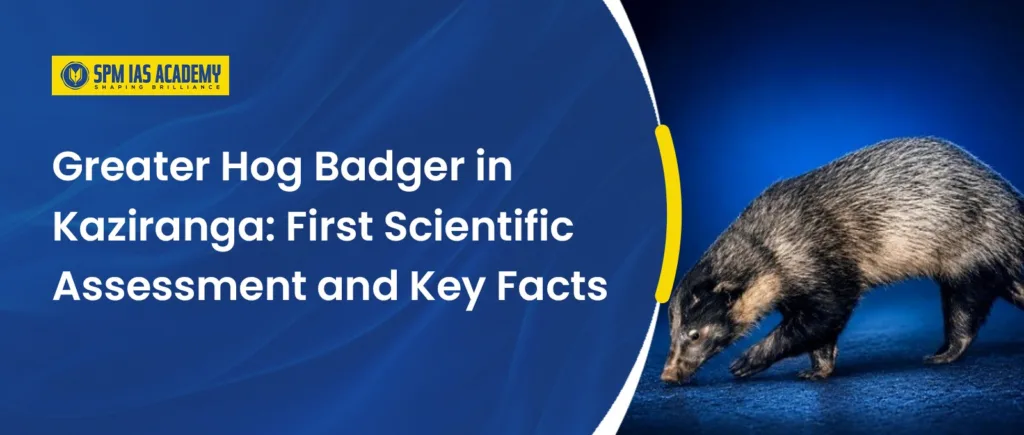
The Greater Hog Badger in Kaziranga has come into focus after Kaziranga National Park and Tiger Reserve released its first scientific assessment of this lesser-known mammal. The study confirmed that the Greater Hog Badger is present across different habitats of Kaziranga and is showing signs of a healthy population. This is important because the species is globally vulnerable and receives the highest legal protection in India.
For UPSC, APSC and State PCS aspirants, the Greater Hog Badger in Kaziranga is important under Environment and Ecology, Biodiversity Conservation, Protected Areas, Species in News and Assam Current Affairs. It also shows how camera-trap data collected for tiger estimation can help scientists study smaller and less visible mammals.
Aspirants can improve Environment and Ecology preparation through UPSC coaching in Assam with expert guidance and updated study resources.
Why is the Greater Hog Badger in Kaziranga in News?
The Greater Hog Badger is in the news because Kaziranga National Park and Tiger Reserve released the first scientific assessment of the species. The study was conducted by the Kaziranga Tiger Cell, Wildlife Conservation Trust and The Fishing Cat Project.
Researchers used camera-trap images collected during tiger estimation exercises. They analysed these images to understand the presence, distribution and population status of the Greater Hog Badger inside the Kaziranga landscape.
This is significant because conservation often focuses on famous animals like rhinos, tigers and elephants. However, Kaziranga’s latest assessment shows that smaller mammals also play a major role in maintaining ecosystem health.
Strengthen biodiversity and current affairs preparation through UPSC coaching in north east India for UPSC, APSC and State PCS exams.
About Greater Hog Badger
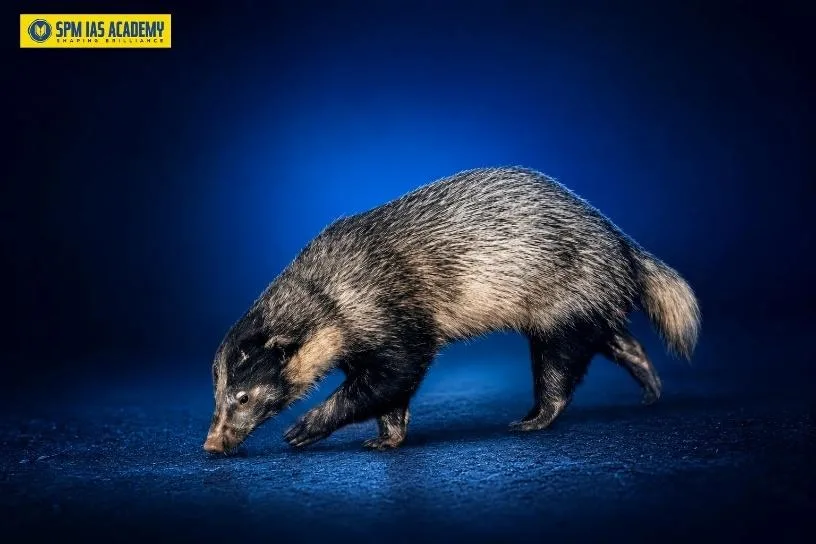
- The Greater Hog Badger is a mammal with the scientific name Arctonyx collaris. In Assamese, people call it Mati Gahori. It is an omnivorous, nocturnal and fossorial animal.
- The term ‘fossorial’ means an animal that is adapted for digging, burrowing and living partly underground. The Greater Hog Badger uses its strong claws and snout-like face to dig soil while searching for food.
- It feeds on insects, worms, roots, fruits, small animals and other organic matter.
Therefore, it plays an important ecological role in the forest floor ecosystem.
What is the Conservation Status of Greater Hog Badger?
- The Greater Hog Badger in Kaziranga is important from a conservation point of view because the species is listed as Vulnerable on the IUCN Red List.
- In India, it is protected under Schedule I of the Wildlife Protection Act, 1972.
- Schedule I species receive the highest level of legal protection in the country. This means hunting, trapping or harming the species is strictly prohibited.
What are the main threats to the Greater Hog Badger?
The main threats to the Greater Hog Badger include habitat loss, hunting, poaching and human disturbance. Therefore, scientific monitoring is necessary to understand its population and protect its habitat.
Practice using the APSC Prelims Question Paper to strengthen Environment, Ecology and Assam current affairs preparation.
Key Findings of the Kaziranga Study
- The first scientific assessment produced encouraging results. Researchers estimated around 55 individual Greater Hog Badgers across approximately 1,100 sq km of the Kaziranga landscape.
- The study also recorded more than 60 sightings through camera-trap by-catch data.
- The assessment confirmed that the species is widely distributed across Kaziranga’s diverse habitats. It also indicated that Kaziranga may support a healthy and potentially viable population of the Greater Hog Badger.
This finding strengthens the idea that Kaziranga is not only a rhino and tiger landscape. It is also a strong habitat for lesser-known mammals.
How Camera Traps Helped the Study
The study used camera-trap images collected during tiger estimation exercises. Camera traps are motion-sensitive devices that capture images or videos when animals move in front of them.
Usually, researchers use such cameras to monitor large mammals like tigers. However, these cameras also record many other species. This additional information is called by-catch data.
In this case, by-catch data helped researchers study the Greater Hog Badger in Kaziranga without launching a separate large-scale field survey. This shows how existing conservation tools can generate new scientific knowledge.
Ecological Importance of Greater Hog Badger
- The Greater Hog Badger performs several ecological functions. Since it digs and burrows, it loosens the soil. This improves soil aeration and allows better movement of air and water.
- Moreover, its digging activity helps redistribute nutrients between soil layers. It also turns over leaf litter while foraging. This supports decomposition and nutrient cycling.
- The burrows and disturbed soil patches can create microhabitats for invertebrates and small vertebrates.
- In addition, the species can help create favourable conditions for seed germination.
Therefore, the Greater Hog Badger in Kaziranga contributes to soil health, forest regeneration and microhabitat formation.
Distribution of Greater Hog Badger
- The Greater Hog Badger occurs across parts of South Asia and Southeast Asia. Its distribution includes India and Bangladesh in South Asia. It is also found in Myanmar, Thailand, Laos, Vietnam and Cambodia.
- However, the species has declined in several parts of its range due to habitat destruction and hunting pressure. Therefore, the healthy presence of the species in Kaziranga is a positive conservation sign.
- Northeast India may become an important stronghold for this species because the region still has rich forest habitats and several protected areas.
Hog Badger Species Worldwide
There are three recognised hog badger species in the world:
| Species | Scientific Name |
| Greater Hog Badger | Arctonyx collaris |
| Northern Hog Badger | Arctonyx albogularis |
| Sumatran Hog Badger | Arctonyx hoevenii |
Among these, India is known to have the Greater Hog Badger and the Northern Hog Badger. Therefore, the finding from Kaziranga adds value to India’s mammal conservation data.
Why This Finding Matters for Kaziranga?
The Greater Hog Badger in Kaziranga proves that the park’s biodiversity goes beyond flagship species. Kaziranga is globally known for the Greater One-Horned Rhinoceros and its strong tiger population. However, a healthy ecosystem also depends on smaller mammals, birds, reptiles, insects and soil organisms.
The presence of the Greater Hog Badger shows that Kaziranga’s grasslands, wetlands, forests and transitional habitats continue to support diverse wildlife.
Moreover, the study highlights the need to monitor lesser-known species. Without regular scientific assessment, many such animals remain under-reported even when they play important ecological roles.
Quick Facts on Greater Hog Badger in Kaziranga
- Scientific name: Arctonyx collaris
- Local Assamese name: Mati Gahori
- Type: Mammal
- Food habit: Omnivore
- Behaviour: Nocturnal and fossorial
- IUCN status: Vulnerable
- Legal protection in India: Schedule I under Wildlife Protection Act, 1972
- Estimated population: Around 55 individuals
- Method used: Camera-trap image analysis
- Study partners: Kaziranga Tiger Cell, Wildlife Conservation Trust and The Fishing Cat Project
Conclusion
The first scientific assessment of the Greater Hog Badger in Kaziranga is an important conservation milestone for Assam. It confirms that Kaziranga supports a healthy population of a globally vulnerable and legally protected mammal.
More importantly, the study reminds us that conservation should not focus only on iconic species. Lesser-known animals like the Greater Hog Badger also keep ecosystems healthy through soil aeration, nutrient cycling and microhabitat formation.
For exam aspirants, this topic is a valuable example of how scientific monitoring, protected areas and biodiversity conservation come together in Northeast India.
APSC Mains Practice Question:
Q. The first scientific assessment of the Greater Hog Badger in Kaziranga highlights the importance of conserving lesser-known species in protected areas. Discuss its ecological significance and explain how camera-trap based monitoring can strengthen biodiversity conservation in Assam.
Sources:
Frequently Asked Questions
The Greater Hog Badger is a nocturnal and fossorial mammal scientifically known as Arctonyx collaris. It is an omnivore and is locally known as Mati Gahori in Assam.
The Greater Hog Badger in Kaziranga is important because it indicates a healthy ecosystem and performs ecological roles such as soil aeration, nutrient cycling and microhabitat formation.
The Greater Hog Badger is listed as Vulnerable on the IUCN Red List. In India, it is protected under Schedule I of the Wildlife Protection Act, 1972.

Behind every article at SPM IAS Academy is a team of skilled content writers and subject experts committed to making preparation easier for aspirants. From answering common doubts to breaking down complex issues and current affairs, we create content that is accurate, easy to understand, and directly useful for UPSC, APSC, and other competitive exams.