
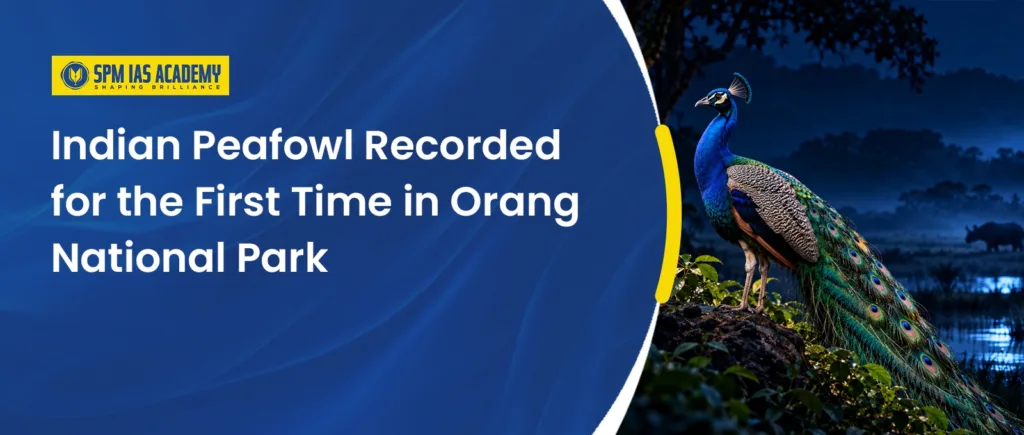
The first official record of the Indian Peafowl (Pavo cristatus) in Orang National Park and Tiger Reserve is an important biodiversity development for Assam. The bird was photographed inside the park by wildlife photographer Nejib Ahmed and cinematographer Chandan Saikia, confirming earlier observations by forest personnel near the Rowmari and Hazaribagh Anti-Poaching Camps.
For APSC aspirants, such Assam-specific environment and biodiversity developments can be useful for current-affairs preparation. Students looking for the best online coaching for APSC can use structured courses to connect current events with relevant topics in Assam Geography, Environment, Ecology, and General Studies.
The record adds a new species to Orang’s documented biodiversity and highlights the importance of continuous wildlife monitoring.
In this article, you will learn about the Indian Peafowl sighting, Orang National Park, its ecological significance, conservation status and relevance to Assam’s biodiversity. It is important from the perspective of UPSC and APSC Prelims, Mains GS 3, GS 5.
Why Is the Indian Peafowl in the News?
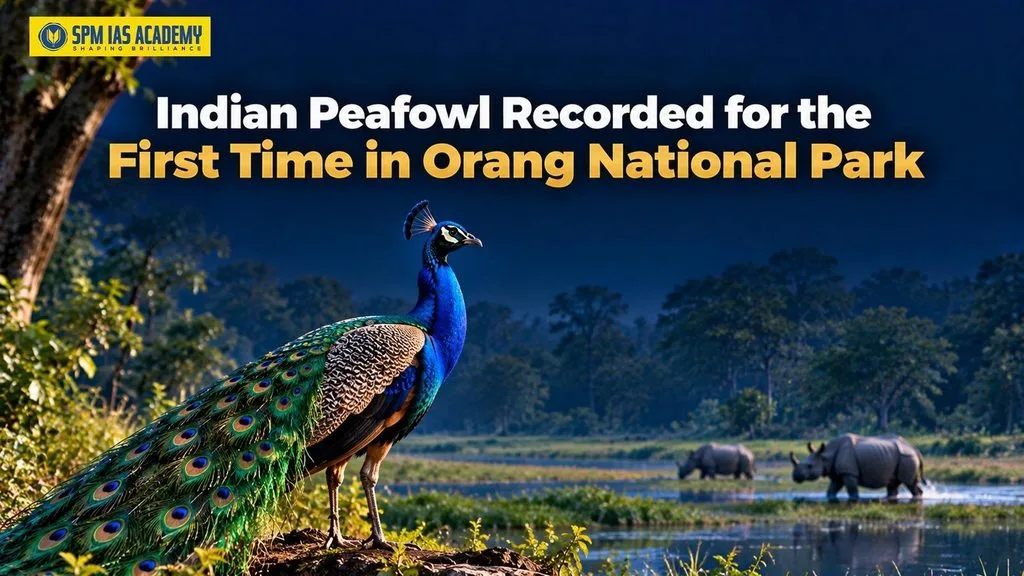
The Indian Peafowl made news after officials confirmed its first documented presence in the Orang National Park and Tiger Reserve. Earlier, forest personnel had reported sightings of an unidentified bird resembling an Indian Peafowl. Later, photographic evidence confirmed the species. Such Assam-specific environment and biodiversity developments can be useful for APSC aspirants, and APSC online classes can help students integrate current affairs with Environment, Ecology, and Assam-specific General Studies preparation.
The record is significant because it adds a new bird species to Orang’s official biodiversity record. It confirms the presence of Pavo cristatus through photographic evidence. Moreover, it highlights the role of forest staff, wildlife photographers and nature enthusiasts in documenting biodiversity. It can encourage further monitoring of bird populations and habitat use in the reserve.
What Is the Indian Peafowl?
- The Indian Peafowl (Pavo cristatus) belongs to the Phasianidae family. It is also known as the Indian Peacock and serves as India’s national bird.
- The species commonly uses open areas, grasslands and forest edges. Therefore, its confirmed presence at Orang is relevant to understanding how different habitats within the protected area support bird diversity.
- The Indian Peafowl also receives legal protection under India’s wildlife legislation. The species appears in Schedule I of the Wild Life (Protection) Act, 1972, giving it a high level of statutory protection.
Orang National Park and Tiger Reserve
- Location: Orang lies on the northern bank of the Brahmaputra River in Assam. This geographical location is relevant for aspirants studying Assam’s protected areas, river systems, and regional geography. Students preparing for civil services examinations can also explore UPSC coaching in North East India for structured guidance in these topics.
- Established: The area was declared a Wildlife Sanctuary in 1985 and later became a National Park in 1999.
- Protected area: It also holds Tiger Reserve status, strengthening its role in wildlife conservation.
- Area: The National Park covers about 78.80 sq km.
- Major habitat: Moreover, its grasslands, wetlands and forests support diverse wildlife.
- Key species: The park supports the greater one-horned rhinoceros, tiger, elephant, wild boar and hog deer.
- Bird diversity: It supports over 200 bird species, including the Greater Adjutant and Bengal Florican.
- Recent biodiversity record: The park recorded the Indian Peafowl (Pavo cristatus) for the first time, adding to its documented avian diversity.
Therefore, Orang is an important example of protected-area management and biodiversity conservation in Northeast India. Students preparing for APSC, UPSC, and other competitive examinations can explore civil service coaching in Guwahati to strengthen their understanding of Environment, Ecology, biodiversity, and Northeast India-specific topics.
What Makes Orang National Park Important for Wildlife?
- Rich biodiversity: Orang supports diverse mammals, birds, reptiles and aquatic species.
- Important rhino habitat: It protects the greater one-horned rhinoceros, one of Assam’s flagship species.
- Brahmaputra floodplain ecosystem: Moreover, its grasslands, wetlands and forests support many wildlife species.
- Important bird habitat: The Assam Forest Department records over 200 bird species in the park, including the Bengal Florican and Greater Adjutant.
- Tiger habitat: Orang forms part of Assam’s tiger landscape and supports tiger conservation.
- National Park and Tiger Reserve: The protected area has both National Park and Tiger Reserve status, strengthening its conservation importance.
- First official Indian Peafowl record: Recently, the park recorded the Indian Peafowl (Pavo cristatus) for the first time, adding to its documented avian diversity.
Therefore, Orang provides an important example of protected-area management, biodiversity conservation and habitat protection in Northeast India.
What Does the Indian Peafowl Record Mean for Orang National Park?
The first recording of Indian Peafowl in Orang provides another example of how biodiversity documentation can improve our understanding of protected ecosystems.
- Expands the biodiversity record: First, the sighting adds a previously undocumented bird to the park’s official species record. This helps researchers maintain a more complete picture of Orang’s wildlife.
- Highlights habitat diversity: Moreover, the sighting indicates that Orang’s combination of grasslands, wetlands and forest habitats can support a wider range of bird species.
- Strengthens wildlife monitoring: Furthermore, the discovery shows why regular field observation matters. Forest personnel noticed the bird before photographers obtained clear photographic evidence. Such collaboration can improve species documentation.
- Supports conservation research: Finally, continued monitoring can help authorities understand whether the sighting represents an occasional movement or a more established presence. Current reports state that forest authorities plan continued monitoring of the area.
Indian Peafowl in Assam: Conservation Significance
The new record also connects with Assam’s wider biodiversity-conservation efforts. Assam’s protected-area network covers about 3,925 sq km, around 5% of the state’s geographical area, according to the state government. The network includes national parks, wildlife sanctuaries, tiger reserves, elephant reserves and biosphere reserves.
The Indian Peafowl is already documented elsewhere in Assam. Reports indicate that the species was previously recorded at Nunoi Wildlife Sanctuary in Udalguri district. Therefore, the Orang record expands the known distribution of the species within the state.
An Assam government environmental assessment also lists Pavo cristatus with an IUCN status of Least Concern (LC). However, this global category does not remove the need for local habitat protection and population monitoring.
What Is the Conservation Status of the Indian Peafowl?
- IUCN Red List: The Indian Peafowl (Pavo cristatus) is classified as Least Concern (LC). Therefore, it does not currently fall under a threatened IUCN category.
- Wildlife Protection Act, 1972: In India, the Indian Peafowl receives the highest level of legal protection under Schedule I of the Wild Life (Protection) Act, 1972. Therefore, hunting, capture and illegal trade face strict legal restrictions.
- CITES: The Indian Peafowl is listed in CITES Appendix III (India). This listing regulates its international trade and requires relevant documentation for covered specimens.
- National Bird of India: Moreover, the Indian Peafowl is India’s national bird, giving the species additional cultural and conservation significance.
Indian Peafowl in Orang National Park: Key Facts
| Key Fact | Details |
| Species | Indian Peafowl |
| Scientific name | Pavo cristatus |
| First official record in Orang | September 2026 |
| Location | Orang National Park and Tiger Reserve, Assam |
| Evidence | Photographic documentation |
| Photographers | Nejib Ahmed and Chandan Saikia |
| Earlier observations | Rowmari and Hazaribagh Anti-Poaching Camps |
| Family | Phasianidae |
| Legal protection | Schedule I, Wild Life (Protection) Act, 1972 |
| IUCN status | Least Concern |
| Orang bird diversity | 222 recorded bird species according to Assam Forest Department |
Conclusion
The Indian Peafowl in Orang National Park is a significant addition to Assam’s biodiversity record. The first official photographic confirmation strengthens knowledge of Orang’s wildlife and highlights the value of continuous monitoring. Therefore, further observation will help determine the species’ presence and habitat use within the protected area.
Read More:
| Article |
| NATIONAL PARKS IN ASSAM 2026 |
| ASSAM’S BIODIVERSITY AND WILDLIFE FOR APSC |
| KAZIRANGA ELEVATED CORRIDOR PROJECT |
Source:
Frequently Asked Question
1. When was the Indian Peafowl recorded in Orang National Park?
The Indian Peafowl (Pavo cristatus) was officially recorded in Orang National Park and Tiger Reserve, Assam, in September 2026 through photographic evidence.
2. What is the conservation status of the Indian Peafowl?
The Indian Peafowl is listed as Least Concern (LC) on the IUCN Red List. However, India provides it the highest legal protection under Schedule I of the Wild Life (Protection) Act, 1972.
3. Why is the Indian Peafowl sighting important for Orang National Park?
The sighting expands the documented biodiversity of Orang National Park. Moreover, it highlights the importance of wildlife monitoring, habitat conservation and biodiversity research in Assam.

Behind every article at SPM IAS Academy is a team of skilled content writers and subject experts committed to making preparation easier for aspirants. From answering common doubts to breaking down complex issues and current affairs, we create content that is accurate, easy to understand, and directly useful for UPSC, APSC, and other competitive exams.