
The KAZIND Exercise 2026 is the ninth edition of the India-Kazakhstan Joint Military Exercise. It is being held from 28 September to 11 October 2026 in Oskemen, Kazakhstan. The exercise focuses on joint counter-terrorism operations, interoperability, and coordinated military action in a sub-conventional environment under a UN mandate. A 60-member Indian contingent, mainly from the Garhwal Rifles, is participating along with Indian Air Force personnel. Such defence and international-relations developments can be relevant to APSC current-affairs preparation, and students can use best APSC online coaching programs for structured coverage of defence, security, and international relations topics.
In this article, you will learn about the Exercise KAZIND, its objectives and significance for India-Kazakhstan relations. This topic is important from the perspective of UPSC, APSC Prelims and Mains GS Paper 2.
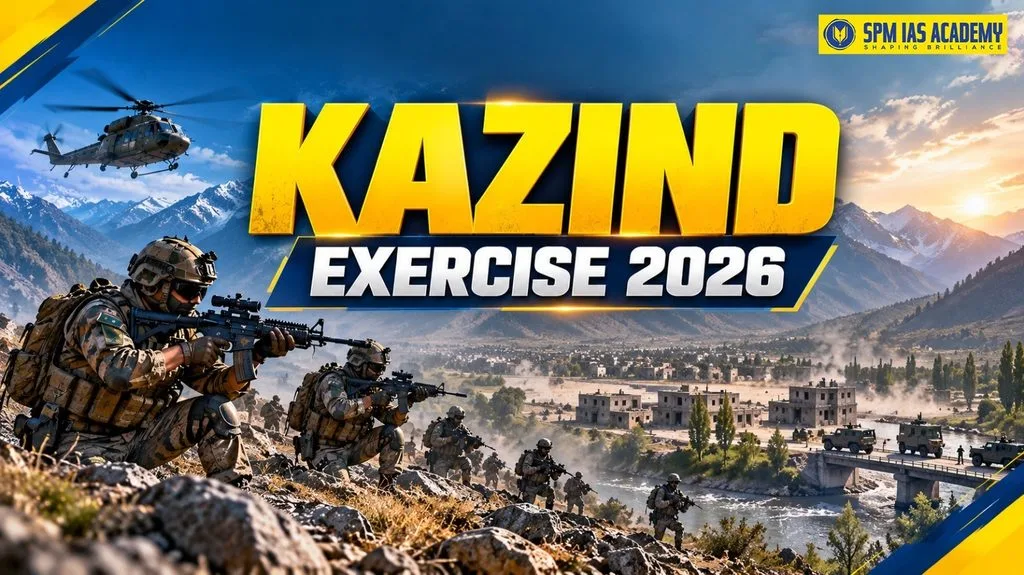
What Is KAZIND Exercise?
- The KAZIND Exercise is a bilateral military exercise between India and Kazakhstan. Moreover, it strengthens military interoperability and prepares both forces for joint counter-terrorism operations. Such defence exercises are relevant to current-affairs and international-relations preparation for civil services examinations. Students can also explore UPSC coaching in the Northeast for structured guidance in defence, security, and international relations topics.
- Notably, the 2026 edition focuses on operations in semi-urban and mountainous terrain. Furthermore, it includes joint planning, air mobility and the use of Unmanned Aerial Systems (UAS) and Counter-UAS capabilities.
Key Facts about Exercise KAZIND 2026
- Edition: Ninth
- Dates: 28 September–11 October 2026
- Venue: Oskemen, Kazakhstan
- Participants: India and Kazakhstan
- Indian contingent: 60 personnel
- Main Indian unit: Garhwal Rifles
- Other Indian participation: Indian Air Force personnel
- Main focus: Joint counter-terrorism operations
- Operational environment: Semi-urban and mountainous terrain
- Framework: Sub-conventional operations under a UN mandate
What Are the Objectives of KAZIND Exercise?
The Exercise KAZIND focuses on improving the operational coordination of both armed forces. It provides an opportunity for personnel from India and Kazakhstan to practise coordinated responses, strengthen interoperability, and understand each other’s operational procedures. These aspects can be included in defence and international-relations notes during APSC exam preparation.
- Enhance interoperability: Firstly, it aims to increase interoperability between both forces. Both forces practise coordinated planning and military operations.
- Strengthen counter-terrorism capabilities: Moreover, troops train to respond to simulated terrorist threats.
- Improve joint planning: The exercise helps both sides coordinate tactics, techniques and procedures.
- Develop air mobility skills: Furthermore, participants practise operations involving air mobility and heliborne activities.
- Strengthen surveillance capabilities: The exercise integrates UAS and Counter-UAS systems into operational training.
- Build mutual trust: Joint training strengthens professional relationships and operational understanding.
What Are the Major Activities in KAZIND Exercise 2026?
The exercise includes several realistic operational activities. Firstly, the forces practise joint responses to terrorist actions, raids and search-and-destroy missions. They also conduct cordon-and-search operations and secure helipads and landing sites. Moreover, troops carry out coordinated tactical activities designed to improve interoperability and operational readiness. These developments can be useful for defence and security-related current affairs, particularly for students pursuing online coaching for APSC. Special Heliborne Operations, joint planning and tactical activities. They also strengthen intelligence and surveillance coordination. Furthermore, both sides establish a Joint Command Post and an Intelligence and Surveillance Centre. Finally, the exercise concludes with a validation exercise based on a simulated terrorist threat.
What is the History of KAZIND Exercise?
- 2016 – Began as Exercise PRABAL DOSTYK: Initially, India and Kazakhstan launched their joint military exercise as PRABAL DOSTYK in Kazakhstan’s Karaganda region. It focused on counter-terrorism and counter-insurgency operations.
- 2018 – Renamed KAZIND: After the second edition, the exercise was upgraded to the company level and renamed Exercise KAZIND.
- 2019 – Expanded bilateral training: The fourth edition took place at Pithoragarh, Uttarakhand. It continued to focus on counter-terrorism operations and interoperability.
- 2021 – Fifth edition: Both the countries held KAZIND-21 in Kazakhstan. The exercise focused on counter-insurgency and counter-terrorism operations in urban areas. Moreover, it included a joint validation exercise.
- 2022 – Hosted in Meghalaya: The sixth edition took place at Umroi, Meghalaya. Troops practised joint tactical drills, humanitarian assistance and disaster relief (HADR), and counter-terrorism operations.
- 2023 – Became a Bi-service Exercise: Moreover, the seventh edition at Otar, Kazakhstan included personnel from the Indian Air Force for the first time.
- 2024 – Eighth edition: The exercise was held at Auli, Uttarakhand. It included training in semi-urban and mountainous terrain, along with drones and counter-drone systems.
- 2026 – Ninth edition: The KAZIND Exercise 2026 is being conducted at Oskemen, Kazakhstan, from 28 September to 11 October. It focuses on joint counter-terrorism operations, air mobility and integrated UAS and Counter-UAS capabilities.
What Is the Significance of Exercise KAZIND for India?
The Exercise KAZIND has significance for India’s defence and Central Asian engagement.
- Strengthens defence cooperation: The exercise deepens military-to-military ties between India and Kazakhstan.
- Improves counter-terrorism preparedness: Moreover, joint training develops capabilities for dealing with terrorist threats in difficult terrain.
- Enhances interoperability: Furthermore, Indian and Kazakh forces learn to coordinate operations, communication and tactical procedures.
- Supports regional security: The exercise reinforces the two countries’ stated commitment to regional peace, stability and collective security.
- Strengthens Central Asia engagement: Kazakhstan is an important partner in India’s engagement with Central Asia. India and the Central Asian states also cooperate through platforms such as the India-Central Asia Dialogue.
- Builds operational experience: Both forces can learn from each other’s military practices and experience.
History of India-Kazakhstan Relations
- Ancient links: India and Kazakhstan share historical links through the Silk Route. It supported exchanges in trade, culture and ideas. Buddhism also travelled from India to Central Asia.
- 1955 – Nehru’s visit: Prime Minister Jawaharlal Nehru visited Almaty in 1955. This visit reflected India’s early engagement with the Central Asian region.
- 1992 – Diplomatic relations: India was among the first countries to recognise independent Kazakhstan. Both countries established diplomatic relations on 22 February 1992.
- 1992 to 1993 – Embassies opened: India opened its Embassy in Almaty in May 1992. On the other hand, Kazakhstan opened its Embassy in New Delhi in 1993.
- 2009 – Strategic Partnership: Moreover, the two countries upgraded their relationship to a Strategic Partnership during Kazakh President Nursultan Nazarbayev’s visit to India in January 2009.
- 2015 – Modi’s visit: Prime Minister Narendra Modi visited Kazakhstan in July 2015. The visit aimed to strengthen cooperation in areas such as energy, defence and connectivity.
- 2017 – SCO membership: Furthermore, India became a full member of the Shanghai Cooperation Organisation (SCO) at the Astana Summit in June 2017. Kazakhstan hosted the summit.
- 2022 – India-Central Asia Summit: India hosted the First India-Central Asia Summit virtually on 27 January 2022. The meeting marked 30 years of diplomatic relations between India and the Central Asian countries.
- 2025 – Regional cooperation: The 4th India-Central Asia Dialogue in New Delhi highlighted cooperation in connectivity, energy, critical minerals, digital technology, security and trade. Kazakhstan also supports greater use of the International North-South Transport Corridor (INSTC).
Conclusion
The India-Kazakhstan joint military exercise strengthens India-Kazakhstan defence cooperation. It involves counter-terrorism training and military interoperability. Moreover, its focus on mountainous and semi-urban operations adds practical relevance. The exercise also supports India’s broader engagement with Central Asia and regional security.
Mains Practice Question
Q. Exercise KAZIND 2026 reflects India’s growing defence engagement with Central Asia. Discuss its significance for counter-terrorism cooperation, military interoperability and regional security.
Read More:
Source:
Frequently Asked Questions
1. What is KAZIND Exercise 2026?
The Exercise KAZIND 2026 is the ninth India-Kazakhstan joint military exercise. It focuses on counter-terrorism and military interoperability.
2. Where is KAZIND Exercise 2026 being held?
The exercise is being held at Oskemen, Kazakhstan, from 28 September to 11 October 2026.
3. Why is Exercise KAZIND important for India?
It strengthens India-Kazakhstan defence cooperation. Moreover, it improves joint counter-terrorism capabilities and supports India’s engagement with Central Asia.

Behind every article at SPM IAS Academy is a team of skilled content writers and subject experts committed to making preparation easier for aspirants. From answering common doubts to breaking down complex issues and current affairs, we create content that is accurate, easy to understand, and directly useful for UPSC, APSC, and other competitive exams.