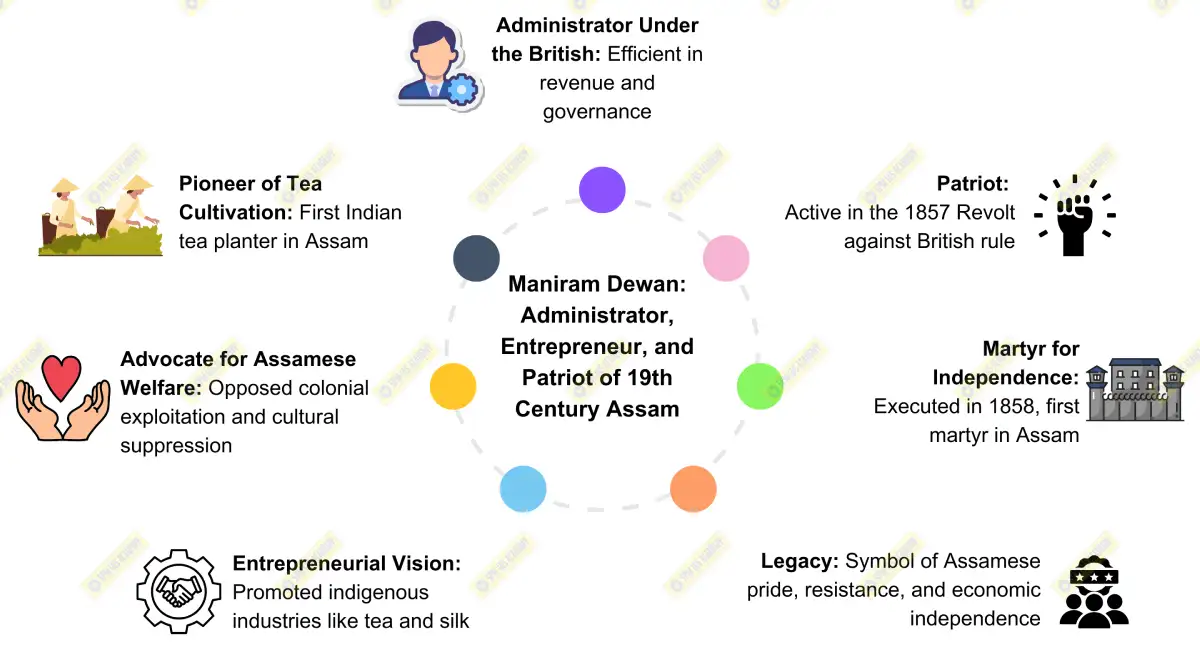
Maniram Dewan (1806–1858), a prominent figure in 19th-century Assam, played a pivotal role as an administrator, entrepreneur, and patriot, contributing significantly to the region’s socio-economic and political landscape during British colonial rule. Born into an aristocratic family, he combined his skills in governance and business with a commitment to resisting British exploitation, ultimately becoming a martyr in India’s first war of independence in 1857.
Role as an Administrator
1. Service Under the British:
○ Maniram served as a Sheristadar (revenue officer) under the British administration, earning their trust due to his efficiency and understanding of Assamese society.
○ He was later appointed the Tehsildar (collector) of Assam Tea Company, where he played a key role in the early development of tea plantations in Assam.
2. Advocate for Assamese Welfare:
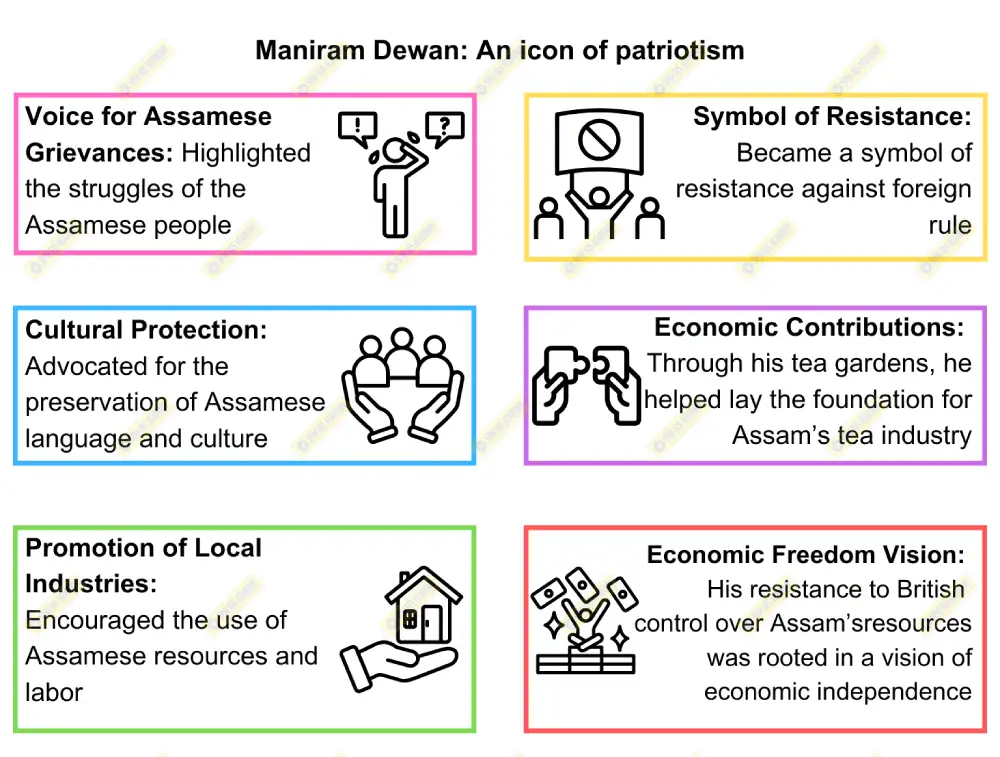
○ As an administrator, Maniram worked to improve the conditions of Assamese people, often highlighting their grievances to the British.
○ He opposed the colonial policies that led to economic decline and cultural suppression, such as the imposition of land taxes and the replacement of Assamese by Bengali as the court language.
Role as an Entrepreneur
- Pioneer of Tea Cultivation:
○ Recognizing Assam’s potential for tea cultivation, Maniram established his own tea gardens in Chinamara and Senglung near Jorhat in the 1840s, becoming the first Indian tea planter.
○ His entrepreneurship challenged the British monopoly in tea production, laying the foundation for indigenous participation in the tea industry. - Promotion of Indigenous Industry:
○ Maniram encouraged the use of local resources and labor, emphasizing the economic independence of Assamese society.
○ His ventures in tea were a direct assertion of Indian agency in an industry dominated by British capital. - Economic Visionary:
○ Maniram sought to revive the traditional crafts and industries of Assam, promoting silk production and other local enterprises to counter colonial exploitation.
Role as a Patriot
- Opposition to British Policies:
○ Disillusioned with British rule, Maniram actively opposed their exploitative policies, particularly those affecting Assamese agriculture and culture.
○ He became a critic of the British control over the tea industry, viewing it as a tool for economic subjugation. - Involvement in 1857 Revolt:
○ Maniram played a crucial role in organizing resistance during the Revolt of 1857. He conspired to overthrow British authority in Assam by supporting the restoration of the Ahom monarchy, backing Prince Kandarpeswar Singha as the rightful ruler.
○ The British uncovered his plans, leading to his arrest and execution by hanging in 1858, making him the first martyr of India’s independence movement in Assam. - Symbol of Assamese Identity:
○ His patriotism was rooted in a vision of an independent Assam, free from foreign exploitation. His sacrifice inspired later generations of freedom fighters in the region.
Legacy
- Cultural Icon: Maniram Dewan is celebrated as a symbol of Assamese pride and resistance against colonial rule.
- Economic Contribution: His efforts in tea cultivation earned him the title of the “Father of Indian Tea Industry.”
- Patriotic Inspiration: His martyrdom during the Revolt of 1857 cemented his place in the annals of Indian and Assamese history.
Maniram Dewan’s multifaceted contributions as an administrator, entrepreneur, and patriot reflect his profound influence on 19th-century Assam. While his administrative skills helped improve governance, his entrepreneurial ventures challenged British economic hegemony, and his patriotic fervor made him a key figure in India’s struggle for independence. Maniram Dewan’s legacy continues to inspire the ideals of self-reliance, cultural preservation, and resistance against oppression.