If you are preparing for Maharashtra civil services this year, understanding the MPSC Rajyaseva exam pattern is the first real step toward a focused preparation strategy. The Maharashtra Public Service Commission conducts the Rajyaseva examination for Group A and Group B government posts in Maharashtra, and the selection happens through a three-stage process. On top of that, 2026 brings major government reforms that change how some of these stages work. This blog covers the complete MPSC Rajyaseva exam pattern stage by stage, prelims, mains, and interview, along with the full syllabus for each paper, the reform updates, the list of optional subjects, and preparation tips.
Candidates seeking expert civil services guidance can choose UPSC coaching in Assam for better preparation.
What Are the 2026 Reforms That Changed the MPSC Rajyaseva Exam Pattern?
Before getting into the stage-wise breakdown, every aspirant must know about the major government reforms introduced in 2026 that directly affect the exam pattern for future recruitment cycles.
The Maharashtra government has implemented these changes to make recruitment faster, more transparent, and less stressful for candidates. The key updates are:
Similar posts are now covered under a single examination system instead of multiple separate exams. Services have been reorganized through cadre restructuring to improve efficiency in recruitment planning. Administrative and technical cadres are consolidated to reduce exam duplication. A total of 553 service entry rules across departments have been revised to simplify the process. Interviews have been removed entirely for Group B non-gazetted and Group C posts, making selection fully exam-based for these categories. The overall aim is to run a faster recruitment cycle with reduced delays and a lower burden on aspirants.
One important note: these reforms apply only to future recruitment cycles. Ongoing examinations continue under the earlier rules. So candidates appearing in the current cycle must check their specific notification to determine which rules govern their recruitment.
Many aspirants prefer UPSC coaching in north east India for quality mentorship and structured learning.
What Is the MPSC Rajyaseva Selection Process 2026?
The MPSC Rajyaseva exam pattern for Group A and higher Group B posts follows a three-stage selection structure.
- Preliminary Examination (Screening Test)
- Main Examination (Descriptive and Analytical Stage)
- Personality Test (Interview)
Candidates must clear each stage to advance to the next. The final merit list for Group A posts is based on combined marks from the Mains and the Interview. Since the Interview has been removed for Group B Non-Gazetted and Group C posts in future recruitments, selection for those categories will rely entirely on written exam performance.
What Is the MPSC Prelims Exam Pattern 2026?
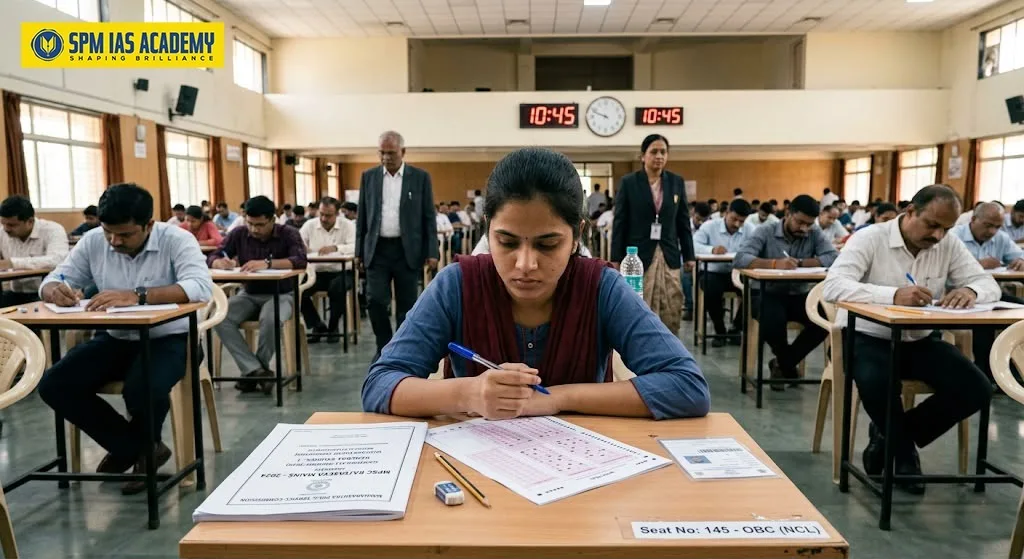
The Preliminary Examination is the first stage of the MPSC Rajyaseva exam pattern and serves as a screening test to qualify candidates for the Mains. The Prelims consists of two objective-type papers, each carrying 200 marks with 100 questions. Both papers run for 2 hours each, are set in Marathi and English medium, and carry negative marking at 1/4th of a mark per wrong answer.
Strengthen Northeast India knowledge through Nagaland History and Hornbill Festival Explained: Naga Tribes.
MPSC Prelims Exam Pattern:
| Paper | Subject | Marks | Questions | Duration | Type |
| Paper 1 | General Studies | 200 | 100 | 2 hours | Objective |
| Paper 2 | CSAT (Aptitude) | 200 | 100 | 2 hours | Objective |
The minimum qualifying marks for Prelims is 33% in each paper. Paper 2, which is the CSAT, is qualifying in nature, meaning its marks are not counted for ranking purposes. Candidates must score at least 33% in CSAT to remain eligible, but the actual ranking for mains shortlisting is based on Paper 1 marks alone.
What Does the MPSC Prelims Syllabus Cover?
The Prelims stage of the MPSC Rajyaseva exam pattern tests candidates across two very different areas. Paper 1 focuses on general studies content, and Paper 2 focuses on aptitude-based skills.
Paper 1 — General Studies (200 Marks)
This paper covers a wide range of topics with a Maharashtra-specific focus alongside national and international content.
- Current events at the state, national, and international levels
- Indian National Movement and history of India with reference to Maharashtra
- Physical, social, and economic geography of Maharashtra, India, and the world including dams, rivers, and inter-state water treaties
- Constitution of India, fundamental rights and duties, important acts and amendments
- Political system in India — Panchayati Raj, urban governance
- Maharashtra Polity and Governance, districts and administrative divisions
- Economic and Social Development in Maharashtra and India — sustainable development, poverty, education, inclusion, and Sustainable Development Goals
- Demography — population, sex ratio, and literacy of Maharashtra and India
- Environment and Ecology — basic principles, biodiversity, climate change, environmental laws in India, wildlife sanctuaries, national parks, Ramsar sites in Maharashtra, and international environmental conventions like Kyoto, Basel, and Montreal
- Social sector initiatives in Maharashtra and India
- General Science—chemistry in everyday life, cell structure and functions, basic human and plant anatomy and physiology, disease prevention and vaccines, food and nutrition, force, work, pressure, gravity, acids, bases, salts, metals, and non-metals
- Maharashtra GK — history, art and culture, famous monuments, folk dances, festivals, saints, poets, and writers
- Freedom fighters and famous personalities of Maharashtra including Pandita Ramabai, Savitribai Phule, Jyotiba Phule, Annabhau Sathe, and others
Paper 2 — CSAT (Common State Aptitude Test) (200 Marks — Qualifying)
Paper 2 covers aptitude and analytical skills.
- Marathi Comprehension and English Comprehension
- Interpersonal skills and communication skills
- Logical reasoning and analytical ability
- Data interpretation through charts, graphs, and tables
- Data sufficiency
- Decision-making and problem-solving
- General mental ability
- Basic numeracy covering number system, ratio and proportion, HCF, LCM, geometry, averages, time and work, fractions, decimals, and problems on ages up to Class X level
What Is the MPSC Mains Exam Pattern 2026?
Candidates who qualify Prelims move on to the Mains examination, which is the second stage of the MPSC Rajyaseva exam and is significantly more detailed and analytical than the Prelims. The Mains consists of 9 papers, all subjective and descriptive, set in Marathi and English medium.
Minimum qualifying marks for Mains: 45 marks for General category candidates and 40 marks for Reserved category candidates in each paper.
MPSC Mains Exam Pattern:
| Paper No. | Subject | Type | Marks |
| Paper 1 | Marathi | Subjective | 300 |
| Paper 2 | English | Subjective | 300 |
| Paper 3 | Essay | Subjective | 250 |
| Paper 4 | General Studies 1 | Subjective | 250 |
| Paper 5 | General Studies 2 | Subjective | 250 |
| Paper 6 | General Studies 3 | Subjective | 250 |
| Paper 7 | General Studies 4 | Subjective | 250 |
| Paper 8 | Optional Subject Paper 1 | Subjective | 250 |
| Paper 9 | Optional Subject Paper 2 | Subjective | 250 |
Papers 1 (Marathi) and 2 (English) are qualifying in nature. The marks scored in these two language papers are not counted for ranking. The final ranking, including Essay (Paper 3), General Studies Papers 4 through 7, and the two Optional Subject papers (Papers 8 and 9), along with the Interview marks.
What Does the MPSC Mains Syllabus Cover?
Each paper in the Mains stage of the MPSC Rajyaseva exam pattern covers specific and detailed content areas.
Paper 1 — Marathi (300 Marks — Qualifying): Tests reading, comprehension, precis writing, usage and vocabulary, short essays, and translation between English and Marathi. Not counted for ranking.
Paper 2—English (300 Marks—Qualifying): Tests reading, comprehension, précis writing, usage and vocabulary, and short essays. Not counted for ranking.
Paper 3 — Essay (250 Marks): Divided into two sections, each with four topic choices. Candidates select one from each section. Essays can be written in Marathi or English as per the opted medium.
Paper 4—General Studies 1 (250 Marks): Indian Heritage and Culture, History, and Geography of the World and Society with Maharashtra weightage. Covers art forms and architecture from ancient to modern times, the Bhakti movement and Maharashtra saints’ tradition, modern Indian history from the 18th century to the present, the Freedom Struggle and post-independence reorganization, world history including the Industrial Revolution, World Wars, colonization, and political philosophies like communism, capitalism, and socialism, and salient features of Indian and world physical geography.
Paper 5—General Studies 2 (250 Marks): Governance, Constitution, Polity, Social Justice, and International Relations with Maharashtra weightage. Covers the Indian Constitution, federal structure, Parliament and state legislatures, the executive and judiciary, local self-government, welfare schemes, poverty and hunger, e-governance, civil services, India’s bilateral and multilateral relations, and important international institutions.
Paper 6—General Studies 3 (250 Marks): Technology, Economic Development, Biodiversity, Environment, Security, and Disaster Management with Maharashtra weightage. Covers Indian economy and planning, inclusive growth, government budgeting, agriculture and irrigation, food processing, land reforms, infrastructure, science and technology developments, biodiversity and environmental conservation, disaster management, internal security challenges, cybersecurity, and various security forces.
Paper 7 — General Studies 4 (250 Marks): Ethics, Integrity, and Aptitude. Covers ethics and human interface, human values, attitude, foundational values for civil service, emotional intelligence, contributions of moral thinkers, ethics in public administration, probity in governance, the right to information, codes of conduct, and case studies on ethical dilemmas.
Papers 8 and 9 — Optional Subject (250 Marks Each): Candidates choose one optional subject from a list of 26 options. The subject covers two papers totaling 500 marks.
What Optional Subjects Are Available Under the MPSC Rajyaseva Exam Pattern?
The MPSC Rajyaseva exam pattern allows candidates to choose from a wide list of optional subjects for Papers 8 and 9. The available optional subjects are Agriculture, Animal Husbandry and Veterinary Science, Anthropology, Botany, Chemistry, Civil Engineering, Commerce and Accountancy, Economics, Electrical Engineering, Geography, Geology, History, Law, Management, Marathi Literature, Mathematics, Mechanical Engineering, Medical Science, Philosophy, Physics, Political Science and International Relations, Psychology, Public Administration, Sociology, Statistics, and Zoology.
Candidates must choose the optional that aligns with their academic background and comfort level, since it contributes 500 marks to the total Mains score and significantly impacts the final rank.
What Is the MPSC Interview Pattern 2026?
The interview or Personality Test is the final stage of the MPSC Rajyaseva exam for Group A posts. It is conducted by an expert panel appointed by MPSC and evaluates the candidate’s personality, communication skills, analytical thinking, and decision-making ability. The focus areas during the interview include current affairs, general knowledge, mental alertness, and the candidate’s suitability for a civil service role.
The final merit list for Group A posts combines the main marks and the interview marks. Candidates who score higher in both stages secure better ranks and consequently better post preferences during allotment.
Since interviews have been removed for Group B non-gazetted and Group C posts in future recruitments as part of 2026 reforms, those category candidates will be ranked entirely on their written exam performance.
What Preparation Tips Work Best for the MPSC Rajyaseva Exam 2026?
Preparing well for the MPSC Rajyaseva exam requires a subject-by-subject strategy alongside consistent writing practice and current affairs awareness. Here are the most effective preparation tips:
- Focus on Maharashtra Current Affairs: State-specific events, government schemes, and administrative updates appear heavily in both Prelims and Mains, so daily reading of Maharashtra-focused news is non-negotiable.
- Practice Descriptive Answer Writing Daily: Since the entire Mains stage is subjective, writing quality directly affects marks across all nine papers and must be built through consistent daily practice.
- Do Not Ignore CSAT: Many candidates fail to clear the 33% qualifying mark in Paper 2 and get eliminated before Mains regardless of their GS performance, so CSAT must receive dedicated preparation time.
- Solve Previous Year Papers Regularly: MPSC PYQs reveal the question style, expected depth, and recurring themes across both Prelims and Mains, which helps candidates align their preparation accurately.
- Follow One Standard Source Per Subject: Using too many books and platforms simultaneously creates confusion and wastes time, so pick one reliable source per topic and study it thoroughly.
- Build Conceptual Clarity Over Memorization: Since grouped exams may increase competition in future cycles, candidates who understand concepts deeply will always have an edge over those who rely on rote learning alone.
Conclusion
The MPSC Rajyaseva exam pattern 2026 is a three-stage system covering Prelims with 400 total marks, Mains with 9 papers across 2,600 total marks, and an Interview for Group A posts. The 2026 reforms, including grouped examinations, cadre consolidation, and interview removal for Group B Non-Gazetted and Group C posts, make the process faster and more exam-focused going forward. CSAT qualifies candidates for Mains but does not contribute to ranking. The language papers in Mains are also qualifying only. The merit-based ranking relies on the Essay, four General Studies papers, and two Optional Subject papers in Mains, combined with Interview marks for Group A posts. A clear understanding of the MPSC Rajyaseva exam pattern from the beginning of preparation helps candidates allocate their time correctly, avoid last-minute surprises, and build a strategy that covers every stage with adequate depth.
Frequently Asked Questions
Yes, negative marking applies in the MPSC Rajyaseva exam for the Prelims examination. For every wrong answer in the objective papers, 1/4th of the marks allocated to that question are deducted. Since both Paper 1 and Paper 2 carry 200 marks with 100 questions each, every wrong answer costs 0.5 marks. Candidates should therefore attempt questions with reasonable confidence rather than making random guesses throughout the paper.
Yes, the CSAT paper (Paper 2) is qualifying in nature within the MPSC Rajyaseva exam pattern. Candidates must score at least 33% marks in the CSAT to remain eligible for the Mains, but the marks obtained in this paper are not counted toward the ranking for Mains shortlisting. Only Paper 1 (General Studies) marks are used for ranking. Despite this, CSAT must be taken seriously since falling below 33% eliminates a candidate regardless of how well they perform in the GS paper.
Yes, 2026 brought significant changes to the MPSC Rajyaseva exam through major government reforms. The key changes include the introduction of a grouped examination system for similar posts, cadre restructuring and consolidation, revision of 553 service entry rules, and the removal of interviews for Group B Non-Gazetted and Group C posts. These reforms aim to create a faster, more transparent, and less burdensome recruitment process for candidates going forward. However, ongoing examination cycles continue under the earlier rules and candidates should check their specific notification for confirmation.

Behind every article at SPM IAS Academy is a team of skilled content writers and subject experts committed to making preparation easier for aspirants. From answering common doubts to breaking down complex issues and current affairs, we create content that is accurate, easy to understand, and directly useful for UPSC, APSC, and other competitive exams.