
The sighting of Rare migratory bird Smew at Laokhowa Wildlife Sanctuary has created an important biodiversity record for Assam. Laokhowa Wildlife Sanctuary recorded its first-ever documented sighting of the Smew (Mergellus albellus) during the 7th Kaziranga Waterbird Count 2026.
Survey teams spotted the bird while assessing important wetlands such as Rowmari, Dondowa and Muamari beels. In addition, teams recorded the Critically Endangered Bengal Florican, highlighting the wider conservation value of Laokhowa’s wetland-grassland ecosystem.
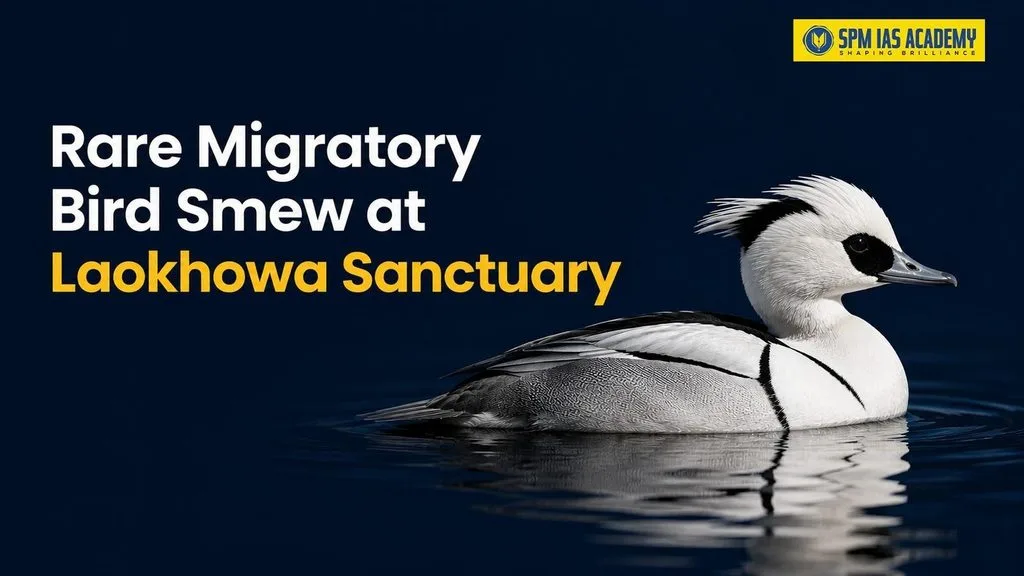
Rare Migratory Bird Smew at Laokhowa Sanctuary: Why Is It in News?
- The sighting of the rare migratory bird Smew at Laokhowa sanctuary marks the first recorded occurrence of this species in the protected area.
- The discovery came during the 7th Kaziranga Waterbird Count 2026, when survey teams documented rich bird diversity across Laokhowa’s wetlands. Therefore, the record adds to scientific knowledge about how migratory waterbirds use the Brahmaputra floodplain during winter.
- Moreover, the Assam government has linked the development with stronger habitat protection, scientific monitoring and enforcement against illegal activities.
What is Smew (Mergellus albellus)?
The Smew is a small diving duck belonging to the Anatidae family. It occurs across Eurasia and migrates between breeding and wintering grounds.
| Feature | Details |
| Common Name | Smew |
| Scientific Name | Mergellus albellus |
| Order | Anseriformes |
| Family | Anatidae |
| Type | Diving duck |
| IUCN Status | Least Concern |
| Distribution | Eurasia |
| Habitat | Lakes, reservoirs, rivers and wetlands |
The male Smew has striking white-and-black plumage with dark patches around the eyes, which gives it a distinctive appearance. In contrast, the female has a greyish body, a rusty-brown head and white cheeks and throat. Cornell’s Birds of the World identifies the species as Least Concern globally.
Smew Habitat and Migration
The rare migratory bird Smew at Laokhowa sanctuary is particularly significant because Smews travel considerable distances between breeding and non-breeding areas.
They primarily use freshwater environments such as:
- Lakes and reservoirs
- Slow-moving rivers
- Marshes and wetlands
- Other suitable wintering water bodies
The species occurs widely across Eurasia, while its distribution changes seasonally because of migration.
Thus, the Laokhowa sighting expands the sanctuary’s documented list of migratory waterbirds.
Conservation of the Rare Migratory Bird Smew at Laokhowa Sanctuary
The first record of the rare migratory bird Smew at Laokhowa sanctuary reinforces the need to protect the sanctuary’s beels and floodplain habitats.
According to the supplied report, authorities have strengthened action against illegal fishing and increased patrolling in vulnerable locations. They are also conducting surprise checks, establishing monitoring points and taking legal action against repeat offenders.
This approach combines three essential elements: Scientific Monitoring, Habitat Protection and Strong Enforcement.
Protecting wetlands benefits more than migratory birds. Healthy wetlands also support fish, amphibians, reptiles and mammals while maintaining the wider ecological functioning of the Brahmaputra floodplain.
Laokhowa Wildlife Sanctuary
- Location: Laokhowa Wildlife Sanctuary lies in Nagaon district of Assam, on the southern bank of the Brahmaputra River.
- Area: The sanctuary covers approximately 70.13 sq km and forms an important part of Assam’s Brahmaputra floodplain ecosystem.
- Ecosystem: It mainly comprises alluvial grasslands, wetlands, swamps, riverine forests and water bodies. Therefore, it supports diverse wetland and grassland species.
- Wildlife: The sanctuary provides habitat for one-horned rhinoceros, wild buffalo, wild boar, swamp deer, hog deer, sambar and various primates and birds.
- One-Horned Rhinoceros: Laokhowa historically supported a significant Indian one-horned rhinoceros (Rhinoceros unicornis) population. However, poaching and habitat pressures caused severe declines in the past.
- Laokhowa-Burachapori Landscape: Laokhowa forms an important ecological landscape with the adjoining Burachapori Wildlife Sanctuary. Together, they create a larger floodplain habitat and wildlife corridor.
- Wetland Importance: Moreover, its wetlands and grasslands provide important habitats for migratory and resident waterbirds, making the sanctuary significant for Assam’s avian biodiversity.
- Brahmaputra Floodplain: Seasonal flooding plays an important ecological role by replenishing nutrients, maintaining wetlands and supporting grassland regeneration.
- Conservation Challenges: However, the sanctuary faces threats from poaching, habitat degradation, invasive species, human–wildlife conflict, encroachment and changes in flood regimes.
- Rhinoceros Conservation: Assam has undertaken habitat protection, anti-poaching measures and landscape-level conservation to support the recovery of rhinoceros populations in the Laokhowa–Burachapori landscape.
Conclusion
The first sighting of the rare migratory bird Smew at Laokhowa sanctuary adds an important record to Assam’s growing documentation of wetland biodiversity. At the same time, the presence of the Bengal Florican highlights the landscape’s importance for both wetland and grassland species.
Therefore, scientific bird monitoring, wetland conservation and stronger enforcement can help Laokhowa remain an important refuge for Assam’s resident and migratory wildlife.
Read More:
Source:
FAQ:
The Smew at Laokhowa Wildlife Sanctuary marks the sanctuary’s first documented record of this rare migratory waterbird. Moreover, it highlights the importance of Assam’s wetlands.
The Smew at Laokhowa Wildlife Sanctuary uses freshwater wetlands, lakes, rivers and reservoirs. Therefore, protecting wetlands of Laokhowa Wildlife Sanctuary can support migratory waterbirds.
The Smew at Laokhowa Wildlife Sanctuary highlights the need for wetland protection and scientific monitoring. Furthermore, stronger enforcement can protect its habitat and other wetland species.

SPM IAS Academy is a leading APSC & UPSC coaching institute based in Guwahati, Assam, dedicated to helping aspirants achieve success in civil services examinations. The academy provides expert mentorship, comprehensive study materials, current affairs guidance, test series, and personalized preparation strategies for APSC, UPSC, and other competitive exams. With a strong focus on quality education, discipline, and result-oriented learning, SPM IAS Academy has become a trusted name among civil service aspirants across Assam and Northeast India.