
The Sukhna Wetland in Chandigarh received international recognition on 15 October 2026 under the Ramsar Convention. Sukhna Wetland is a human-made freshwater reservoir located at the foothills of the Shivalik Hills. Its designation recognises its importance for biodiversity, migratory birds and water conservation.
Moreover, Sauj Jheel in Uttar Pradesh also received Ramsar recognition. Consequently, India’s total number of Ramsar sites increased to 103.
This article explains about Sukhna Wetland Ramsar Site, its ecological significance, India’s latest Ramsar sites and important facts for UPSC, APSC and State PCS examinations. Also, if you are looking for Best UPSC and APSC Coaching, Click on this!
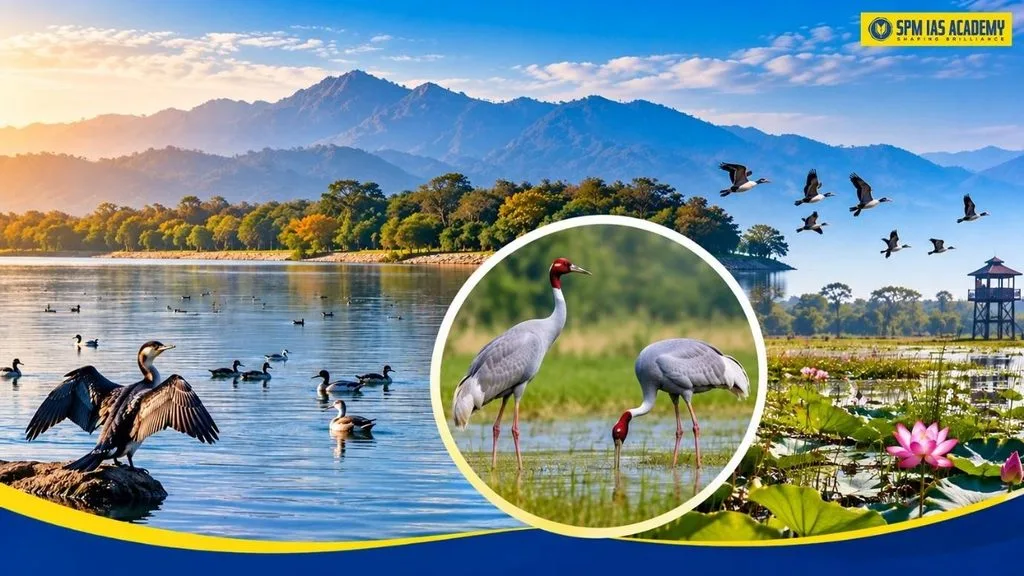
Why Is Sukhna Wetland Ramsar Site in the News?
On 15 October 2026, Union Environment Minister Bhupender Yadav announced two new Ramsar sites. These are Sukhna Wetland, Chandigarh and Sauj Jheel, Uttar Pradesh. These additions increased India’s Ramsar site count from 101 to 103. Furthermore, Sukhna became Chandigarh’s first Ramsar site.
What Is Sukhna Wetland Ramsar Site?
The Sukhna Wetland Ramsar Site is a human-made freshwater reservoir in Chandigarh, located at the foothills of the Shivalik Hills. It supports rich biodiversity and provides an important habitat for migratory birds.
Key facts about Sukhna Wetland Ramsar Site:
- Location: Sukhna Wetland lies in Chandigarh, near the Shivalik foothills of the Outer Himalayas.
- Origin: Chandigarh created Sukhna Lake in 1958 by damming the seasonal Sukhna Choe stream.
- Wetland Type: It is a human-made freshwater reservoir that supports aquatic and terrestrial ecosystems.
- Area: The lake covers approximately 565 acres (229 hectares).
- Ramsar Recognition: It received Ramsar designation on 15 October 2026.
- Migratory Birds: Moreover, the wetland provides wintering and feeding habitats for birds travelling along the Central Asian Flyway.
- Biodiversity: It supports aquatic plants, fish, turtles and several resident and migratory bird species.
- Ecological Importance: Furthermore, the wetland supports local biodiversity, water regulation and ecological balance.
- Conservation Challenges: However, siltation, catchment degradation and human activities threaten its ecological health.
Why Is Sukhna Wetland Important for Biodiversity?
The Sukhna Wetland Ramsar Site provides feeding, breeding, roosting and wintering habitats for resident and migratory birds.
Important species include:
- Common Pochard: A waterbird classified as Vulnerable on the IUCN Red List.
- Pallas’s Fish Eagle: An Endangered bird of prey associated with wetland habitats.
- Black Pond Turtle: An Endangered freshwater turtle found in shallow wetland habitats.
Moreover, the wetland supports birds travelling along the Central Asian Flyway, which connects breeding and wintering habitats across Eurasia and the Indian subcontinent.
What Is Sauj Jheel, India’s Other New Ramsar Site?
Sauj Jheel is a shallow freshwater wetland in Uttar Pradesh, located in the Ganga River floodplain. It supports rich biodiversity and provides an important habitat for resident and migratory birds.
Key facts about Sauj Jheel:
- Location: Sauj Jheel lies in Uttar Pradesh, within the Ganga River floodplain.
- Wetland Type: It is a shallow freshwater wetland that supports aquatic vegetation and waterbirds.
- Ramsar Recognition: It received Ramsar designation on 15 October 2026.
- Nearby Protected Area: It lies near the Saman Bird Sanctuary, an important wetland habitat in Uttar Pradesh.
- Bird Population: Moreover, the wetland regularly supports more than 30,000 waterbirds.
- Biodiversity Recognition: Bird Life International recognises Sauj Jheel as an Important Bird and Biodiversity Area (IBA).
- Important Species: Furthermore, it provides habitats for the Sarus Crane (state bird of Uttar Pradesh), and the Greater Spotted Eagle.
- Aquatic Vegetation: The wetland supports plants such as sacred lotus and wild sugarcane.
- Ecological Importance: Additionally, it supports migratory birds, wetland connectivity and biodiversity conservation.
Therefore, its Ramsar recognition strengthens efforts to protect freshwater ecosystems and their wildlife.
What Is the Ramsar Convention?
The Ramsar Convention is an international environmental treaty that promotes wetland conservation and sustainable use worldwide.
Key facts about the Ramsar Convention:
- Establishment: Initially, countries adopted the Ramsar Convention on 2 February 1971 in Ramsar, Iran. Subsequently, the convention came into force on 21 December 1975.
- Main Objective: Primarily, it promotes wetland conservation and the wise use of wetland resources.
- India’s Membership: Furthermore, India joined the Ramsar Convention on 1 February 1982.
- Ramsar Sites: Additionally, the convention recognises ecologically important wetlands as Wetlands of International Importance.
- Selection Criteria: Notably, countries use nine criteria to identify Ramsar sites based on ecological and biodiversity significance.
- International Cooperation: Similarly, it promotes cooperation on shared wetlands, river basins and migratory species.
- World Wetlands Day: Every year, the world observes 2 February to promote awareness about wetland conservation.
- Montreux Record: Besides this, the convention maintains the Montreux Record to identify Ramsar sites facing significant ecological changes.
What Is the Significance of Sukhna Wetland Ramsar Site?
The recognition of the Sukhna Wetland Ramsar Site strengthens India’s wetland conservation efforts.
- Protect Biodiversity: It highlights the need to conserve endangered species and migratory bird habitats.
- Improve Water Security: Moreover, the wetland helps regulate water flows and supports local ecological balance.
- Strengthen Climate Resilience: Healthy wetlands can reduce certain climate-related risks and support ecosystem stability.
- Promote Sustainable Tourism: Ramsar recognition encourages responsible recreation and environmental education.
- Address Conservation Challenges: However, authorities must control siltation, invasive species and catchment degradation.
Conclusion
The Sukhna Wetland Ramsar Site marks an important achievement in India’s biodiversity conservation efforts. Along with Sauj Jheel, it increased India’s Ramsar site count to 103. However, long-term conservation requires effective wetland management, catchment protection and public participation.
Read More:
Source:
Sukhna Wetland received Ramsar recognition on 15 October 2026 for its ecological importance. Moreover, it supports migratory birds, aquatic biodiversity and wetland conservation in Chandigarh.
India had 103 Ramsar sites as of October 2026. Notably, the addition of Sukhna Wetland in Chandigarh and Sauj Jheel in Uttar Pradesh increased the total from 101 to 103.

Written by SPM IAS Academy Content Team
We don’t create content to fill pages; we create content that fills the gaps in your preparation. Every article is researched, refined, and designed with one goal — to make your journey towards success a little sharper.
No unnecessary noise. No recycled information. Just focused insights, exam-oriented guidance, and content that actually helps aspirants move forward.
Because when the competition is tough, average preparation doesn’t make the cut.