
The Union Public Service Commission (UPSC) conducts the CAPF examination to recruit Assistant Commandants (Group A) for the BSF, CRPF, CISF, ITBP, and SSB. The UPSC CAPF Selection Process 2027 is expected to involve multiple stages, including the written examination, Physical Standards Test (PST), Physical Efficiency Test (PET), Medical Standards Test, and Interview/Personality Test, followed by the preparation of the final merit list. Candidates must qualify at each applicable stage to remain in contention for final selection. Aspirants preparing through an IAS Academy in Guwahati should follow the official UPSC notification for the confirmed 2027 selection process, eligibility conditions, and stage-wise requirements.
According to the UPSC Annual Calendar 2027, the Commission will release the CAPF (AC) notification, 2027 on 17 February 2027 and the application will start from 9 March 2027. Moreover, UPSC will conduct the written examination CAPF 2027 on 4 July 2027. However, UPSC may change these dates if circumstances require.
Important: UPSC has not yet issued the detailed CAPF 2027 notification. Therefore, this guide explains the UPSC CAPF Selection Process 2027 using the latest officially notified 2026 scheme as the current reference. Candidates should check the 2027 notification once UPSC releases it.
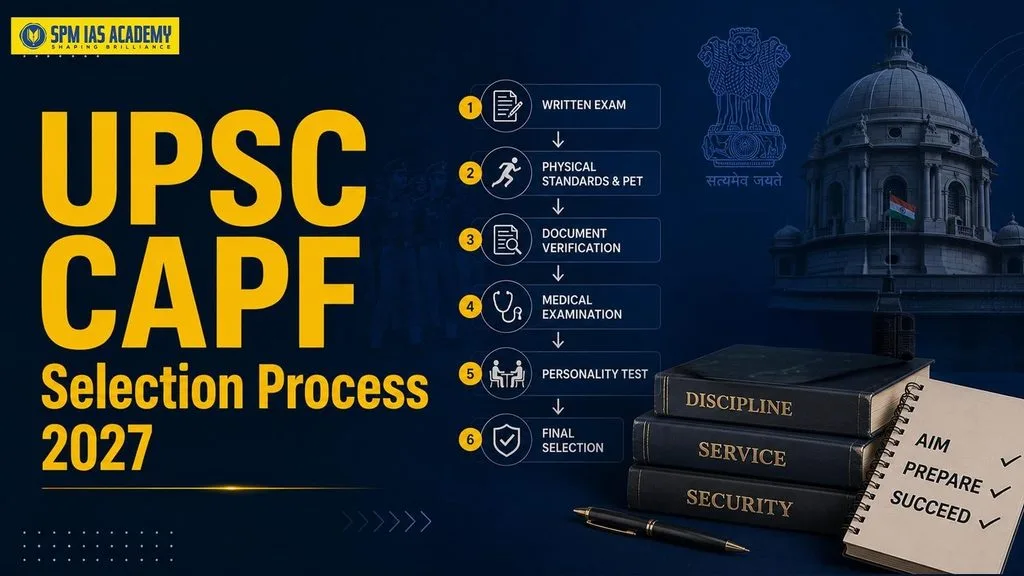
UPSC CAPF Selection Process 2027: Stages at a Glance
Based on the latest CAPF scheme, CAPF Selection process goes through the following stages:
| Stage | Selection Component | Marks/Status |
| Stage 1 | Written Examination – Paper I | 250 Marks |
| Stage 1 | Written Examination – Paper II | 200 Marks |
| Stage 2 | Physical Standards Test & Physical Efficiency Test | Qualifying |
| Stage 3 | Interview/Personality Test | 150 Marks |
| Stage 4 | Medical Standards Test | Qualifying |
| Final Selection | Written Exam + Interview | 600 Marks |
UPSC CAPF Exam Pattern: Stage 1 Written Examination
The first stage of the UPSC CAPF Selection Process 2027 will be the written examination if UPSC retains the current exam pattern. The written test is expected to assess candidates through two papers covering General Ability and Intelligence, General Studies, Essay, Comprehension, and related areas. Candidates who qualify the written stage can then proceed to the subsequent physical, medical, and interview stages as prescribed by UPSC. Aspirants who want to crack APSC exam online can also benefit from strengthening their General Studies, current affairs, reasoning, and analytical skills, as these areas overlap with preparation for several competitive examinations.
It consists of two papers:
CAPF Paper I – General Ability and Intelligence
- Marks: 250
- Duration: 2 hours
- Type: Objective/Multiple Choice
- Medium: Hindi and English
Paper I tests General Mental Ability, General Science, Current Affairs, Indian Polity and Economy, History of India, and Indian and World Geography.
CAPF Paper II – General Studies, Essay and Comprehension
- Marks: 200
- Duration: 3 hours
- Type: Descriptive
- Essay: Hindi or English
- Comprehension, précis and language skills: English only
UPSC evaluates Paper I first, and Paper II is considered only for candidates who secure the minimum qualifying marks prescribed in Paper I. UPSC may also prescribe separate qualifying standards for both papers, so candidates should prepare for each paper with equal attention. Understanding this evaluation approach helps aspirants plan their preparation and avoid focusing exclusively on one section of the written examination. Candidates seeking structured guidance can consider the best civil service coaching in Guwahati for systematic preparation, regular practice, and mock-test support.
Thus, the written stage carries 450 marks.
CAPF Syllabus and Its Role in the Selection Process
Understanding the CAPF syllabus is crucial because written performance contributes directly to final merit.
- Paper I covers reasoning, science, current affairs, polity, economy, history and geography.
- Meanwhile, Paper II tests essay writing, security and human-rights awareness, analytical ability, comprehension, précis writing and communication skills.
Therefore, aspirants should prepare the syllabus and exam pattern together instead of treating them as separate areas. A strong foundation in General Studies can help candidates perform well in Paper I and meet the required qualifying standard, while regular essay, comprehension, and writing practice can improve performance in Paper II. Candidates should also use previous-year papers and mock tests to understand question patterns and manage time effectively. Aspirants preparing through UPSC coaching in the Northeast can benefit from a structured study plan that combines conceptual learning, current affairs, writing practice, and regular performance analysis.
UPSC CAPF Selection Process 2027: Physical Standards Test
Candidates who qualify the written examination move to the Physical Standards Test (PST).
Under the latest standards, the basic requirements include:
| Physical Standard | Men | Women |
| Minimum Height | 165 cm | 157 cm |
| Chest | 81 cm with minimum 5 cm expansion | Not Applicable |
| Minimum Weight | 50 kg | 46 kg |
However, weight must also correspond appropriately with height and age under the prescribed medical tables.
Candidates who fail to meet the prescribed physical standards cannot proceed to the Physical Efficiency Test.
CAPF Physical Efficiency Test: PET Requirements
The UPSC CAPF Selection Process involves qualifying the Physical Efficiency Test (PET).
The latest PET includes:
| Test | Male Candidates | Female Candidates |
| 100 metres | 16 seconds | 18 seconds |
| 800 metres | 3 min 45 sec | 4 min 45 sec |
| Long Jump | 3.5 m – 3 chances | 3.0 m – 3 chances |
| Shot Put (7.26 kg) | 4.5 m | Not Applicable |
PET does not add marks to final merit. However, candidates must qualify to continue in the selection process.
Therefore, aspirants should begin running, strength training and jump practice before the written examination, rather than waiting for the written result.
UPSC CAPF Interview and Personality Test
Candidates who qualify the PST and PET become eligible for the UPSC CAPF Interview/Personality Test, based on the latest scheme.
The interview carries 150 marks and plays a direct role in final ranking.
The board assesses qualities relevant to an Assistant Commandant, including:
- Leadership potential
- Mental alertness
- Decision-making ability
- Communication skills
- Balanced judgement
- Awareness of national and security issues
- Integrity and suitability for command responsibilities
Moreover, possession of an NCC ‘B’ or ‘C’ Certificate is treated as a desirable qualification and receives consideration at the Interview/Personality Test stage under the latest notification.
UPSC CAPF Selection Process 2027: Medical Standards Test
Under the latest CAPF scheme, the Medical Standards Test follows the Interview/Personality Test. Authorities examine candidates against prescribed physical and medical standards.
The examination covers areas such as:
- Eyesight and refractive errors
- Hearing
- General physical fitness
- Limbs and joint movement
- Dental health
- Cardiovascular and respiratory health
- Skin conditions
- Overall mental and bodily fitness
The 2026 standards allow LASIK correction subject to specified conditions, including stability and the required post-operative interval.
Medical fitness remains qualifying. Therefore, a candidate who scores highly in the written examination and interview still cannot receive an appointment without meeting the required medical standards.
UPSC CAPF Final Merit and Force Allocation
The final stage of the UPSC CAPF Selection Process 2027 will determine the merit ranking.
UPSC currently calculates final merit using:
- Written Examination: 450 Marks + Interview/Personality Test: 150 Marks = 600 Marks. PST, PET and medical tests remain qualifying and do not contribute numerical marks to final merit.
- Force allocation depends on the candidate’s position in the merit list, force preferences and available vacancies. Candidates indicate preferences for forces during the application process.
- Under the latest tie-breaking system, UPSC first gives preference to the candidate with higher written marks. If the tie continues, Paper I marks and then age become relevant.
UPSC CAPF 2027 Important Dates
According to the official UPSC Annual Calendar:
- Notification release date: 17 February 2027
- Last Date to Apply: 9 March 2027
- Written Examination: 4 July 2027
UPSC has stated that these dates remain subject to alteration.
Conclusion
The UPSC CAPF Selection Process 2027 demands academic knowledge, descriptive writing ability, physical fitness, medical suitability and officer-like qualities. Candidates must therefore look beyond the written examination and prepare for the complete selection journey.
Since UPSC has not yet released the detailed 2027 notification, aspirants should currently follow the latest official selection scheme while monitoring UPSC for changes. Understanding the CAPF syllabus, exam pattern, PET/PST, interview, medical requirements and final merit system early can provide a major strategic advantage.
Read More:
Source:
Frequently Asked Question
1. What is the UPSC CAPF Selection Process 2027?
The UPSC CAPF Selection Process 2027 is expected to include the written examination, Physical Standards Test (PST), Physical Efficiency Test (PET), Interview/Personality Test and Medical Standards Test. Finally, UPSC prepares the merit list using marks from the written examination and interview.
2. How many marks are included in the final merit under UPSC CAPF Selection Process 2027?
Under the UPSC CAPF Selection Process 2027, the written examination carries 450 marks, while the Interview/Personality Test carries 150 marks. Therefore, UPSC calculates the final merit out of 600 marks. However, PST, PET and medical tests remain qualifying in nature.
3. What happens after the written exam in UPSC CAPF Selection Process 2027?
After candidates clear the written examination, they proceed to the Physical Standards Test and Physical Efficiency Test. Next, qualified candidates appear for the Interview/Personality Test and Medical Standards Test. Finally, UPSC prepares the merit list based on written and interview scores.

Behind every article at SPM IAS Academy is a team of skilled content writers and subject experts committed to making preparation easier for aspirants. From answering common doubts to breaking down complex issues and current affairs, we create content that is accurate, easy to understand, and directly useful for UPSC, APSC, and other competitive exams.