
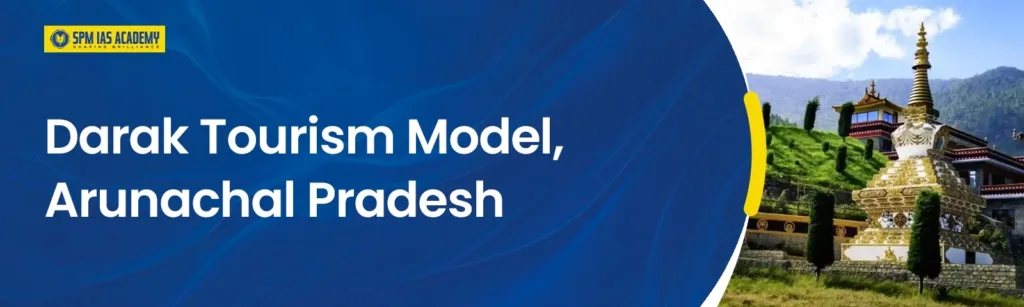
What is the Darak Tourism Model in Arunachal Pradesh?
The Darak Tourism Model in Arunachal Pradesh represents a low-impact, conservation oriented andcommunity-centric tourism approach. At its core, the model promotes tourism in a biologically sensitive region. It balancesecological protection with equitable benefits for local communities. As a result, it offers a sustainable framework that links environmental conservation, livelihood generation, andresponsible tourism.
About Darak Village:
To begin with, Darak is a scenic village located in the West Siang district of Arunachal Pradesh. Notably, the village is known for its largely unspoiled natural landscape, which forms the foundation of its sustainable tourism model.
Geographically, the area is characterised by the pristine waters of the Sibu River andthe Siik (Siek) River, adding to its ecological and aesthetic value. At the same time, the region is home to the Galo community, one of the indigenous communities of Arunachal Pradesh. Their culture and traditional knowledge play a vital role in the local tourism framework.
Dimensions of Darak Tourism Model:
Ecological Dimension:
- To begin with, the Darak Tourism Model follows a low-impact tourism framework that is well suited to the fragile riverine and forest ecosystems of the region.
- At its core, the model adopts a conservation-first approach, ensuring that tourism activities cause minimal ecological disturbance.
- In particular, special emphasis is placed on the protection of freshwater biodiversity, especially the river ecosystems of the area.
Eco-Tourism–cum–Angling Festival:
- In addition, Darak hosts an annual eco-tourism–cum–angling festival, which acts as a flagship conservation initiative.
- Through this festival, the community works to protect endangered aquatic species, most notably the golden mahseer, along with other endemic fish found in the Sibu and Siik rivers.
- Importantly, the festival promotes catch-and-release angling. It actively discourages exploitative fishing practices.
Riverine Conservation Advocacy:
- Moreover, the festival functions as a strong platform for environmental awareness and conservation advocacy.
- During the event, local leaders and community members educate visitors about the dangers of destructive fishing methods, such as poisoning, electrocution, and the use of explosives.
- As a result, these practices are highlighted as serious threats to river biodiversity and long-term ecological balance.
Cultural Sustainability Dimension:
- At the same time, the Darak Tourism Model uses tourism as a means of preserving the cultural identity of the Galo ethnic group.
- Specifically, it showcases the Traditional Ecological Knowledge (TEK) of the community.
- Key cultural elements highlighted include traditional village architecture, sustainable agricultural practices, and community-based resource management systems. All of which reflect a centuries-old harmony between humans and nature.
Community Empowerment and Heritage Preservation:
- Furthermore, by presenting Galo culture in an authentic and respectful manner, tourism encourages the community to preserve their customs, language, and traditional social structures.
- Consequently, cultural heritage is treated as an asset rather than a liability.
- Importantly, cultural exchange remains participatory and non-commercialised, ensuring the long-term integrity of local traditions.
Economic Dimension – Equitable Growth:
- Finally, the Darak Tourism Model prioritises equitable economic benefits for local residents.
- It promotes rural entrepreneurship through homestays, local guiding services, handicrafts, and community-managed tourism activities.
- As a result, dependency on external operators is reduced, while local ownership and inclusive development are strengthened.
Broader Significance of Darak Tourism Model:
- To begin with, the Darak Tourism Model aligns closely with the principles of sustainable tourism and community-led development.
- Moreover, it contributes simultaneously to biodiversity conservation, livelihood security, and cultural preservation, creating a balanced development framework.
- At a broader level, the model reflects India’s commitment to the Sustainable Development Goals, particularly SDG 8 (Decent Work and Economic Growth), SDG 12 (Responsible Consumption and Production), and SDG 15 (Life on Land).
- Finally, it serves as a practical example of environmentally responsible tourism in ecologically sensitive regions. It offers a replicable model for other parts of the country.
Conclusion:
Overall, the Darak Tourism Model in Arunachal Pradesh stands out as a strong example of sustainable tourism. It also promotes community-led development and conservation-driven growth. By carefully balancing ecological protection, cultural preservation, and local livelihood generation, the model demonstrates how tourism can support both environmental sustainability and inclusive economic development. Moreover, its alignment with the Sustainable Development Goals (SDGs) and focus on low-impact, responsible tourism make Darak a replicable model for ecologically sensitive regions. This topic is highly relevant for GS I, GS III, UPSC, and APPSC current affairs.
Mains Practice Question:
Q. “The Darak Tourism Model demonstrates how sustainable tourism can integrate environmental conservation, cultural preservation, and rural livelihood generation.” Critically examine this statement with reference to the Darak Tourism Model of Arunachal Pradesh.
Also read: Seva Aapke Dwar 2.0 Camp
Arunachal Pradesh Current Affairs Articles
- Arunachal Pradesh: History, Culture, Economy, Tourism & Key Facts
- Itanagar: The Capital of Arunachal Pradesh – History, Facts & Significance
- Inner Line Permit (ILP) System in Arunachal Pradesh: Digital Overhaul & Significance
- McMahon Line Explained: India–Tibet Border Dispute & Shimla Convention
Source: Arunachal Times
The Darak Tourism Model is a low-impact, community-centric, and conservation-oriented tourism model in West Siang district, Arunachal Pradesh. It balances biodiversity protection, local livelihoods, and sustainable tourism development.
The Darak Tourism Model promotes eco-friendly tourism, community empowerment, and cultural preservation. Moreover, it also protects river ecosystems and freshwater biodiversity, making it a strong example of sustainable development in ecologically sensitive regions.
The Darak Tourism Model aligns with SDG 8 (Decent Work and Economic Growth), SDG 12 (Responsible Consumption and Production), and SDG 15 (Life on Land) by supporting inclusive growth, conservation, and responsible tourism practices.

Behind every article at SPM IAS Academy is a team of skilled content writers and subject experts committed to making preparation easier for aspirants. From answering common doubts to breaking down complex issues and current affairs, we create content that is accurate, easy to understand, and directly useful for UPSC, APSC, and other competitive exams.