
According to the latest SRS 2022-24 data, Assam’s Maternal Mortality Rate (MMR) has declined to 84 maternal deaths per 1,00,000 live births, which is now below India’s national MMR of 87. This marks a major public health achievement for Assam, a state that once recorded one of the highest maternal mortality ratio (480 in 2006) in India.
For aspirants, this topic is important because it connects health, governance, women’s empowerment, social justice, public policy, and the Sustainable Development Goals. Therefore, Assam’s Maternal Mortality Ratio (MMR) should be studied not only as data, but also as an example of improved state capacity and health service delivery.

What is Maternal Mortality Rate (MMR)?
Many people search for What is Maternal Mortality Rate (MMR)? However, the official term used by WHO and the Sample Registration System is Maternal Mortality Ratio. It means the number of maternal deaths during a given period per 1,00,000 live births during the same period. It reflects the risk of death linked to pregnancy, childbirth and post-delivery complications.
In simple words, MMR tells us how safe pregnancy and childbirth are in a society. A lower MMR usually means better antenatal care, safer delivery, skilled birth attendance, emergency obstetric care, blood availability and better referral systems.
Sample Registration Survey 2022-24: Assam’s Maternal Mortality Ratio (MMR)
The latest Sample Registration Survey 2022-24 data shows a historic improvement in Assam’s Maternal Mortality Ratio (MMR). Assam’s MMR has come down to 84, while India’s national MMR stands at 87. The SRS Special Bulletin on Maternal Mortality is released by the Office of the Registrar General of India and provides nationally representative estimates for maternal mortality.
This is significant because Assam has, for many years, been counted among the high-burden states in maternal health. As per earlier data cited in public health reporting, Assam’s MMR was 125 in 2020-22 and 110 in 2021-23. The latest fall to 84 in 2022-24 shows a sharp improvement in a short period.
Maternal Mortality Rate in India: National Trend
The trend of Maternal Mortality Rate in India shows a long-term improvement. India’s MMR has declined from 167 in 2011-13 to 87 in 2022-24. This means India has nearly halved maternal deaths in just over a decade.
India has also achieved the National Health Policy 2017 target of reducing MMR to 100 per 1,00,000 live births. However, the country is still working towards the Sustainable Development Goal 3.1, which aims to reduce global MMR to less than 70 per 1,00,000 live births by 2030.
Therefore, India’s progress is strong, but the next stage will be more challenging. The focus must now shift from general improvement to targeted interventions in high-risk districts, tribal areas, tea garden communities, riverine belts and other difficult geographies.
Comparison of Assam’s MMR and Other States
- A comparison of Assam’s MMR and other states shows why Assam’s progress is important. In the latest 2022-24 estimates, Assam’s MMR of 84 is now slightly better than India’s national average of 87. This is a major shift because Assam earlier remained far above the national average.
- However, several southern and western states still perform better. Kerala (24), Tamil Nadu (25), Maharashtra (37), Andhra Pradesh (39), Telangana (48) and Gujarat (64) are among the states that have already reached the SDG-level benchmark of MMR below 70.
- On the other hand, states like Uttar Pradesh (154), Madhya Pradesh (135), Odisha (24) and Chhattisgarh (124) continue to record higher MMR levels.
This comparison shows that Assam has moved from a high-risk category to a much better position. However, it must continue improving to reach the SDG target of less than 70.
Assam’s Maternal Mortality Rate Current Year and Previous Years
The latest data shows a major improvement in Assam’s Maternal Mortality Ratio (MMR). As per the latest SRS 2022-24 bulletin, Assam’s MMR has declined to 84 maternal deaths per 1,00,000 live births, while India’s national MMR stands at 87. This means Assam has moved below the national average for the first time, which is a significant achievement for the state’s public health system.
| Year / Period | Assam’s MMR | India’s MMR | Key Point |
| 2006 | 480 | 254 | Assam had one of the highest maternal mortality levels in India. |
| 2014 | 300 | 167 | Assam improved, but it was still far above the national average. |
| 2016 | 237 | 130 | The gap reduced, but maternal health remained a major concern. |
| 2020-22 | 125 | 88 | Assam showed strong improvement, but remained above India’s average. |
| 2021-23 | 110 | 88 | Assam continued its downward trend. |
| 2022-24 | 84 | 87 | Assam performed better than the national average. |
The trend clearly shows that Assam’s Maternal Mortality Ratio (MMR) has declined sharply over the years. From 480 in 2006 to 84 in 2022-24, Assam has recorded a major public health transformation. The fall from 125 in 2020-22 to 110 in 2021-23, and then to 84 in 2022-24, also shows faster progress in recent years.
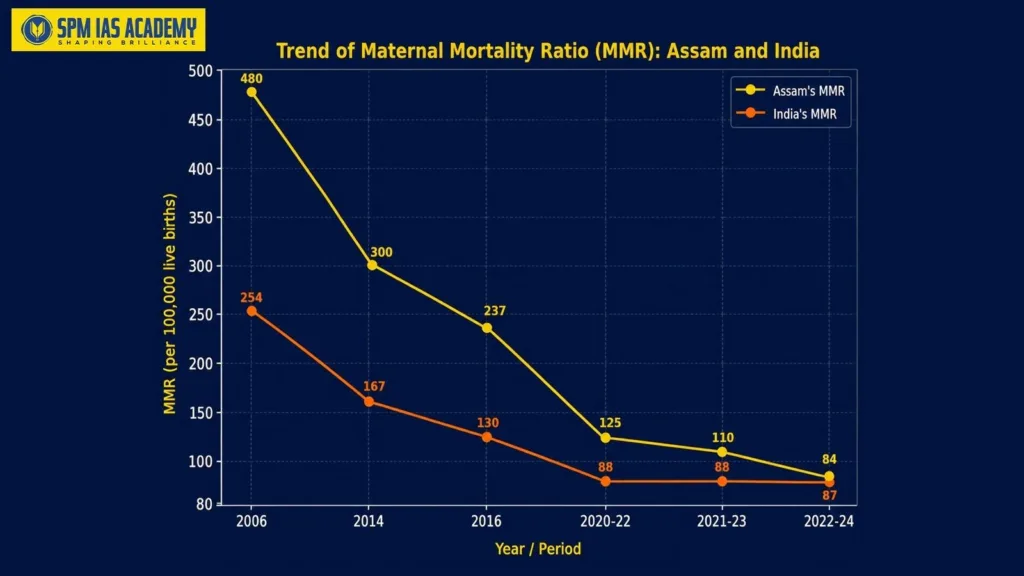
For UPSC and APSC aspirants, this trend is important because it reflects the impact of sustained health interventions, stronger institutional delivery systems, frontline health workers, maternal health schemes and better monitoring. However, Assam still needs to work towards the Sustainable Development Goal target of reducing MMR below 70 per 1,00,000 live births by 2030.
Why Did Assam’s Maternal Mortality Ratio (MMR) Improve?
The fall in Assam’s Maternal Mortality Ratio (MMR) is linked to multiple factors. No single scheme can explain this improvement. Instead, it reflects better convergence between doctors, nurses, ASHA workers, Anganwadi workers, hospitals and government programmes.
Major reasons include:
- Higher institutional delivery: More pregnant women now deliver in health facilities instead of homes.
- Better antenatal care: Regular check-ups help detect high-risk pregnancies early.
- Role of ASHA workers: Frontline workers improve awareness, tracking and referral support.
- Emergency obstetric care: Better facility readiness helps manage complications.
- Public health schemes: National programmes have supported safe motherhood.
- Improved data monitoring: Maternal death reviews help identify gaps and improve action.
The Union Government has also implemented several maternal health initiatives under the National Health Mission. These include Janani Suraksha Yojana, Janani Shishu Suraksha Karyakram, Pradhan Mantri Surakshit Matritva Abhiyan, LaQshya and SUMAN. These schemes focus on institutional delivery, free care, quality antenatal check-ups and respectful maternity services.
What are the Challenges Ahead for Assam to reduce MMR?
Despite the progress, Assam cannot afford complacency. Many challenges still remain:
- Remote areas face delays in transport and referral.
- Tea garden and char areas need stronger maternal health outreach.
- Anaemia, malnutrition and early marriage continue to affect maternal health.
- Some districts may still perform worse than the state average.
- Quality of care must improve along with access to care.
Therefore, the next goal should be to bring Assam’s Maternal Mortality Ratio (MMR) below the SDG target of 70. Assam needs district-level planning, better ambulance networks, stronger blood banks, more specialists, improved maternal death audits and continued community-level awareness.
Way Forward
- Assam should now move from basic access to quality-based maternal healthcare. The state must strengthen high-risk pregnancy tracking, improve First Referral Units, expand specialist availability and ensure respectful maternity care.
- Moreover, digital health records can help track pregnant people from registration to postnatal care.
- The state should also focus on nutrition, adolescent health, family planning and prevention of child marriage. These social factors directly affect maternal outcomes.
- As a result, reducing MMR is not only a health department task. It requires convergence between health, education, nutrition, transport, women and child development and local governance departments.
Conclusion
Assam’s Maternal Mortality Ratio (MMR) falling to 84 in SRS 2022-24 is a landmark achievement in Assam’s public health journey. It shows that sustained policy focus, frontline health workers and better institutional care can produce measurable results. However, Assam must now aim higher and work towards the SDG target of less than 70.
For UPSC, APSC and State PCS aspirants, this topic is highly relevant. It provides a strong example of governance, health policy, women empowerment and human development from Assam.
Read Also:
Sources:
FAQs on Assam’s Maternal Mortality Ratio (MMR)
Assam’s Maternal Mortality Ratio (MMR) is 84 maternal deaths per 1,00,000 live births as per the latest SRS 2022-24 data.
Maternal Mortality Rate is commonly searched, but the correct term is Maternal Mortality Ratio. It means maternal deaths per 1,00,000 live births.
India’s MMR is 87 per 1,00,000 live births as per the latest SRS 2022-24 data.

Written by SPM IAS Academy Content Team
We don’t create content to fill pages; we create content that fills the gaps in your preparation. Every article is researched, refined, and designed with one goal — to make your journey towards success a little sharper.
No unnecessary noise. No recycled information. Just focused insights, exam-oriented guidance, and content that actually helps aspirants move forward.
Because when the competition is tough, average preparation doesn’t make the cut.