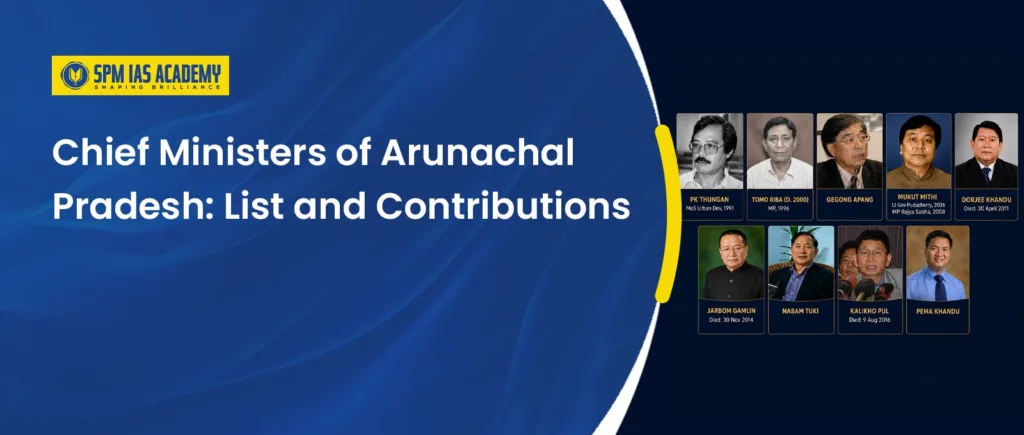
The Chief Ministers of Arunachal Pradesh have played a defining role in shaping the state across five decades of governance, from its early years as a Union Territory to its emergence as a full-fledged state with a growing economy, expanding infrastructure, and a distinct identity in India’s Northeast. Each leader has brought a unique administrative approach, and together their tenures reflect the political, economic, and social evolution of Arunachal Pradesh. This article presents the complete list of Chief Ministers of Arunachal Pradesh from 1975 to 2026, including their party affiliations, terms in office, and key contributions. For aspirants preparing at an apsc coaching institute in guwahati, this topic is highly relevant for APSC, UPSC, and other competitive examinations covering Indian Polity, State Governance, and Current Affairs.
Who Were the Chief Ministers of Arunachal Pradesh From 1975 to 2026?
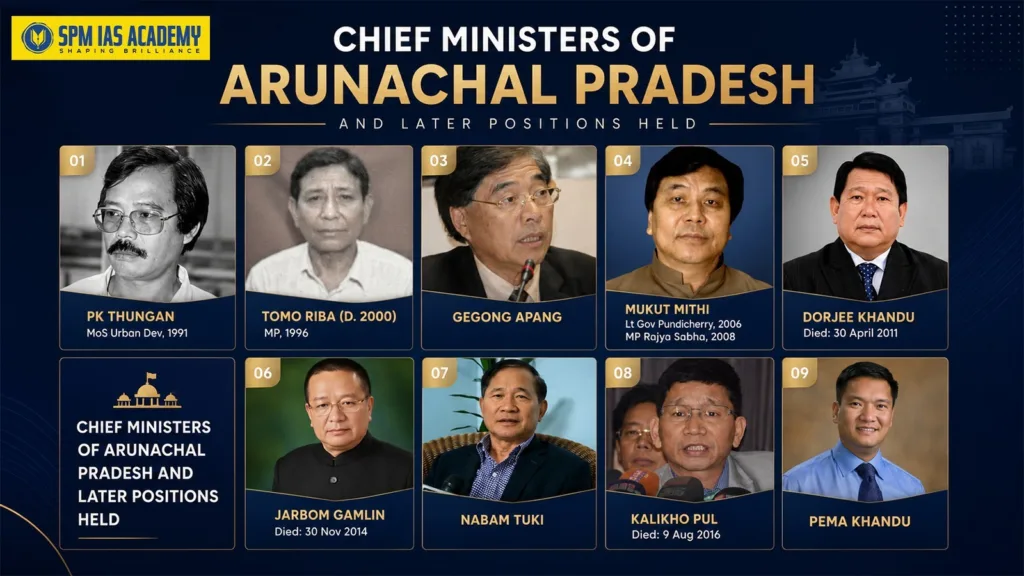
The list of Chief Ministers of Arunachal Pradesh spans 11 individuals across multiple parties and political shifts. Some leaders served for short terms during political transitions while others left lasting institutional imprints through long uninterrupted tenures.
| Sl. No. | Chief Minister | Period | Party |
| 1 | Prem Khandu Thungan | 13 August 1975 to 18 September 1979 | Janata Party |
| 2 | Tomo Riba | 18 September 1979 to 3 November 1979 | People’s Party of Arunachal |
| 3 | Gegong Apang | 18 January 1980 to 19 January 1999 | Indian National Congress + Arunachal Congress |
| 4 | Mukut Mithi | 19 January 1999 to 3 August 2003 | Arunachal Congress (Mithi) + Indian National Congress |
| 5 | Gegong Apang | 3 August 2003 to 9 April 2007 | United Democratic Front + Bharatiya Janata Party |
| 6 | Dorjee Khandu | 9 April 2007 to 30 April 2011 | Indian National Congress |
| 7 | Jarbom Gamlin | 5 May 2011 to 1 November 2011 | Indian National Congress |
| 8 | Nabam Tuki | 1 November 2011 to 26 January 2016 | Indian National Congress |
| 9 | Kalikho Pul | 26 January 2016 to 19 February 2016 | People’s Party of Arunachal |
| 10 | Nabam Tuki | 13 July 2016 to 17 July 2016 | Indian National Congress |
| 11 | Pema Khandu | 17 July 2016 to 16 September 2016 | Indian National Congress |
| 16 September 2016 to 31 December 2016 | People’s Party of Arunachal | ||
| 31 December 2016 to 29 May 2019 | Bharatiya Janata Party | ||
| 29 May 2019 to Present | Bharatiya Janata Party |
Who Was the First Chief Minister of Arunachal Pradesh?
Prem Khandu Thungan holds the distinction of being the first Chief Minister of Arunachal Pradesh, assuming office on 13 August 1975 and serving until 18 September 1979 under the Janata Party. His tenure came during a critical formative period when Arunachal Pradesh was still a Union Territory, and the foundations of its governance, public administration, and development policies were being established. For students avoid mistake in apsc preparation, understanding the contributions of early political leaders and the administrative evolution of Northeast Indian states is essential, as such topics are frequently covered in APSC and UPSC examinations under Polity, History, and Current Affairs.
Thungan worked to put in place the early institutional structures that would guide the state’s growth for decades. He prioritized basic infrastructure development, roads, schools, and hospitals, in a region that was largely isolated from the Indian mainland at the time. His focus on building physical connectivity gave future administrations something concrete to build upon. Thungan is remembered as the leader who gave the state its first sense of organized governance, and his contributions set the direction that subsequent Chief Ministers of Arunachal Pradesh would follow and expand upon.
Who Was the Longest Serving Chief Minister of Arunachal Pradesh?
Among all the Chief Ministers of Arunachal Pradesh, Gegong Apang stands out as the longest-serving. His first term ran from 18 January 1980 to 19 January 1999 under the Indian National Congress and Arunachal Congress, and he returned for a second term from 3 August 2003 to 9 April 2007 under the United Democratic Front and later the BJP. Combined, Apang’s total years in office cover roughly two and a half decades of the state’s political history.
Gegong Apang’s long tenure made him the dominant political figure in Arunachal Pradesh for an entire generation. He consistently focused on expanding education, strengthening healthcare services, and improving road connectivity across the state’s challenging terrain. His administration also introduced several development projects and economic initiatives that significantly influenced the state’s growth trajectory. The depth and continuity of his institutional contributions make his tenure one of the most significant in the history of the Chief Ministers of Arunachal Pradesh. Aspirants preparing with SPM IAS Academy Guwahati should study his tenure carefully, as questions related to the political history and governance of Northeast India frequently appear in APSC and UPSC examinations.
What Did Each Chief Minister of Arunachal Pradesh Contribute?
Beyond the list, understanding what each leader contributed gives aspirants a deeper appreciation of the state’s political and administrative evolution.
Prem Khandu Thungan (1975–1979): As the founding Chief Minister, he established the basic administrative framework for Arunachal Pradesh, prioritized infrastructure in an underdeveloped Union Territory, and created the earliest development pathways for the region.
Tomo Riba (September–November 1979): Riba served a short term during a transitional phase following Thungan’s departure. His brief tenure marked the first time the People’s Party of Arunachal held the chief ministerial office.
Gegong Apang (1980–1999 and 2003–2007): The longest-serving Chief Minister whose two combined terms cover nearly 25 years. He expanded education infrastructure, improved healthcare access, worked on economic development, and remained the most politically dominant figure in Arunachal Pradesh’s history.
Mukut Mithi (1999–2003): Mithi led the state through a period of political realignment. His administration worked on economic development and governance reform during a period when Arunachal Pradesh was navigating shifting political alliances.
Dorjee Khandu (2007–2011): Khandu brought renewed focus on development and governance until his untimely death in a helicopter crash in April 2011 — a loss that the state mourned deeply. His tenure saw increased attention to rural development and border area infrastructure.
Jarbom Gamlin (May–November 2011): Gamlin served briefly as Chief Minister following Dorjee Khandu’s death, maintaining governance continuity during a difficult transition period for the state.
Nabam Tuki (2011–2016 and briefly in July 2016): Tuki served as Chief Minister for two separate periods. His administration focused on social welfare schemes, educational expansion, and administrative consolidation across the state.
Kalikho Pul (January–February 2016): Pul’s very brief tenure came during a period of intense political flux. Though short, it represented a significant moment in the turbulent political landscape that Arunachal Pradesh experienced in early 2016.
Pema Khandu (2016–Present): The current and most prominent among the contemporary Chief Ministers of Arunachal Pradesh, Khandu has served continuously since July 2016, spanning three party affiliations before settling with the BJP in December 2016.
Who Is the Current Chief Minister of Arunachal Pradesh ?
Pema Khandu is the current Chief Minister of Arunachal Pradesh in 2026. He has been serving continuously since 29 May 2019 under the Bharatiya Janata Party (BJP). Today, he is one of the most influential leaders among the chief ministers of Arunachal Pradesh.
- Focus on Development: Under Pema Khandu’s leadership, Arunachal Pradesh has improved road connectivity through border roads and the Trans-Arunachal Highway. The government has also expanded schools, healthcare facilities, and skill development programs across the state.
- Support from the Deputy Chief Minister:
Chowna Mein, the Deputy Chief Minister, has played an important role in the administration. He has contributed to economic planning, policy implementation, and coordination between different government departments. - Inclusive Leadership:
Pema Khandu follows a practical and inclusive style of governance. He focuses on balanced development while addressing the unique geographical and cultural needs of Arunachal Pradesh. - A Prominent Political Leader: Among all the Chief Ministers, Pema Khandu is widely recognized as one of the most prominent leaders today. Under his leadership, the BJP has strengthened its presence in the state, making him a key political figure in both Arunachal Pradesh and Northeast India.
Who Is the Most Famous Among the Chief Ministers of Arunachal Pradesh?
Among all the Chief Ministers, Pema Khandu is widely regarded as the most prominent leader. He has served as Chief Minister since 17 July 2016 and has led the state under the Bharatiya Janata Party (BJP) since 31 December 2016. His government also includes Deputy Chief Minister Chowna Mein, who plays an important role in the state’s administration.
Pema Khandu is known for focusing on infrastructure, better road connectivity, education, healthcare, and economic development. His leadership has helped strengthen the BJP’s presence in Arunachal Pradesh, making him one of the most influential political leaders in the state and across Northeast India.
Conclusion
The story of the Chief Ministers of Arunachal Pradesh from 1975 to 2026 is a story of political evolution, state-building, and the gradual development of one of India’s most geographically and culturally distinctive regions. From Prem Khandu Thungan’s foundational leadership to Gegong Apang’s unmatched political longevity to Pema Khandu’s ongoing administration focused on infrastructure and economic growth, each Chief Minister has contributed something distinct to the state’s journey. For competitive exam aspirants, particularly those preparing for APSC, APPSC, and other Northeast-focused recruitment examinations, knowing this list, the tenures, the party affiliations, and the key contributions of each chief minister is directly useful in answering general studies questions on Arunachal Pradesh’s political history.
Frequently Asked Questions
Arunachal Pradesh got its first Chief Minister, Prem Khandu Thungan, in 1975, when the region was still a Union Territory rather than a full state. He assumed office on 13 August 1975 under the Janata Party and served until 18 September 1979. His leadership marked the beginning of organized governance in the region, setting the early foundations that future chief ministers would continue to build upon.
Arunachal Pradesh has had 11 individuals serve as Chief Minister since 1975. Among these, some served multiple terms, Gegong Apang served two separate terms across different parties, and Pema Khandu has served continuously since 2016 across three party affiliations. The variation in tenure lengths ranges from a few weeks to nearly 25 combined years.
The Chief Ministers serve a standard five-year constitutional term, subject to retaining the majority confidence of the state legislative assembly. A chief minister can be removed earlier through a vote of no confidence if they lose assembly support. This has happened multiple times in Arunachal Pradesh’s political history, most dramatically in 2016 when several transitions occurred within a single calendar year.
Behind every article at SPM IAS Academy is a team of skilled content writers and subject experts committed to making preparation easier for aspirants. From answering common doubts to breaking down complex issues and current affairs, we create content that is accurate, easy to understand, and directly useful for UPSC, APSC, and other competitive exams.