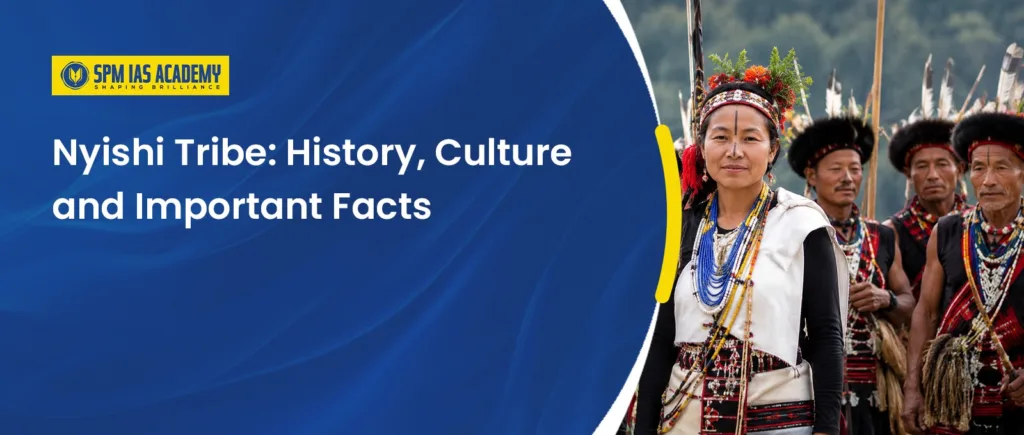
Among the many indigenous communities of Arunachal Pradesh, the Nyishi tribe stands out for its size, cultural richness, and remarkable ability to balance tradition with conservation. It is the largest Scheduled Tribe of Arunachal Pradesh, with a population of approximately 300,000 people spread across the central and western parts of the state. The Nyishi are known for their iconic hornbill-beak headgear, egalitarian social structure, vibrant festivals, and indigenous faith. Their history, customs, and contribution to the cultural heritage of Northeast India make them an important topic for competitive examinations.
What Does the Name “Nyishi” Actually Mean?
The name itself offers valuable insight into how this community understands its identity. In the traditional Nyishi language, the word “Nyi” refers to a man or human being, while “shi” means a being. Together, the term “Nyishi” translates to “a civilized human being.” This is more than just a name—it reflects a strong sense of dignity, community, and cultural belonging that has been preserved for generations.
The Nyishi tribe belongs to the Tani group of tribes. This also includes the Adi, Apatani, Galo, and Tagin communities of Arunachal Pradesh, as well as the Mishing people of Assam. All these communities trace their ancestry to a common mythological progenitor, Abo Tani and refer to themselves collectively as the Tani people. The bond of shared ancestry has kept these communities connected in identity, belief, and certain cultural practices even as they developed distinct traditions over centuries.
Where Did the Nyishi Tribe Come From? A Look at Their History
According to the oral traditions of the Nyishi tribe, their ancestors migrated from the north long before Buddhism spread across China and Tibet. They crossed a great river called Supung, which scholars believe was the Tsangpo River in present-day China. The absence of Buddhist influence in the Nyishi tribe’s faith further supports this belief. After crossing the high mountain ranges along today’s international border, the Nyishi tribe split into smaller lineage groups and settled across different regions. This is why the Nyishi tribe is now spread across five to eight districts of central Arunachal Pradesh instead of living in one place. Historical accounts also suggest that some communities lived in the foothills and border areas of Assam before moving into the hills of Arunachal Pradesh.
The Nyishi tribe believes that the universe was created from nothingness by the supreme being Jingbu Pabu Abu, who brought all living beings into existence through supernatural powers. According to their traditional beliefs, their legendary ancestor Abo Tani was born during this act of creation. After creating the universe, Jingbu Pabu Abu withdrew from the world, a belief that closely resembles the “creator-who-retreats” concept found in many indigenous cultures across the globe. Understanding such indigenous belief systems is important for aspirants preparing with UPSC coaching in North East India, as questions on the tribes, culture, and traditions of Northeast India frequently appear in UPSC, APSC, and other competitive examinations.
Where Do Nyishi People Live Today?
The Nyishi tribe is primarily concentrated across eight districts of Arunachal Pradesh:
- Papum Pare
- East Kameng
- Pakke Kesang
- Lower Subansiri
- Kamle
- Kra Daadi
- Kurung Kumey
- Upper Subansiri
Their settlements are typically in hilly and forested terrain, which has historically shaped everything from their house-building practices to their farming methods and their relationship with the natural environment. Beyond Arunachal Pradesh, smaller Nyishi populations also reside in the Sonitpur and North Lakhimpur districts of Assam, in the foothills near the Arunachal border.
What Is the Social Structure of the Nyishi Tribe?
One of the most distinctive features of the Nyishi tribe is that their society is built neither on caste nor on rigid class distinctions. Although social differences exist, they are flexible and are not determined by birth or occupation. This egalitarian social structure distinguishes the Nyishi from many other communities across the Indian subcontinent. Understanding such tribal social systems is also important while studying topics like the Assam Land Policy, as issues related to indigenous communities, land rights, traditional governance, and cultural identity are closely linked to land administration and frequently appear in APSC and UPSC examinations.
- Patrilineal Family System: The Nyishi tribe follows a patrilineal system, where family lineage and inheritance pass through the father’s side. Society is divided into five major phratries, called Hosa, Dopum, Dodum, Dolu, Hagung, and Anyia Hari, which trace their origin to a common ancestor. Each phratry is further divided into smaller clans.
- Importance of Phratries and Clans: Phratries and clans play a key role in the social and religious life of the Nyishi tribe. Members support one another during rituals and ceremonies and strengthen their bond through a sacred brotherhood ritual known as Uyi Haa Debam Nam, which involves sharing the blood and heart of a sacrificed animal. However, they do not need to live together or share the same occupation.
- Marriage Customs: The Nyishi strictly follows clan exogamy and tribe endogamy. This means a person cannot marry within their own clan but must marry within the Nyishi tribe. Breaking these customs can lead to social exclusion from weddings and important festivals such as Nyokum Yullo, Longte Yullo, and Boori Yullo.
- Role of Women: Women enjoy a respected position in the Nyishi tribe and are regarded as symbols of peace, prosperity, and family well-being. Men often seek their opinions before making important decisions, while the traditional marital exchange system helps maintain strong family ties across generations.
- Village Administration: The Nyishi manage village affairs through customary institutions led by respected village elders. These traditional laws regulate marriage, inheritance, land ownership, and community disputes, helping preserve social harmony and cultural values.
What Language Does the Nyishi Tribe Speak?
The Nyishis speak the Nyishi language, which belongs to the Tani branch of the Sino-Tibetan language family. The language is primarily oral in nature, it has a rich spoken tradition but limited written material. In recent years, however, active efforts are underway to develop scripts, dictionaries, and educational material to preserve and standardize the language for future generations.
What Is the Traditional Economy of the Nyishi Tribe?
Traditionally, the Nyishi relied on shifting cultivation, also called “jhum”, along with hunting, fishing, and the collection of forest produce. They also kept animals and used the produce for both food and ritual purposes.
Over time, many Nyishi communities have transitioned toward more settled agricultural practices, including terrace farming, horticulture, and wet-rice cultivation. Bamboo-based livelihoods have also grown significantly. The community is skilled in a wide range of handicrafts, including weaving, cane and bamboo work, pottery, blacksmithing, wood carving, and carpentry. Today, government employment and small-scale trade have also become common livelihood options for many Nyishi families. Major crops grown include rice, maize, millet, and vegetables.
Traditional houses are constructed on raised bamboo or wooden platforms, a practical design choice suited to the hilly terrain and the heavy rainfall the region receives throughout the monsoon months.
What Are the Festivals of the Nyishi Tribe?
The Nyishi celebrates three major festivals across the year:
Nyokum Yullo is the most significant and widely recognized festival of the community. It is celebrated every year in February and is dedicated to prayers for prosperity, peace, agricultural productivity, and harmony between humans and the natural world. The festival also seeks protection from natural calamities. It is marked by traditional dances including Rekham Pada, folk songs, communal feasts, and community gatherings. Nyokum Yullo has become one of the most important symbols of Nyishi cultural identity across Arunachal Pradesh.
Boori-Boot is also celebrated in February and is another major community festival tied to agricultural cycles and communal well-being.
Longte is celebrated in April. Together, all three festivals reflect the Nyishi community’s deep connection to seasonal cycles, agricultural life, and the natural world.
What Religion Does the Nyishi Tribe Follow?
The Nyishi follow a mix of beliefs. Traditionally, Nyishi spiritual practice was rooted in an indigenous animistic faith, a belief in nature spirits, ancestral spirits, and supernatural forces that govern the world. This traditional belief system is centered on a deep relationship between human communities and the natural environment.
The Donyi-Polo movement emerged as an effort to revive and formalize this indigenous faith. The movement is centered on the worship of the Sun (Donyi) and the Moon (Polo) as divine entities, a faith that reflects the Nyishi community’s historical reverence for the natural world. Many Nyishi people continue to practice Donyi-Polo today.
As per the 2011 Census, 31% of Nyishi people identify as Christian and 29% follow Hinduism. The rest continue with Donyi-Polo and other traditional spiritual practices. Hindu influences have also entered certain areas over time.
What Is the Traditional Dress of the Nyishi Tribe?
The most iconic element of traditional Nyishi dress and what the Nyishi tribe is perhaps best known for beyond Arunachal Pradesh is the headgear worn by men. Known as the “podum,” this is a woven cane cap traditionally decorated with the beak of the Great Hornbill. It is striking, ceremonial, and deeply tied to Nyishi cultural identity.
The traditional dress is sometimes referred to as the Nyishi Pomo and is regarded as one of the most distinctive traditional garments in Arunachal Pradesh. Beyond the headgear, traditional attire includes cane and bamboo ornaments, bead necklaces, woven garments, and the traditional dao, a machete used in everyday life and ceremonies.
Why Is the Nyishi Tribe Significant for Conservation?
The Nyishi has become a widely cited example in conservation studies, and the reason is the Great Hornbill. The use of real hornbill beaks in the podum headgear created a genuine threat to the bird’s population in Arunachal Pradesh. As hornbill numbers declined, awareness campaigns involving the community, NGOs, and the Forest Department led to a significant voluntary shift, artificial replicas of hornbill beaks, made from fiberglass and other materials, replaced the real ones in ceremonial use.
This shift happened without abandoning the cultural practice. The community kept the tradition intact while removing the ecological harm it caused. The Nyishi tribe‘s hornbill conservation initiative is now widely regarded as a successful model of community-led conservation, one where cultural identity and biodiversity protection were balanced rather than traded against each other.
Conclusion
The Nyishi tribe is far more than a statistical record or a competitive exam topic. They are a living community with a deep migration history, a rich oral tradition, a genuinely egalitarian social structure, a complex system of clan-based governance, three major annual festivals, and a voluntary conservation initiative that has drawn international attention. What makes the Nyishi tribe particularly significant is the way their cultural practices intersect with ecological stewardship. The hornbill conservation story is a genuine example of a community choosing to adapt a beloved tradition rather than destroy a species, and doing so through awareness and community participation rather than external enforcement.
Frequently Asked Questions
In the traditional Nyishi language, “Nyi” means a man or human being, and “shi” means a being. Together, the words translate to a civilized human being. This name reflects the community’s deep sense of identity and self-understanding as a community rooted in dignity and social cohesion rather than in external labels.
The Nyishi tribe is primarily concentrated across eight districts of Arunachal Pradesh, Papum Pare, East Kameng, Pakke Kesang, Lower Subansiri, Kamle, Kra Daadi, Kurung Kumey, and Upper Subansiri. A smaller population also lives in the Sonitpur and North Lakhimpur districts of Assam, in the foothills near the Arunachal border.
The Nyishi speak a Tani language that falls under the broader Sino-Tibetan language family. The language is primarily oral, with active ongoing efforts to develop written scripts, dictionaries, and educational materials to preserve it for future generations.

Behind every article at SPM IAS Academy is a team of skilled content writers and subject experts committed to making preparation easier for aspirants. From answering common doubts to breaking down complex issues and current affairs, we create content that is accurate, easy to understand, and directly useful for UPSC, APSC, and other competitive exams.