
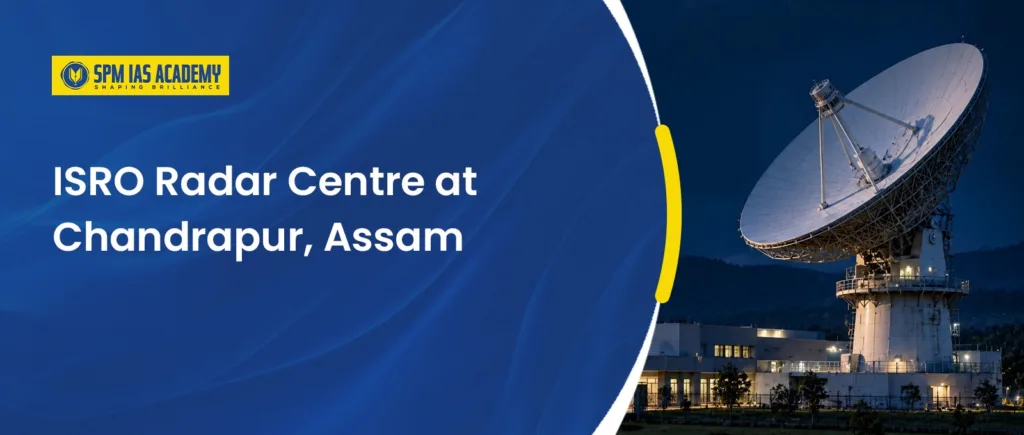
The ISRO Radar Centre in Chandrapur, Assam, is a planned space-surveillance facility under the Indian Space Research Organisation’s ISTRAC network. The Chief Minister of Assam laid its foundation stone on 21 September 2026. Known as the ISTRAC Advanced Radar Research Facility (IARRF), it is a part of ISRO’s Project NETRA. Project NETRA aims to improve India’s ability to detect and track objects in space. The project will expand space-surveillance infrastructure in Northeast India and support safer satellite operations. Such developments are also relevant for aspirants looking for best online coaching for APSC, as science and technology developments in Assam and Northeast India can form part of the exam preparation.
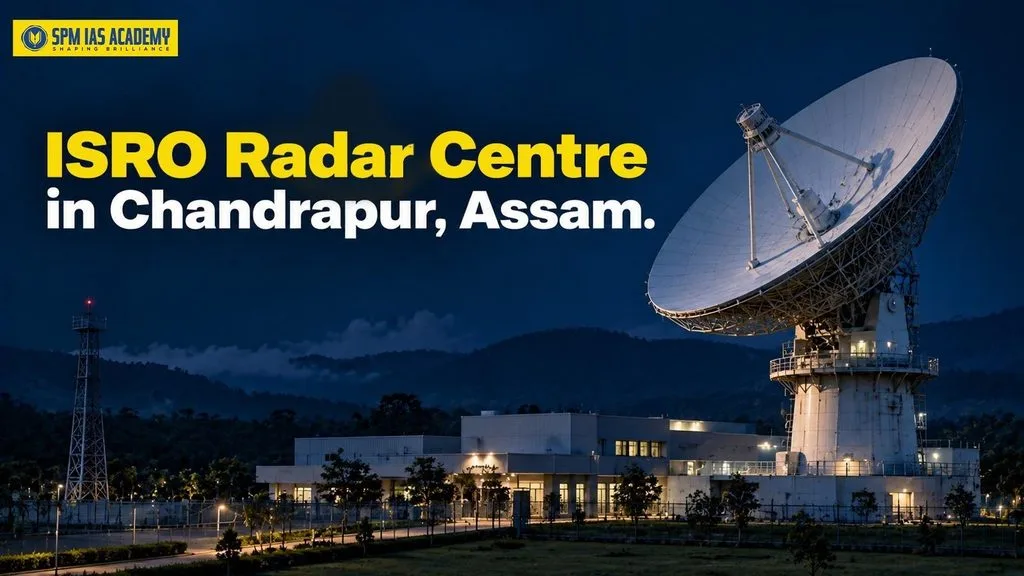
What Is the ISRO Radar Centre in Chandrapur, Assam?
- The ISRO Radar Centre at Chandrapur is an upcoming radar research and tracking facility near Guwahati. Aspirants preparing through an APSC course online can include such developments in their Science and Technology and Assam-specific current affairs preparation.
- It will operate under the ISRO Telemetry, Tracking and Command Network (ISTRAC), which supports spacecraft tracking and mission operations.
- This ISRO Radar Centre at Chandrapur will strengthen India’s ability to observe objects orbiting Earth. These objects include operational satellites, inactive spacecraft and fragments of space debris. The foundation-stone ceremony marks the beginning of the facility’s development.
What Are the Key Features of the ISRO Radar Centre in Chandrapur?
- The ISRO Radar Centre at Chandrapur will occupy approximately 70 acres of land provided by the Assam government.
- The planned facility will include multiple radars with different research and monitoring functions.
- According to reports from the foundation-stone ceremony, ISRO Chairman V. Narayanan said the first cloud radar would be commissioned by the end of February 2027.
- Two additional radars are expected within approximately 18 months of the announcement. The cloud radar will study cloud patterns and generate data that may help researchers understand rainfall. These are planned commissioning timelines, not confirmation that the radars are operational. Students preparing for civil services examinations can explore UPSC coaching in the Northeast to strengthen their understanding of regional developments, Science and Technology, and current affairs
How Will ISRO Advanced Radar Research Support Project NETRA Space Tracking?
- Project NETRA aims to strengthen India’s space situational awareness (SSA). It will strengthen the ability to detect, track and assess objects and potential hazards in space.
- Radar systems send radio waves towards an object and analyse the returning signals. This helps operators estimate an object’s position and movement. When tracking data indicates a possible close approach, satellite operators can assess the risk and decide whether a collision-avoidance manoeuvre is necessary.
- The ISRO Radar Centre at Chandrapur will contribute to this wider tracking effort. However, radar observations alone do not prevent collisions. Operators must combine reliable tracking data with timely decisions.
Why Does India Need a Northeast Space Surveillance Facility?
India uses satellites for communication, navigation, weather forecasting, disaster management, and Earth observation. Therefore, a collision involving a satellite could disrupt services that people and institutions rely on. Students preparing for competitive examinations can explore online coaching in Assam to strengthen their understanding of Science and Technology topics, including space technology, satellite applications, and developments relevant to India.
Moreover, space debris can remain in orbit long after a mission ends. Even small fragments can damage spacecraft because objects in orbit travel at very high speeds.
The Northeast space surveillance facility will add tracking infrastructure within India and support the country’s broader efforts to monitor orbital hazards. Its location in Assam also makes the project an important development for the region’s scientific infrastructure.
How Could the Chandrapur Radar Research Centre Help Assam?
- Improve rainfall research: The cloud radar will study cloud formation and rainfall patterns. Therefore, it can strengthen scientific understanding of Assam’s monsoon system.
- Support flood management: Better rainfall data can improve weather research. Consequently, authorities can use scientific information for flood preparedness and disaster management.
- Strengthen space research: The facility will expand advanced space and radar research infrastructure in Assam and strengthen the state’s role in India’s space sector.
- Develop scientific skills: Moreover, the centre can create opportunities for researchers, engineers and technical professionals to work with advanced radar and space technologies.
- Promote research collaboration: The facility can encourage cooperation between ISRO, universities and research institutions in Assam and the wider Northeast.
- Strengthen regional infrastructure: Finally, the centre will bring major scientific infrastructure to Northeast India and support the region’s participation in national space and technology programmes.
What Is Project NETRA?
Project NETRA (Network for Space Object Tracking and Analysis) is an initiative of the Indian Space Research Organisation (ISRO) to strengthen India’s Space Situational Awareness (SSA) capabilities. ISRO launched the project in 2019 to detect, track and assess objects in Earth’s orbit, including operational satellites, inactive spacecraft and space debris.
What are the Key Objectives and Features of Project NETRA
- Track space objects: Project NETRA uses ground-based observation systems, including radars and optical telescopes, to monitor objects orbiting Earth.
- Prevent satellite collisions: Moreover, the project helps ISRO assess possible collisions between satellites and space debris. Satellite operators can then plan collision-avoidance manoeuvres when necessary.
- Strengthen independent monitoring: The project aims to improve India’s ability to collect and analyse its own space-tracking data.
- Protect space missions: Additionally, better tracking information can help ISRO protect operational satellites and assess risks to future missions.
- Expand surveillance infrastructure: The proposed ISTRAC Advanced Radar Research Facility at Chandrapur, Assam, will contribute to India’s wider space-tracking capabilities.
Why is Project NETRA important?
India relies on satellites for communication, navigation, weather forecasting and disaster management. Therefore, Project NETRA supports the safety of these services by helping ISRO identify and assess potential hazards in orbit.
ISRO Radar Centre in Chandrapur: Important Facts
| Important fact | Answer |
| Location | Chandrapur, near Guwahati, Assam |
| Foundation-stone date | 21 September 2026 |
| Facility name | ISTRAC Advanced Radar Research Facility (IARRF) |
| Parent organisation | Indian Space Research Organisation (ISRO) |
| Associated network | ISRO Telemetry, Tracking and Command Network (ISTRAC) |
| Associated initiative | Project NETRA |
| Land provided | Approximately 70 acres |
| First planned radar | Cloud radar, with commissioning targeted by February 2027 |
| Key areas of relevance | Space situational awareness, satellite safety, atmospheric research and disaster management |
Conclusion
The ISRO Radar Centre at Chandrapur will strengthen India’s space surveillance capabilities and expand scientific infrastructure in Assam. Moreover, its planned cloud radar will support rainfall research and could improve flood preparedness. Therefore, the facility will contribute to satellite safety, scientific research and disaster management in Northeast India.
UPSC/APSC Mains Practice Question
Q. The establishment of the ISRO Radar Centre at Chandrapur, Assam, marks an important step towards strengthening India’s Space Situational Awareness (SSA) capabilities. Discuss the significance of such facilities for satellite safety, disaster management and scientific research. Also examine the challenges associated with space debris management.
Read More:
Source:
Frequently Asked Questions
1. How will the ISRO Radar Centre at Chandrapur support Project NETRA?
The ISRO Radar Centre will strengthen India’s ability to track objects in space. Moreover, its tracking data will help satellite operators assess collision risks and protect spacecraft.
2. How could the ISRO Radar Centre benefit Assam?
The centre’s planned cloud radar will study cloud patterns and rainfall. Therefore, its research could support flood preparedness while expanding scientific infrastructure in Assam.
3. When will the ISRO Radar Centre in Chandrapur become operational?
ISRO plans to commission the centre’s first cloud radar by February 2027. Moreover, it expects to install two additional radars within approximately 18 months of the foundation-stone ceremony.
5. What is the main purpose of the ISRO Radar Centre at Chandrapur?
The ISRO Radar Centre at Chandrapur aims to strengthen India’s space-surveillance capabilities. Moreover, it will support research and tracking activities that help to protect satellites from potential hazards in orbit.

Behind every article at SPM IAS Academy is a team of skilled content writers and subject experts committed to making preparation easier for aspirants. From answering common doubts to breaking down complex issues and current affairs, we create content that is accurate, easy to understand, and directly useful for UPSC, APSC, and other competitive exams.