
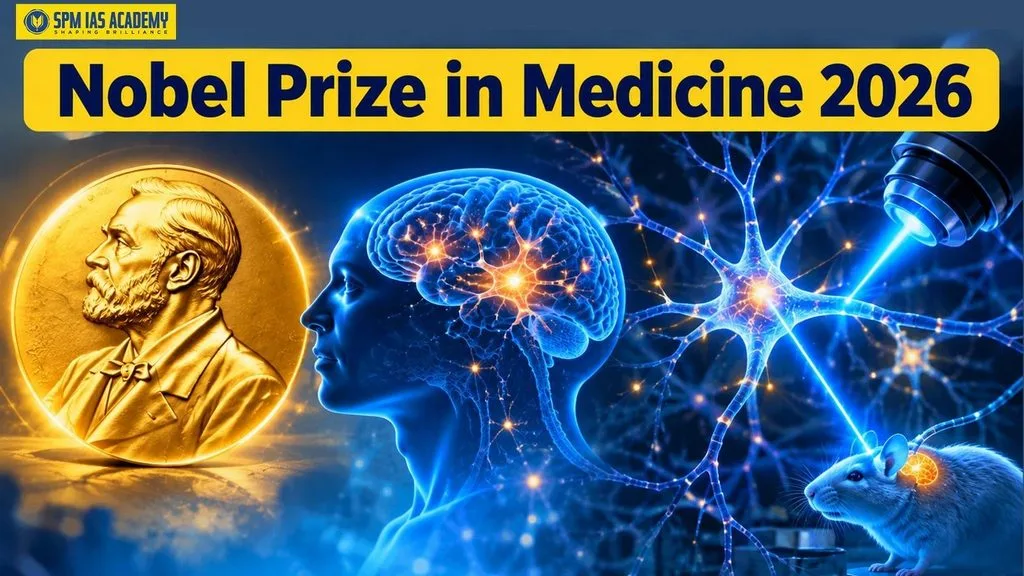
The Nobel Prize in Medicine 2026 has been awarded jointly to Karl Deisseroth, Peter Hegemann and Georg Nagel for their discoveries concerning light-gated ion channels and optogenetics. The Nobel Assembly at Karolinska Institutet announced the award on 5 October 2026. Their work has transformed neuroscience by allowing researchers to control the activity of specific nerve cells using light.
The discovery has opened new ways to understand how the brain controls memories, feelings and behaviour. It also has potential applications in treating conditions such as visual impairment and neurological disorders.
In this article, you will learn why the Nobel Prize in Medicine 2026 was awarded, what optogenetics means, how it works and why the discovery matters.
Why Was the Nobel Prize in Medicine 2026 Awarded?
The Nobel Prize in Medicine 2026 recognised three scientists for discoveries that made it possible to control nerve-cell activity using light.
The award honours their work on Light-gated ion channels, Optogenetics and understanding the functioning of neural circuits. Moreover, it also honours the studying on how nerve cells influence memory, emotions and behaviour.
Together, their research created a powerful tool for studying the living brain with much greater precision.
Who Won the Nobel Prize in Medicine 2026?
Peter Hegemann: Peter Hegemann is a German scientist associated with Humboldt University of Berlin. His research helped reveal how certain proteins respond to light.
Georg Nagel: Georg Nagel, from the University of Würzburg, collaborated with Hegemann in studying light-sensitive proteins found in algae.
Karl Deisseroth: Karl Deisseroth is an American scientist associated with Stanford University and the Howard Hughes Medical Institute. He developed the application of light-sensitive proteins for controlling nerve cells.
The three scientists will share the 12 million Swedish kronor Nobel Prize amount.
What Is Optogenetics?
Optogenetics is a technique that combines genetic modification and light to control the activity of specific cells, particularly neurons. In simple terms, scientists introduce genes for light-sensitive proteins into selected nerve cells. They can then use light to switch these neurons on or off. This gives researchers much greater control over individual neural circuits than many earlier methods.
What Are Light-Gated Ion Channels?
Light-gated ion channels are proteins that respond to light. Peter Hegemann and Georg Nagel studied Chlamydomonas, a single-celled alga, and discovered channelrhodopsin, a light-sensitive protein found on the cell surface. When blue light hits channelrhodopsin, the channel opens. As a result, charged ions pass through it and generate an electrical signal. This discovery laid the foundation for the development of optogenetics, a technique that uses light to control specific cells.
How Does Optogenetics Work?
Optogenetics combines genetic modification with light to control specific nerve cells. First, scientists introduce genes for light-sensitive proteins into selected neurons. These proteins act as light-controlled switches. Next, researchers use light to activate or inhibit the targeted neurons. As a result, they can study how specific neural circuits affect memory, emotions and behaviour. Therefore, optogenetics gives scientists precise control over nerve-cell activity and helps them understand how the brain works.
Why Is Optogenetics Important?
The Nobel Prize in Medicine 2026 highlights the growing importance of optogenetics in neuroscience. The technique allows researchers to study specific neural circuits linked to memory, emotions and behaviour. It also helps scientists investigate neurological and psychiatric disorders. Previously, researchers could identify links between brain regions and certain functions. But they often could not prove a clear cause-and-effect relationship. However, optogenetics allows them to control selected neurons and observe the resulting changes. Therefore, it provides a more precise way to understand how the brain works.
What Are the Medical Applications of Optogenetics?
- Vision restoration: Optogenetics can help researchers develop new approaches to restore vision in people with visual impairment.
- Neurological disorders: Moreover, the technique can help scientists study brain circuits linked to neurological conditions.
- Psychiatric disorders: Similarly, researchers can use it to investigate neural circuits involved in psychiatric conditions.
- Brain research: Furthermore, optogenetics allows scientists to control specific neurons and understand their functions more precisely.
- Future treatments: Therefore, the technique could support the development of new treatments for neurological and other brain-related disorders.
Nobel Prize in Medicine 2026: Key Facts
| Particular | Details |
| Award | Nobel Prize in Physiology or Medicine 2026 |
| Laureates | Karl Deisseroth, Peter Hegemann and Georg Nagel |
| Award announced | 5 October 2026 |
| Discovery | Light-gated ion channels and optogenetics |
| Key protein | Channelrhodopsin |
| Organism linked to discovery | Chlamydomonas algae |
| Major field | Neuroscience |
| Prize amount | 12 million Swedish kronor |
| Major applications | Brain research and potential medical applications |
Conclusion
The Nobel Prize in Medicine 2026 recognises a major breakthrough in neuroscience. Hegemann and Nagel discovered the light-sensitive tools, while Deisseroth helped develop their use for controlling nerve cells with light. As a result, optogenetics has transformed brain research. It helps scientists study memory, emotions, behaviour and brain function with greater precision. Moreover, it offers new possibilities for future medical applications.
Source:
Read More:
| Articles |
| Nobel Prize in Economics, 2025 |
| WHAT ARE MICRORNAS (MIRNAS) |
| Orangutans: Species, Habitat, Conservation Status & Threats |
| India’s First Hydrogen |
The Nobel Prize in Physiology or Medicine 2026 was awarded to Karl Deisseroth, Peter Hegemann and Georg Nagel. They received the prize for discoveries related to light-gated ion channels and optogenetics.
Optogenetics combines genetic modification with light to control specific nerve cells. It helps researchers study neural circuits, memory, emotions and behaviour more precisely. Moreover, it may support future treatments for neurological and visual disorders.
Optogenetics has potential applications in vision restoration, neurological disorders and psychiatric disorders. Furthermore, researchers can use it to understand specific brain circuits and develop new medical treatments.

Written by SPM IAS Academy Content Team
We don’t create content to fill pages; we create content that fills the gaps in your preparation. Every article is researched, refined, and designed with one goal — to make your journey towards success a little sharper.
No unnecessary noise. No recycled information. Just focused insights, exam-oriented guidance, and content that actually helps aspirants move forward.
Because when the competition is tough, average preparation doesn’t make the cut.