
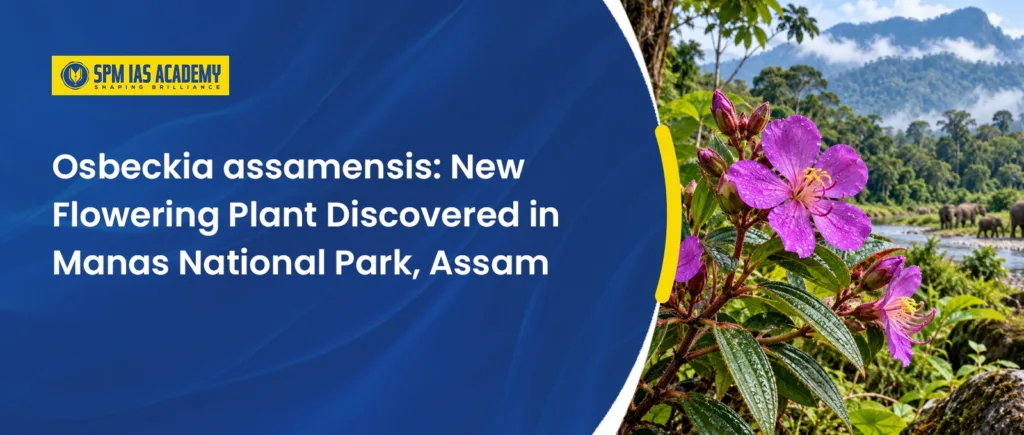
Osbeckia assamensis is a newly identified flowering plant species discovered in Manas National Park, Assam. The perennial shrub belongs to the ‘Melastomataceae’ family. It grows in the grasslands of the Himalayan foothills. Researchers identified the species through botanical studies, highlighting the rich but incompletely documented floral diversity of Assam. The plant has distinctive pink flowers, large opposite leaves and a largely unbranched stem. Its preliminary conservation assessment places it in the Data Deficient (DD) category under the IUCN criteria.
This article explains the flowering plant, including its characteristics, habitat, conservation status, and significance. This topic is important not only for UPSC and APSC Prelims but also for Mains GS Paper III, particularly under biodiversity and protected areas. Aspirants studying at an IAS academy in Guwahati can use such topics to strengthen their understanding of environmental conservation and biodiversity for competitive examinations.
Why Was Osbeckia assamensis in the News?
This flowering plant recently attracted attention after researchers reported its discovery in Assam’s Manas National Park in October 2026.
- Researchers identified a previously undescribed flowering plant species belonging to the genus Osbeckia.
- Notably, the plant was found in the grassland habitats of Manas National Park.
- The species belongs to ‘Melastomataceae’, a large family of flowering plants.
- Moreover, Researchers provisionally classified the species as Data Deficient under IUCN criteria.
- The discovery highlights the need for further botanical exploration and habitat conservation in Assam.
What Is Osbeckia assamensis?
Osbeckia assamensis is a perennial flowering shrub belonging to the genus Osbeckia. Understanding such native plant species can support environmental awareness and biodiversity-related topics for aspirants enrolled in an APSC coaching institute in Guwahati.
Its major botanical characteristics include:
- Plant Type: It is a perennial shrub that survives for more than two years.
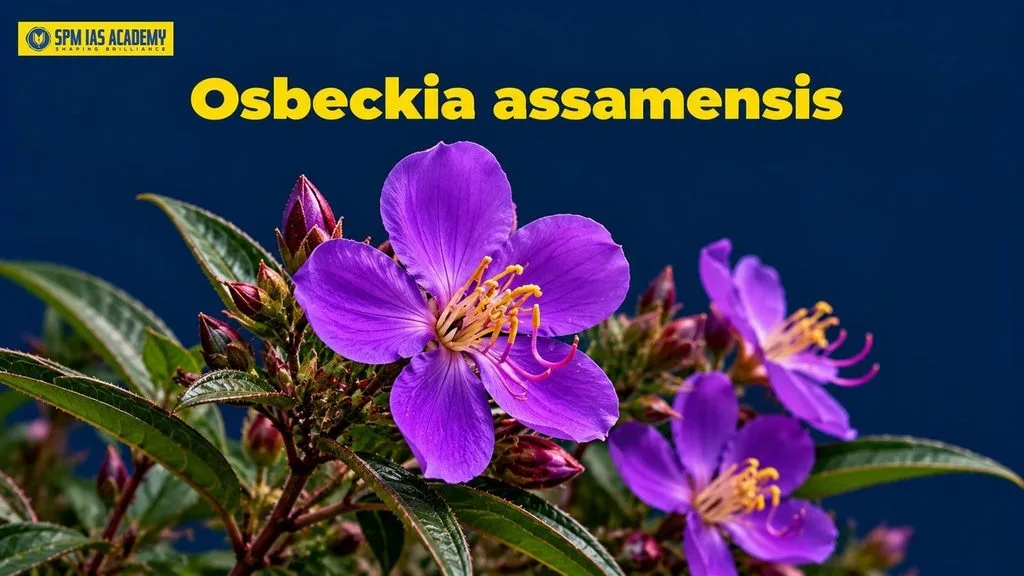
- Flowers: The plant produces distinctive pink flowers.
- Leaves: Moreover, it has large, oppositely arranged leaves.
- Stem: The species has a largely unbranched stem.
- Family: It belongs to the Melastomataceae family.
- Habitat: It grows in grasslands within the Himalayan foothill ecosystem.
Furthermore, the species adds to the documented plant diversity of northeastern India.
Where Was Osbeckia assamensis Discovered?
Researchers discovered Osbeckia assamensis in Manas National Park, located in western Assam along the India–Bhutan border. The park forms part of the Eastern Himalayan foothill landscape. Moreover, its grasslands, forests and riverine habitats support diverse plant and animal species.
What Are the Characteristics and Habitat of Osbeckia assamensis?
The characteristics and habitat of this flowering plant reflect the ecological importance of Assam’s natural grasslands. Aspirants enrolled in UPSC coaching in North East India can study such native plant species to strengthen their understanding of biodiversity, habitat conservation, and environmental issues relevant to competitive examinations.
- Grassland Habitat: The species grows in open grassland ecosystems within Manas National Park.
- Perennial Growth: It survives across multiple growing seasons.
- Distinctive Morphology: Its pink flowers, opposite leaves and mostly unbranched stem help distinguish it from related plants.
- Ecological Importance: Moreover, its discovery demonstrates the botanical diversity of Himalayan foothill habitats.
However, researchers need further studies to determine its complete geographical distribution, population size and ecological requirements.
What Is the IUCN Conservation Status of Osbeckia assamensis?
Researchers have provisionally assessed Osbeckia assamensis as Data Deficient (DD) under IUCN criteria. This classification is relevant for APSC coaching in Assam, as it helps aspirants understand IUCN conservation categories, biodiversity assessment, and the importance of further research on lesser-known plant species.
The International Union for Conservation of Nature (IUCN) develops the Red List framework to assess the extinction risk of species.
- Data Deficient: Available information is insufficient to assess the species’ extinction risk.
- Not a Threat Category: Moreover, Data Deficient does not mean the species is safe or threatened.
- Further Research: In fact, Scientists must study its population, distribution and potential threats.
- Conservation Planning: Additionally, future field surveys can help determine appropriate protection measures.
Importantly, a preliminary assessment under IUCN criteria should not be confused with a confirmed entry on the global IUCN Red List.
Why Is Osbeckia assamensis Important for Assam’s Biodiversity?
The discovery of this flowering plant in Manas National Park highlights the state’s rich floral diversity and ecological significance.
- Highlights Floral Diversity: The discovery adds a newly identified plant species to Assam’s recorded flora. Moreover, it demonstrates the region’s rich botanical diversity.
- Strengthens Manas National Park’s Significance: Scientists discovered the species in Manas National Park, a UNESCO World Heritage Site. Consequently, the finding highlights the park’s importance for plant conservation alongside wildlife protection.
- Supports Botanical Research: The discovery encourages further taxonomic studies of the genus Osbeckia and the family Melastomataceae. Additionally, it helps scientists document previously unidentified plant species.
- Highlights the Eastern Himalayan Biodiversity Hotspot: Manas lies within the Eastern Himalayan biodiversity region. Therefore, the discovery reinforces the ecological importance of northeastern India’s forests.
- Improves Biodiversity Documentation: Scientists can use the discovery to update regional floristic records. Furthermore, accurate species identification supports biodiversity monitoring and conservation planning.
- Highlights Conservation Needs: Researchers have provisionally assessed the species as Data Deficient (IUCN). At present, information about its population and distribution remains limited. Thus, further field surveys are necessary.
- Promotes Habitat Protection: The discovery highlights the importance of protecting natural habitats from deforestation, fragmentation and other environmental pressures.
- Supports Scientific Exploration: Moreover, the finding shows that protected areas may contain plant species that science has not yet formally documented.
Conclusion
Therefore, the discovery of Osbeckia assamensis in Manas National Park highlights Assam’s remarkable floral diversity. Its distinctive botanical features and preliminary Data Deficient assessment underline the importance of continued scientific research.
Moreover, the discovery reinforces the need to protect grassland ecosystems and strengthen biodiversity documentation. Therefore, systematic botanical surveys and habitat conservation will remain essential for safeguarding Assam’s natural heritage.
Read More:
Source:
Frequently asked question
1. What is Osbeckia assamensis, and where was it discovered?
It is a newly identified perennial flowering shrub discovered in Manas National Park, Assam, in October 2026. It belongs to the Melastomataceae family. Moreover, the plant has distinctive pink flowers, large opposite leaves and a mostly unbranched stem. Its discovery highlights Assam’s rich floral biodiversity.
2. What is the IUCN conservation status of Osbeckia assamensis?
Researchers have provisionally assessed this flowering plant as Data Deficient (DD) under IUCN criteria. This means scientists lack sufficient information to determine its extinction risk. Furthermore, researchers need additional field surveys to study its population, distribution and habitat threats. The preliminary assessment does not confirm its inclusion on the official IUCN Red List.

Behind every article at SPM IAS Academy is a team of skilled content writers and subject experts committed to making preparation easier for aspirants. From answering common doubts to breaking down complex issues and current affairs, we create content that is accurate, easy to understand, and directly useful for UPSC, APSC, and other competitive exams.