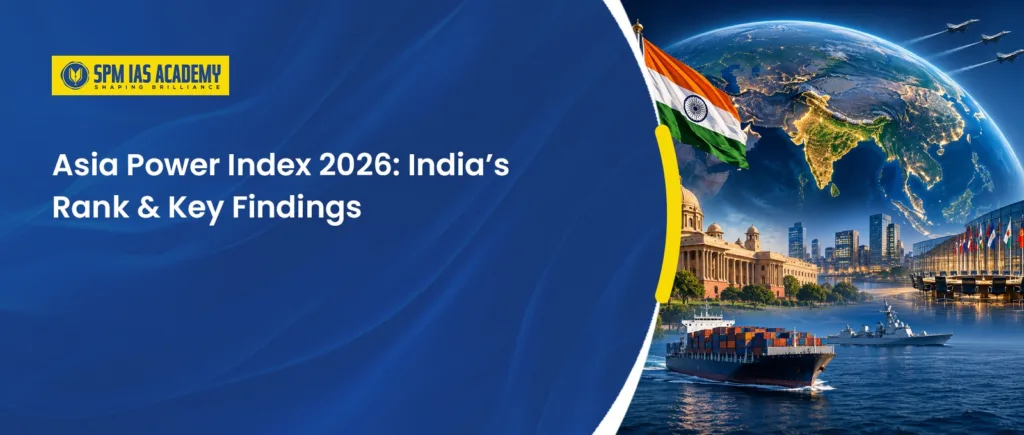
The Asia Power Index 2026 assesses the relative power and influence of countries across the Asia-Pacific region. Australia’s Lowy Institute publishes the index. It evaluates eight key parameters, including economic capability, military capability, diplomatic influence, resilience and future resources. Moreover, it highlights changing geopolitical dynamics and the balance of power in Asia. This topic is particularly relevant for aspirants enrolled in online APSC coaching in Guwahati, as it helps strengthen their understanding of international relations, geopolitics and current affairs.
India secured third rank among 27 countries and territories with an overall score of 40.5 out of 100. The United States and China secured the First and Second Rank in the index. Furthermore, India strengthened its position as a major power through improved defence networks and cultural influence.
This article explains the Asia Power Index 2026, its ranking methodology, India’s performance, key findings and geopolitical significance. This topic is important for the International Relations sections of UPSC, APSC and other State PCS examinations.

Why Was the Asia Power Index 2026 in the News?
The index was in the news after its release by Lowy Institute, which published its latest assessment of power and influence across the Asia-Pacific region. The Index retained India at the third position, behind the United States and China. It highlights India’s growing economic, military and diplomatic influence in the region. Such current affairs topics are important for APSC exam preparation, particularly for strengthening knowledge of international relations, India’s foreign policy and geopolitical developments. .
What Is the Asia Power Index?
It is an annual assessment published by the Lowy Institute. Lowy Institute is an independent Australian think tank based in Sydney. The Asia Power Index measures the power and influence of countries across the Asia-Pacific region.
The index was first launched in 2018. It evaluates how effectively countries use their resources to influence other nations and regional developments.
Key facts about the index:
- Released by: Lowy Institute, Australia.
- First published: 2018.
- 2026 edition: Eighth edition.
- Coverage: 27 countries and territories.
- Assessment framework: 8 measures, 30 thematic sub-measures and 131 indicators.
- Purpose: To assess the distribution of power and changing geopolitical influence in Asia.
India’s Rank in Asia Power Index 2026
India retained its third position in the Asia Power Index 2026, with an overall score of 40.5 out of 100. Its score increased by 0.5 points compared with 2025. The ranking places India among the major powers in Asia. Moreover, the gap between India and China has narrowed to its lowest level since the index began in 2018. These developments are important for aspirants preparing through UPSC coaching in North East India, as they help strengthen their understanding of India’s geopolitical position, regional influence and international relations.
Top Five Countries in Asia Power Index 2026
| Rank | Country | Score |
| 1 | United States | 78.9 |
| 2 | China | 73.6 |
| 3 | India | 40.5 |
| 4 | Japan | 38.6 |
| 5 | Russia | 32.2 |
Other important findings about India:
- Prime Minister Narendra Modi ranked as the second-most effective regional leader after Chinese President Xi Jinping.
- India recorded its strongest performance in future resources, securing third position.
- Moreover, India ranked fourth in diplomatic influence and military capability.
- Furthermore, India improved its defence networks through greater regional defence engagement and BrahMos missile exports to Southeast Asian countries.
- In addition, India recorded its biggest score improvement in cultural influence, gaining 2.3 points.
- However, India’s economic capability score declined by 0.7 points. It highlights the need to strengthen its economic position and global competitiveness.
What Are the Eight Measures of the Asia Power Index 2026?
The Index uses eight measures to assess the overall power of countries. These measures cover both existing capabilities and future potential, providing a comprehensive understanding of each country’s strategic influence. Such topics are relevant for aspirants preparing through APSC coaching in Assam, as they help develop a better understanding of international relations, geopolitics and global power dynamics.
| Measure | What Does It Assess? |
| Economic Capability | Economic size, technology, productivity and international economic leverage. |
| Military Capability | Defence spending, armed forces, weapons and military preparedness. |
| Resilience | Political stability, resource security and ability to withstand external challenges. |
| Future Resources | Future economic, military and demographic resources. |
| Economic Relationships | Trade, investment and economic partnerships. |
| Defence Networks | Military alliances, defence partnerships and security cooperation. |
| Diplomatic Influence | Diplomatic networks, international organisations and foreign policy influence. |
| Cultural Influence | Cultural reach, educational exchanges and international perceptions. |
These measures help distinguish between a country’s available resources and its ability to convert those resources into regional influence.
Significance of Asia Power Index 2026 for India
The index highlights India’s growing role in the changing geopolitical landscape of Asia.
- Indo-Pacific strategy: India’s growing influence strengthens its role in maintaining a free, open and stable Indo-Pacific region.
- Defence cooperation: Moreover, stronger defence partnerships and indigenous defence exports improve India’s strategic position.
- Economic diplomacy: Trade and investment partnerships help India expand its regional influence.
- China’s growing influence: Furthermore, the narrowing gap highlights the importance of India’s strategic engagement with regional powers.
- Global leadership: India’s diplomatic and cultural influence strengthens its position in international affairs.
For India, maintaining economic growth, strengthening defence capabilities and expanding regional partnerships will remain important to its long-term strategic ambitions.
Conclusion
The Asia Power Index highlights India’s emergence as a major power in the Asia-Pacific region. Its third position reflects growing military, diplomatic and cultural influence, although economic and defence-network challenges remain. For India, strengthening regional partnerships and improving economic capabilities will be essential to expanding its strategic influence.
UPSC/APSC Mains Practice Question
Q. Examine India’s emergence as a major power in the Asia-Pacific region in light of the Asia Power Index 2026. Discuss the opportunities and challenges in strengthening India’s regional influence.
Read More:
Source:
Frequently asked question
1. What is the Asia Power Index?
The Asia Power Index measures the relative power and influence of 27 countries and territories across the Asia-Pacific region. Moreover, the Australia-based Lowy Institute publishes this index to assess changing regional power dynamics.
2. What is India’s rank in the Asia Power Index 2026?
India secured third rank in the Asia Power Index 2026 with an overall score of 40.5 out of 100. Meanwhile, the United States and China secured the first and second positions, respectively.
3. What are the eight parameters of the Asia Power Index?
The Asia Power Index evaluates eight parameters. These are economic capability, military capability, resilience, future resources, economic relationships, defence networks, diplomatic influence and cultural influence. Together, these parameters assess a country’s resources and regional influence.
4. Why is the Asia Power Index 2026 important for India?
The Index highlights India’s growing military, diplomatic and cultural influence in the Asia-Pacific region. Furthermore, it helps to assess India’s strategic position, economic challenges and role in Indo-Pacific geopolitics.

Behind every article at SPM IAS Academy is a team of skilled content writers and subject experts committed to making preparation easier for aspirants. From answering common doubts to breaking down complex issues and current affairs, we create content that is accurate, easy to understand, and directly useful for UPSC, APSC, and other competitive exams.