
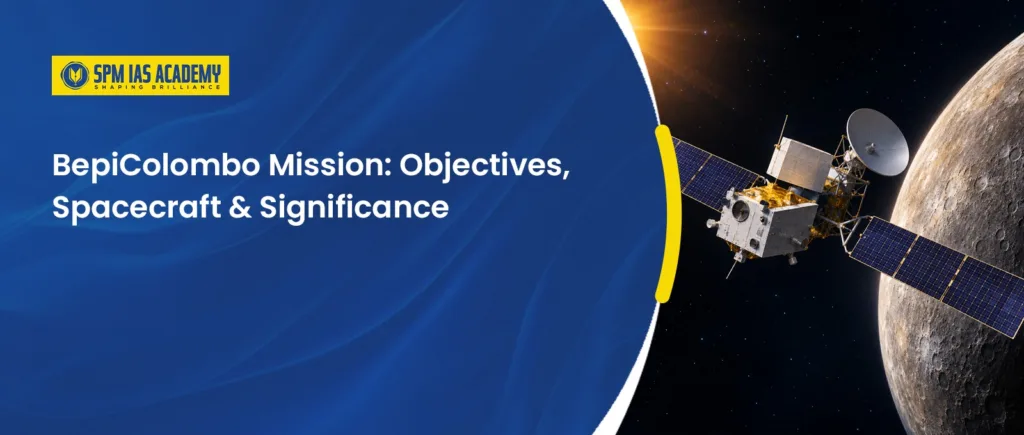
The BepiColombo Mission is a joint space exploration mission of the European Space Agency (ESA) and the Japan Aerospace Exploration Agency (JAXA) to study Mercury, the closest planet to the Sun. Launched on 20 October 2018, the mission aims to explore Mercury’s surface, composition, magnetic field and internal structure. Moreover, it uses two scientific orbiters to investigate the planet’s origin and evolution. The mission will also help scientists better understand the formation of the Solar System and terrestrial planets.
This article explains the Mercury Exploration Mission, its objectives, key features and scientific significance. It is important for the Science and Technology section of UPSC, APSC and other State PCS examinations. Aspirants preparing through UPSC coaching in Guwahati can use this topic to strengthen their understanding of space exploration, planetary science and India’s scientific developments.
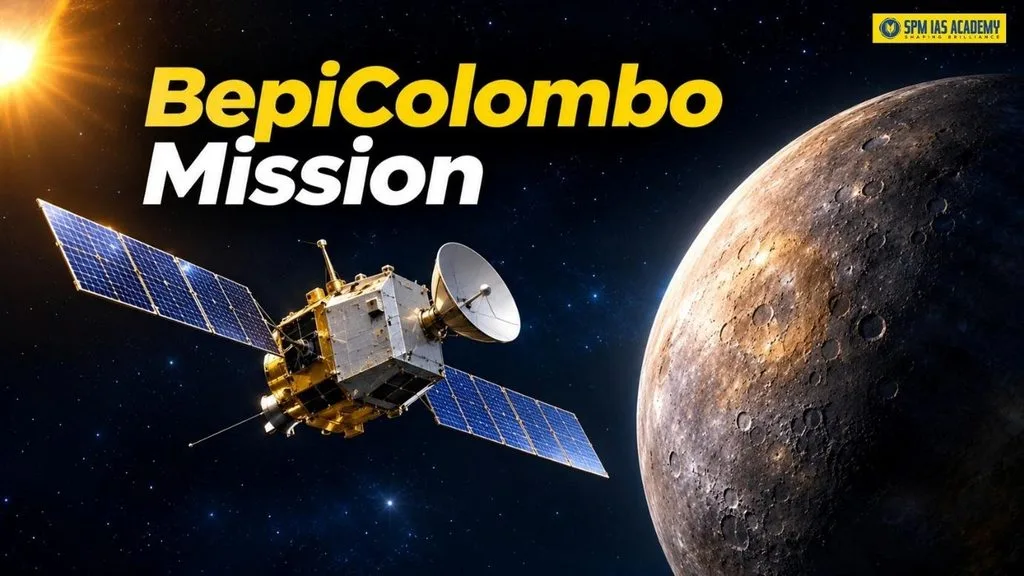
Why Was the BepiColombo Mission in the News?
The BepiColombo Mission was in the news following reports about its journey towards Mercury and the challenges faced during its interplanetary travel. This ESA-JAXA joint mission aims to study Mercury’s surface, internal structure, composition and magnetic environment. Understanding such Science and Technology topics is essential for aspirants preparing to crack APSC exam online, as space missions and scientific advancements are important areas of current affairs.
What Is the BepiColombo Mission?
- The BepiColombo is a joint planetary exploration programme developed by ESA and JAXA.
- It aims to study Mercury, the smallest and innermost planet of the Solar System.
- Launched in October 2018, the mission carries two scientific orbiters designed to investigate different aspects of Mercury.
- It is the third spacecraft mission to visit the planet and the first European-Japanese mission to explore Mercury. Moreover, the mission was named after Italian mathematician and scientist Giuseppe (Bepi) Colombo.
- The mission uses multiple planetary flybys and solar-electric propulsion to reach Mercury. Since the planet lies close to the Sun, a spacecraft must carefully reduce its orbital energy to enter a stable orbit around it.
What are the Main Components of BepiColombo?
The mission uses three main components during its journey, making it an important topic for aspirants preparing through UPSC coaching in the Northeast to understand space technology, interplanetary missions and scientific advancements.
- Mercury Planetary Orbiter (MPO): Developed by ESA to study Mercury’s surface, internal structure, composition and geological features.
- Mercury Magnetospheric Orbiter (MMO or Mio): Developed by JAXA to investigate Mercury’s magnetic field, magnetosphere and solar wind interactions.
- Mercury Transfer Module (MTM): Provides propulsion during the journey from Earth to Mercury.
The mission will eventually separate its two scientific orbiters. So that they can observe Mercury from different orbits and provide complementary scientific data.
Who Launched the BepiColombo Mission?
The European Space Agency (ESA) and Japan Aerospace Exploration Agency (JAXA) jointly developed and launched this mission in October 2018.
What Are the Objectives of the BepiColombo Mission?
Mercury remains one of the least explored planets in the Solar System. Therefore, this Mercury Mission aims to answer several important scientific questions about the planet’s composition, internal structure, magnetic field and geological evolution. These developments are relevant for aspirants preparing through APSC coaching in Assam, as space exploration and scientific discoveries are important topics in Science and Technology.
Its major objectives include:
- Study Mercury’s surface: It aims to map the planet’s surface and examine its craters, volcanic plains and geological features.
- Understand internal structure: It will investigate Mercury’s core, mantle and crust to understand its formation and evolution.
- Examine magnetic fields: It will study the planet’s magnetic field and magnetosphere, including their interaction with the solar wind.
- Investigate polar ice: Moreover, it will examine the possibility of water ice inside permanently shadowed craters near Mercury’s poles.
- Study the exosphere: Furthermore, it will analyse Mercury’s extremely thin atmosphere, known as an exosphere, and understand how solar radiation affects it.
- Understand planetary evolution: In addition, it will explore how Mercury formed and evolved under the intense influence of the Sun.
BepiColombo: Latest Updates and Mercury Orbit Arrival
- After nearly eight years of interplanetary travel, BepiColombo successfully entered Mercury’s orbit on 21 November 2026. This marked a major milestone in the mission.
- However, the orbit-insertion manoeuvre faced an unexpected technical problem. The spacecraft’s thruster burn ended earlier than planned because of a software glitch.
- The manoeuvre achieved approximately 77% of the planned velocity change. The spacecraft entered safe mode, a protective operating state.
- Moreover, the ESA confirmed that the spacecraft remained safe in a stable orbit around Mercury. The two scientific orbiters are scheduled to separate on 9-10 December 2026.
- Furthermore, routine scientific operations are expected to begin in April 2027. Thus, despite the technical challenge, the mission remains on track for its scientific objectives.
Previous Missions to Mercury
Before BepiColombo, only two NASA missions had explored Mercury. These missions laid the foundation for understanding the planet.
| Mission | Space Agency | Key Details |
| Mariner 10 | NASA (USA) | Launched in 1973, it conducted three Mercury flybys during 1974-1975 and captured the first close-up images of the planet. |
| MESSENGER | NASA (USA) | Launched in 2004, it entered Mercury’s orbit in 2011 and operated until 2015. |
Important fact: BepiColombo is the third spacecraft mission to visit Mercury and the second mission to orbit the planet.
Why Is the BepiColombo Mission Significant?
This Mercury Exploration Mission holds scientific and technological importance for planetary exploration.
- Understanding planetary formation: It will provide insights into how rocky planets formed and evolved in the inner Solar System.
- Advancing space technology: Secondly, the mission demonstrates advanced propulsion, navigation and deep-space communication capabilities.
- International cooperation: Notably, ESA and JAXA demonstrate how international partnerships can support complex scientific missions.
- Understanding Mercury: Moreover, its findings will improve knowledge of planetary magnetic fields, polar ice and geological evolution.
- Future space exploration: Furthermore, the mission will provide valuable scientific data for planning future planetary exploration programmes.
Conclusion
The BepiColombo represents an important milestone in international planetary exploration. By studying Mercury, ESA and JAXA aim to uncover the planet’s geological history, internal structure and magnetic environment. Despite technical challenges during its orbit-insertion manoeuvre, the spacecraft successfully reached Mercury in November 2026. Its upcoming scientific observations will expand our understanding of the Solar System and planetary evolution.
UPSC/APSC Prelims Practice Question
Q. With reference to the BepiColombo Mission, consider the following statements:
- It is a joint space exploration mission of the European Space Agency (ESA) and the Japan Aerospace Exploration Agency (JAXA).
- The Mercury Planetary Orbiter primarily studies Mercury’s magnetosphere and its interaction with the solar wind.
- The mission uses solar-electric propulsion and multiple planetary flybys to reach Mercury.
- BepiColombo is the first spacecraft mission to orbit Mercury.
Which of the statements given above are correct?
(a) 1 and 2 only
(b) 1 and 3 only
(c) 2, 3 and 4 only
(d) 1, 3 and 4 only
UPSC/APSC Mains Practice Question
Q. Discuss the scientific objectives and significance of the BepiColombo Mission in understanding Mercury’s evolution. How does the mission contribute to advancements in space technology and international scientific cooperation?
Read More:
| Articles |
| VOYAGER 1 REACHES ONE LIGHT-DAY FROM EARTH |
| Chandrayaan 3 |
| NASA Artemis II Mission 2026 |
| AXIOM-4 MISSION TO INTERNATIONAL SPACE STATION (ISS) |
Source:
Frequently asked question
1. What is the BepiColombo Mission?
This is a joint space exploration mission of ESA and JAXA to study Mercury. It aims to investigate the planet’s surface, internal structure, composition and magnetic environment.
2. Who launched the BepiColombo and when?
The European Space Agency and the Japan Aerospace Exploration Agency jointly launched the BepiColombo Mission on 20 October 2018. It represents the first European-Japanese mission to explore Mercury.
3. What are the main objectives of the BepiColombo Mission?
The mission aims to study Mercury’s geological features, internal structure, magnetic field and exosphere. Moreover, it investigates polar ice deposits and the planet’s formation and evolution.
4. Why is the BepiColombo Mission important?
The BepiColombo helps scientists understand Mercury’s evolution and the formation of rocky planets in the Solar System. Furthermore, it promotes space exploration technology and strengthens international scientific cooperation.
5. What was the purpose of the BepiColombo Mission?
The fundamental purpose of this Mercury mission is to understand its origin, composition, internal structure and magnetic field. Moreover, the mission aims to uncover how rocky planets formed and evolved in the inner Solar System.

Behind every article at SPM IAS Academy is a team of skilled content writers and subject experts committed to making preparation easier for aspirants. From answering common doubts to breaking down complex issues and current affairs, we create content that is accurate, easy to understand, and directly useful for UPSC, APSC, and other competitive exams.