
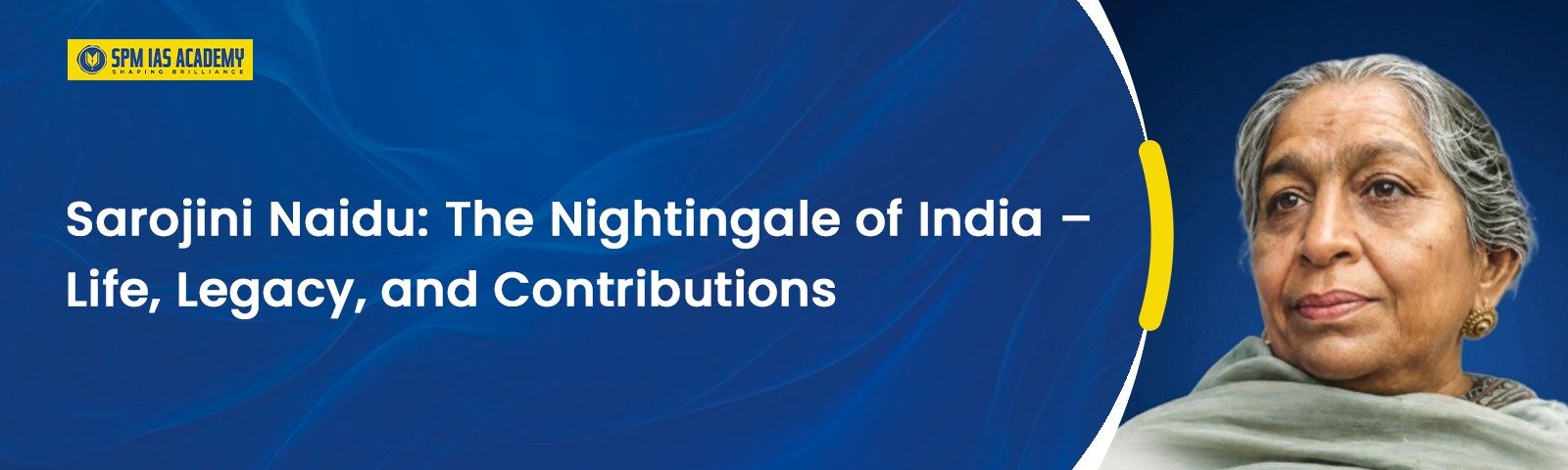
Sarojini Naidu was one of the most influential women leaders in Indian history. She was a renowned poet, freedom fighter, political leader, and women’s rights activist. Moreover, people widely known Sarojini Naidu as the “Nightingale of India” because of her lyrical poetry and inspiring speeches. Mahatma Gandhi gave her this famous title. Born on 13 February 1879 in Hyderabad, Sarojini Naidu played a major role in India’s freedom movement and strongly supported women’s empowerment and social reform. Furthermore, after independence, she became the first woman Governor of the United Provinces, now known as Uttar Pradesh. Therefore, the biography, literary contribution, political role, and freedom struggle of Sarojini Naidu are highly important for UPSC, APSC, and other State PCS examinations.
Who Was Sarojini Naidu?
Sarojini Naidu was an Indian political leader, freedom fighter, and renowned poet who played a major role in India’s independence movement. Moreover, she became the first Indian woman President of the Indian National Congress and later became the first woman Governor of an Indian state (United Province i.e. present-day Uttar Pradesh). Due to her leadership, powerful speeches, and nationalist activities, people widely regard Sarojini Naidu as one of the strongest voices of the Indian freedom struggle.
Furthermore, Sarojini Naidu also gained fame as a gifted literary figure. She wrote English poems filled with rich imagery, patriotism, and Indian cultural themes. Therefore, she earned great respect both as a political leader and as one of the most celebrated poets in Indian English literature.
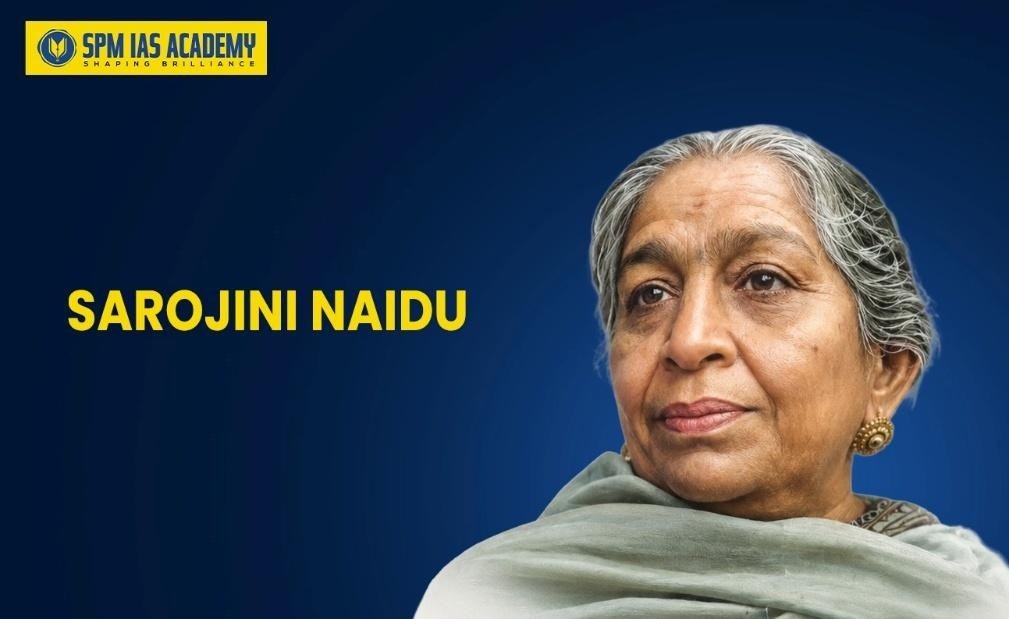
Biography of Sarojini Naidu
When Was Sarojini Naidu Born?
- Sarojini Naidu was born on 13 February 1879 in Hyderabad. Her birth name was Sarojini Chattopadhyay.
- Moreover, her father, Aghorenath Chattopadhyay, was a Bengali Brahmin scholar and scientist. He earned a doctorate in science from University of Edinburgh and later served as the principal of Nizam College.
- Furthermore, her mother, Barada Sundari Devi, was a poet who wrote poetry in Bengali literature.
- Sarojini Naidu was the eldest among eight siblings in a highly educated and culturally rich family.
- Moreover, her brother Virendranath Chattopadhyay became a revolutionary freedom fighter, while her brother Harindranath Chattopadhyay gained fame as a poet, dramatist, and actor.
- Growing up in such an intellectual and artistic environment greatly influenced Sarojini Naidu’s interest in literature, poetry, nationalism, and social reform.
Education and Marriage
- Sarojini Naidu was an exceptionally talented student from a young age. Moreover, she passed her matriculation examination at the age of just 12 years and secured the highest rank in the exam.
- Due to her outstanding academic performance, the Nizam of Hyderabad awarded her a scholarship for higher studies abroad.
- Furthermore, Sarojini Naidu studied at King’s College London and later attended Girton College between 1895 and 1898.
- After returning to India in 1898, she married Govindarajulu Naidu, a doctor from Machilipatnam.
- Moreover, their inter-caste marriage was considered highly progressive and courageous during that period. Both families supported their relationship and marriage.
- Together, Sarojini Naidu and Govindarajulu Naidu had five children.
- Furthermore, their daughter Padmaja Naidu later became a prominent political leader and freedom fighter in independent India.
Why Is Sarojini Naidu Called the Nightingale of India?
- Sarojini Naidu is widely known as the “Nightingale of India” because of her extraordinary poetic talent and melodious writing style.
- Moreover, Mahatma Gandhi personally gave her this famous title due to the musical quality and emotional depth of her poetry.
- Just like a nightingale sings beautifully, the poems of Sarojini Naidu reflected lyrical rhythm, vivid imagery, and rich emotional expression.
- Furthermore, her poetry focused on Nature, Patriotism, Love, Indian culture and Everyday life of common people.
- Her poems deeply connected with readers and inspired many people during India’s freedom movement.
- Moreover, people also called Sarojini Naidu “Bharat Kokila” and “Bulbul-e-Hind,” both of which mean “Nightingale of India.”
- Key reasons why Sarojini Naidu is called the Nightingale of India:
- Her poems had a musical and lyrical quality.
- She used vivid imagery and rich descriptions of Indian life.
- Mahatma Gandhi gave her the title “Nightingale of India.”
- She inspired millions through her speeches and poems during the freedom struggle.
- She gained recognition in both English and Indian literary traditions.
What was Sarojini Naidu’s Contribution in the Freedom Movement of India?
- Sarojini Naidu played a highly active and influential role in India’s freedom movement against British rule.
- Moreover, she became a close associate of Mahatma Gandhi in 1914. After meeting Gandhi, her commitment toward the Indian independence movement became much stronger.
- She used her powerful speeches and oratory skills to inspire millions of Indians to join the freedom struggle.
- Furthermore, Sarojini Naidu travelled widely across India and abroad to spread the message of Indian nationalism and independence.
- Her speeches were emotional, patriotic, and deeply motivating. Therefore, she became one of the most respected women leaders of the Indian National Movement.
Major contributions of Sarojini Naidu in the freedom movement:
- She actively participated in the Non-Cooperation Movement launched by Mahatma Gandhi.
- She joined and helped lead the famous Salt March in 1930.
- British authorities imprisoned her multiple times for participating in nationalist movements.
- She returned her Kaisar-i-Hind Medal to protest the Jallianwala Bagh massacre of 1919.
- She became the 44th President of the Indian National Congress in 1925.
- She participated in the Round Table Conferences held in London.
- She also supported the Quit India Movement in 1942.
Due to her fearless leadership and patriotic contribution, Sarojini Naidu remains one of the most important women freedom fighters in Indian history.
Regular reading of current affairs helps aspirants understand important historical personalities and modern governance topics.
What was Sarojini Naidu’s Contribution to the Women’s Rights Movement?
- Sarojini Naidu was a passionate advocate of women’s rights, women’s education, and women’s empowerment in India.
- Moreover, she strongly believed that educated and empowered women could play a major role in national progress and social reform.
- From 1904 onwards, Sarojini Naidu began delivering public speeches on women’s rights and social equality at major conferences across India.
- Furthermore, she co-founded the Women’s Indian Association along with Muthulakshmi Reddy. This organisation became an important milestone in India’s women’s rights movement.
- During her time in England, Sarojini Naidu also worked as a suffragist and supported women’s voting rights and political participation.
- In addition, she represented Indian women at several international conferences and global platforms.
- Sarojini Naidu actively promoted women’s education and encouraged women to participate in India’s freedom movement and public life.
- Moreover, she inspired millions of Indian women through her leadership, speeches, courage, and social reform activities.
- Due to her contribution to women’s empowerment and social equality, Sarojini Naidu remains one of the most important women leaders in modern Indian history.
What was Sarojini Naidu’s Contribution to Literature?
- Sarojini Naidu made a remarkable and lasting contribution to Indian English literature through her poetry and literary works.
- Moreover, she wrote poems that beautifully celebrated Indian culture, nationalism, nature, spirituality, and everyday life in India.
- Her poetry reflected deep emotion, lyrical beauty, vivid imagery, and rich cultural themes. Therefore, she became one of the most celebrated poets of her time.
- Major literary works of Sarojini Naidu include:
- The Golden Threshold (1905), her first collection of poems
- The Bird of Time (1912), which explored themes of life, love, and death
- The Broken Wing (1917), which focused on patriotism and sacrifice
- In the Bazaars of Hyderabad (1912), one of her most famous poems
- Furthermore, her poems covered important themes such as patriotism, tragedy, nature, Indian traditions, and social life.
- She also wrote poems for children and used simple yet musical language that attracted readers across the world.
- Moreover, the literary works of Sarojini Naidu helped global readers understand the beauty, culture, and diversity of India.
- Due to her extraordinary poetic talent and literary contribution, Sarojini Naidu remains one of the greatest poets in Indian English literature.
Sarojini Naidu’s Contribution in Post-Independence India
- After India achieved independence in 1947, Sarojini Naidu continued serving the nation through public administration and social leadership.
- Moreover, the Government of India appointed her as the first Governor of the United Provinces on 15 August 1947. This made her the first woman Governor in independent India.
- Furthermore, this appointment became a historic milestone in Indian political and administrative history.
- Sarojini Naidu served as Governor with dedication and continued working for public welfare, national unity, and social harmony.
- She remained actively involved in people’s issues and administrative responsibilities until her final days.
- Moreover, Sarojini Naidu passed away on 2 March 1949 in Lucknow at the age of 70.
Due to her lifelong contribution to India’s freedom movement, women’s rights, literature, and governance, Sarojini Naidu remains one of the most respected women leaders in Indian history.
Conclusion
In conclusion, Sarojini Naidu remains one of the most influential women leaders in Indian history. As the “Nightingale of India,” she made remarkable contributions to India’s freedom movement, women’s rights movement, and Indian English literature. Moreover, her role as a poet, freedom fighter, and the first woman Governor of independent India continues to inspire generations. Therefore, the biography, literary works, political achievements, and freedom struggle of Sarojini Naidu are highly important for UPSC, APSC, and other State PCS examinations.
Students preparing for civil services can explore the best upsc coaching centre guwahati for expert UPSC guidance.
Source:
Frequently Asked Questions:
Sarojini Naidu was an Indian freedom fighter, poet, political leader, and women’s rights activist. Moreover, she played a major role in India’s independence movement and became the first Indian woman President of the Indian National Congress.
People call Sarojini Naidu the “Nightingale of India” because of her melodious poetry and lyrical writing style. Moreover, Mahatma Gandhi gave her this famous title due to the musical beauty and emotional depth of her poems.
Sarojini Naidu actively participated in major freedom movements such as the Non-Cooperation Movement, Salt March, and Quit India Movement. Furthermore, she inspired millions through her speeches and nationalist activities against British rule.
Some famous poems and literary works of Sarojini Naidu include The Golden Threshold, The Bird of Time, The Broken Wing, and In the Bazaars of Hyderabad. Moreover, her poems beautifully reflected Indian culture, patriotism, and nature.
Sarojini Naidu strongly promoted women’s education, women’s empowerment, and political participation of women in India. Moreover, she co-founded the Women’s Indian Association and encouraged women to actively participate in the freedom movement and public life.