
Nagaland is not just a state of mountains and tribes. It is a living museum of traditions, warrior culture, and vibrant festivals. Nagaland history, Naga tribes, culture, traditions, and the Hornbill Festival form an important part of Northeast India studies for UPSC, APSC, and State PCS exams. Nagaland is famous for its rich tribal heritage, colourful festivals, traditional dances, and unique cultural identity. Moreover, the Hornbill Festival showcases the traditions, music, food, and customs of different Naga tribes. Therefore, understanding Nagaland history, Naga culture, important tribes, and the Hornbill Festival is highly important for current affairs, geography, culture, and Northeast India preparation.
What is the History of Nagaland?
Nagaland history reflects tribal traditions, colonial influence, political developments, and strong cultural identity. For centuries, different Naga tribes lived in isolated hill regions across present-day Nagaland. MBritish Rule in Nagaland
The British entered the Naga Hills during the 19th century and gradually expanded their control over the region. Furthermore, the British administration created the Naga Hills District under Assam Province. During this period, Christian missionaries introduced Christianity, modern education, and Western influence in the region. Consequently, Christianity became an important part of Naga society and culture.
Stay updated with Northeast India topics, culture, polity, and important UPSC current affairs through regular exam-oriented coverage at SPM IAS Academy Current Affairs.
Formation of Nagaland State
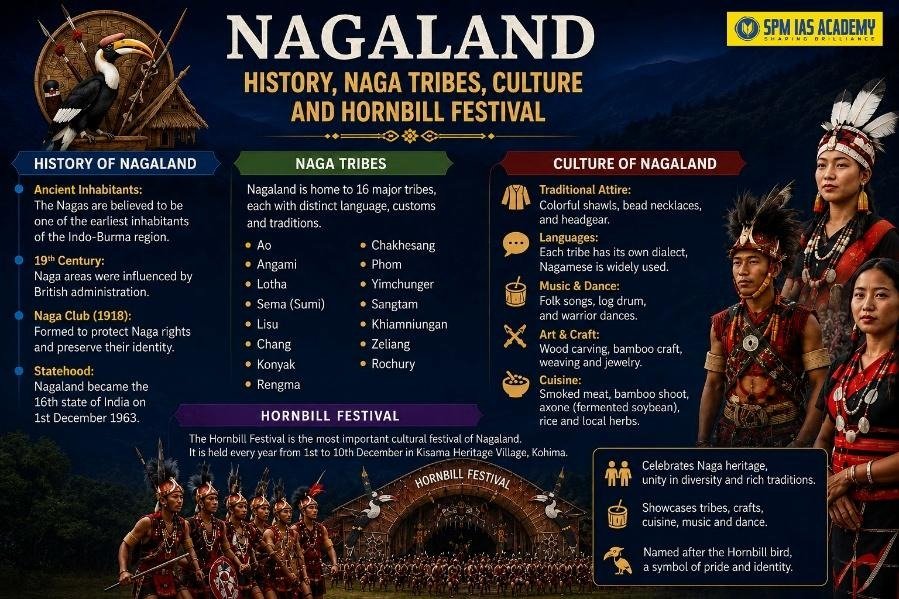
Nagaland became the 16th state of India on 1 December 1963 after political negotiations between Naga leaders and the Government of India. Moreover, Kohima became the capital of Nagaland. The Indian Constitution also granted special protections to the state under Article 371A, which safeguards Naga customary laws, traditions, and land rights.
Quick Facts About Nagaland” Table
| Feature | Details |
| Capital | Kohima |
| Statehood | 1 December 1963 |
| Official Language | English |
| Famous Festival | Hornbill Festival |
| Major Tribes | Angami, Ao, Konyak |
| Constitutional Provision | Article 371A |
What is the Naga Movement?
The Naga movement is one of the oldest insurgency movements in Northeast India. It began during British rule when the Naga Club submitted a memorandum to the Simon Commission in 1929 and demanded separate political recognition for the Naga people. After India’s independence, the Naga National Council (NNC) under A.Z. Phizo intensified the movement and declared Naga independence in 1947. Later, the movement became militant and led to insurgency in the Naga Hills region. Moreover, the Shillong Accord of 1975 created divisions within Naga groups and eventually led to the formation of the National Socialist Council of Nagaland (NSCN) in 1980. The NSCN later split into NSCN-IM and NSCN-K factions. Furthermore, the Government of India signed a ceasefire agreement with NSCN-IM in 1997 and later signed the Framework Agreement in 2015 to continue peace negotiations. Therefore, the Naga movement remains highly important for UPSC, APSC, and internal security studies because it involves issues related to insurgency, peace talks, federalism, ethnic identity, and Article 371A.
What is Article 371A?
Article 371A grants special constitutional status to Nagaland under the Indian Constitution. It protects the cultural identity, traditional practices, and customary laws of the Naga people. Moreover, Parliament cannot automatically apply laws related to Naga religious practices, social customs, and traditional legal systems without the approval of the Nagaland Legislative Assembly. The provision also gives Nagaland control over land ownership and natural resources within the state. Therefore, Article 371A remains highly important for Indian Polity, Northeast India studies, UPSC, and APSC preparation.
Why was Article 371A Introduced?
Article 371A was introduced to protect the unique cultural identity, customary laws, traditional practices, and land rights of the Naga people. Moreover, the Government of India added this special constitutional provision after political negotiations during the formation of Nagaland state in 1963. The provision aimed to preserve Naga traditions, social customs, and tribal governance systems from external interference. Furthermore, Article 371A helped strengthen trust between the Naga communities and the Indian Union. Therefore, Article 371A remains highly important for Indian Polity, Northeast India studies, UPSC, and APSC preparation.
Who are the Major Naga Tribes?
Nagaland is home to 17 major tribes, including the Angami, Ao, Chakhesang, Chang, Konyak, Khiamniungan, Kuki, Kachari, Lotha, Phom, Pochury, Rengma, Sumi, Sangtam, Tikhir, Yimkhiung, and Zeliang tribes. Moreover, each tribe follows distinct languages, customs, traditional dresses, and unique festivals. Throughout the year, colourful celebrations, folk songs, warrior dances, and strong hospitality reflect the rich cultural heritage of Nagaland.
Naga tribes form the cultural foundation of Nagaland history and culture. These tribal communities preserve the rich cultural diversity and traditional heritage of Nagaland. Therefore, understanding the major Naga tribes is highly important for UPSC, APSC, and Northeast India studies.
What are the Important Features of Naga Tribal Culture?
Naga tribal culture reflects strong community life, warrior traditions, festivals, and rich oral heritage. Moreover, Naga society preserves its cultural identity through traditional institutions, customs, music, and festivals. Different Naga tribes maintain unique social practices and cultural traditions that highlight the diversity of Nagaland.
Important Features of Naga Culture
- Strong tribal identity shapes the social and cultural life of Naga communities.
- Moreover, community-based living plays an important role in village society.
- Traditional village councils manage local governance and social matters.
- Naga tribes wear colourful traditional dresses during festivals and ceremonies.
- Folk music and warrior dances remain important parts of Naga cultural traditions.
- Furthermore, bamboo and wood craftsmanship reflect the artistic skills of Naga communities.
- Oral storytelling traditions preserve tribal history, legends, and cultural values across generations.
Therefore, festivals and traditional institutions continue to protect and promote the rich cultural heritage of Nagaland.
What is the Hornbill Festival?
The Hornbill Festival is the most famous cultural festival of Nagaland and is often called the “Festival of Festivals.” The Government of Nagaland started the festival in 2000 to showcase the rich cultural heritage, traditions, music, dances, food, and tribal diversity of the Naga people. Moreover, the festival takes place every year from 1 to 10 December at Kisama Heritage Village near Kohima. All major Naga tribes participate in the celebration through traditional performances, indigenous games, handicrafts, folk songs, and cultural exhibitions. Therefore, the Hornbill Festival plays an important role in promoting tourism, preserving tribal culture, and strengthening the cultural identity of Nagaland.
Important Facts About Hornbill Festival
| Feature | Details |
| Started In | 2000 |
| Organised By | Government of Nagaland |
| Venue | Kisama Heritage Village |
| Duration | 1st to 10th December |
| Main Objective | Promote Naga culture and tourism |
The festival showcases Nagaland history, Naga tribes, culture and Hornbill Festival traditions on a global platform.
Why is Hornbill Festival Called the “Festival of Festivals”?
Hornbill Festival is called the “Festival of Festivals” because it brings together all major Naga tribes under one grand cultural celebration. Moreover, the festival showcases traditional dances, folk songs, indigenous games, handicrafts, tribal food, and cultural performances from different communities of Nagaland. The event celebrates unity in diversity and highlights the rich tribal heritage of Northeast India. Therefore, the Hornbill Festival represents the cultural identity, traditions, and collective spirit of the Naga people.
Why is the Hornbill Bird Important?
- The Hornbill bird holds great cultural significance in Naga tribal traditions and festivals.
- It symbolises bravery, strength, and warrior spirit in Naga culture.
- Moreover, many Naga tribes traditionally used hornbill feathers in ceremonial headgear and traditional attire.
- The bird also represents the rich biodiversity and ecological importance of Northeast India.
- Furthermore, the Hornbill reflects the close relationship between tribal communities and nature.
Therefore, the famous Hornbill Festival of Nagaland derives its name from this culturally respected bird.
What are the Traditional Economic Activities of Nagaland?
Agriculture forms the backbone of Nagaland’s traditional economy. Moreover, tribal communities depend heavily on farming, handicrafts, and forest-based activities for their livelihood. Traditional economic practices continue to play an important role in the social and cultural life of Nagaland. Furthermore, the state is known for its rich handloom and handicraft traditions.
Major Economic Activities of Nagaland
- Jhum cultivation remains one of the most common traditional farming methods in Nagaland.
- Moreover, terrace farming supports agriculture in hilly regions.
- Handloom weaving reflects the rich cultural and artistic traditions of Naga tribes.
- Bamboo handicrafts provide livelihood opportunities and promote traditional craftsmanship.
- Horticulture plays an important role in Nagaland’s rural economy.
- Furthermore, animal husbandry supports household income and food security.
- Nagaland also produces rice, maize, millet, and various horticultural crops across different regions.
What is Jhum Cultivation?
- Jhum cultivation refers to a traditional shifting cultivation method practised mainly in hilly regions of Northeast India.
- In this farming method, farmers clear forest patches for cultivation.
- Afterwards, they burn vegetation to increase soil nutrients naturally.
- Moreover, farmers cultivate crops on the land for a temporary period.
- Later, they shift to another area after soil fertility decreases.
What are the Challenges of Jhum Cultivation?
- Jhum cultivation increases soil erosion in hilly areas.
- Furthermore, repeated clearing of forests causes deforestation.
- The practice also affects biodiversity and wildlife habitats forcing them to migrate. Consequently, it leads to human-wildlife conflicts.
- Moreover, continuous shifting cultivation reduces long-term agricultural productivity by decreasing soil fertility.
Therefore, sustainable farming practices and modern agricultural methods are becoming increasingly important in Northeast India.
Important Facts About Languages of Nagaland
- English is the official language of Nagaland.
- Moreover, different Naga tribes speak distinct tribal languages and dialects.
- Nagamese acts as a common link language among different communities in Nagaland.
- Many Naga languages use the Roman script because of missionary influence and modern education.
- Furthermore, oral traditions, folk songs, and storytelling help preserve Naga languages and tribal heritage.
- Major tribal languages include Angami, Ao, Sumi, Lotha, Konyak, Chang, Phom, and Rengma languages.
- Language diversity reflects the strong cultural identity and traditional heritage of Naga tribes.
Explore UPSC preparation resources, Northeast India study material, mock tests, and comprehensive Civil Services guidance at SPM IAS Academy.
Conclusion
Nagaland history, Naga tribes, culture, traditions, and the Hornbill Festival remain highly important topics for UPSC, APSC, and State PCS preparation. Moreover, these topics help aspirants understand Northeast India’s tribal diversity, constitutional protections, cultural heritage, and traditional institutions. The Hornbill Festival, Article 371A, Naga languages, and Jhum cultivation frequently appear in current affairs and static syllabus discussions. Therefore, aspirants should prepare Nagaland history, Naga tribes, culture, and Hornbill Festival with conceptual clarity and current affairs integration for better performance in competitive examinations.
Source:
Frequently Asked Questions.
The Hornbill Festival is the most famous festival of Nagaland. The Government of Nagaland organises this festival every year at Kisama Heritage Village near Kohima. Moreover, the festival showcases Naga tribal culture, traditional dances, folk music, handicrafts, indigenous food, and cultural heritage. Therefore, the Hornbill Festival remains highly important for tourism, culture, and Northeast India studies.
Hornbill Festival is called the “Festival of Festivals” because it brings together all major Naga tribes under one cultural celebration. Moreover, different tribes perform traditional dances, folk songs, tribal games, and cultural rituals during the festival. Therefore, the event represents the unity, diversity, and rich cultural traditions of Nagaland.
Article 371A grants special constitutional status to Nagaland under the Indian Constitution. It protects Naga customary laws, religious practices, traditional institutions, and land ownership rights. Moreover, Parliament cannot automatically apply laws related to Naga customs without approval from the Nagaland Legislative Assembly. Therefore, Article 371A plays an important role in protecting Naga cultural identity and tribal traditions.
Nagaland is home to several major Naga tribes, including the Angami, Ao, Sumi, Lotha, Konyak, Chakhesang, Phom, Chang, Sangtam, Rengma, Yimkhiung, and Zeliang tribes. Moreover, each tribe follows distinct customs, dialects, traditional dresses, dances, and festivals. Therefore, the Naga tribes collectively preserve the rich cultural diversity and tribal heritage of Nagaland.