The Minimum Support Prices (MSP) for Rabi crops for the 2027-28 Marketing Season have been increased by the Union Government. The Cabinet Committee on Economic Affairs approved higher MSPs for all six mandated Rabi crops. Safflower received the highest increase of ₹675 per quintal, followed by rapeseed and mustard at ₹413. Such agricultural policy developments are relevant for aspirants studying economy and agriculture for competitive examinations, and an APSC coaching center in Guwahati can provide structured guidance for covering these current-affairs topics.
The decision aims to provide farmers with remunerative prices while supporting crop diversification towards pulses and oilseeds. For UPSC, APSC and other State PCS examinations, the topic is important under Indian Economy, Agriculture, Government Policies and Food Security.
In this article, you will learn about the latest MSP rates, the meaning of MSP, its calculation and the significance of the 2027-28 Rabi MSP decision.
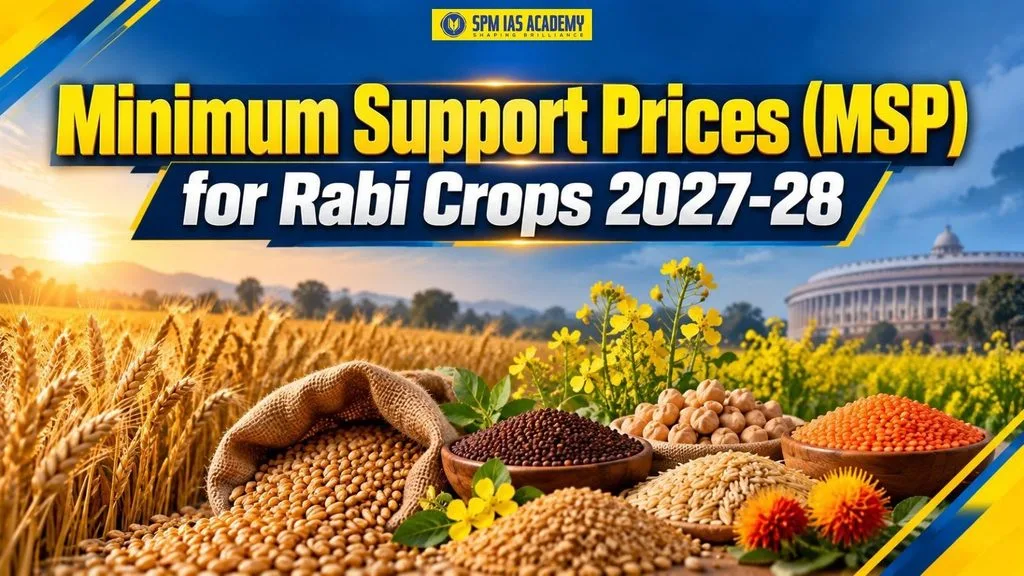
Why Are Minimum Support Prices (MSP) in the News?
The government has approved higher Minimum Support Prices (MSP) for all six mandated Rabi crops for the 2027-28 Marketing Season. The increases range from ₹25 per quintal for wheat to ₹675 for safflower. Such developments are important for understanding agricultural policy, farm economics, and government support measures. Students preparing for APSC can use APSC online classes to study these current-affairs topics alongside the relevant Economy and Agriculture syllabus.
The revised MSPs are also linked to the government’s policy of keeping MSP at least 1.5 times the All-India weighted average cost of production.
What Is MSP?
- Minimum Support Price (MSP) is a government-announced price intended to provide price support to farmers for specified agricultural crops.
- Moreover, the Centre fixes MSPs annually for 22 mandated crops based on recommendations from the Commission for Agricultural Costs & Prices (CACP). Additionally, it considers the views of State Governments and concerned Central Ministries.
- The 22 crops include 14 Kharif crops, six Rabi crops and two commercial crops. The six Rabi crops are wheat, barley, gram, masur, rapeseed and mustard, and safflower.
MSP for Rabi Crops 2027-28
The revised Minimum Support Prices (MSP) for the six Rabi crops are:
| Rabi Crop | MSP 2027-28 | Increase |
| Wheat | ₹2,610/quintal | ₹25 |
| Barley | ₹2,286/quintal | ₹136 |
| Gram | ₹5,958/quintal | ₹83 |
| Masur (Lentil) | ₹7,390/quintal | ₹390 |
| Rapeseed & Mustard | ₹6,613/quintal | ₹413 |
| Safflower | ₹7,215/quintal | ₹675 |
Safflower recorded the highest absolute increase, while wheat received the smallest increase.
How Is MSP Determined?
The CACP considers several economic and agricultural factors while recommending MSP. These include production costs, overall demand and supply, domestic and international prices, inter-crop price parity, terms of trade between agriculture and non-agriculture, and the likely impact of the MSP on the wider economy. Aspirants can study these concepts as part of Indian Economy and Agriculture preparation, with UPSC coaching in the Northeast providing structured guidance for civil services examination topics.
- Cost of production
- Demand and supply conditions
- Domestic and international prices
- Inter-crop price parity
- Terms of trade between agriculture and non-agriculture
- Impact on the wider economy
- Efficient use of land, water and other resources
Moreover, the government has followed the principle of providing at least a 50% margin over the All-India weighted average cost of production since 2018-19. Furthermore, the cost calculation also includes inputs such as hired labour, seeds, fertilisers, irrigation, machinery. In addition, it also includes other inputs such as diesel, electricity, working capital and the imputed value of family labour.
Why Is the Rabi MSP Hike Significant?
The latest Minimum Support Prices (MSP) decision has several implications for Indian agriculture.
- Farmer income: Firstly, higher MSP can improve the price support available to farmers.
- Crop diversification: Secondly, the government highlighted pulses and oilseeds as areas where higher returns can encourage diversification.
- Food security: Thirdly, MSP and procurement policies support the availability of key food crops.
- Price stability: Moreover, government procurement can provide support when market prices fall below MSP, subject to applicable arrangements.
- Agricultural investment: Furthermore, more predictable price support can influence farmers’ production decisions.
MSP and Crop Diversification
The 2027-28 decision also highlights India’s focus on encouraging pulses and oilseeds. Rapeseed and mustard received a ₹413 increase, while lentil received ₹390. Safflower received the highest absolute increase at ₹675 per quintal. These MSP changes are important for understanding agricultural policy, food security, farm income, and crop diversification. Aspirants preparing for competitive examinations can study such developments through civil service coaching in Guwahati as part of their Economy and Agriculture preparation.
The government stated that the revised rates aim to provide remunerative returns while encouraging a shift towards pulses and oilseeds.
What is the Commission for Agricultural Costs & Prices (CACP)?
- The CACP is an expert body under the Ministry of Agriculture and Farmers Welfare, Government of India.
- It recommends Minimum Support Prices (MSP) for major agricultural crops before each marketing season.
- The government considers CACP recommendations while fixing MSPs for 22 mandated crops.
- These include 14 Kharif crops, 6 Rabi crops and 2 commercial crops.
- Moreover, CACP considers factors such as cost of production, demand and supply, domestic and international prices, inter-crop price parity and terms of trade.
- It also considers the impact of MSP on the overall economy, consumers and agricultural producers.
- CACP submits its price recommendations to the government. The Cabinet Committee on Economic Affairs (CCEA) takes the final decision on MSP.
Therefore, CACP plays an important role in India’s agricultural price policy and farmer income support system.
Conclusion
The latest MSP for Rabi crops strengthens India’s agricultural price-support framework for the 2027-28 Marketing Season. The decision gives particular attention to pulses and oilseeds while maintaining the government’s 1.5-times cost-of-production principle.
For UPSC and APSC preparation, candidates should connect MSP with CACP, agricultural pricing, procurement, food security, farmer income and crop diversification.
Read More:
Source:
Frequently Asked Questions
1. What is the Minimum Support Price (MSP)?
The MSP is a government-announced price for selected crops. Moreover, it aims to provide farmers with price support.
2. Which Rabi crop received the highest MSP increase in 2027-28?
Safflower received the highest increase of ₹675 per quintal. Therefore, its MSP reached ₹7,215 per quintal.
3. Who recommends the Minimum Support Prices (MSP)?
The Commission for Agricultural Costs & Prices (CACP) recommends MSPs. However, the Cabinet Committee on Economic Affairs (CCEA) takes the final decision.

Behind every article at SPM IAS Academy is a team of skilled content writers and subject experts committed to making preparation easier for aspirants. From answering common doubts to breaking down complex issues and current affairs, we create content that is accurate, easy to understand, and directly useful for UPSC, APSC, and other competitive exams.