

The Nolan Committee provides one of the most widely used ethical frameworks for public life and public administration. The United Kingdom established the Committee on Standards in Public Life in October 1994 under the chairmanship of Lord Michael Nolan. Prime Minister John Major asked the committee to examine concerns about the conduct of public office holders and recommend measures to maintain high standards of propriety. For aspirants preparing for the APSC examination, an Assam APSC coaching centre can provide structured guidance on ethics, governance, and public administration.
In its first report in 1995, the committee articulated the Seven Principles of Public Life: Selflessness, Integrity, Objectivity, Accountability, Openness, Honesty and Leadership. These principles later became widely known as the Nolan Principles.
For civil-services aspirants, the Nolan Committee is particularly important for Ethics, Integrity and Aptitude. It relates to questions on public-service values, probity, accountability, conflict of interest and ethical leadership.
What is the Nolan Committee?
The Nolan Committee, formally the Committee on Standards in Public Life, was established on 25 October 1994 in the United Kingdom. Understanding key facts accurately is essential for competitive exam preparation, and knowing the common mistakes students avoid in APSC preparation can help aspirants study more effectively and improve their overall performance.
Its original mandate asked it to examine standards of conduct among holders of public office, including concerns involving financial and commercial interests. It also had to recommend institutional changes that could ensure high standards of ethical behaviour in public life.
The committee initially examined areas such as:
- Ministers and civil servants
- Members of Parliament
- Public bodies
- National Health Service bodies
- Local authorities
- Other publicly funded institutions
Notably, the committee did not simply claim that ethical standards had distorted. Instead, its first report identified weaknesses in the systems that defined, maintained and enforced standards. Therefore, it recommended clearer ethical principles, codes of conduct, independent scrutiny and ethics education.
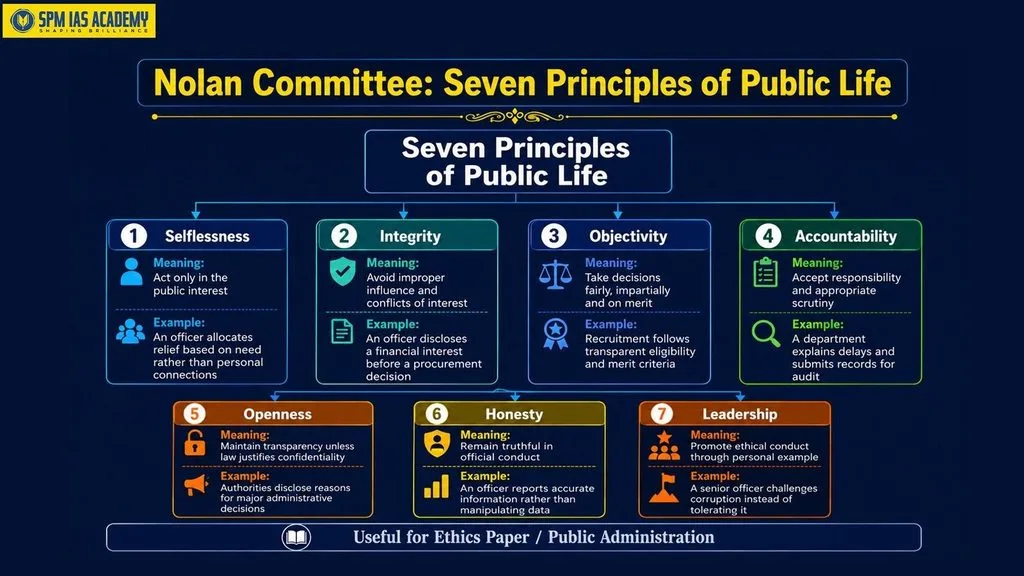
Nolan Committee: Seven Principles of Public Life
The Seven Principles of Public Life form the core contribution of the Nolan Committee. These seven principles are as given below:
| Nolan Principle | Meaning for Public Administration | Example |
| Selflessness | Act only in the public interest | An officer allocates relief based on need rather than personal connections |
| Integrity | Avoid improper influence and conflicts of interest | An officer discloses a financial interest before a procurement decision |
| Objectivity | Take decisions fairly, impartially and on merit | Recruitment follows transparent eligibility and merit criteria |
| Accountability | Accept responsibility and appropriate scrutiny | A department explains delays and submits records for audit |
| Openness | Maintain transparency unless law justifies confidentiality | Authorities disclose reasons for major administrative decisions |
| Honesty | Remain truthful in official conduct | An officer reports accurate information rather than manipulating data |
| Leadership | Promote ethical conduct through personal example | A senior officer challenges corruption instead of tolerating it |
The current official formulation continues to describe these seven values as the ethical standards expected from public office holders.
1. Selflessness under the Nolan Committee
- Selflessness requires public officials to place the public interest above personal benefit.
- For example, a District Commissioner distributing disaster-relief resources should prioritise most affected communities on objective need rather than political pressure or personal relationships.
- Thus, selflessness directly supports the idea that public office represents a public trust.
2. Integrity in Public Administration
- Integrity requires officials to resist improper influence and identify potential conflicts of interest. Aspirants preparing for civil service examinations can benefit from the best civil service coaching in Guwahati for structured guidance in ethics, integrity, and governance.
- Suppose an officer participates in awarding a government contract while a close relative owns one of the bidding companies. The officer should disclose the relationship and withdraw from the decision-making process.
- India’s Department of Personnel and Training similarly emphasises integrity, transparency, public interest and avoidance of real or perceived conflicts of interest in its competency framework for civil servants.
3. Objectivity and Merit-Based Decision-Making
- The Nolan Committee defines objectivity through impartial, fair and evidence-based decision-making.
- Public authorities should therefore apply merit while making appointments, awarding contracts, distributing benefits or selecting beneficiaries.
- For example, choosing contractors through transparent technical and financial criteria promotes objectivity, while favouritism undermines it.
4. Accountability in Public Life
- Accountability means that public officials must answer for their decisions and accept legitimate scrutiny.
- Mechanisms such as legislative oversight, audits, judicial review, social audits, vigilance institutions and citizen grievance systems strengthen administrative accountability.
- However, accountability goes beyond punishment. It also requires officers to explain why they made a particular decision.
5. Openness and Transparency
- Openness requires authorities to make decisions transparently and disclose information unless clear legal or public-interest reasons justify confidentiality.
- In India, mechanisms such as the Right to Information framework, proactive disclosure, e-governance and open procurement systems can support this ethical principle.
- Nevertheless, openness does not mean releasing sensitive security, privacy or legally protected information without restriction.
6. Honesty in Public Service
- Honesty requires public office holders to remain truthful.
- An ethical civil servant should report facts accurately even when the information may expose administrative shortcomings. Similarly, officials should not hide errors, falsify records or mislead citizens. Aspirants preparing for civil services can also consider an online UPSC institute in Assam for structured guidance in ethics, governance, and other important subjects.
- Honesty therefore strengthens both institutional credibility and public trust.
7. Leadership: The Most Visible Nolan Principle
- Leadership requires senior officials to practise ethical values personally and actively encourage others to follow them.
- An administrator who ignores misconduct may indirectly normalise unethical behaviour. In contrast, a leader who rewards integrity, challenges wrongdoing and protects honest officers can shape an ethical organisational culture.
- Therefore, leadership converts ethical principles from written rules into institutional behaviour.
Nolan Committee and Ethics in Indian Public Administration
The Nolan Committee has particular significance for India because the Second Administrative Reforms Commission (ARC) scrutinized these principles while deliberating ethics in governance.
Drawing from the Nolan framework, the 2nd ARC suggested values for an Indian civil-service Code of Ethics, including integrity, impartiality, commitment, accountability etc.
Nolan Committee: Beyond Seven Principles
A high-quality answer should not stop after listing the seven values.
The Nolan Committee’s first report also stressed three institutional mechanisms for sustaining ethical conduct:
- Codes of Conduct
- Independent Scrutiny
- Guidance and Education
The committee argued that principles work best when institutions translate them into rules, oversight systems and regular ethical training.
This point is particularly useful in analytical answers because individual morality alone cannot ensure ethical governance. Institutions must also support ethical behaviour.
Why is the Nolan Committee Important for Ethics Paper?
The Nolan Committee provides a ready framework for questions on probity, civil-service values, corruption, conflict of interest, transparency and leadership.
Candidates can also use Nolan Principles in case studies. For example, when an officer faces pressure to favour a contractor, the answer can invoke Integrity, Objectivity, Accountability and Openness.
Similarly, in questions on public trust, candidates can argue that ethical administration requires both personal values and institutional safeguards.
Conclusion
The Nolan Committee transformed broad ideas of ethical governance into seven practical principles: Selflessness, Integrity, Objectivity, Accountability, Openness, Honesty and Leadership.
Their continued relevance lies in a simple idea: public officials must exercise authority for the public interest and under public scrutiny. For ethics answers, combining the Nolan Principles with Indian examples, the Second ARC and real administrative dilemmas can produce stronger and more analytical responses.
Read More:
Source:
Frequently Asked Questions
1. What is the Nolan Committee and why is it important for UPSC?
The Nolan Committee was established in the United Kingdom in 1994 under Lord Michael Nolan. This committee was assigned responsibility to examine ethical standards in public life. It introduced the Seven Principles of Public Life, which directly relate to UPSC Ethics topics such as integrity, accountability, transparency, probity and ethical leadership. Therefore, aspirants can use the Nolan framework in both theory answers and case studies.
2. What are the Seven Principles of Public Life given by the Nolan Committee?
The Nolan Committee identified seven principles of public life. These are Selflessness, Integrity, Objectivity, Accountability, Openness, Honesty and Leadership. Together, these principles guide ethical behaviour in public administration. Moreover, they help civil servants place public interest, fairness and responsibility above personal or political considerations.
3. How is the Nolan Committee relevant to Indian public administration?
The Nolan Committee is significant for India because its principles closely align with values promoted in Indian civil services. Moreover, it is also closely related to the recommendations of the Second Administrative Reforms Commission. For example, integrity, impartiality, accountability and commitment to public service remain central to ethical governance. Therefore, candidates can connect Nolan Principles with RTI, audits, conflict-of-interest rules, transparency mechanisms and administrative accountability in India.

Behind every article at SPM IAS Academy is a team of skilled content writers and subject experts committed to making preparation easier for aspirants. From answering common doubts to breaking down complex issues and current affairs, we create content that is accurate, easy to understand, and directly useful for UPSC, APSC, and other competitive exams.