
The Sixth Schedule of Indian Constitution is a special constitutional provision that grants autonomy to tribal communities in certain areas of Northeast India through Autonomous District Councils (ADCs) and Autonomous Regional Councils (ARCs). Operating under Article 244(2) and Article 275(1), it applies to tribal areas in Assam, Meghalaya, Tripura, and Mizoram. The framers of the Constitution introduced this unique arrangement to protect tribal culture, customary laws, land rights, and traditional governance systems while ensuring democratic self-governance. Moreover, the Sixth Schedule empowers tribal councils with legislative, administrative, judicial, and financial authority over local matters.
Therefore, the Sixth Schedule of the Indian Constitution remains a vital component of India’s federal structure and tribal administration framework.
What is the Sixth Schedule of the Indian Constitution?
The Sixth Schedule of Indian Constitution provides autonomous administrative arrangements for tribal-majority areas in Assam, Meghalaya, Tripura and Mizoram. It allows tribal communities to manage their local affairs through elected councils while preserving their customs, traditions, and cultural identity.
The Sixth Schedule operates under Article 244(2) and Article 275(1) of the Constitution.
Constitutional Basis
Six Schedule of Indian Constitution is in Part X of Indian Constitution. Article 244(2) and Article 275(1) provides provisions related to six schedule areas and their governance.
| Provision | Subject |
| Article 244(2) | Administration of Tribal Areas in Northeast India |
| Article 275(1) | Grants-in-aid for tribal development |
| Sixth Schedule | Autonomous administration of tribal areas |
Thus, the Sixth Schedule combines self-governance with constitutional safeguards.
Why was the Sixth Schedule Introduced?
The Constituent Assembly recognised that tribal communities in Northeast India possessed distinct social systems, customary laws, and governance structures. Therefore, a uniform administrative model could not adequately address their unique needs.
Main Objectives of the Sixth Schedule
- Primarily, the Sixth Schedule protects tribal identity and cultural heritage by safeguarding indigenous customs, traditions, and social practices.
- Moreover, it preserves customary laws and traditional institutions that have guided tribal communities for generations.
- The Schedule promotes self-governance by empowering tribal communities to manage their local affairs through Autonomous District Councils.
- Furthermore, it prevents the exploitation of tribal populations by protecting their land, resources, and socio-cultural interests.
- It encourages local participation in administration and ensures that tribal communities play an active role in decision-making processes.
- In addition, the Schedule supports balanced socio-economic development while addressing the unique needs of tribal areas.
- Most importantly, it integrates tribal regions into the Indian Union without disrupting their traditional governance systems and cultural identity.
Historical Background of the Sixth Schedule
The roots of the Sixth Schedule can be traced to British tribal administration policies.
Before Independence, many tribal regions were administered separately under:
- Excluded Areas
- Partially Excluded Areas
Later, the Constituent Assembly formed the North-East Frontier (Assam) Tribal and Excluded Areas Committee under the chairmanship of Gopinath Bordoloi.
The committee recommended special constitutional safeguards for tribal communities. Consequently, the Sixth Schedule became part of the Constitution when it came into force on 26 January 1950.
Therefore, the Sixth Schedule is often referred to as one of the most innovative federal arrangements in the Indian Constitution.
Which States are Covered Under the Sixth Schedule?
The Sixth Schedule of the Indian Constitution currently applies to tribal areas in four northeastern states – Assam, Meghalaya, Tripura, and Mizoram. Moreover, it provides special constitutional safeguards through Autonomous District Councils to protect the cultural, social, and administrative rights of tribal communities. Furthermore, these councils enjoy significant legislative, judicial, and financial powers, enabling local self-governance while preserving traditional institutions and customary laws.
States Covered Under the Sixth Schedule
| State | Autonomous Councils |
| Assam | 3 Autonomous Councils |
| Meghalaya | 3 Autonomous Councils |
| Tripura | 1 Autonomous Council |
| Mizoram | 3 Autonomous Councils |
Thus, the Sixth Schedule currently governs ten Autonomous District Councils.
Autonomous District Councils Under the Sixth Schedule
Assam
Bodoland Territorial Council (BTC)
- Covers Bodoland Territorial Region (BTR)
- Represents Bodo tribal communities
Karbi Anglong Autonomous Council (KAAC)
- Governs Karbi Anglong district
North Cachar Hills Autonomous Council (Dima Hasao)
- Governs Dima Hasao district
Meghalaya
Khasi Hills Autonomous District Council (KHADC)
Jaintia Hills Autonomous District Council (JHADC)
Garo Hills Autonomous District Council (GHADC)
These councils protect Khasi, Jaintia, and Garo tribal traditions.
Tripura
Tripura Tribal Areas Autonomous District Council (TTAADC)
The council covers nearly two-thirds of Tripura’s geographical area.
Mizoram
Chakma Autonomous District Council
Lai Autonomous District Council
Mara Autonomous District Council
These councils preserve the interests of smaller tribal communities.
What is the Composition and tenure of Autonomous District Councils?
Each Autonomous District Council (ADC) consists of both elected and nominated members to ensure effective local governance. The council can have a maximum of 30 members, including up to 26 elected members and up to 4 nominated members, whom the Governor appoints. Moreover, elected members generally serve a five-year term, subject to constitutional provisions. Therefore, Autonomous District Councils function much like local legislatures and play a crucial role in administering tribal areas under the Sixth Schedule.
What are the Legislative Powers of Autonomous District Councils?
One of the most significant features of the Sixth Schedule of the Indian Constitution is the legislative powers granted to Autonomous District Councils (ADCs). These councils can enact laws on various local matters to protect tribal interests and preserve traditional governance systems. Moreover, these powers enable tribal communities to manage their social, cultural, and economic affairs according to their customs and local needs. However, the Governor retains the authority to approve, modify, or withhold such laws before they come into effect.
Subjects Under the Jurisdiction of Autonomous District Councils
- Land management and regulation of land use in tribal areas.
- Forests, except reserved forests controlled by the state government.
- Agriculture and related local farming practices.
- Shifting cultivation (Jhum cultivation) and its regulation.
- Village administration and local governance matters.
- Social customs and traditional practices of tribal communities.
- Marriage and divorce under customary laws.
- Inheritance and succession matters.
- Traditional institutions and tribal governance systems.
Therefore, the legislative powers of Autonomous District Councils help preserve tribal identity while promoting self-governance and local decision-making.
What are the Judicial Powers given Under the Sixth Schedule?
The Sixth Schedule empowers Autonomous District Councils (ADCs) to establish village courts for resolving disputes involving tribal customary laws and local matters. Moreover, these courts help preserve traditional justice systems while ensuring quick and accessible dispute resolution within tribal communities. Furthermore, village courts reduce dependence on formal judicial institutions for minor cases and local issues.
Functions of Village Courts
- Resolve local disputes within tribal communities.
- Apply customary tribal laws and traditional legal practices.
- Handle minor civil cases related to local matters.
- Adjudicate minor criminal cases as permitted under the Sixth Schedule.
Therefore, village courts play an important role in protecting tribal customs and strengthening grassroots justice in Sixth Schedule areas.
What are the Executive Powers of Autonomous District Councils?
Autonomous District Councils (ADCs) exercise several executive and administrative powers under the Sixth Schedule of the Indian Constitution. Moreover, these councils manage essential public services and oversee local development activities in tribal areas. Furthermore, their administrative authority enables them to address the specific needs of tribal communities while promoting grassroots governance and regional development.
Understanding the Role of ASO in Government Policy Implementation helps aspirants connect administration with governance mechanisms.
Major Responsibilities of Autonomous District Councils
- Manage primary education and support local educational institutions.
- Improve public health services and healthcare infrastructure.
- Oversee water supply systems for local communities.
- Develop roads and communication networks within their jurisdiction.
- Regulate local markets and commercial activities.
- Promote fisheries development and resource management.
- Support agricultural growth and farming activities.
- Implement rural development programmes and welfare initiatives.
Therefore, Autonomous District Councils function as important local self-governing institutions and contribute significantly to the administration and development of tribal areas.
What are the Financial Powers of Autonomous District Councils?
The Sixth Schedule of the Indian Constitution grants significant financial autonomy to Autonomous District Councils (ADCs). Moreover, these councils can generate revenue through various taxes, fees, and local levies to fund administrative and developmental activities. Furthermore, they receive financial assistance from both the Central and State Governments to support governance and infrastructure development in tribal areas.
Sources of Revenue of Autonomous District Councils
- Collect land revenue within their jurisdiction.
- Levy taxes on buildings and properties.
- Impose taxes on local markets and commercial establishments.
- Collect taxes on animals and livestock.
- Levy professional taxes on certain occupations.
- Charge taxes on the entry of goods into specified areas.
- Collect license fees for various activities and businesses.
- Additionally, the councils receive grants-in-aid from the Central and State Governments for developmental and administrative purposes.
Therefore, these financial powers enable Autonomous District Councils to function effectively and promote the socio-economic development of tribal areas.
Which are the Sixth Schedule Areas in Assam?
Assam contains some of the most important Sixth Schedule areas in India, where Autonomous District Councils exercise self-governance to protect the rights and interests of tribal communities. Currently, the Sixth Schedule applies to three autonomous areas in Assam – the Bodoland Territorial Region (BTR), administered by the Bodoland Territorial Council (BTC); Karbi Anglong, governed by the Karbi Anglong Autonomous Council (KAAC); and Dima Hasao, administered by the North Cachar Hills Autonomous Council (NCHAC).
Many Northeast aspirants choose SPM IAS Academy Guwahati for comprehensive UPSC and APSC preparation.
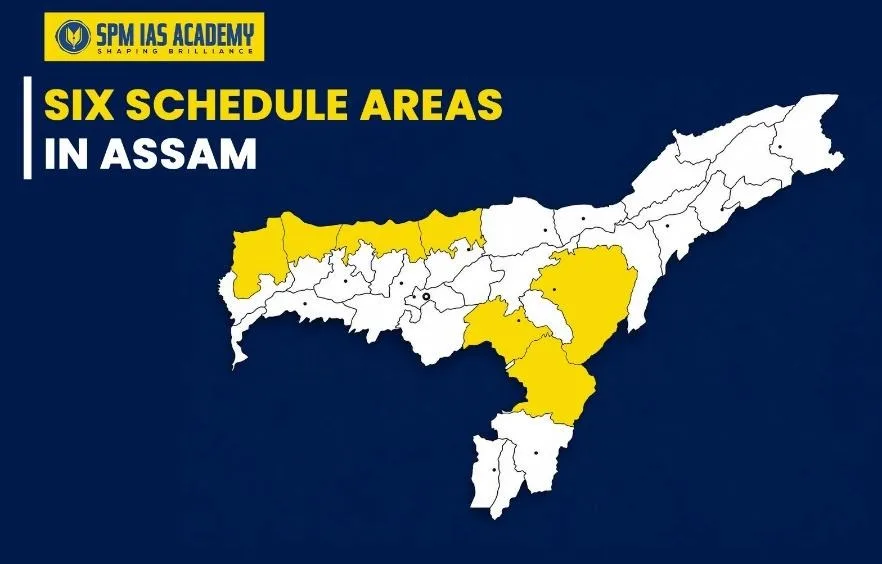
Moreover, these councils enjoy legislative, administrative, and financial powers over subjects such as land management, forests, agriculture, village administration, customary laws, and local development. Furthermore, the Sixth Schedule helps preserve the cultural identity, traditional institutions, and socio-economic interests of tribal communities while strengthening grassroots democracy in Assam.
Therefore, these autonomous areas play a crucial role in tribal governance and regional development in the state.
Difference Between Fifth Schedule and 6th Schedule of Indian Constitution
Many students confuse the Fifth Schedule and Sixth Schedule.
Comparison Table
| Feature | Fifth Schedule | Sixth Schedule |
| Area Covered | Tribal areas outside Northeast India | Tribal areas in Northeast India |
| Self-Governance | Limited | Extensive |
| Autonomous Councils | No | Yes |
| Legislative Powers | Limited | Significant |
| Customary Law Protection | Partial | Strong |
| States Covered | Multiple states | Assam, Meghalaya, Tripura, Mizoram |
Therefore, the Sixth Schedule provides a much higher degree of autonomy.
Significance of the Sixth Schedule of Indian Constitution
Students seeking guidance on polity and governance can explore best upsc coaching in assam.
- Most importantly, the Sixth Schedule protects tribal identity by safeguarding indigenous languages, customs, traditions, and cultural heritage.
- Moreover, it promotes self-governance by enabling tribal communities to participate directly in administration and local decision-making.
- The Schedule strengthens federalism by creating a unique system of autonomous governance within India’s constitutional framework.
- Furthermore, it reduces regional conflicts by addressing tribal aspirations and demands through constitutional and democratic mechanisms.
- It preserves customary laws and traditional institutions by granting legal recognition to tribal governance systems.
- In addition, it empowers local communities to manage their social, economic, and cultural affairs according to their specific needs.
- The Schedule also supports inclusive development while protecting the rights and interests of tribal populations.
Therefore, the Sixth Schedule serves as a vital instrument of inclusive governance, tribal empowerment, and cooperative federalism in India.
What are the Challenges Associated with the 6th Schedule of India Constitution?
- However, overlapping jurisdiction between Autonomous District Councils and state governments often creates administrative and legal complexities.
- Moreover, many councils remain financially dependent on government grants, which limits their ability to function independently.
- Administrative inefficiencies sometimes affect governance and service delivery in certain autonomous areas.
- Furthermore, political conflicts within councils can slow down decision-making and developmental activities.
- Several tribal groups continue to demand greater autonomy and additional constitutional safeguards for their regions.
- Developmental disparities persist across different Sixth Schedule areas, leading to uneven socio-economic progress.
- In addition, limited institutional capacity can hinder effective implementation of policies and development programmes.
Therefore, many experts argue that Autonomous District Councils require greater financial resources, administrative authority, and institutional support to fulfil their constitutional responsibilities more effectively.
Conclusion
The Sixth Schedule of Indian Constitution provides a unique system of autonomous governance for tribal communities in Northeast India. It protects tribal culture, customary laws, and traditional institutions through Autonomous District Councils. Moreover, the Schedule strengthens grassroots democracy, promotes self-governance, and supports inclusive development. Despite certain challenges, it remains one of the most successful constitutional arrangements for managing cultural diversity and regional aspirations in India. Therefore, understanding the Sixth Schedule of the Indian Constitution is essential for comprehending tribal administration, federalism, and governance in Northeast India.
Source:
Frequently Asked Questions
The Sixth Schedule of the Indian Constitution provides autonomous governance to tribal areas in Assam, Meghalaya, Tripura, and Mizoram through Autonomous District Councils. Moreover, it protects tribal culture, customary laws, land rights, and traditional institutions while promoting self-governance.
The Sixth Schedule areas are located in Assam, Meghalaya, Tripura, and Mizoram. Furthermore, these states have Autonomous District Councils that exercise legislative, administrative, judicial, and financial powers to safeguard tribal interests and local governance.
The main purpose of the Sixth Schedule of the Indian Constitution is to protect tribal identity, preserve customary laws, and promote self-governance in tribal areas. Moreover, it empowers local communities to manage their affairs while ensuring their integration within India’s constitutional framework.

Behind every article at SPM IAS Academy is a team of skilled content writers and subject experts committed to making preparation easier for aspirants. From answering common doubts to breaking down complex issues and current affairs, we create content that is accurate, easy to understand, and directly useful for UPSC, APSC, and other competitive exams.