Why Did So Many Common Questions in UPSC Prelims 2026 Come from One Source?
Every UPSC aspirant asks the same question after prelims:
“How did they predict these questions?”
After UPSC Prelims 2026, many students found the answer in Satyajit Sir’s Newspaper Analysis at SPM IAS Academy. Students who attended the sessions noticed something surprising. Many topics and concepts from the analysis appeared in the actual UPSC paper. The overlap went well beyond 45 questions.
This was not luck. Satyajit Sir followed a structured newspaper analysis approach. He connected current affairs with static subjects. He focused on concepts, issue analysis, and UPSC’s evolving question style. That strategy helped students identify important themes before the examination itself.
In this article, you will discuss how it happened. You will get a complete topic-wise breakdown of the common questions in UPSC Prelims 2026. It also explains why many aspirants considered the paper unusually difficult.
You will discover how UPSC framed analytical and concept-based questions. In addition, you will also get to knowwhich topics appeared repeatedly. Further, how Satyajit Sir’s approach helped students stay ahead of the trend. The article also explores what these overlaps mean for UPSC 2027 aspirants and how smart newspaper analysis can change preparation strategy.
Key Stat:
More than 45 questions in UPSC Prelims 2026 GS Paper-1 closely matched topics, themes, and concepts covered in Satyajit Sir’s Newspaper Analysis.
How Tough Were UPSC Prelims 2026 — and Why Did Common Questions in UPSC Prelims Matter More This Year?
UPSC Prelims 2026 raised the difficulty level significantly. Many aspirants found the paper unpredictable, analytical, and concept-heavy. In such a paper, common questions in the UPSC Prelims from strong current affairs preparation became even more important.
Three major patterns made the examination tougher than usual
- Static questions contained deliberate traps. Options tested fine distinctions that surface-level reading could not resolve — forcing aspirants to choose between two seemingly correct statements.
- Current-affairs questions demanded precise recall, not just awareness. Knowing a topic existed was not enough; aspirants needed to know specific numbers, designations, and qualifying facts.
- Several questions blended current events with geography, polity, ecology, and science. It makes them hard to pin to a single subject and nearly impossible to attempt without integrated current-affairs preparation.
Many aspirants depended only on static books. During the exam, they struggled with the paper’s analytical nature and unfamiliar framing. Many ended up guessing a large number of questions.
Students who regularly followed Satyajit Sir’s Newspaper Analysis experienced the paper differently. They recognised several common questions in UPSC Prelims 2026 across multiple subjects. These included environment, economy, science and technology, polity, and international relations.
The paper confirmed one major reality for UPSC aspirants. Current affair no longer plays a supporting role in preparation. It now influences a decisive portion of the prelims score.
Students who consistently followed current-affairs analysis sessions gained a clear advantage in UPSC Prelims 2026.
Which Topics Produced the Most Common Questions in UPSC Prelims 2026?
Did Environment and Ecology Deliver the Highest Volume of Common Questions in UPSC Prelims 2026?
Environment and ecology produced some of the most direct common questions in UPSC Prelims 2026 from Satyajit Sir’s analysis. Each question below appeared after a dedicated analysis session:
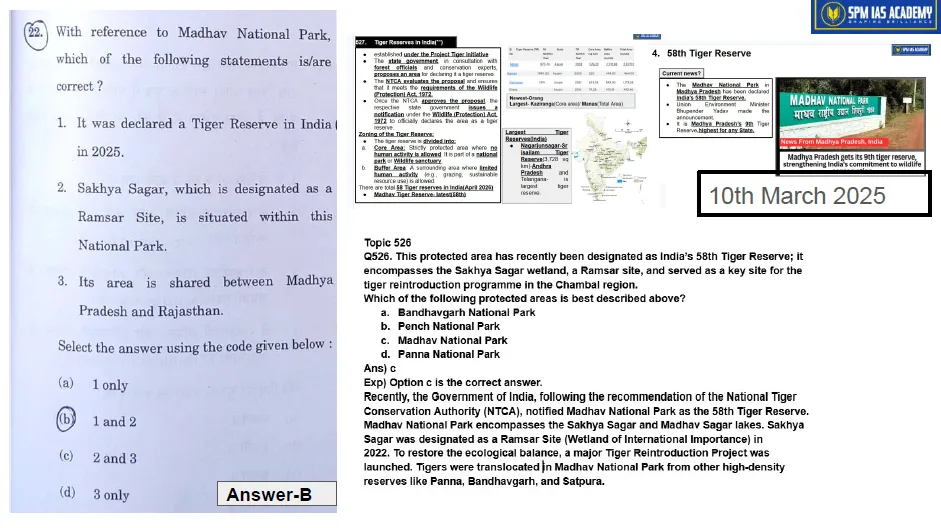
One question focused on Madhav National Park, India’s 58th Tiger Reserve. Satyajit Sir’s Newspaper Analysis had already discussed the park in detail. The sessions covered:
- Sakhya Sagar as a Ramsar wetland,
- the Chambal tiger reintroduction programme,
- and Madhya Pradesh becoming home to its 9th tiger reserve.
In the actual UPSC paper, aspirants had to identify all three statements correctly. Students who followed the analysis sessions found the question familiar and conceptually easier to attempt.
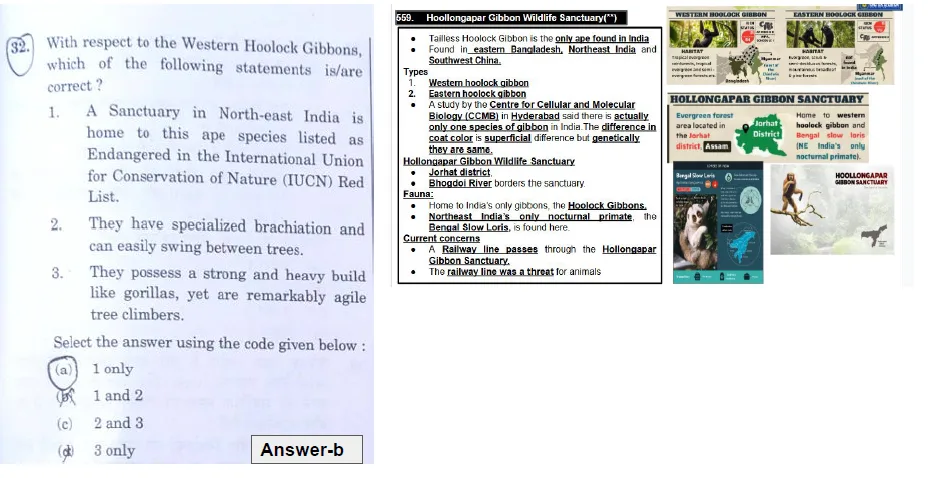
Another question connected to the Hoollongapar Gibbon Wildlife Sanctuary and the endangered Western Hoolock Gibbons.
Satyajit Sir’s Newspaper Analysis had already highlighted the sanctuary, the IUCN status of the species, the gibbons’ unique brachiation movement, and the conservation concerns linked to the railway line passing through the habitat.
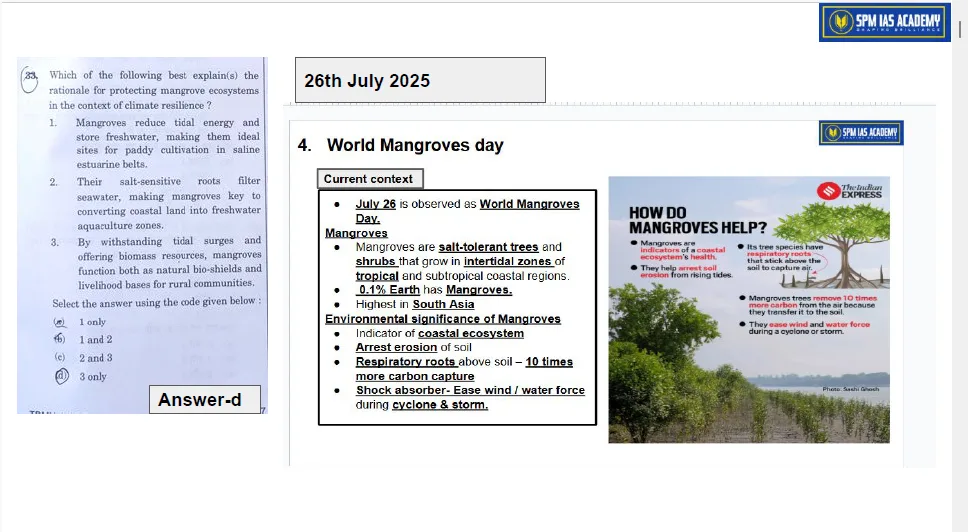
The analysis sessions also discussed mangrove ecosystems during the World Mangroves Day coverage on July 26, 2025. Students learned how mangroves reduce cyclone impact, capture carbon through respiratory roots, and prevent soil erosion. These environment-focused discussions helped aspirants approach ecosystem and biodiversity questions more confidently.
Another major match appeared from the discussion on Amur Falcon migration and conservation. The March 2026 session explained how the falcons travel from Northeast India to Africa. It made them one of the world’s longest-travelling raptors. Satyajit Sir also highlighted the conservation efforts around Doyang Lake in Nagaland and the important role played by local communities in protecting the species.
Moidams of the Tai-Ahom Kingdom — UNESCO World Heritage Site inscription. The Day 34 session confirmed Moidams as burial grounds of the Royals and Nobles (not army fortresses or recreation centres).
These five environment questions alone account for a significant slice of the common questions in UPSC Prelims 2026. Each required precise fact-level knowledge that the analysis sessions explicitly delivered.
How Many Economy Common Questions in UPSC Prelims 2026 Came from the Analysis?
The economy produced a surprisingly high number of common questions in UPSC Prelims 2026 linked to current policy developments:
- Financial Inclusion Index (FI-Index) — tested the three sub-indices: Access (35%), Usage (45%), and Quality (20%). The analysis covered the updated FI-Index of 67 for 2025, noting that 33% of India’s population remains financially excluded.
- Blockchain technology — the question tested four statements about decentralised ledgers, database copies, consortium blockchains, and mathematical immutability. The analysis session covered all four, making this among the most direct common questions in UPSC Prelims 2026.
- Real-World Asset (RWA) Tokenisation — tested facts about 24×7 access, financial inclusion, and high-growth investment access for individuals in India.
- Non-Banking Financial Companies (NBFCs) — the question tested whether NBFCs can accept demand deposits. Aspirants had to identify whether NBFCs can accept demand deposits, require RBI registration, form part of the payment system. It also receives DICGC insurance coverage.
- Multidimensional Poverty Index (MPI) tested the Alkire-Foster methodology and the indicators used by NITI Aayog. The question covered the 12 indicators, including Maternal Health and Bank Account access. It also tested the distinction between the NITI Aayog and UNDP versions of the index.
- Crowding Out Effect in fiscal policy tested the impact of excessive government borrowing on private investment. The October 2025 Debt-to-GDP analysis session explained how higher government borrowing can raise interest rates and reduce private sector investment.
- Rare Earth Elements and Critical Minerals tested their growing role in AI, robotics, and advanced technologies. The question also covered China’s dominance in rare earth mining and the National Critical Mineral Mission launched in 2025
- Rainfed Area Development (RAD) under NMSA tested the scheme’s actual objective under climate-resilient agriculture. The analysis sessions explained how RAD promotes Integrated Farming Systems . It aims to improve productivity and minimise climatic risks, unlike many commonly assumed objectives.
- Committees in India: R.N. Malhotra, L.C. Gupta, Urjit R. Patel, Y.H. Malegam — the match-the-following question on financial sector committees appeared in the analysis archive.
- ONDC (Open Network for Digital Commerce) — tested the core objective of breaking the dominance of large e-commerce platforms through interoperability.
- UPI vs Digital Rupee — the question tested whether both carry liability with users and their banks (the correct, counterintuitive answer).
Economy alone contributed more than a dozen common questions in UPSC Prelims 2026. This shows how important economic current affairs are in the exam. It also reflects the depth at which UPSC actually tests these topics.
How Many Science and Technology Topics Were Asked in UPSC Prelims 2026?
Science and technology delivered some of the sharpest common questions in UPSC Prelims 2026. These questions were highly conceptual and current-affairs based. Candidates without structured preparation in this area would have struggled to attempt them confidently.
- DHRUV64 microprocessor — India’s first homegrown 1.0 GHz, 64-bit dual-core processor developed under the Digital India RISC-V (DIR-V) programme by C-DAC. The analysis distinguished it from earlier chips (THEJA S64, DHANUSH64) and confirmed it as the third chip under DIR-V.
- In February 2026, Satyajit Sir covered Large Language Models (LLMs). It explained probability-based next-word prediction and how mathematical optimisation reduces prediction error. It also discussed why LLMs can still produce biased outputs.
- Stealth technology was examined in detail through key conceptual statements. It confirmed that stealth objects have a reduced radar cross-section using Radar Absorbing Materials. It also noted that they can still be detected at certain frequencies. Furthermore, the claim about metamaterials increasing electromagnetic scattering was incorrect.
- Drone swarms and GPS Spoofing — the Day 55 of current affair session covered inter-drone communication. Along with it swarms and GPS spoofing as a counter-drone technique. This produced a direct common question in UPSC Prelims 2026.
- Bharat Forecast System — In May 2026 Satyajit Sir talked about 6 km resolution forecasts (highest in the world). It was developed by IITM Pune (not IIT Delhi), generating Panchayat-cluster-level predictions.
- Green Hydrogen — Green hydrogen was covered through its core production process using electrolysis powered by renewable electricity. The discussion also highlighted the National Green Hydrogen Mission and its targets. It emphasized the goal of 50 MMT of annual greenhouse-gas abatement by 2030
- In June 2025, Satyajit Sit talked about Black boxes in aircraft include both voice and flight data recorders. They are built with durable materials like stainless steel or titanium to withstand extreme impact. They also use underwater ultrasound beacons, not red-light signals, to aid recovery after crashes.
- The GenomeIndia Project is funded by the Department of Biotechnology (DBT). Its main objective is to create a comprehensive catalogue of genetic diversity in the Indian population. It is distinct from the Human Genome Project, which focused on mapping a single reference human genome.
- The National Quantum Mission (NQM) was discussed in the March 2026 session. It set a target of developing 50–1000 physical qubits. It also established four Thematic Hubs across academic and national R&D institutions in India.
- India’s Deep Ocean Mission (Samudrayaan) includes the development of the submersible Matsya-6000, designed to carry three people. It is implemented under the broader Deep Ocean Mission framework. The project is led by the Ministry of Earth Sciences, not the Ministry of Ports and Shipping.
- Private sector space involvement in India is enabled through IN-SPACe, which acts as an autonomous facilitation body. It supports and regulates non-government participation in the space sector. Agnikul Cosmos also marked a milestone by launching the world’s first flight using a 3D-printed rocket engine.
Science and technology contributed more than ten common questions in UPSC Prelims 2026. These questions drew from developments spanning 2024 to May 2026. This confirms the 12–18 month current-affairs window typically used in UPSC Prelims
How Did Polity and Governance Generate Common Questions in UPSC Prelims 2026?
Polity questions in UPSC Prelims 2026 were drawn from governance-related current affairs that many aspirants often miss without structured analysis. They covered programmes, constitutional provisions, and institutional details tested in a statement-based format.
- Sagarmala Programme — It tested port-led economic growth. It included inland waterway shipping success. It also covered Sagarmala 2.0 as a maritime innovation hub aligned with Viksit Bharat 2047.
- Vizhinjam International Seaport — It tested deep-draft advantage. It highlighted its strategic location reducing dependence on foreign transshipment ports. It also covered its PPP model under the Government of Kerala and Adani Group.
- Parliament Question Hour — It tested starred and unstarred questions. It checked whether supplementary questions are allowed. It also focused on correct answer formats in Parliament.
- SC/ST provisions — It included Sixth Schedule administration in Assam, Meghalaya, Tripura, and Mizoram (not Fifth Schedule). It also covered tax exemptions for certain tribes. It included reservation in Panchayats, including SC/ST women.
- Rights of Persons with Disabilities Act, 2016 — It tested reservation provisions. It included Sugamya Bharat Abhiyan’s three components: built infrastructure, transport, and ICT. It also mentioned NDFDC under the Ministry of Social Justice & Empowerment.
- Indian States geography — It tested Rajasthan having the longest international border. It confirmed Uttar Pradesh has the highest number of state boundaries. It also corrected that Sikkim borders only West Bengal among Indian states.
- BIMSTEC Centres (match-the-following) — Cultural Industries Observatory is in Noida. Energy Centre is in Bengaluru. Centre for Weather and Climate is in Colombo. Technology Transfer Facility is in Thimphu.
Which International Relations Topics Produced Common Questions in UPSC Prelims 2026?
- Strait of Hormuz — Ships from Bahrain and Qatar must pass through the Strait to reach the Indian Ocean. Ships from Syria and Egypt do not use it, as Syria is on the Mediterranean and Egypt has Suez Canal access.
- INTERPOL Notices — Silver Notice identifies and traces criminal assets. Blue Notice collects additional information on a person’s identity or location in criminal investigations. Black Notice warns about unidentified bodies. Green Notice provides warnings about a person’s criminal activities.
- India–ASEAN connectivity — Kaladan Multi-Modal Transit Transport Project qualifies. IMT Trilateral Highway also qualifies. Agartala–Akhaura Rail Line is India–Bangladesh, not ASEAN.
- Indian Air Force hardware manufactured in India — Su-30 MKI is built under HAL licence. T-90 MK-III tanks are also domestically produced under licence. Akula Class Submarine is imported from Russia.
- India–Singapore semiconductor partnership — CG Power (Gujarat) is tied with Renesas and Stars Microelectronics. Tata Semiconductor Assembly is in Assam. SicSem Pvt Ltd is in Odisha. HCL–Foxconn is in Karnataka, not Madhya Pradesh, making that option incorrect.
- AI Impact Summit 2026 (New Delhi) — It introduced three Sutras: People, Planning, Progress. The New Delhi Declaration includes Seven Chakras such as AI for Social Empowerment, AI for Science, and Secure and Trusted AI. The statement about the Charter for Democratic Diffusion is incorrect.
- Boong (Manipuri film) — It won the BAFTA Best Children’s and Family Film award. It was directed by Lakshmipriya Devi. It is the first Indian film to win in this category. All statements are correct.
- Mission Sudarshan Chakra — It focuses on air defence and ballistic missile defence, not offensive capability. It ensures rapid and precise defensive response. It aims to create a multilayered air defence system for public places by 2035.
Why Does Satyajit Sir’s Newspaper Analysis Produce So Many Common Questions in UPSC Prelims?
Does the Analysis Go Deeper Than Surface-Level News Summaries?
Most current-affairs platforms stop at headlines. Satyajit Sir’s Newspaper Analysis at SPM IAS Academy goes deeper in three layers.It first explains the news itself. It then links it to the underlying static concept. It finally identifies how UPSC can frame a question from it. This three-layer structure ensures deeper retention and clarity. It is also why topics from 2024 and 2025 appeared as common questions in UPSC Prelims 2026, even after they had faded from public attention.
The Madhav National Park session did not just mention the 58th tiger reserve notification. It explained the Tiger Reserve declaration process under the Wildlife Protection Act. In addition, it covered Sakhya Sagar as a Ramsar wetland. Furthermore, it included the geographic fact related to Madhya Pradesh and Rajasthan.These were exactly the three elements tested in the UPSC question.
Aspirants who attended the session could identify the answer directly in the exam.
Does the Analysis Cover the Full 12–18 Month Window UPSC Draws From?
One of the most important revelations from mapping common questions in UPSC Prelims 2026 back to their source sessions is the date range. The earliest session that produced a Prelims question was from August 2024 (Oeko-Tex certification for Eri Silk, Assam). The most recent was from May 2026 (semiconductor plant locations, AI Impact Summit). UPSC draws from a broad window — and Satyajit Sir’s analysis covers that entire window, every working day.
From August 2024 to May 2026 — the entire UPSC current-affairs window — Satyajit Sir’s Newspaper Analysis at SPM IAS Academy covered every topic that became a common question in UPSC Prelims 2026.
What Preparation Strategy Does the Volume of Common Questions in UPSC Prelims 2026 Confirm?
Should You Now Treat Newspaper Analysis as a Core Prelims Subject?
The number of common questions in UPSC Prelims 2026 from current-affairs analysis confirms what the top scorers have known for years: daily newspaper analysis is not supplementary preparation — it is a core component of UPSC strategy, on par with NCERT revision and previous year paper practice.
- Treat analysis sessions as study material — not just videos to passively watch. Take notes, tag topics, and revisit sessions from 12–18 months before the exam.
- Build a current-affairs register topic-wise: environment, economy, science and technology, polity, international relations. Cross-link every news item to its static chapter.
- Prioritise sessions tagged with (**) or ‘frequently asked’ markers — these signal topics where UPSC has historically repeated question patterns.
- Revise the archive for two full months before the exam. The common questions in UPSC Prelims 2026 show that fact-level recall — not just awareness — decides the score.
- Do not skip any section of the analysis, assuming it is not ‘UPSC relevant’. The 2026 paper pulled from art and culture (Moidams), sports (BAFTA), tech (LLMs, GPS spoofing), and defence (Mission Sudarshan Chakra) — everything the analysis covers is exam-relevant.
How Can Aspirants Maximise Their Score from Common Questions in UPSC Prelims 2027?
UPSC Prelims 2026 sets the benchmark for 2027. The paper showed that a consistent daily newspaper analysis habit can create a strong advantage in UPSC Prelims. When followed from June 2026 onwards, it can directly help in solving 50+ common questions in UPSC Prelims 2027. Satyajit Sir’s Newspaper Analysis at SPM IAS Academy begins with the day’s most important current event. It then systematically builds the related static concepts used by UPSC to frame questions.
Top scorers in UPSC Prelims 2026 did not depend on luck or last-minute crash courses. They followed structured newspaper analysis consistently for 12 to 18 months. They also revised the full archive with discipline over time. This helped them recognize common questions instantly in the exam. They had already studied the same topics in the same depth during preparation.
What Does the UPSC Prelims 2026 Paper Tell Every 2027 Aspirant?
The message from UPSC Prelims 2026 is unambiguous. More than 45 common questions in UPSC Prelims 2026 came from topics covered in Satyajit Sir’s Newspaper Analysis at SPM IAS Academy. These were discussed in dedicated sessions across 2024 to 2026. The paper was tougher than average.It clearly separated aspirants based on preparation style. Those who followed structured, concept-linked current affairs performed better than those who did not.
Every topic category — environment, economy, science and technology, polity, international relations — produced common questions in UPSC Prelims 2026 from the analysis. Sessions from as far back as August 2024 appeared in the 2026 paper. The analysis archive covers the entire UPSC current-affairs window. And the depth of each session — connecting news to static concepts to question angles — gave aspirants not just awareness, but the precision required to answer under exam conditions.
Source –

Behind every article at SPM IAS Academy is a team of skilled content writers and subject experts committed to making preparation easier for aspirants. From answering common doubts to breaking down complex issues and current affairs, we create content that is accurate, easy to understand, and directly useful for UPSC, APSC, and other competitive exams.