
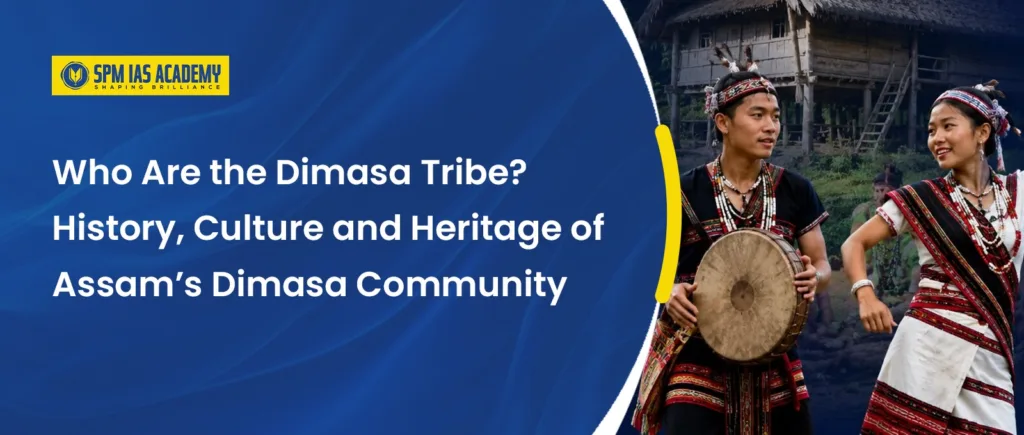
The Dimasa Tribe of Assam is regarded as one of the earliest-known indigenous communities associated with the Brahmaputra Valley. The community is primarily concentrated in the Dima Hasao district, with significant populations also residing in Karbi Anglong, Cachar, and other parts of Assam. However, the identity of the Dimasa people extends far beyond their present-day settlements. Historical records identify Dima Hasao as an integral part of the former Cachari Kingdom, while Maibang is officially recognised as one of its historic capitals. This rich historical and cultural legacy makes the Dimasa community an important subject in the study of Assam’s history and society. Aspirants preparing at the best APSC coaching in Guwahati should study the Dimasa tribe carefully, as topics related to Assam’s tribes, regional kingdoms, and cultural heritage are frequently covered in both the Preliminary and Main examinations.
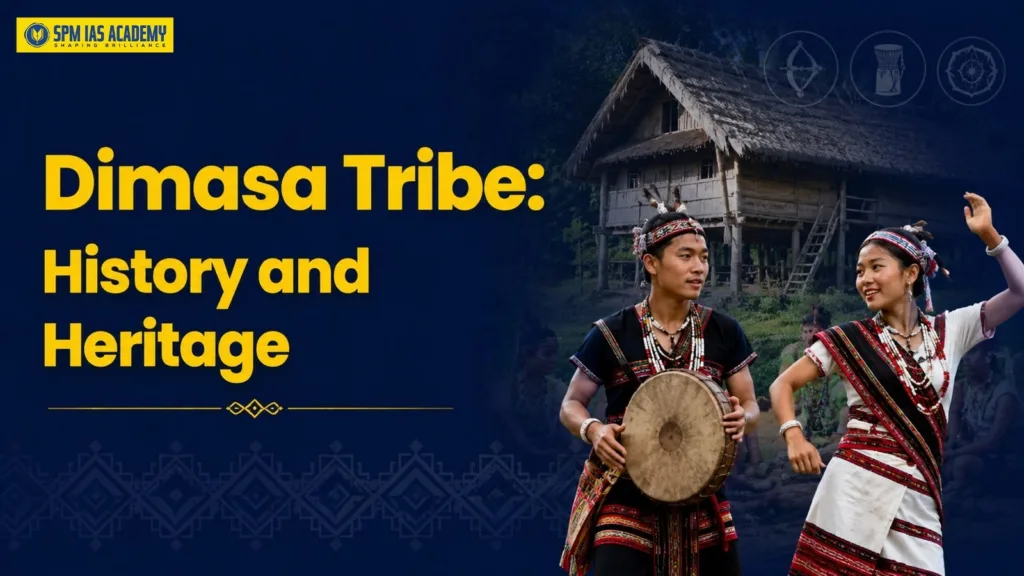
Who Are the Dimasa Tribe?
The Dimasa Tribe is one of the prominent indigenous communities of Assam. The community is officially listed as “Dimasa (Kachari)” among the Scheduled Tribes of Assam’s autonomous districts under the Constitution (Scheduled Tribes) Order, 1950. The Dimasas primarily reside in Dima Hasao, where they constitute the largest tribal community and play a significant role in the district’s social, cultural, and political life. Aspirants preparing at the best APSC coaching in Assam should remember these constitutional and demographic facts, as questions related to Scheduled Tribes, autonomous districts, and Assam’s tribal communities are frequently asked in competitive examinations.
Dimasa communities are also found in Karbi Anglong, West Karbi Anglong, Hojai, Nagaon and Cachar districts of Assam, as well as in parts of neighbouring Nagaland. The name “Dimasa” is commonly interpreted as “children of the big river.” Here, “Di” means water or river, “Ma” means big, and “Sa” means child or descendant.
Historically, the Dimasas were associated with the powerful Dimasa or Cachari Kingdom, which influenced different parts of Northeast India. Dimapur, Maibang, and Khaspur are connected with different phases of its political history.
History and Origin of the Dimasa Tribe
The Dimasa tribe history is closely connected with the wider Bodo-Kachari communities of Northeast India. Although the exact origin of the community remains uncertain, Dimasa oral traditions associate their ancestors with the great rivers of the Brahmaputra Valley. The name “Dimasa” is generally interpreted as “children of the big river”—“Di” meaning water, “Ma” According to a commonly accepted interpretation, the name Dimasa is derived from two words: “Di”, meaning water or river, and “Ma-sa”, meaning the children or sons. Thus, the term is often understood to mean “children of the great river.” However, historians and scholars hold different views regarding the specific river to which the name originally referred, making its exact historical origin a subject of ongoing academic discussion. Aspirants attending APSC online classes should note such cultural and historical interpretations, as they are relevant to Assam’s tribal heritage and frequently appear in Art and Culture sections of competitive examinations.
Beginning of the Dimasa Kingdom
Historically, the Dimasas established a powerful kingdom that influenced parts of present-day Assam and Nagaland. Dimapur is commonly associated with an early phase of Dimasa rule. The surviving stone structures and archaeological remains found there reflect the kingdom’s political organisation and architectural knowledge.
From Dimapur to Maibang
In the sixteenth century, conflicts with the Ahoms weakened Dimasa control over the Dhansiri Valley. Consequently, after a major confrontation in 1536, the rulers shifted their political centre from Dimapur to Maibang, now located in Dima Hasao. Maibang later developed into an important centre of Dimasa administration and culture.
Establishment of the Capital at Khaspur
During the eighteenth century, the kingdom’s centre moved farther south to Khaspur in present-day Cachar. This phase brought the Dimasa rulers into closer contact with the social and religious traditions of the Barak Valley. Eventually, the British annexed the Cachar plains in 1832, bringing independent Dimasa rule to an end.
Nevertheless, the community’s historical identity survived long after the decline of its kingdom. Today, the archaeological remains at Dimapur, Maibang, and Khaspur preserve important chapters of the Dimasa civilisation, while oral traditions, folklore, and customary practices continue to pass this rich heritage from one generation to the next. These historical sites and cultural narratives reflect the enduring legacy of the Dimasa community in Assam’s history. Aspirants preparing through UPSC coaching in Assam should study these aspects carefully, as questions related to Assam’s tribal history, heritage sites, and regional kingdoms are frequently asked in competitive examinations.
Where Does the Dimasa Tribe Live?
The Dimasas primarily live in Assam, particularly in the hill districts of Dima Hasao. It is also the largest tribal community in that region. Halflong is an important cultural and administrative centre of Dima Hasao.
Beyond Dima Hasao, Dimasa settlements are also found in Karbi Anglong, West Karbi Anglong, Hojai, Nagaon, and Cachar districts. In Cachar, members of the community are officially recognised as “Barmans in Cachar.” Moreover, smaller Dimasa populations live in neighbouring Nagaland, especially around Dimapur.
Thus, the geographical presence of the Dimasas extends across both the hill and plain regions of Northeast India. However, Dima Hasao remains at the heart of their cultural identity, language and traditional community life.
Major Festivals of the Dimasa Tribe
Busu Dima 
- Busu Dima is the principal post-harvest festival of the Dimasa community. It is generally celebrated after jhum cultivation.
- During the festival, families and villagers come together to rest, share food, and celebrate the harvest after months of agricultural work.
- Moreover, traditional songs and the Baidima dance are performed to the music of instruments such as the Khram, a drum, and Muri, a wind instrument.
- The duration of Busu Dima varies according to local customs and preparation. A three-day celebration is called Busu Jidap, a five-day celebration is known as Surem, and a seven-day celebration is called Hangseu Busu.
- Therefore, the festival is not only a harvest celebration but also an important occasion for strengthening community relationships and passing cultural practices to younger generations.
Rajini Gabra and Harni Gabra
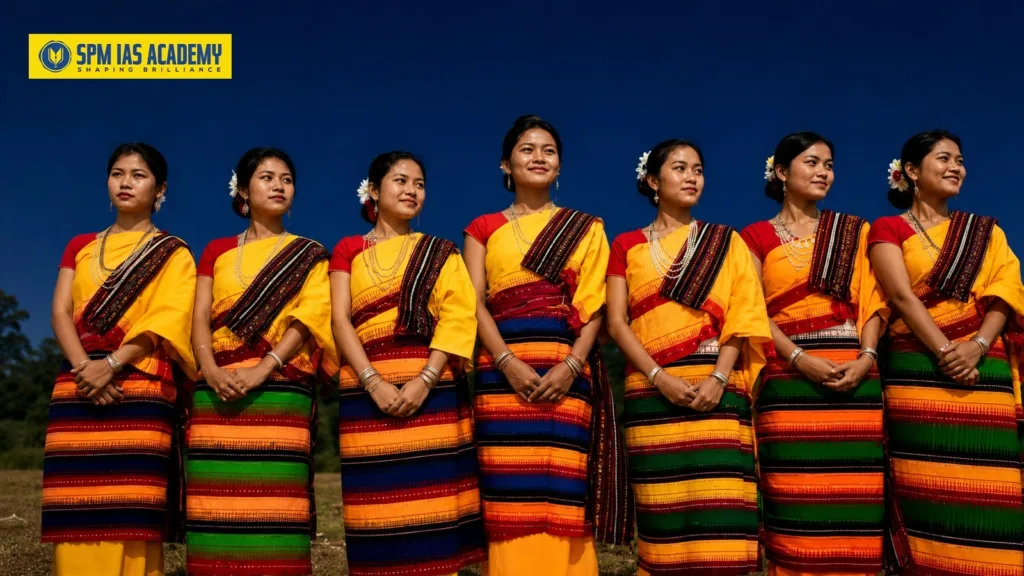
- Rajini Gabra and Harni Gabra are connected parts of an annual socio-religious observance held before the beginning of a new agricultural cycle.
- First, Rajini Gabra is observed during the day. The village headman, traditionally called the Khunang or Kunang, leads the community rituals.
- Subsequently, Harni Gabra is observed at night. During this ceremony, prayers are offered to the presiding deity for the protection, prosperity, and well-being of the village.
- Traditionally, the village entrance is closed while the ceremonies are taking place. This helps maintain the ritual boundaries of the observance.
Religion and Traditional Beliefs of the Dimasa Tribe
The traditional religion of the Dimasas is associated with nature, ancestors, and community welfare. The Dimasas believe in spiritual beings and deities known as Madai, who are associated with the land, forests, rivers, agriculture, and human well-being.
An important part of their faith is the Daikho, meaning the sacred abode of a deity. Traditionally, twelve Daikhos are recognised across Dimasa-inhabited areas. These sacred spaces are linked with particular territories and clan deities believed to protect the people and their land. Rituals are performed by traditional priests, including the Jonthai, according to established customs.
Over time, Hindu traditions influenced Dimasa religious life, particularly in Cachar and during the later period of the Dimasa Kingdom. Consequently, many families combine traditional beliefs with Hindu practices. Nevertheless, the worship of clan deities, respect for ancestors, and reverence for nature continue to remain important parts of Dimasa cultural identity.
Traditional Dress and Ornaments of the Dimasa Tribe
The traditional clothing of Dimasas is known for its handwoven fabric, bright colours, and geometric or nature-inspired motifs. Dimasa women have traditionally played a central role in weaving these garments on household looms using cotton and, in some cases, eri silk.
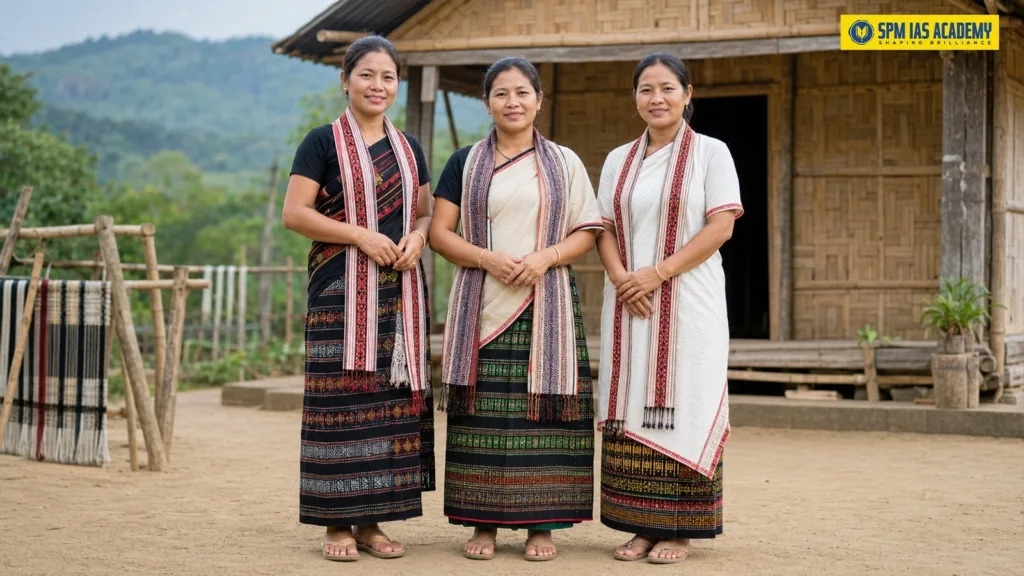
Traditional Dress of Dimasa Women
- Rigu: A colourful wraparound skirt worn from the waist downward. It forms the lower part of the traditional three-piece attire.
- Rijamphain: A rectangular cloth wrapped around the chest. It may be plain or decorated with traditional woven patterns.
- Rikhaosa: A scarf or shawl worn over the Rijamphain. Its ends are generally decorated with woven motifs, adding colour and detail to the attire.
Traditional Dress of Dimasa Men
- Risha: A short dhoti-like garment wrapped around the waist and generally extending to the knees.
- Gainthao: A longer dhoti that reaches closer to the ankles.
- Sgaopha or Phagri: A traditional turban, commonly made in green or yellow. White versions may be worn by bridegrooms or performers on special occasions.
- Rigdo: A small woven muffler or shoulder cloth carried or worn by men.
Traditional Ornaments of the Dimasa Tribe
- Phowal: A necklace traditionally made with coral and silver beads. It may be worn by both women and men.

- Jongsama: A necklace made from small coloured beads, often combined with coral and silver beads.
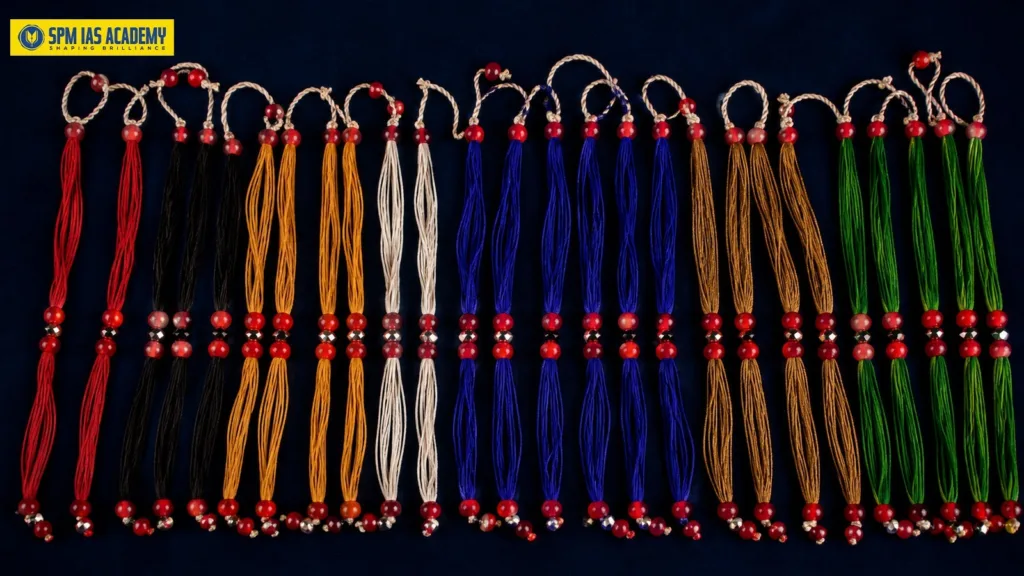
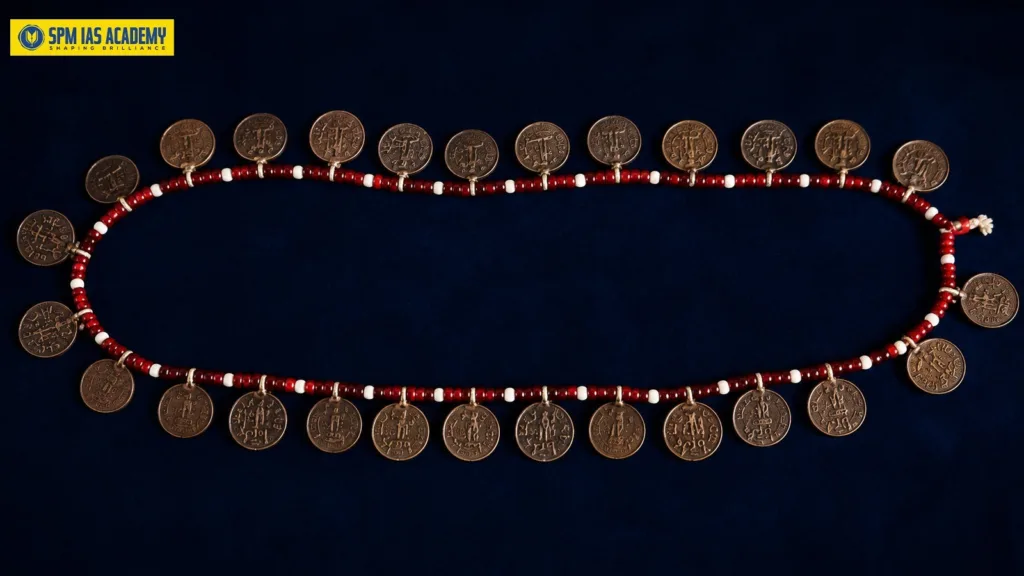
- Rangbarsha or Rangbersa: A distinctive necklace made with silver coins and beads.
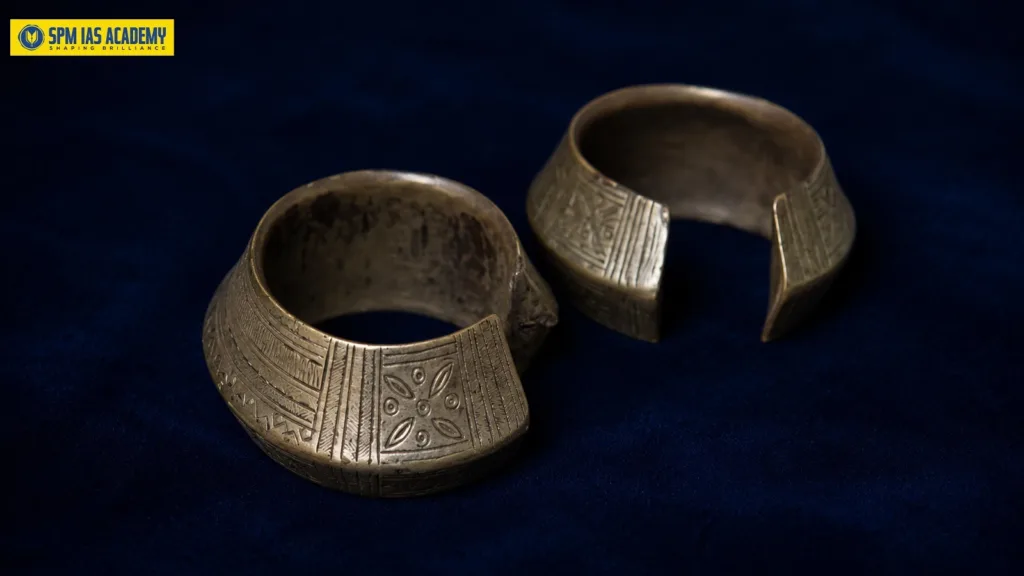
- Khadu: A heavy silver bangle traditionally worn by Dimasa women.
Traditional Occupations and Livelihood
The traditional livelihood of the Dimasas is connected with agriculture, forests, and household-based skills. Although occupational patterns are changing, many families continue to practise farming, weaving, and craftwork alongside modern employment.
- Agriculture: Agriculture has traditionally been the main source of livelihood. In the hills, many families practise jhum or shifting cultivation, while settled and terrace farming are also practised. Rice and maize are important crops; ginger, turmeric, sesame, cotton, chillies, vegetables, pineapple, and oranges are cultivated as well.
- Handloom Weaving: Weaving is an age-old, women-centred occupation in Dimasa society. Traditionally, women spin and weave cotton or eri silk to produce garments such as the Rigu, Rijamphain, and Rikhaosa. Although weaving mainly meets household and ceremonial needs, surplus textiles may also provide additional income.
- Bamboo and Cane Work: Moreover, locally available bamboo and cane are used to make baskets, mats, agricultural tools, fishing equipment, household objects, and furniture. These crafts serve everyday needs while supporting the income of some families.
- Animal Husbandry and Poultry: Along with farming, households commonly rear cattle, pigs, goats, and poultry. Therefore, livestock provides food, income, and support during community feasts and ceremonies.
- Fishing and Forest Resources: Fishing and the collection of edible plants, bamboo shoots, firewood, and other forest products traditionally supplement household requirements. However, their extent varies according to location and access to natural resources.
Conclusion
The Dimasa Tribe represents a living connection between Assam’s past and present. Its history, language, festivals, beliefs, weaving traditions, and close relationship with nature continue to shape its identity. Although modern life is bringing change, the community remains proud of its roots. Preserving this heritage will help future generations understand and celebrate the rich cultural diversity of Northeast India.
Frequently Asked Questions
Q1. Who are the Dimasa Tribe?
The Dimasa Kachari tribe is one of the prominent indigenous communities of Assam. Historically, the community was associated with the Dimasa or Cachari Kingdom. Moreover, its language, festivals, clan system, weaving, and traditional beliefs remain central to its identity today.
Q2. What is the main festival of the Dimasa Tribe?
Busu Dima is the most important harvest festival of the Dimasa community. It is celebrated after agricultural work is completed. During the festival, families gather for feasts, traditional music, and the Baidima dance. Therefore, Busu Dima expresses gratitude for the harvest while strengthening community bonds and cultural pride.
Also Read

Behind every article at SPM IAS Academy is a team of skilled content writers and subject experts committed to making preparation easier for aspirants. From answering common doubts to breaking down complex issues and current affairs, we create content that is accurate, easy to understand, and directly useful for UPSC, APSC, and other competitive exams.